Sunday, December 4, 2022

MESSIAH


Canberra Choral Society Massed Choir and Orchestra

Music by George Frideric Handel

Conducted by Dr. Graeme Morton

Llewellyn Hall December 3

Reviewed by Len Power

Composed in 1741 By George Frideric Handel, “Messiah” was first performed in Dublin, Ireland in 1742.  It has gained in popularity since then, becoming one of the best-known and most frequently performed choral works in the world.

In three parts, the first part concerns itself with the prediction by the Old Testament prophets of the Messiah’s coming and the virgin birth.  The second part covers the annunciation, Christ’s passion, his death, resurrection and ascension, the first spreading of the Gospel through the world and culminates in God’s glory with the famous “Hallelujah” chorus.  In the third part, there is the promise of redemption, a prediction of the Day Of Judgement, the final victory over sin and death and the acclamation of Christ.

The Canberra Choral Society Massed Choir and Orchestra plus four soloists under the baton of conductor, Dr. Graeme Morton produced a memorable evening of fine music.


Conductor, Dr. Graeme Morton

The orchestra began with “Sinfony”, played with assurance and skill, and this fine level of performance continued throughout the concert.  Their sensitive playing of the pastoral “Pifa” was particularly notable.

The four soloists, Susannah Lawergren, soprano, Stephanie Dillon, contralto, Andrew Goodwin, tenor and Andrew Fysh, bass, sang with accuracy and warmth.

From left: Susannah Lawergren, Stephanie Dillon, Andrew Goodwin and Andrew Fysh

Susannah Lawergren’s solos in “The Annunciation of the shepherds” and “Christ’s healing and redemption” were memorably sung, especially “Rejoice greatly, O daughter of Zion”.

Stephanie Dilllon, contralto, also sang very well.  Her solo, “He was despised and rejected” and her duet in the third part with tenor, Andrew Goodwin, “O Death where is thy sting”, were particularly memorable.

Andrew Goodwin gave “Ev’ry valley shall be exalted” a fine performance early in the evening.  His beautiful tenor voice and fine diction brought out all the shades of meaning in the words.  “Thy rebuke hath broken His heart” in the second part was sung with great sensitivity.

Andrew Fysh, bass, with his first solo, “Thus saith the Lord of hosts”, proved to be in fine voice and his breath control was excellent in “Why do the nations so furiously rage together?”  “The trumpet shall sound”, with great trumpet work by Brendan Tasker, was also especially well sung.

The large chorus sang the demanding music with skill and confidence throughout.  Highlights were “For unto us a child is born”, “All we, like sheep, have gone astray”, “Since by man came death”, as well as an astounding performance of “Hallelujah”.

This was a great evening of sublime music with everyone at the top of their game.


Photos by Peter Hislop

This review was first published by Canberra CityNews digital edition on 4 December.

Len Power's reviews are also broadcast on Artsound FM 92.7 in the ‘Arts Cafe’ and ‘Arts About’ programs and published in his blog 'Just Power Writing' at https://justpowerwriting.blogspot.com/.


A STELLAR LINEUP

Chameleon Collective performing "Golden Ratio"
Photo: Andrew Sikorski


Devised and Directed by Liz Lea for The Stellar Company, Belco Arts and Canberra Dance Theatre.

Lighting Design by Linda Buck

Belconnen Arts Centre 3rd & 4th December.

Reviewed by Bill Stephens.

Devised and presented to co-incide with the International Day of People with Disability, “A Stellar Lineup” proved to be a surprisingly  affecting  showcase for the many Canberra  organisations engaged in providing inclusive programs and opportunities for those who identify as disabled, HOH (hard of hearing), chronically ill, neurodiverse or have lived mental health experience.

Drawing on the talents of such diverse groups as Ignite Makers,  the Zest Dancers, the Chameleon Collective,  Project Dust, The Deaf Butterflies  and Canberra Dance Theatre’s  GOLD Company, Liz Lea has drawn on her own considerable professional theatrical skills and   taken advantage of the superb staging facilities of the Belconnen Arts Centre to provide a professional setting to  showcase the many ways the talented enablers  involved in these various organisations provide  opportunities for hitherto unexpected talents to flower.

Even before the audience entered the auditorium a procession of white figures dressed in spectacular wearable art devised by IGNITE Makers signalled that this was to be a memorable performance.  Following these figures into the auditorium the audience was greeted by about thirty members of the ZEST dancers seated on stage. 

Led by Jane Ingall, Philip Piggins, Jacqui Simmonds and Debora Di Centa, The ZEST dancers, who include people with Parkinsons and other mobility and neurological issues specialise in chair dancing and their entertaining interpretations of several Elvis Presley songs were convincing proof that these conditions need not be a bar to busting a move.

An inspiring short film by Christian Doran, edited by Arianna Bosi, and filmed in the burnt-out ruins of Mt. Stromlo featuring members of the Chameleon Collective performing to music of the constellations recorded by the Griffyn Ensemble, was followed by a performance by an emerging First Nations dance group, Project Dust, directed by Emma Laverty, which included a very young dancer who captivated the audience with his determination to execute all the dance moves correctly.

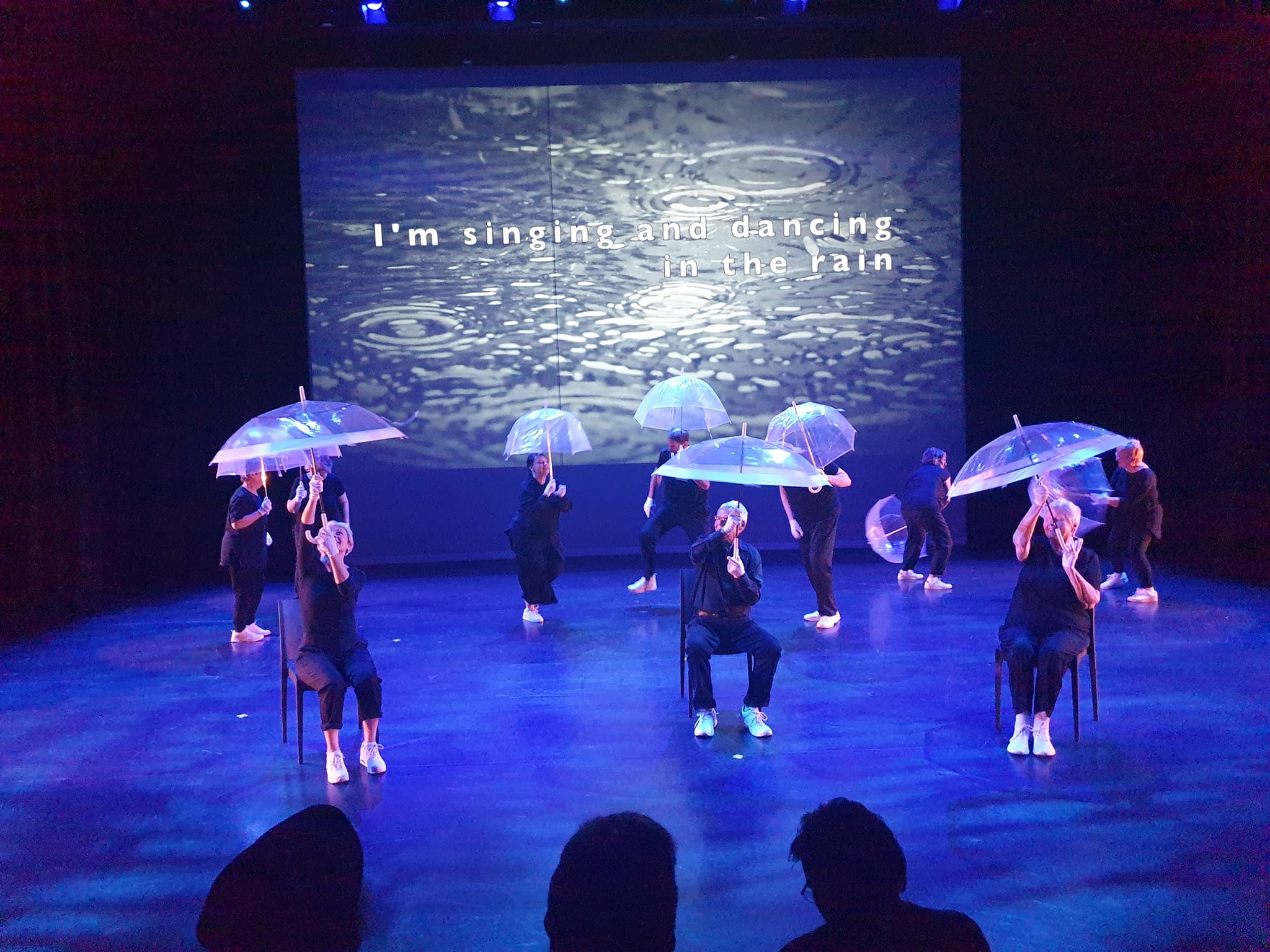
The Deaf Butterflies performing "Singing In The Rain"


The Deaf Butterflies, led by Gretel Burgess and Debora di Centa, also captivated with two items, both performed in front of beautiful atmospheric films by Justin Ray and Liam Budge and edited by Liz Lea.  “Singing In The Rain” for which the Gene Kelly lyrics were interpreted by Auslan interpreter, Brett Olzen, and “Spring”.

An engaging duet performed by Nat Thomas and Charlie Wan, loosely based on the ABC program “You Can’t Ask That” but entitled “Why would you SAY That?” gave a sneak peek into the daily interactions they experience as Disabled mothers, queer people and performers.

 Dancer, Emily Knight, of the Chameleon Collective followed with a striking solo which she choreographed with Courtney Tha to the music of John Metcalfe in front of visualization by Dylan Nelson.

GOLD  Dancers performing "No regrets


A program highlight was provided by the GOLD (Growing Old Disgracefully) dancers with the world premiere of a delightful new work, choreographed by Liz Lea, entitled “No Regrets”. Outrageously costumed in feathers and spangles the group lived up to its name with some cheeky fun, performed with precision and gusto, which had the audience in stitches through-out, and certainly justified the title.


Chameleon Collective performing "Golden Ratio"


However the best was kept till last when the Chameleon Collective performed a stunning new work to music by Vivaldi, and choreographed by Liz Lea. Entitled “Golden Ratio” and based on the Fibonacci Sequence,  Brydie Bulley, Anna Connelly, Katie Senior, Emily Knight, Neave Darmody, Lataesha Marsden,  Karin Adriansdatter, Sabrina Madafarri, led by Liz Lea, and costumed in glittering white sequins, performed together and individually.

To a poetic spoken soundtrack expounding the beauty of difference, each of the dancers was spotlighted in front of glowingly beautiful images of themselves, filmed by Andrew Sikorski and edited by Arianna Bosi.

It was a powerful, revealing and masterful work which provided a stunning finale to a superbly presented program. 


This review first published in the digital edition of CITY NEWS on 3rd December 2022.  


Saturday, December 3, 2022

EMILIA


Written by Morgan Lloyd Malcolm

Directed By Petra Caliva

Essential Theatre production

The Playhouse, Canberra Theatre Centre to 4 December


Reviewed by Len Power 2 December 2022


Inspired by 17th century poet and revolutionist Emilia Bassano, the supposed ‘Dark Lady’ of Shakespeare’s sonnets, ‘Emilia’ features a team entirely made up of women and non-binary creatives from diverse cultural backgrounds.

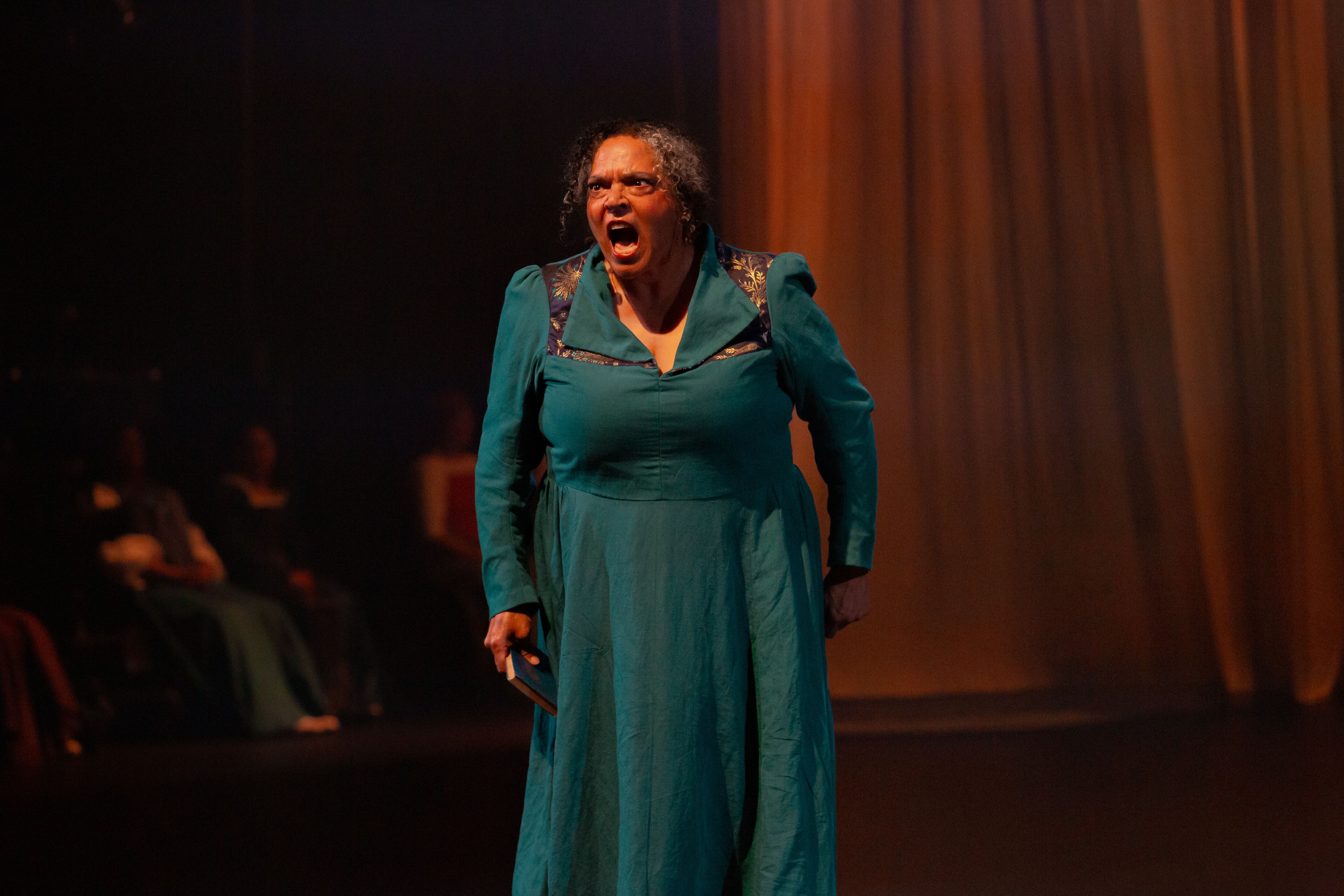
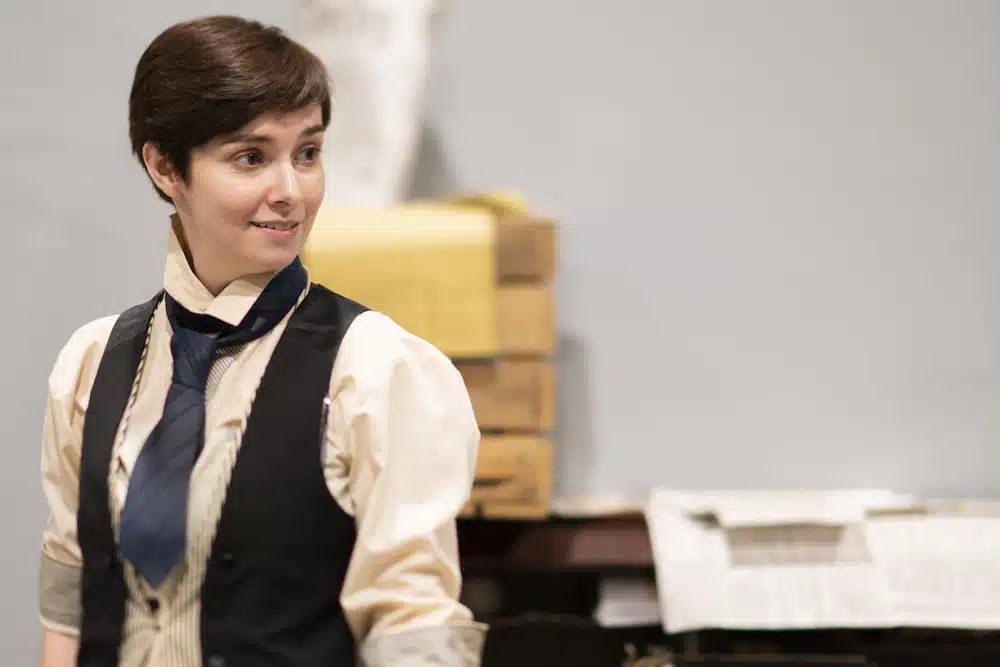
A reimagining, that unapologetically champions all women, has three different women playing Emilia at particular stages of her life – Manali Datar as the younger, Cessalee Stovall, the middle-aged Emilia, and Lisa Maza as the older Emilia.  All three give strong, compelling performances.

There is quite a large cast for a touring production.  The few male characters, also played by women, are caricatures to laugh at.  William Shakespeare is played by Heidi Arena as a weak, ineffectual man who probably got at least some of his ideas from Emilia without acknowledging them.

Staged with minimal scenery – a set of stairs and lots of curtains - the production, designed by Emily Collett, looks good and there are colourful period costumes designed by Zoё Rouse.

Cessalee Stovall and Manali Datar

There are some well-written scenes in the play about Emilia’s life that are interesting and involving and the company performs them very well, but the play takes every opportunity to beat us over the head with political messages about how wronged women were over the centuries and insisting we still have a long way to go.  The frequent lectures delivered direct to the audience get pretty tiresome.

Lisa Mazar

The final speech to the audience by the older Emilia is so fiery and there’s such hatred in the words that it left me cold.

According to their publicity, ‘Essential Theatre is a female-led, values-driven company headed by experienced theatre-makers Amanda LaBonté and Sophie Lampel. The two are passionately committed to championing women and presenting Shakespeare through a female lens’.


Photos supplied by the company.

Len Power's reviews are also broadcast on Artsound FM 92.7 in the ‘Arts Cafe’ and ‘Arts About’ programs and published in his blog 'Just Power Writing' at https://justpowerwriting.blogspot.com/.
 

Emilia


Emilia by Morgan Lloyd Malcolm.  Presented by Essential Theatre and Canberra Theatre Centre at The Playhouse, December 1-3 2022.

Reviewed by Frank McKone
Opening Night December 2


Creative Team

Playwright: Morgan Lloyd Malcolm (UK)
Director: Petra Kalive; Movement Director: Xanthe Beesley
Set Designer: Emily Collett; Costume Designer: Zoë Roüse
Composer & Sound Designer: Emah Fox/Sharyn Brand
Lighting Designer: Katie Sfetkidis
Production Manager: Rockie Stone; Stage Manager: Olivia Walker
Deputy Stage Manager: Rain Iyahen; Assistant Stage Manager: Amy Smith
Co-Producers: Amanda LaBonté, Sophie Lampel, Darylin Ramondo and Sonya Suares Associate
Producer: Trish Carlo

Cast

Emilia 1: Manali Datar; Emilia 2: Cessalee Stovall; Emilia 3: Lisa Maza
William Shakespeare / Man 2: Heidi Arena
Lady Margaret Clifford / Midwife / Man 1: Emma J Hawkins
Lord Alphonso Lanier / Lord Collins / Emilia (Othello) and others: Catherine Glavicic
Margaret Johnson / Mary Sidney / Hester: Carita Farrer Spencer
Judith / Priest / Lord Henry Carey: Genevieve Picot
Lady Cordelia / Lady Anne and others: Jing-Xuan Chan
Susan Bertie The Countess of Kent / Mary Bob: Amanda LaBonté
Lady Katherine / Desdemona (Othello): Sonya Suares
Lord Thomas Howard / Dave / Flora: Sophie Lampel
Eve / Lady Helena: Sarah Fitzgerald

Understudies: NazAree Dickerson and Izabella Yena

_____________________________________________________________________________


Bruce Lehrmann / Retrial won’t proceed after prosecutors drop charges for alleged rape of Brittany Higgins

When I read this headline that night in The Guardian I felt sickened and angry.  

When I read why this woman would not receive justice, my anger was not abated. The ACT director of public prosecutions, Shane Drumgold …. said he still believed "there was a reasonable prospect of conviction at a second trial".

But he said he had to consider the public interest in proceeding, given a retrial would pose a “significant and unacceptable risk to the life of the complainant”. [My emphasis]

“I’ve recently received compelling evidence from two independent medical experts that the ongoing trauma associated with this prosecution represents a significant and unacceptable risk to the life of the complainant.”

Though the evidence made public during the aborted trial could hardly be seen in any light except that though the woman was at the very least mistreated, it is the man who becomes the ‘defendant’ in court as if he is the victim and she the aggressor.  But how else can she get justice except by laying charges?  

And then to have a juror break the jury room rules by introducing material beyond the evidence heard in court!  My anger only grew as I wondered who this juror was and what was their motivation.  Reading more – as the prosecutor says “During the investigation and trial, as a sexual assault complainant, Ms Higgins has faced a level of personal attack that I have not seen in over 20 years of doing this work…. She’s done so with bravery, grace and dignity and it is my hope that this will now stop.” – and I can only feel horrified and even more angry that the law cannot find justice for the woman while all the man has to do is to continue to maintain he is innocent.

So when at the end of Emilia, Lisa Maza as Emilia in her later years expresses her deep anger at the refusal of men to treat women as their equals, with an image of hot anger like the heat in the centre of the earth, I understood what she meant.  She spoke directly to us, asking us did we feel that anger?  The first time just one woman’s voice broke the silence, “Yes”.  When asked again, all the women’s voices filled the Playhouse, “Yes!”  

This is the woman, Emilia Lanier née Aemilia Bassano, described in Essential Theatre’s program: “poet and revolutionist in 1609 and her sisters reaching out to audiences across the centuries with passion, fury, laughter and song as they inspire and unite to celebrate women’s voices through the story of this trailblazing, forgotten woman”.

In this remarkably complex script, intertwining the words of  Emilia with those of William Shakespeare, taking up the possibility that she was his ‘dark lady’ – his inspiration and likely originator of speeches in many of his plays – writer Morgan Lloyd Malcolm stands alongside other women whose works I have mentioned on this blog site: Pat Barker (April 2022) in her two novels about the Trojan War: The Silence of the Girls (Penguin 2018) and The Women of Troy (Penguin 2021) and Maggie O’Farrell (June 2020) in her story of Shakespeare’s son, Hamnet (Tinder Press, UK 2020).

The production of Emilia is certainly done with “passion, fury, laughter and song as they inspire and celebrate”, in an amazing array of costumes and a simple but cleverly designed set, with excellent lighting and sound.  The show is exciting to watch, engaging us with the issues in a very modern way in an almost cartoon-like picture of the English court in the time of the Lord Chamberlain’s Players, Shakespeare's theatre company.  Often very funny, yet with times of despair, we are taken through the experiences of this fascinating character Emilia, determined to be a writer from a demanding seven-year-old (Manali Datar) through growing up and maturity against the odds (Cessalee Stovall), to a very justifiably angry older woman (Lisa Maza).

Perhaps you may want to criticise me for writing more detail about the real Bruce Lehrmann case than about the performance on stage, but this is a polemical play.  The truth is that in my threescore years and twenty – older than King Lear – the poems of Emilia Lanier, nor even her existence, have never been brought to my attention.  The silence is the injustice, just as it is for Brittany Higgins.  The headline on the front page of The Canberra Times, December 3, 2022, reads “Higgins in hospital, case dropped”.

But thankfully today we have Wikipedia https://en.wikipedia.org/wiki/Emilia_Lanier and AZ Quotes https://www.azquotes.com/author/69017-Emilia_Lanier  to tell us more.  If Emilia Lanier had no part to play in Kate’s ironic speech to women at the end of The Taming of the Shrew, I would find it hard to believe.  Emilia Lanier wrote

Then let us have our liberty again,
And challenge to yourselves no sovereignty.
You came not in the world without our pain,
Make that a bar against your cruelty;
Your fault being greater, why should you disdain
Our being your equals, free from tyranny?

William Shakespeare’s Kate says, and means it:

My mind hath been as big as one of yours,
My heart as great, my reason haply more,
To bandy word for word and frown for frown.

Morgan Lloyd Malcolm has written Emilia to break 400 years of silence.  So far its run has been at the Playhouse Theatre Arts Centre Melbourne, November 11th to 27th, and now at Canberra Theatre Centre. Commissioned by Shakespeare’s Globe, where it premiered in August 2018, Emilia then transferred to the West End, "becoming the hottest ticket in London". Surely this Australian production must at least tour this country.  The Canberra season is far too short.

And I hope for Brittany Higgins’ full recovery and that she will receive the justice she is due.  


Essential Theatre Company

 My suggested follow-up movies: Margrete Queen of the North and She Said.


Friday, December 2, 2022

FINUCANE & SMITH'S DANCE HALL


Jazida in "Finucane &Smith's Dance Hall"

Tuggeranong Arts Centre November 30th and December 2nd.

Reviewed by Bill Stephens


Finucane & Smith can justly claim to have planted the seed of the flourishing burlesque in Canberra when they presented their lavishly staged, eye-brow-raising “Burlesque Hour” in the Street Theatre nearly 20 years ago. Since then they’ve continued to present a succession of provocative variety shows around the city in venues which include the Street Theatre, the Canberra Theatre Centre and the Tuggeranong Arts Centre, each production notable for the excellence of presentation and the quality and skills of the featured artists.

Upholding that reputation, the current edition of Finucane & Smith’s Dance Hall is being presented in the Tuggeranong Arts Centre where the tiny theatre has been converted into an intimate velvet draped cabaret room. However, this presentation varies from previous editions of the show in that in addition to their own extraordinary feature artists, Finucane & Smith spotlight several Canberra performers including 2022 Canberra Critic’s Circle Award recipient, Jazida.

Maude Davey in "Finucane & Smith's Dance Hall"


Recently named this year’s recipient of the Melbourne Fringe Living Legend Award, Maude Davey was the compere for the show, her elegant appearance a convenient cover for some sly wickedness, including her very technical, very funny, lecture for intending vampires.

Maude explained at the beginning that the show would be presented in two sections. The first half would be the “PG” section, still risqué, but providing the opportunity for those with delicate sensitivities to leave at interval. The “Adults Only” second half was meant for the more daring. No one left at interval.

Bede Nash in "Finucane & Smith's Dance Hall"


Described in an Edinburgh newspaper as “the sexiest hula hoop artist alive”, rubber-faced, Bede Nash, lived up to that description with an outstandingly clever hula hoop routine, which he topped later in the program with some amazing hand-stand feats.

A practising yoga teacher and cabaret artiste, Chris Burgess, thrilled with his unique rendition of the Lieber and Stoller classic, “Is that All There Is”, before conducting a hilarious group yoga session to commence the second half of the program.

Prominently featured in the first half of the program, 16 year-old Wiradjuri and Tongan singer and The Voice contestant, Tahalianna Sowward-Mahanga was the first of the Canberra artists to perform and had the audience entranced with her mesmerising vocals.  

Already touring nationally with Finucane & Smith’s Dance Hall, but still proudly Canberran, exotic dancer Jazida, captivated with her extraordinary ability to artfully remove sections of her gorgeous costumes. The highlight among her routines being an artistic presentation for which her entire costume consisted of two huge ostrich feather fans.

Ostrich feather fans were also much in evidence with Jazida’s Fabulous Fan Dancers, a troupe of diverse artists who delight with their graceful routines with feathers and silks which punctuate the program.


This review first published in the digital edition of  CITY NEWS on 1st December 2022.


THE TORRENTS


The Torrents by Oriel Gray.

Directed by Lexi Sekuless. Designed by Victoria “Fi” Hopkins. Movement direction. Netty Sharpe and Tim Sekuless. Musical Arrangements Leisa Keen. Voice and Acting coach. Sarah Carroll. Lighting designer Stefan Wronski. Sound production Andrew Brown. Prop design Tracy Cui.Production stage manager Zeke Chalmers. Lexi Sekuless Productions supported by Elite Event Technology. Mill Theatre at Dairy Road. Building 3.3. Bookings: humanitix.com/au 

Reviewed by Peter Wilkins 

Lexi Sekuless as J.G. Milford in The Torrents
 

I first saw Oriel Gray’s  play The Torrents in a Sydney Theatre Company production in 2019. The play is about a female journalist arriving to work in the  male-dominated office of the local Argus in the late 1890s. This co-production of WA’s Black Swan Theatre and the Sydney Theatre Company in 2019 was only the second professional production of Gray’s prize winning melodrama since its first production at Adelaide’s Playhouse in 1996. I was immediately struck by Gray’s astutely observed eccentricity of her characters in the small gold-mining town of Koolgallah and the forceful  conviction of her skilfully crafted dialogue.  More than that, I was surprised by the relevance of her arguments and the social issues that she raises as journalist J G Milford confronts the entrenched sexism of a male dominated environment. Milford’s arrival challenges the town’s conservatism when it comes to gender, class, the role of journalism and environmental sustainability and survival in the face of a changing society. I am also surprised to learn that Gray came equal first with Ray Lawler’s Summer of the Seventeenth Doll, and yet it would be another four decades before her play reached the professional stage  Perhaps it was because she was a woman or more than that a member of the Australian Communist Party. Perhaps audiences were more attuned to plays about cane cutters, bushmen and male role models . There was little interest in the new woman or the environment.

Elaine Noon as McDonald. Rachel Howard as Rufus Torrent
 At one point in the current inaugural production at the newly established Mill Theatre JG Milford, (Lexi Sekuless) urges Argus editor Rufus Torrents (Rachel Howard) to have the courage to be different. It could be the mantra for Oriel Gray’s plays and director and founder of the Mill Theatre Sekuless embraces the challenge with fervour and flair, and I understand with the blessing of Oriel Gray’s son. Apart from the roles of Jenny Milford, played with commanding presence and intelligence by Sekuless, and Gwynne Thomas   (Jasmin Shojai), the fiancée of Ben Torrent (Kat Smalley), the male roles are all played by female actors.

Consequently, this evokes an altered perception of Oriel Gray’s characters but not their circumstances or utterances. The cast play their characters as males and remain true to the intent of Gray’s text.  To avoid a perception where credibility could come into question, the key roles of the two women in the cast, J.G.Milford and GwynneThomas, are played by female actors.  By casting females in the male roles Sekuless invites audiences to focus on the profound and prophetic nature of Gray’s play.  Stefanie Lekkas as Kingsley Myers in Sekuless's production is still attempting  to persuade Torrent’s board of directors to invest in an irrigation scheme. Smalley as the son Ben Torrent is still struggling with an inferiority complex in his father’s shadow. Rachel Howard gives an entirely convincing and grounded performance as Argus editor Rufus Torrent. As the printer McDonald Elaine Noon also manages to convincingly and realistically portray her character as a man. Only Helen McFarlane as the office clown verges on caricature. Her portrayal of the tall story telling Christy may conjure impressions of the 1890’s vaudevillian but in the very intimate performance space of the Mill Theatre her overbearing physicality would be more apt on a proscenium mainstage. Heidi Silberman adopts the  devious persona of Koolgalla’s slimy businessman but lacks vocal command of her character. By casting female actors in the roles of male characters and playing them as males Sekuless risks disbelief.  The cast avoid this pitfall by truthful delivery of character and conversation and I find Gray’s play absorbing and compelling.

Kat Smally as Ben Torrent in The Torrents
As I enter the theatre I am immediately struck by the meticulous authenticity of designer Victoria “Fi” Hopkins’s stage props and costuming of the office staff. It is in distinct contrast to the modern pop music being played and the later use of such tracks as Material Girl by Madonna, a self-styled pop icon of the Eighties. Is Sekuless suggesting that women like J.G. Milford have forged a path for the emergence of strong, independent women like Madonna? Milford’s manipulative use of Ben Torrent’s article for the good of the Argus and the town is echoed by the manipulative confession in “Material Girl.”

This, of course, is pure supposition but Lexi Sekuless Production’s inaugural theatrical offering takes risks that may or may not be entirely successful. What is commendable is the establishment of another independent theatre producing works that merit revival as echoed in Julian Meyrick’s recent publication Australia in 50 Plays. Oriel Gray is an important undervalued and relatively unrecognized Australian playwright who laid the way for the female playwrights who emerged after the Seventies.  I commend Sekuless and her company for bringing Gray’s significant Australian drama to the stage and for taking risks and embracing challenges to illuminate issues that are as relevant today as they were in fictional Koolgalla and  Australia in 1890.

Thursday, December 1, 2022

Picture Yourself, and Woodlands, Forests, Life

Photography | Brian Rope

Picture Yourself | Gerry Orkin

Woodlands, Forests, Life by David Wong

Photo Access | 18 Nov 2022 - 17 Dec 2022

Gerry Orkin and David Wong are Canberra locals, and each of their exhibitions  here celebrates and explores aspects of life in the nation's capital.

Orkin was a founding member of Photo Access. He helped develop and deliver documentary and participatory photography projects so communities could tell their own stories.

With Picture Yourself, Orkin moved away from the traditional documentary approach, handing image making and storytelling to the subjects themselves.

Comprising images captured during Summer 1985, the exhibition is seventy-four unconventional, yet uncomplicated, artworks showing Canberra’s community.

Orkin set up a tripod-mounted camera in temporary structures at public events and invited passers-by to take “selfies” by squeezing a hand-held bulb to trigger the shutter.

The photographs include individuals, plus small and large groups. Orkin was investigating the idea that something interesting might happen when he asked people “who are you?” - to make it possible to show (not just tell) stories about themselves, in one photograph, at that moment.

The results are delightful and quirky. If you went to Sunday in the Park events or Canberra Day parades in that 1985 Summer, you may well have gone into the booth with some family or friends and posed for the camera. Whether you did or not, this is an exhibition every then resident of Canberra should visit to explore this wonderful collection and see if you recognise anyone. Indeed, even if you didn’t live in Canberra at that time, you will love looking at these people shots. So, do yourself a favour and visit this exhibition.

Prints of images are available for purchase in various sizes and can be viewed at https://pictureyourself.picflow.com/catalogue. Orkin also seeks our assistance to identify the people pictured and you can do that on the catalogue website. There is also a book containing all 74 images which can be purchased from Photo Access.

Gerry Orkin - Picture Yourself, 1985

And whilst visiting, you will also very much enjoy the companion exhibition. From an early age, Wong has loved nature and explored the bushland areas close to his home. The high-quality prints of his imagery on show are a beautiful collection of photos of those places - and what he has found and seen in them.

These Woodlands, Forests, Life artworks span around a decade and explore the different aspects of eucalypt ecosystems within local nature reserves – their variety and quality, their safeguarding. And also explores people seeking to understand, restore and protect them. Woodlands, Forests, Life is also part of a broader 2022 Eucalypt Australia Dahl Fellowship project.

The strength of this exhibition lies in its broad coverage. There are wonderful woodland landscapes, but also much more.


David Wong - Bruce Ridge, 2021


There are the elements of those woodlands, including a beetle, a gum hopper, a bull ant, moss capsules, a gecko, and fungi.


David Wong - Eastern Stone Gecko

There are images relating to the threats to woodlands and about the good folk who are involved in various ways seeking to protect them - a fence, a sculpture, a sign.


David Wong - Little Eagle, Ginninderry, 2022

There are even polaroid prints of the woodlands cascading from a wall onto the floor with an invitation for visitors to take a piece of the landscape.

All this is accompanied by an excellent catalogue essay by Canberra photographer Chris Holly and two great pieces of Wong’s own writing on top of two pedestals in the gallery. Here’s just a snippet from The Helpers: 

When the morning news

tells of apocalypse

They get to work


Writing letters

Chipping weeds

Teaching kids

Testing hypotheses

All the images and accompanying words in this quality exhibition should result in visitors getting out into the woodlands to, as Holly says, stand among eucalypts and recognise who you are.

This review was first published online by The Canberra Times on 28/11/22 here then in the print version on page 10 of Panorama on 3.12.22. It is also available on the author's blog here,