Thursday, July 13, 2023

Brian Rope | Photography

Resistance Relapse | Nico Krijno

Photo Access | 29 June to 12 August

Resistance Relapse is an Australian premiere of esteemed Cape Town-based, South African artist Nico Krijno whose free-flowing creative process disrupts and transforms familiar, figurative representations into the realm of mirage and illusion. 

It builds on his extensive previous performance, sculpture and photography work. Here he has deliberately distorted, indeed reconfigured, imagery to create a landscape to challenge our preconceived notions of what constitutes landscapes. Traditional landscape photographers would most likely be appalled – but that is not a bad thing as all photographers (and other artists) need to be challenged to think about what they are doing and what their works are saying if they are to grow and develop in their chosen fields.

There are just three works in this theatrical show – the artist has a theatre background. There is a wonderful piece titled Resistance Relapse comprising a grid of 45 separate 21 by 15 cm inkjet prints in five rows each of nine images. It presents as a tapestry – traditionally a form of textile art that is woven by hand on a loom, but here a design printed on paper which could well be displayed in your home in the manner of a wall hanging.

Untitled, one of the 45 images in the series Resistance Relapse, 2023 © Nico Krijno

Secondly, there is pentagonal tray on the floor filled with sand. Portions of a dozen or so inkjet prints of varying sizes poke out of the sand, whilst the rest of them are buried beneath it. This piece is titled Resistance relapse (sandpit), 2023. Gabrielle Hall-Lomax’s catalogue essay suggests we are being invited to unveil newly discovered treasures, to expose the obscured and delve deeper into the artist’s creation. Has anyone dared to do so I wonder.

The third piece is a glorious single channel portrait-oriented video Die Son, 2023. A richly yellow shiny egg yolk rolls across someone’s hands - repulsing one visitor who can’t stand raw eggs, but fascinating and holding the attention of others. Other things flicker in the background – a bonfire burning, a child swimming, tomatoes cascading. There are also glimpses of other artworks by this artist.

A small exhibition in terms of the number of pieces on show, but a large one in terms of the artist’s concept, his different approaches to each artwork, and his challenges to our pre-existing and often conventional or traditional idea about landscape. Even the exhibition title requires contemplation as we explore the artworks and read the informative catalogue. 

As Hall-Lomax says in concluding her essay “….it is a philosophical invitation to traverse a world under different principles…..It shakes up the conventional and dismantles viewers’ pre-existing ideas about the nature of photography and its possibilities.” Serious photographers of any genre would do well to let themselves be challenged in such ways.

This review is also available on the author's blog here.

Wednesday, July 12, 2023

Assembly for the Future, Canberra


Assembly for the Future by The Things We Did, produced by Not Yet It’s Difficult. An Uncharted Territory Event: Canberra producer Kiri Morcombe.  At Marie Reay Teaching Centre, Australian National University, July 11, 2023.


Reviewed by Frank McKone

“Assembly for the Future is a series of participatory gatherings in which the public create new visions for futures that may be realistic, idealistic or utterly fanciful.”
www.thethingswedidnext.org/assembly-for-the-future

Those who attended the sixth Assembly for the Future were surely not aware of the next event of this kind which will be at the Canberra Theatre Centre, August 8: An Evening with the Late John Cleese.  Cleese will report  “on his experiences in the afterlife, and what the audience can expect when they get there (announced in Private Capital, Canberra Times July 12, 2023: Ron Cerabona)

What we participated in was a rather less fanciful consideration of what our future might be like 6 years ahead, in 2029.  The Things We Did is co-created by Alex Kelly & David Pledger and produced by Not Yet It’s Difficult, and Assemblies began in 2020 with

Beyond Whiteness – the Rise of New Power
The Last Disabled Oracle
Somewhere, Everywhere, Right Here

followed in 2022 with

Live from Planet City 2029
Live from Blakfullas University 2029

For Uncharted Territory, the standard – even, can I say, old-fashioned – conference format was set up: Keynote Speaker; two 7 minute speakers in reply; then break-up into tables of about 6 for discussion, with each Table Moderator reporting with table-sized butcher’s paper to the whole group at the end.  

There was no attempt to finalise a consensus view of the gathering, leaving ideas to float in the expectation that innovators and creators from the sciences and the arts would produce new works in response.

In a sense then, like the John Cleese show, we were participating in a fiction beginning with  “a provocation from 2029, [by] First Speaker Bhiamie Williamson - a Euahlayi man from north-west New South Wales with family ties to north-west Queensland – [who mapped] how we have faced the threats of climate change through Indigenous land justice and embedding Caring-for-Country within the national psyche while drawing from Indigenous masculinities to reshape social attitudes more broadly.”

In an unpleasant challenge, I guess, for this kind of Canberra audience, Bhiamie in 2029 presented himself as the first member of the newly formed First Nations Party, following the unsuccessful referendum of October 2023, to be elected to the Senate.  His provocative offering was (will be?) his maiden speech in Parliament.  

Though the first other speaker, interdisciplinary artist and researcher, Erica Seccombe took a highly positive view of his 'success', creative technologist, Keir Winesmith took a critical position, pointing out that rather than Bhiamie’s election being the result of a new development in Indigenous Intelligence, it was in fact the First Nations Party’s use of Artificial Intelligence in the election process that had won the day for them.


Table Moderators were

 Roboticist Damith Herath
 Musician & Environmentalist Tim Hollo
 Dancer-Performance Maker Alison Plevey
 Multidisciplinary artist Anna Raupach
 Activist & Researcher Felicity Ruby
 Artist-Curator Nina Sellars
 Writer & Tsunami scientist Kaya Wilson
 Barkindji artist and poet Barrina South

Since, on my table, the moderator was the Roboticist, it was perhaps not surprising that the possibility was raised that AI could be instructed to run the world for us and then could perhaps decide – since AI has no emotional intelligence – on rational grounds to remove the totally destructive free-market oriented humans entirely in order to save the Earth.

On the other hand, others on my table and on most other tables, remained hopeful that through managing capitalism, including by instituting a simple feature such as positively underpinning of society by Universal Basic Income – without the negativity of the concept of ‘welfare’ – and limiting house ownership to only one per person, that in the face of the threat of runaway global warming, collaboration and cooperation will win the day – though hardly in just six years, by 2029, to be honest.

Maybe, John Cleese will find such a fantasy world in his afterlife.  I’m planning to find out in August – or more seriously in October.


https://unchartedterritory.com.au/program


Tuesday, July 11, 2023

Photography - You are close be-side me by Chin-Jie Melodie Liu (Canberra)

Photography Review by Brian Rope

You are close be-side me | Chin-Jie Melodie Liu

Photo Access | 29 June to 12 August

You are close be-side me by Canberra-based Taiwanese artist Chin-Jie Melodie Liu, questions traditional memorialisation practices in the digital era, drawing from her experience of virtually attending her grandfather's funeral last year.

This is a fascinating exhibition. Personal experience tells me it is hard enough to participate remotely in the funeral of an old friend whom you haven’t seen for some considerable time. Virtually attending your much-loved grandfather's funeral must be an extraordinarily emotional experience. A great deal of the emotion felt by this artist is not just shown to gallery visitors, but very much shared with each of them who take the time to look closely at the images. The exhibited prints are actually CMYK screen-prints on Stonehenge paper, not matted or framed but simply pinned to the wall.

Almost all of the works show screenshots that the artist took during the Zoomed memorial service – sadly with patchy and disconnected video when there were network issues and when guests at the service accidentally knocked the phone stand over. We see Covid-masked people at the funeral, floral tributes, musicians playing, a photographer using a camera, and a man bowing in respect. We see Melodie herself as a zoom participant. Most of the screenshots are paired with phone camera shots taken by her sister Annette An-Jen Liu who, because of pandemic restrictions, was the only grandchild able to be at the Taiwan funeral in person. Despite only Melodie’s name being on the image list in the catalogue, it is, therefore, very much a collaborative exhibition with Annette.

Looking at her sister’s phone photos, which have been described as footnotes to the screenshots, Melodie noticed they were of things she had not seen on Zoom. They were of ceremonial proceedings intended only for immediate family members – of which she, of course, was one. From that she realised she had only been “present” for a portion of the funeral and “excluded” from the parts intended for immediate family. So using Annette’s images provides additional context to the scenes she did not witness.

The titles of the artworks reveal much of the artist’s feelings. Anyone who has ever had just a little experience of Jewish or Christian worship, or read the best-known parts of the Bible, will recognise words from the much-loved Psalm 23 which uses a shepherd's care for his sheep as a metaphor to describe the wisdom, strength, and kindness of God. For many, the words serve as a reminder that God is faithful and can be trusted in life or death, good times or bad. Every exhibit title comes from one or another version of that psalm, which was sung at the funeral.

Chin-Jie Melodie Liu, You are close be-side me, 2023, CMYK screen-print on Stonehenge paper, paired with footnote image by Annette An-Jen Liu (2022, digital photograph).

Chin-Jie Melodie Liu, lead me by the quiet stream, 2023, CMYK screen-print on Stonehenge paper,  paired with footnote image by Annette An-Jen Liu (2022, digital photograph).

So, as we look at the images and read their titles, we can see and know the author’s emotions as she felt close to her grandfather and drew personal comfort from the familiar words assuring her that she (and he) had nothing to fear as they rested in green pastures beside a quiet stream. She took strength from knowing the days ahead would be filled with goodness and mercies.

Chin-Jie Melodie Liu, You have spread a feast for me, 2023, CMYK screen-print on Stonehenge paper, paired with footnote image by Annette An-Jen Liu (2022, digital photograph).


Whilst not all of the gallery visitors will have the same understanding of Psalm 23 or have had the same experience of faith as this family, each person looking at these works should, nevertheless, understand what is being shared with us. With both sisters’ images and the words of the psalm, it all hangs together most effectively.

The exhibition absolutely shows us the sisters’ shared grief and different mourning experiences, one in person at the actual event and the other via the digital access available in today’s world. In the exhibition catalogue, sister Annette says she is reminded of Susan Sontag’s description of photographs as “an invitation to sentimentality”, for the way they “turn the past into an object of tender regard”.

This review is also available on the author's blog here.


GATHER


QL2 Dance in partnership with Youth Dance Australia

Choreographed by:

Timothy Farrar (AUSTI Dance, Wollongong NSW)

Caitlin Comerford (Stompin, Launceston TAS)

Gabrielle Rose (FLING, Bega NSW)

Ruth Osborne and Stephen Gow (QL2 Dance, Canberra ACT)

Alexandra Ford (Catapult, Newcastle NSW)

Kyall Shanks (Yellow Wheel, Melbourne VIC)

At The Playhouse, Canberra Theatre Centre  10 July 2023


Reviewed by Len Power


‘Gather’ is the Meet Up Performance of this year’s gathering of Australian Youth Dance companies in Canberra.  Normally held every two years, this is the first gathering after postponements due to Covid.

Meet Up is an opportunity for youth dance company leaders and young dancers to maintain national connections, discuss important issues and opportunities and share knowledge and skills.  It is also an opportunity for their work to be performed on stage at the Playhouse.

This year, six dance companies from around Australia performed six new dance works.  The local QL2 Dance company was joined by dance companies Yellow Wheel (Melbourne), Stompin (Launceston), Catapult – The Flipside Project (Newcastle), AUSTI Dance and Physical Theatre (Wollongong) and FLING Physical Theatre (Bega).

The evening of dance commenced with a short but visually striking contemporary Aboriginal piece by Jahna Lugman of Bundjalung and Gumbaynggirr country and Julia Villafor of Waigman country.  The two dancers showed considerable skill and technique in their performance of this work.

What followed were six works by each of the companies’ choreographers, developed in collaboration with the dancers.  In each case, the imagination shown in the works was very appealing and mostly very effective.  Some of the underlying meaning of the works needed more clarity but the dancers performed them all with sensitivity, technical skill and enthusiasm.

It was a good opportunity to see the work of other Australian companies as well as our local QL2 Dance company.  It is clear that these companies provide an essential and worthwhile training ground for the choreographers and dancers of the future.


Len Power's reviews are also broadcast on Artsound FM 92.7 in the ‘Arts Cafe’ and ‘Arts About’ programs and published in his blog 'Just Power Writing' at https://justpowerwriting.blogspot.com/.

NGAPA WILLIAM COOPER - Australian Youth Orchestra


AYO with Lior - Nigel Westlake - Lou Bennett

Composed and written by Nigel Westlake, Lior and Dr Lou Bennett AM, with additional lyric content Sarah Gory.

Australian Youth Orchestra conducted by Nigel Westlake.

Llewellyn Hall, Canberra, 9th July, 2023.

Reviewed by BILL STEPHENS.

Visits to Canberra by the Australian Youth orchestra are always highly anticipated events, both for the opportunities they provide to hear outstanding young emerging musicians and for the stimulating repertoire choices.

The repertoire for this year’s program was particularly exciting, consisting of three new works by one of country’s most celebrated composers, Nigel Westlake, who would conduct all of his compositions.

Adding to the excitement was the fact that one of these works was the world premiere of a major symphonic work, Ngapa William Cooper, which celebrates a significant First Nation’s activist and incorporates his Yorta Yorta language to be performed by his great, great, great granddaughter, Dr Lou Bennett AM.   

Ngapa William Cooper is the result of collaboration between composer Nigel Westlake, singer-songwriter Lior, and performer and academic Dr Lou Bennett AM. A chamber version of this work had been premiered at the 2023 Adelaide Festival.

The Australian Youth Orchestra subsequently commissioned Westlake to develop the work as an orchestral suite for full symphony orchestra; along with two other of his works, The Glass Soldier and Beneath the Waves. All three would be performed at this concert.

Ngapa William Cooper campaigned tirelessly for Aboriginal representation in Parliament. He founded the Australian Aborigines’ League in Melbourne and in 1938 famously led its members on a march to the German Consulate to deliver a formal petition condemning the persecution of Germany’s Jews and calling for it to end.

Although the protesters were denied entry by the Nazi German consul, who refused to receive their petition, Cooper continued to fight for equal rights for Aboriginal people and to stand in solidarity with the Jewish.

Composed in seven sections, the first being an unaccompanied “Exile/Call to Ancestors” performed by Lior and Lou Bennett, the next six sections of Ngapa William Cooper, drew on the full power of the 87 piece orchestra to create a series of individual dramatic sections entitled The Noise, The Silence, Yakapna-Nuk, The Meeting, The Protest, and finally, At the End Of My Days.

For each section, Westlake exercised the skills of the orchestra’s talented young emerging instrumentalists with his talent with creating arresting orchestrations, sometimes utilising unusual instruments, even bunches of gum leaves at some points, to create powerful auditory images. .

The young musicians responded brilliantly to his concise conducting, especially during the Stravinsky-like complexities of The Protest section where the inconsistent sound balance was finally corrected allowing the audience to relish the gorgeous vocal harmonies of Lior and Bennett.

Both singers used microphones because each of the six sections contained evocative explanatory lyrics which were beautifully performed by Lior and Lou Bennett singing in both English and Yorta Yorta. Disappointingly however, during the early sections, the vocalists had to battle to be heard above the poor sound-mix, sending the audience scrambling for their programs in order to follow the lyrics.

Despite this blemish however the audience was fully aware that it was experiencing a remarkable performance of an epic work which it rewarded it with a vociferous standing ovation.


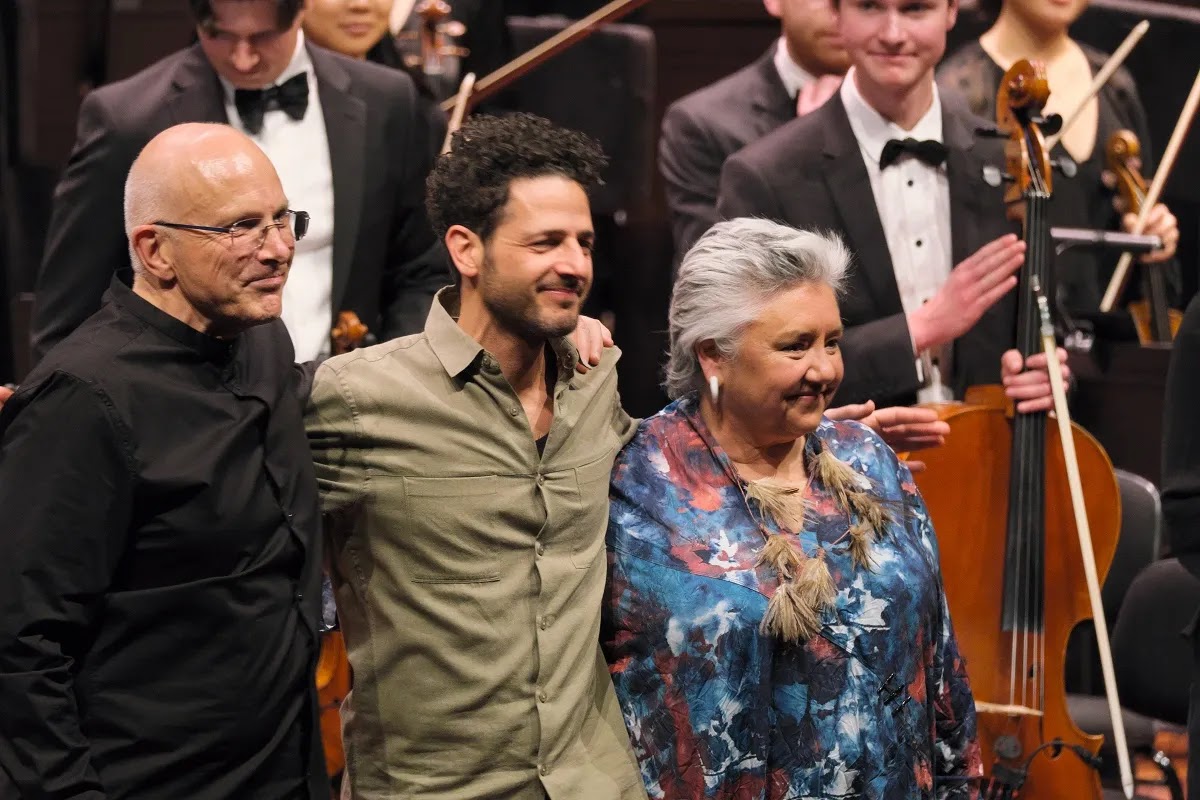
Nigel Westlake - Lior - Lou Bennett taking bows after AYO's premiere preformance of
Ngapa William Cooper


Preceding Ngapa William Cooper, the orchestra offered two other Westlake compositions, both also arranged and conducted by the composer himself.

The first, The Glass Soldier, was a suite in four movements utilising music originally written for Hannie Rayson’s play of the same name. This beautiful work, commemorated the life and exploits of a young soldier, N.H.Ferguson, who lost his sight as a result of injuries received during the First World War.

Lushly orchestrated, this warmly lyrical, delightfully textured score was given a superb performance by the orchestra, during which a dramatic, moving trumpet solo by Arkie Moore drew spontaneous applause from the appreciative audience.

Westlake’s other work was a gorgeous suite for cello and orchestra, Beneath the Waves,  especially commissioned from Westlake by the Australian Youth Orchestra to showcase the virtuosic talents of cellist Sharon Grigoryan.

Westlake based this suite on music originally composed for the film Blueback. His deep love of the ocean, inherited from his fisherman father, was immediately obvious in the melodic swirls of music that effectively conjured up the rise and fall and changing moods of the sea.  


Sharon Grigoryan with AYO performing  "Beneath the Waves"


Grigoryan, spot-lit on a small rostrum in front of the orchestra, led the orchestra in a luminous performance of this suite, which Westlake conducted with such impressive attention to detail and phrasing that it was possible to become fascinated by the accuracy of the bowing of the string section while entranced by the warmth of tone elicited from her cello by Grigoryan, or captivated by an extraordinary section during which Grigoryan mimicked the call of whales with her instrument.


                                                    Photos by Peter Hislop


This review also published in AUSTRALIAN ARTS REVIEW. www.artsreview.com.au


Sunday, July 9, 2023

The ballad of sexual dependency

Brian Rope | Photography

The ballad of sexual dependency | Nan Goldin

National Gallery of Australia | 8 Jul 2023 – 28 Jan 2024

In 1985, The Ballad of Sexual Dependency was a slide show, in 1986 it became an artist's book publication of photographs taken between 1979 and 1986. New York Times art critic Andy Grundberg described it as “an artistic masterwork that tells us …. about the times in which we live.”

Now it is a collection of 126 Cibachrome colour prints acquired by the National Gallery of Australia (NGA) – the last available of just ten copies. It is an autobiographical document of a portion of New York City's avant-garde music and visual art scene, the gay subculture of the late 70s/early 80s, and the artist's personal family and love life.

The artwork’s title is taken from a song in Kurt Weill and Bertolt Brecht's Threepenny Opera, tying in with its theme of love and sex, dissecting how romance and infatuation can distract people from their self-interests and larger societal duties and obligations. The great Australian performer Robyn Archer includes the ballad in her repertoire. As I began writing this, she was performing in Canberra – perhaps singing it right then!

This defining photographic artwork is by the internationally renowned American photographer, artist and activist Nan Goldin whose work often explores LGBT subcultures, moments of intimacy, the HIV/AIDS crisis, and the opioid epidemic.

Aged 13, Goldin left home and hooked up with a group of young people focussed on drugs, violence and sex. Handed a camera at the age of 16, she discovered photography and began using it to document, from 1979 to 1986, subjects like post-punk music, post Stonewall gay subculture, and Bowrey’s hard drug subculture. Her images depicted violence, belligerent couples and drug usage. Among the people she photographed, were the actress Cookie Mueller and the artist Greer Lankton.

Just as Goldin was emerging as a photographer, she became truly addicted to drugs. She spent a great deal of time not seeing daylight - whilst snorting drugs. She got sober at a rehabilitation clinic near Boston in 1988, then returned to New York to discover many friends had contracted AIDS.

In her “snapshots” of people - partying, in bars, being sexually intimate, on beaches, and much more, she recorded their positive and negative experiences. Many did not live then traditional lifestyles. Numerous people appear in many images, including Brian, her longtime boyfriend. Most of her subjects died by the 1990s, due to AIDS or drug use. Goldin says photography saved her life. She seeks to pass on her salvation through her art and her activism. In 2021, she wrote “If I can help one person survive, that’s the ultimate purpose of my work.”

Goldin refers to the ballad as her ‘public diary’, stating that her photographs ‘come out of relationships, not observation’. The work’s overriding themes explore the tensions in relationships in which all genders struggle to find a common language.

Her documentary, snapshot style laid bare her life in what we know as a family album - but one that was put on public view. It shows her alongside friends and lovers as they hung out (in the bathroom, in bed, at Evelyne’s bar, on the beach, on Tin Pan Alley), fell in and out of love and had children. The ballad is as much evidence of what her community lost, as it is a record of a past time.

The level of intimacy revealed in many of these images is extraordinary. The level of trust from her subjects is extraordinary. Others have captured intimate photographs of partners – Alfred Stieglitz made nude portraits of Georgia O’Keefe - but I cannot think of any other photographer who has revealed as much of friends and lovers as Goldin.

I asked curator Anne O’Hehir if she had a favourite amongst the collection. She laughed, then spoke about the most famous photograph from The Ballad - a self-portrait showing Goldin’s face badly bruised, one of her eyes almost sealed shut. Boyfriend Brian had read her diaries and become so angry he beat her almost to the point of blindness. The image has been described as “the ultimate example of photography as a means of both survival and catharsis.” She took the photograph to remind herself to never go back to him.

O’Hehir also noted that Suzanne’s closeness is revealed by the fact that she is in almost every image – until she disappears. We don’t know what happened to her. Cookie is also in lot of images, but not as much as Suzanne.

It would be impossible for me to select just one favourite but, amongst numerous others, I particularly like Nan and Brian in bed, French Chris on the convertible, and Greer on the bed.

Nan and Brian in bed, New York City, 1983

from the series The ballad of sexual dependency, 1973-86,

National Gallery of Australia, Kamberri/Canberra,

purchased 2021 in celebration of the National Gallery of Australia's 40th anniversary, 2022

© Nan Goldin


French Chris on the convertible, New York City, 1979

from the series The ballad of sexual dependency, 1973-86,

National Gallery of Australia, Kamberri/Canberra,

purchased 2021 in celebration of the National Gallery of Australia's 40th anniversary, 2022

© Nan Goldin


 Greer on the bed, New York City, 1983

from the series The ballad of sexual dependency, 1973-86,

National Gallery of Australia, Kamberri/Canberra,

purchased 2021 in celebration of the National Gallery of Australia's 40th anniversary, 2022

© Nan Goldin


In addition to the prints, the exhibition includes other items, as this installation shot shows:

Installation view, Nan Goldin the ballad of sexual dependency, National Gallery of Australia, 2023. Photo by Karlee Holland

This an exhibition which everyone with an interest in photography should see. The images are varied, sometimes curious and always interesting. They pour out passion. Viewer discretion is advised - it is not suitable for children under the age of 15.

If you are unable to visit the exhibition, then at least find an opportunity to watch All the Beauty and the Bloodshed, a 2022 American documentary biographical film about Goldin told through her slideshows, intimate interviews, and ground-breaking photography. This R18+ movie is streaming exclusively here

This review (in an abbreviated form) was first published by Canberra City News on 9 July 2023 here. It is also available on the author’s blog here.

ROBYN ARCHER: An Australian Songbook.


Devised and presented by Robyn Archer with George Butrumlis, Cameron Goodall, Enio Pozzebon.

At Canberra Theatre Centre Playhouse, July 7 & 8.

Reviewed by BILL STEPHENS.

If you’re a fan of Robyn Archer it will come as no surprise that the songs in her Australian Songbook might be quite different to what you might have chosen. In fact it would be surprising if you had previously heard more than a few of her choices.

It’s no accident that Archer is regarded as a National Living Treasure. With an international reputation for her contributions to the arts, Archer is a much decorated songwriter/entertainer/political activist/provocateur/historian/artistic director and influencer.


Robyn Archer with Enio Pozzebon and Cameron Goodall


She’s also a delightfully cheeky entertainer with a penchant for rude songs. All these passions are reflected in this brilliantly devised, simply staged entertainment, which she delivered, positioned behind a microphone, her script on a stand in front of her. Her choices were thought-provoking, sometimes provocative, often surprising, always interesting, definitely entertaining and threaded together by an engrossing script.

Joining her on stage were three skilled musical colleagues in George Butrumlis on piano accordion, Cameron Goodall on guitars and banjo, and Enio Possebon on keyboard who gilded her lily with delicious musical arrangements, cheeky harmonies, and even contributing the occasional amusing solo when opportunity presented .

Setting the tone with her own composition, “I Am Not Now or Will I Ever Be”, Archer declares that she is not to be compared with other Australian icons like Crocodile Dundee, Bazza McKenzie or Germaine Greer, before launching into a fascinating history of Australia told through song.

Archer obviously delights in words and includes in her program several musicalisations of the words of Australian poets and playwrights, even politicians. A stand-out song being an intriguing  musical setting by  Brisbane-based composer, Rob Davidson, of Julia Gillard’s misogyny speech.

Early in the program when commenting on Australians who had come from other lands, she included a heart-felt reading of a poem by Queanbeyan poet, Omar Musa, “The Great Displaced”. When commenting on First Nation’s issues she sang Dr Lou Bennet’s haunting song about her birthing tree, “Jaara Nyilamum”.

Included in the program were several songs from Australian musicals. From Max Lambert’s musical based on Kenneth Slessor’s poems, “Darlinghurst Night”, Archer chose “In choker’s Lane”, an ode to Sydney’s infamous Palmer Street. From the musical “Lola Montez” she featured a new song written by Peter Stannard for a revival of this show, “Lola’s Misgivings”.

Enio Pozzebon and Cameron Goodall offered an hilarious version of “Heavens, Mr. Evans” from the Casey Bennetto’s hugely successful, “Keating the Musical” for which Pozzebon was an original cast member, and from the musical  “Songs from Sideshow Alley” which she  wrote for herself and Robyn Nevin, Archer performed an up-beat version of “The Backyard Abortion Waltz”,  opening up the opportunity for several other of her strident feminist anthems including “The Menstruation Blues”, “The Menopause Blues” and Kate Miller-Heidke’s uncharacteristically bitter,  “The Facebook Song”.  

Taking a deep dive into political parody Archer included a song by Bungendore satirist’s Shortis and Simpson, “Bob Menzies Balls”, Art Leonard’s 1930’s depression song “Banish the Budget Blues”, which still felt remarkably pertinent, and a song she wrote with Paul Grabowsky “I Dig Up Dirt”.


Robyn Archer 


Archer covered many more topics in her wide-ranging, generous program. Too many to list here  but the crowning achievement of the night, was the fabulous encore in which Archer and her associates sang through snippets of no fewer than 31 songs about Australian towns and cities which earned them a spontaneous and enthusiastic standing ovation.


                  Hero Image: Claudio Raschella - Production images: Brett Boardman


             This review first published in the digital edition of  CITY NEWS on 8.07.23