Showing posts with label ANCA. Show all posts

Wednesday, May 21, 2025

Stilleven

Visual Art Exhibition Review | Brian Rope

Stilleven I Rose-Mary Faulkner

ANCA Gallery I 14 May – 1 June 2025

A decal is “a plastic, cloth, paper, or ceramic substrate that has printed on it a pattern or image that can be moved to another surface upon contact, usually with the aid of heat or water.” Rose-Mary Faulkner transfers images onto kiln formed glass. She layers several related images before further manipulating the surface and form through multiple fusing or cold working. This expands the imagery beyond the original photograph as the transparency of glass enhances layering for the purpose of depth and overlapping. 

Rose-Mary Faulkner, Six oranges and a Saturday morning ritual, 2024,
kiln formed glass with decals, 30 x 20 x 1cm.

Stilleven exhibits works by glass artist Faulkner, considering connections to places and objects as both self-portraiture and representative of lived experience and narrative. Softly focused compositions of domestic settings form an avenue to explore dynamics of the absence and presence of people and bodies, connection to environments we embody and the way objects can exist as metaphors.

Domesticity, and artworks depicting inanimate objects found in domestic situations, are domains that have historically been disregarded. The Dutch-origin term "stilleven" means inanimate objects. However, disguised symbolism means domestic objects can be extremely significant revealing the narrative of people's lives, bearing witness to time and change. That is why many of us value, and display in our own homes, precious objects inherited from our forebears.

Sadly, many still consider domestic tasks a domain for women only. This exhibition examines the familiarity and femininity of these topics as ones that possess significance, story, and profound meaning. Faulkner illustrates what is simultaneously familiar, difficult, and valuable amidst the subtle rhythms of everyday.

One particularly delightful work, Snowdon (a study) is a diptych about a much-loved farm house which, I believe, has been in the artist’s family for many generations.

Rose-Mary Faulkner, Snowdon (a study), 2023, kiln formed glass with decals.

Faulkner is based in Australia’s national capital, Canberra. She graduated from the Australian National University School of Art & Design, Glass Workshop, with a Bachelor of Visual Arts in 2015 and then with first class honours in 2016. Since then, her work has been exhibited widely - in Australia, Berlin, America and Japan. It has been acquired for the Wagga Wagga National Art Glass Gallery collection. The artist works as an arts educator and creates art at Canberra Glassworks and in her home studio which she shares with her partner and glass artist, Rob Schwartz.

In 2018 Faulkner won the National Emerging Art Glass Prize (Wagga Wagga) and spent six weeks at Northlands Creative in Lybster, Scotland, taking part in intensive classes. The same year she held her first solo exhibition, with a body of work that developed from the processes and ideas she had explored in her honours year. In 2019, she was a finalist in the inaugural Klaus Moje Glass Award (Canberra Glassworks). 

For me the most interesting piece in the show is an artwork comprising 32 separate still life compositions gathered from women in her extended family and artists network of friends. Each contributor provided photographs of objects or spaces in their own homes which Faulkner has fused into glass. The images are from women who range in age from 20 to 89. They live in Australia, America and the United Kingdom. The catalogue describes the collection of pieces as a kind of still life portraiture. This fabulous artwork is a created composition revealing a great deal about women’s experiences despite (or because of) the contents being domestic.

Rose-Mary Faulkner, three of the 32 works in Tending (quiet testimonies from homes), 2025 – Kilnformed glass with decals, dimensions variable (installation images by Brian Rope)

There are also a number of works featuring bent glass forms which, again, are about inanimate objects.
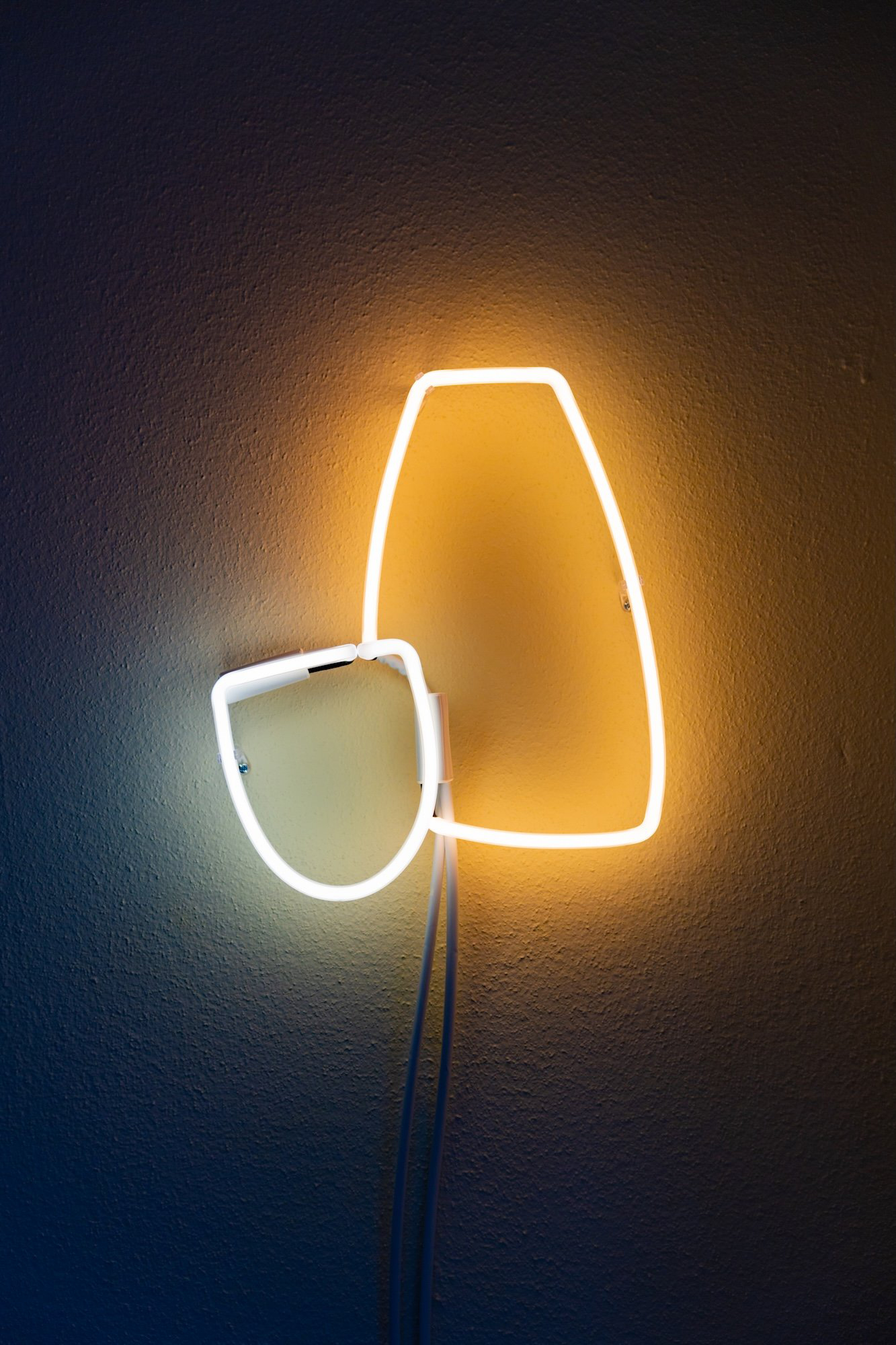
Rose-Mary Faulkner, Two vessels in light, 2024, hand bent neon with argon mercury gas, dimensions variable. 

The exhibition essay by Dr Jacqueline Bradley is a beautifully written piece, well worth reading in conjunction with a visit to the exhibition. Bradley speaks of Faulkner’s “deep consideration of the still life genre, shifting between the formal and symbolic, the private and personal.”

This review is also available on the author's blog here.

Friday, April 25, 2025

Emotional Landscapes II

Visual Art Exhibition Review | Brian Rope

Emotional Landscapes II I Margaret Gordon, Manuel Pfeiffer and Alan Pomeroy

ANCA Gallery I 23 April – 11 May 2025

In July/August 2024, ANCA exhibited Emotional Landscapes I by Jenny Adams, Julie Delves, Eva van Gorsel & Delene White. Van Gorsel subsequently received a Canberra Critics Circle award for her imaginative and creative observations and, in particular, her key part in that exhibition.

Emotional Landscapes II featuring artworks by three other artists has the same purpose - questioning the dichotomy of being apart from nature versus being an integral part of it. Photographer and former climate scientist van Gorsel curated this show, in close consultation with the artists.

My initial reaction on entering the gallery was to immediately see the landscape in Pfeiffer’s pieces, but not in the other works. That was my narrow interpretation of landscape. Gordon’s works feature landscapes of nude human bodies, whilst Pomeroy has “set out to re-imagine the contemplative posture as a composite posture figure set against evocative landscapes.” Pfeiffer’s art is not a straightforward representation of landscapes as we might actually see them. Like those of all good artists, they are interpretations of what he saw.

Each artist has revealed something of their personal emotional experiences to a variety of landscapes, enabling viewers of the works to reflect on their own emotional responses to landscapes they explore.

Gordon most commonly produces small sculptural pieces of her models. But here she presents mostly pastel and charcoal drawings, with just one acrylic painting and one ceramic sculpture.

Margaret Gordon, 38 Small Form, 2024, ceramic sculpture, 13.5 x 18.5 x 10cm

Photograph provided by ANCA

All these human landscapes are female. She participates in a variety of workshops sketching both genders, but as selected pieces for this show she felt it appropriate to use only drawings of female models. The drawings are diverse, showing various amounts of detail in differing parts of the sketched bodies. That, plus the variety of body types reveals the diversity of the female body landscape. How we each respond emotionally will depend on our genders, ages, personal body types and more.

Margaret Gordon, 26 Another Seated Form, 2024, pastel and charcoal, 52 x 46cm

Photograph provided by ANCA

Six of Pfeiffer’s works on canvas are painted with acrylic; two are mixed media. All eight vibrantly colourful works are striking in appearance. As always with this artist, they are beautifully composed and executed. One most interesting feature is the inclusion of shapes, such as that of a diamond or an egg. They are paintings of landscapes many of us have visited or, at least, seen in photographs. We can clearly recognise some outback places. My favourite work is of the Devil’s Marbles, but they are all a joy to look at.

Manuel Pfeiffer, 04 Karlu Karlu (Devil's marbles), 2023, Acrylic on canvas, 24x36 inches (61x92cm)

Photograph provided by the artist

Some of the landscapes portrayed are less obvious, but the titles identify them. So, for example, we know the Nullarbor is being portrayed even if we don’t immediately recognise it. I very much enjoyed the clear representation of the long straight stretch of road through a flat landscape with no trees. The magical place known as Larapinta is also delightfully shown, almost demanding we walk on the long trail.

Manuel Pfeiffer, 07 Magic Larapinta, 2024, Acrylic on canvas, 24x36 inches (61x92cm)

Photograph provided by the artist

And then there are Pomeroy’s wonderfully thought-provoking works. Again the catalogue titles arguably provide keys which enable us to open the doors to the material we need to explore in order to properly think about what this artist is saying. Each piece shows figures set against evocative landscapes. They are observing and meditating, fingers pressed against their mouths almost being gnawed. They are sitting on the fence in one work – seeking the wisdom of the three wise monkeys?

Alan Pomeroy 02, On the Fence, 2024, oil on canvas, 76 x 91.5 cm. Photograph, Alan Pomeroy. TBE

All are simply delightful paintings. And there is also a most affordable 40pp book featuring the artist’s own photographs of his art. In it his artist’s statement reveals the inspirations for these works in his continuing artistic inquiry, and his hoping to encourage awareness of the power of thought .

Alan Pomeroy 05, In Too Deep, 2024, oil on canvas, 76 x 112 cm. Photograph, Alan Pomeroy. TBE 

As with its forerunner, Emotional Landscapes I, this exhibition most successfully achieves what its artists set out to do. They have created artworks which cause us to reflect on our personal emotional responses to the natural world in which we live. And invite us to ask ourselves how and whether we can live in harmony with our natural environment.


This review is also available on the author's blog here.


Tuesday, November 12, 2024

Poetry of Place

Exhibition Review: Photography | Brian Rope

Poetry of Place I Julia Charles

ANCA Gallery I 30 October - 17 November 2024

Julia Charles has tertiary qualifications in Landscape Architecture, Environmental Horticulture, and Photoimaging. She teaches in applied object design and is a self-employed photographer.

This artist’s photography exhibition Poetry of Place has been promoted as a collection of photographic works which reveal a rare way of seeing – offering an intimate distillation of beauty in the built landscape. I’m not sure that I agree with the use of the word rare, since I am familiar with the work of various other photographers who also find beauty in selected parts of buildings. However, I certainly accept that the images in this show portray beauty in the buildings photographed; indeed they do so most successfully. 

There are 26 giclee prints, mostly in rich black and white, on archival cotton rag fine art paper in the exhibition, plus a single non-photographic piece which is laminated oak veneer and charred Oregon. The prints are sensual studies of the built form. When visiting the display, I asked the artist, Julia Charles, why she had opted to include the latter piece of artwork and was pleased to hear in response that she simply felt it belonged there – because it certainly fits with the overall portrayal of beauty.

Charles has a background in furniture making, landscape architecture and lecturing in art and design. So it is unsurprising that she included sculptural “timbers.” She also describes herself as an architectural and fine art photographer. Once again it is not a surprise therefore that the photographs are of elements of the architecture of buildings – most, she told me, being in Sydney, whilst about four portray places in Canberra. I have no doubt whatsoever that all Canberrans would instantly recognise, in Untitled #22, the landmark that is the Australian Academy of Science’s Shine Dome building.

Untitled #22, 2024 © Julia Charles

None of the artworks are titled so, whilst studying each of them we could, if we wished, try to name the buildings we were looking at. But in many cases of course we would be unsuccessful – perhaps because it is a building with which we are not familiar, or maybe we simply do not recognise the specific elements the artist has included in her photographic creation. I wonder how many exhibition visitors have been able to attach a building name to Untitled #3.

Untitled #3, 2016 © Julia Charles

Camilla Block, of Durbach Block Jaggers architects, has written “Julia Charles has an unerring artistic eye. She convincingly translates sculptural weight and power within a two dimensional medium. Julia’s pictures are somehow unafraid, deftly stepping toward feeling, shadow and beauty.” Untitled #2, the image used by the ANCA gallery to promote the exhibition is only one of the exhibits that show the artist’s keen artistic eye.

Untitled #2, 2016 © Julia Charles

The artist herself says she tries to create pictures that have a poetic quality. She works slowly, finding from experience that her patience is rewarded. As I moved around the displayed works and looked into them, I saw how Charles had explored the light and shadows being cast on her subjects and used them to remove unwanted material. I observed how she had explored the qualities of reflected, diffused and dappled light and created images revealing elements in the architecture that are beautiful and which sensitively express emotions. Untitled #4 is a fine example of her use of light and shadow.

Untitled #4, 2016 © Julia Charles

The exhibition’s title is most appropriate as the artworks combine design and art, uncovering the "poetry of place" to produce minimalist, graphic, and sculpture-based compositions.

Readers who are unable to visit this exhibition might like to look at the artist’s works on her webpages here.


This review is also available on the author's blog here.

Wednesday, October 23, 2024

Candle. Collapsar

Exhibition Review: Photography | Brian Rope

Candle. Collapsar | Ioulia Panoutsopoulos

ANCA Gallery, Dickson | 9 - 27 Oct 2024

Candle. Collapsar is a series of nine new works made in the studio and on analogue film by Adelaide-born and Sydney-based artist Ioulia Panoutsopoulos, who has a Bachelor of Fine Arts, First Class Honours from the College of Fine Arts, UNSW. A recipient of the John and Margaret Baker Memorial Fellowship, she has been selected as a finalist for the Josephine Ulrick and Win Schubert Photography Award, the National Photography Prize, MAMA and Hazelhurst Art on Paper Award.

The room sheet for this exhibition starts by informing us that the works are by a contemporary artist. That is most definitely correct - the works clearly and absolutely fit into the Contemporary mould. The sheet goes on to reveal that this artist weaves together photographic, drawing and sculptural practices to embrace both the analogue and the digital realms. The artist herself tells us that, in these new works, she is pursuing synoptic connection and ambiguous movement between those realms. Why? She informs us that she is looking for an original language that pushes at the edges of photographic possibility.

I am always delighted when artists seek to push the boundaries of what is possible, whether with photography or any other art medium. That is how they (and we) grow and develop our artistic talents – or our understanding of art. To create these pieces, negatives were scanned and shown on a computer monitor, then an analogue camera was used to construct the finished product by photographing what the monitor displayed. Hotspots, screen flare, and the subtle banding pattern on the screen were embraced. Grain and the random optical texture of photographic film was overwritten, transmuted with its digital counterpart. Panoutsopoulos suggests the resulting works resemble an “open expanded pictorial nervous system.” Think about that next time you use your optical nerve to carry visual information from your eyes to your brain whilst creating a photographic artwork.

In the past, one of the main areas of focus for cognitive science was the pictorial theory of mental imagery. Proponents contended that our mechanisms which respond to perceptual inputs also reinterpret images. According to their theory, an observer not only creates an image of what someone else sees, but the perceptual system also uses the image in a bottom-up fashion. Others contend that a pictorial theory of visual perspective-taking must, at the very least, accurately depict the relative distance between various points of a scene as it would be viewed from an alternate position.

Little wonder that many of us find it difficult to define what we are looking at in images such as those in this exhibition. Are they objects, light drawings, simply marks, altered reality shapes? In my view, it simply doesn’t matter what we see, or think we do. For me, each of the artworks here are Contemporary (and I use the uppercase C deliberately) and fascinating. We can look at them for extended periods of time, finding new things of interest and continuing to imagine possibilities.

Installation image © Hilary Wardhaugh

The titles of the nine works being exhibited all share the words “Packed Matter.” That, in itself, raises questions about the images. Matter is made up of very tiny particles which are so small that we cannot see them with our naked eyes. But I am not a scientist so I’ll just leave that there and allow you to think about the titles, and the things you can see in the images, for yourself. You also should obtain and read Michael Moran’s informative catalogue essay Collapsars.


Packed Matter IX, 2022 © Ioulia Panoutsopoulos, Gelatin silver hand printed photograph, 83 x 124.7cm
 

Packed Matter VI, 2022 © Ioulia Panoutsopoulos, Gelatin silver photograph, 107 x 83cm

Packed Matter IV, 2019-2022 © Ioulia Panoutsopoulos

If you are nearby and able to visit the gallery at 2pm on 27 October 2024, in addition to viewing the high-quality works in their beautiful custom steel frames (and possibly purchasing one) you can listen to an in-conversation event between the artist and David Greenhalgh, National Gallery of Australia Curator (International painting and sculpture.)


This review is also available on the author's blog here.


Thursday, July 25, 2024

Emotional Landscapes I

Exhibition Review: Photography | Brian Rope

Emotional Landscapes I | Jenny Adams, Julie Delves, Eva van Gorsel & Delene White

ANCA Gallery, Dickson | 17 July - 4 August 2024 

This art exhibition at the ANCA Gallery with the Tinshed Art Group examines the emotional connections that humans have with the natural world. It makes observations about the nuanced and intricate interaction between the natural world and humankind. It looks at how humans affect the climate and the earth, but it also maintains optimism that appreciating nature's marvels makes us feel a part of it and inspires us to take constructive action. Through this investigation, the show hopes to spark reflection, foster empathy, and motivate viewers to dedicate themselves to the pursuit of a peaceful and long-lasting cohabitation with the natural world.

The participating artists work with various mediums. Jenny Adams and Julie Delves paint with acrylic on canvas. Delene White uses oils on canvas, found objects, and fibreglass & silicone. I enjoyed all their works very much, particularly White’s installation The bigger picture, with its lightweight wall marching ants. 

However, I will concentrate here on the photography of Eva van Gorsel - since it is the art form in which I work myself and, so, am best qualified to discuss. This artist’s seventeen pieces are archival pigment prints. The seventeen works form a series created by van Gorsel for this exhibition. They are all of a high standard and I was most pleased to see several of them had already been purchased when I visited.

Watching Out explores the fact that human development and the pursuit of food security have been intertwined throughout history. The artist notes that deforestation for cultivation disrupts ecosystems, leading to biodiversity loss and climate change. She reminds us that humanity needs to watch over the landscapes and ecosystems we depend on for survival, making concerted efforts toward environmentally friendly and socially responsible land use practices.

In that piece, two or more images have been combined into a beautifully blended composite showing something of the interactions between humans and a rural landscape. So there is a human looking out over the landscape, plus a section of fencing and parts of a building constructed by humans.

Watching Out © Eva van Gorsel

The same approach has been taken with most of the artist’s other works, but the messages are diverse. For example, Morning Flight includes birds and van Gorsel’s artist statement speaks about how engaging with natural environments has been linked to improved mental health, increased creativity, and heightened feelings of belonging fostering a deeper connection with the natural world.

Morning Flight © Eva van Gorsel

I particularly appreciated Encroachment. It incorporates a drawing of Canberra’s central national capital area and two examples of the native animals seen in the city’s urban areas. This is all about the need for urban planning that achieves sustainable developments.

Encroachment © Eva van Gorsel

There are also works about foxes, weeds and habitats. One artwork is titled Endemophilia. That word may not be familiar to you. If that is the case, let me tell you that it is about the particular love manifest in the people of a place that is special to them. It is what gives people a particular sense of belonging as opposed to a global sense of place. This image shows us an example of the type of water and forest environment where the artist feels a deep sense of belonging.

Endemophilia © Eva van Gorsel

Other works tell us to stop messing with the environment, speak about the unpredictability of nature, discuss the history of climate extremes, reference the fact that water is essential for life and note that global carbon emissions have surged to record levels.

This exhibition most successfully does what it set out to do. I commend it to you and applaud all the artists.


This review is also available on the author's blog here.