Showing posts with label Australian. Show all posts

Thursday, December 8, 2022

Viewfinder: Photography from the 1970s to Now

 Photography | Brian Rope

Viewfinder: Photography from the 1970s to Now | Various artists

National Library of Australia Exhibition Gallery | 16 Sep 2022-13 Mar 2023

Viewfinder: Photography from the 1970s to Now explores fifty years in the life of Australia. 125 images from the National Library of Australia's collections reveal a changing Australia and the evolving nature of photography. It looks at powerful Australian documentary photography, from 1970s black and white images to recent vibrant high-definition images.


Quintessential Aussies feature, including shearers, dancers, infantry diggers, knitters, sporting heroes and bronzed bodies on the beach. However, there is a much bigger, far more inclusive story, including William Yang’s winged angels at Mardi Gras in 2003, migrant lives, Australian First Nations people, and the joys of family life.


William Yang, Rainbow Angel Wings, New Mardi Gras, 2003,
nla.gov.au/nla.obj-136950531, courtesy William Yang


A 1973 Jon Rhodes image of a ticket booth employee at a railway station would have meaning and memories for his family and all who remember those booths. Others, too young to remember, should also be interested in this snippet of history.


Jon Rhodes, Paul Jackson, Dubbo, News South Wales, 1973,
nla.gov.au/nla.obj-2147881601, courtesy Jon Rhodes


There’s a cyclist towing an older woman in a wheeled cart, itself towing a caged dog. Bruce Howard’s delightful 1985 image shows that such modes of transport are not new.


Bruce Howard and Herald and Weekly Times, On a bicycle built for ?, 1981,
nla.gov.au/nla.obj-148147368, courtesy Bruce Howard


Bill Bachman’s image of three Aussie blokes having a beer in 1995 is simply classic.


Bill Bachman, Council mechanics, Jack Western, Bob Mackenzie and Bryan Steele
having a drink of beer, Gascoyne Junction, Western Australia, ca. 1995,
nla.gov.au/nla.obj-138088597, courtesy Bill Bachman


Anne Zahalka’s colourful 1998 image of Star City Casino is of particular interest right now because it, and other casinos, have been in the news.


Anne Zahalka, Star City Casino (after Breughel), 1998,
nla.gov.au/nla.obj-150880157, courtesy Anne Zahalka


Matthew Sleeth shows us senior citizens on the footpath to see their much-loved Queen pass by in 2000.


Matthew Sleeth, Residents of a Retirement Home are Wheeled onto the Footpath to Watch the Queen, Western Freeway, Friday 24 March 2000,
nla.gov.au/nla.obj-145875044, copyright courtesy Matthew Sleeth and Josef Lebovic Gallery, Sydney


And, from 2007, Martin Mischkulnig shows us a very dusty Pilbara Aussie rules venue.


Martin Mischkulnig, Warralong, Western Australia, 2007,
nla.gov.au/nla.obj-691608047, courtesy Martin Mischkulnig


These are just examples of works from this wonderful collection which is never fully on view at any one time.


The exhibition also focusses on the evolving nature of photography as a way of recording our lives and highlights the significant technological advances and increasing diversity of styles, approaches and techniques utilised by photographers over the past five decades.


Walking through and taking time to look, study and absorb each work and the accompanying information, I was struck by a message for children under a self-portrait of Tracey Moffatt. It included this definition “A portrait is a painting, drawing or a photograph of a person”. Just 700m away at the National Portrait Gallery, another current exhibition is boldly proclaiming about the show being designed to make visitors think about “the ever-evolving and ever-expanding idea of portraiture”.


Does that mean the NLA is out of touch? No, because the images it is showing from its collection are primarily from the past, whereas the diverse artworks on display at the other institution are from collections that have a different focus. Any and all collections in national institutions have an important place and opportunities to view pieces from those collections are most welcome and, indeed, important. Being able to view both exhibitions at the same time is an especially valuable opportunity for us all.


So, back to the NLA exhibition. What does it tell us about Australia? The diverse works include well-known pieces that anyone with a modest knowledge of Australian photography will recognise. There are images most of us will not be familiar with, by photographers whose names we may not recollect having heard. Pleasingly, the indigenous country location is identified for each image.


The NLA describes its image collections as the photo albums of Australia. They certainly are an invaluable archive that can assist us to understand the story of this country. They reveal the communities we live in, the landscapes we inhabit, our history and moments both significant and ephemeral.


Documentary photographers – including you - capture images that assist us understand both place and people, and to plot our way forward in this uncertain world.

This review was first published online by The Canberra Times here. It is also available on the author's own blog here.

Monday, November 29, 2021

RECOVERY

Photography | Brian Rope

RECOVERY | Various Artists

ANBG Visitors Centre Gallery | 25 November – 12 December

Recovery is the eighth annual photographic exhibition by the Friends of the Australian National Botanic Gardens Photographic Group.

This year there are four categories of images. Firstly, there are plant portraits of a single plant, or group of primarily the same species. Then there are wildlife images (in the Gardens, but also outside due to access restrictions this year). Next there are creative compositions of banksia plants in recognition of Joseph Banks’ visit to Australia and the new banksia garden. And, to complete the show, images of rare, threatened or endangered plants. In total there are forty-eight prints by twenty artists, all framed in a light-coloured timber and, so, the overall exhibition looks cohesive.

The exhibition successfully displays in print aspects of our beautiful natural environment through the camera lens - and on screen with revolving images of plants, birds and animals in the ANBG.

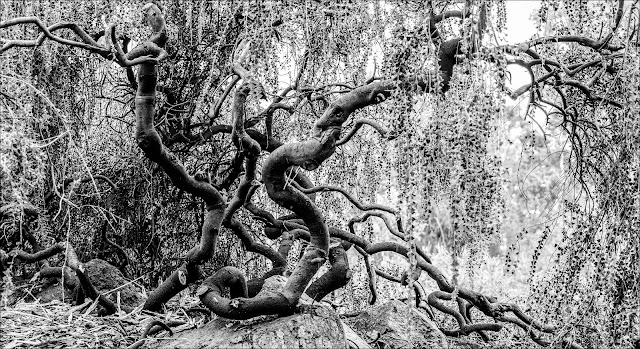
There are just three monochrome prints on display, all by the same author - Ulli Brunnschweiler. They stand out amongst the colour works, not just because they are black and white but also because they are quite lovely works each showing plants (plural). In particular, Acacia pravissima, hung at the top of the three works here is just delightful. Commonly known as the Ovens or Tumut wattle, this is an acacia with which we are all familiar. But generally, we see it in yellow and green.


Ulli Brunnschweiler - Acacia pravissima

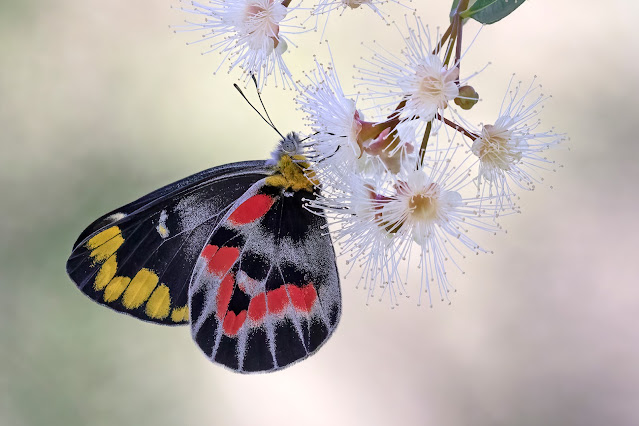
Amongst the colour works the standouts for me include David Bassett’s Feeding Gang-Gang and Imperial Jezabel. This Queanbeyan author’s nature imagery – indeed all his varied artworks - are consistently excellent and these are no exception.


David Bassett - Imperial Jezabel

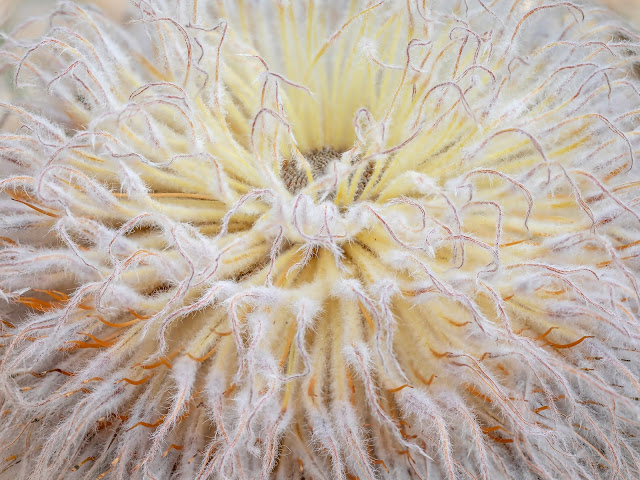
Local professional and photography teacher Irene Lorbergs has contributed several fine prints - Honeyeater and Macrocarpa, Bee and Flower, and Banksia. The latter is suggestive of a delicious tasting cupcake.


Irene Lorbergs - Banskia

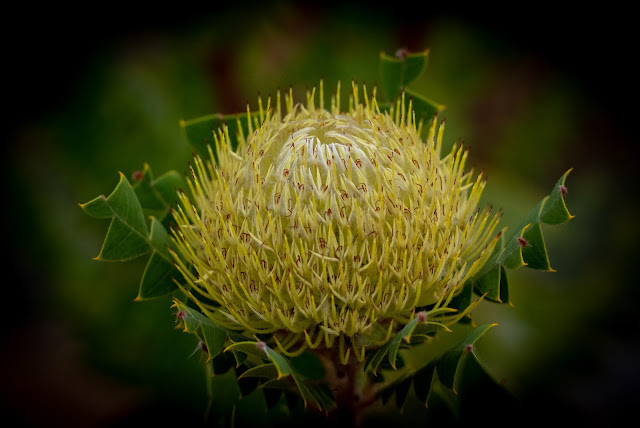
Pam Rooney’s winning Woolly Banksia image superbly displays what can only be described as delicate tracery.


Pam Rooney - Woolly Banksia

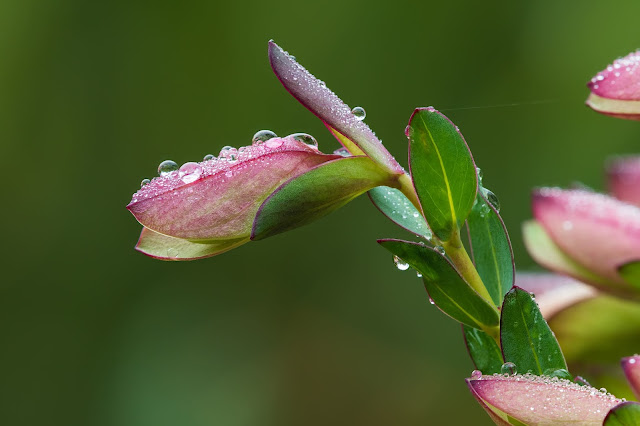
Bill Hall’s vulnerable Thick-lip Spider Orchid shows great detail and makes excellent use of complementary colours. Steve Playford’s Bejeweled Qualup Bell does the same with virtually identical colours.


Bill Hall - Thick-lip Spider Orchid


Steve Playford - Bejeweled Qualap Bell

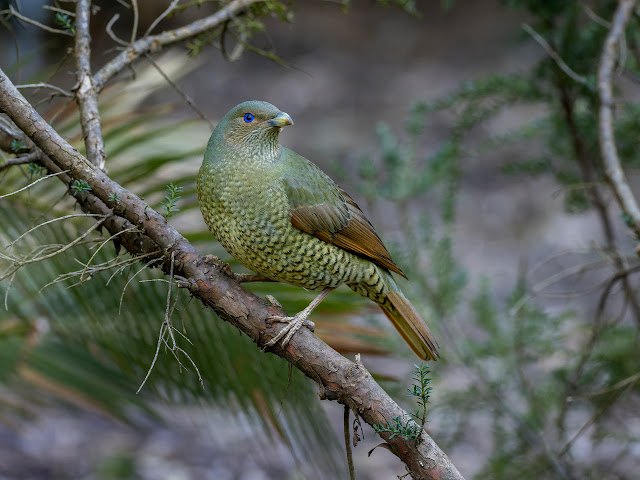
Graham Gall’s Juvenile Male Satin Bowerbird shows the bird’s soft, mostly green and brown, colours amongst similar greens and browns of the foliage. The rich blue of the bird’s eye is striking and commands attention.


Graham Gall - Juvenile Male Satin Bowerbird

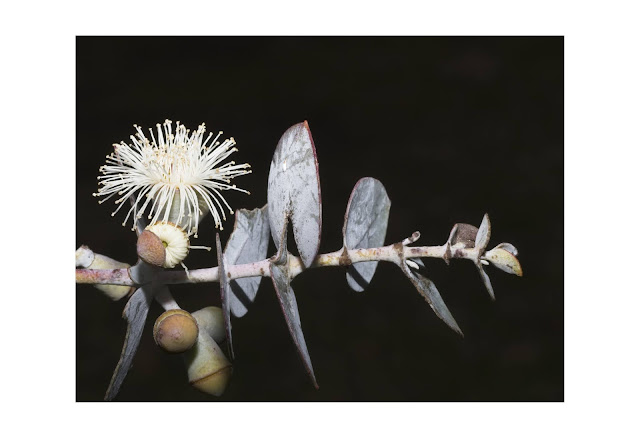
Jim Gould’s Baby Blue Flowers is a visually pleasing selection of a small piece of a silver-leaved mountain gum, clearly showing viewers how its flowers bud in groups of three; white flowers and cup-shaped to cylindrical fruit.

Jim Gould - Baby Blue Flowers

All the prints are worthy of close examination, and I encourage readers who can do so to visit and see for themselves.

Both framed works and unframed prints are for sale. Unique gifts of cards, calendars, photo bags and more are also on display and available for purchase. A percentage of sales go to the Friends for projects in the Gardens.

Visitors can also check out the 2022 Calendar that is available in the bookshop; all images produced by the Photographic Group members.

The exhibition supports and raises awareness of the aims and values of the ANBG and highlights the Gardens’ wide-ranging diversity of flora and fauna through the medium of photography. The participating members of the Photographic Group should be pleased and proud of their contributions.

Any reader who would like more information on the Photographic Group should email photo@friends.org.au. The Group encourages potential speakers and new members.

This review is also on the author's own blog here.
Saturday, November 13, 2021

Experiments in Living [Melt], Surface Appearances, Light Materials, & 398

Photography | Brian Rope

Experiments in Living [Melt], by Sammy Hawker (ACT)
Surface Appearances, by Eunie Kim (ACT)
Light Materials, by Caroline Huf (ACT)
398, by Aloisia Cudmore (ACT)

PhotoAccess Huw Davies Gallery | Until 27 November 2021

Each year, PhotoAccess awards local and interstate artists, both emerging and established, assisting them to expand and develop their photo-media practices. They are provided with mentorship to produce solo exhibitions in the Huw Davies Gallery. The four ACT exhibitors this year were recipients of the Dark Matter, Emerging Artists Support Scheme, and Wide Angle residencies.

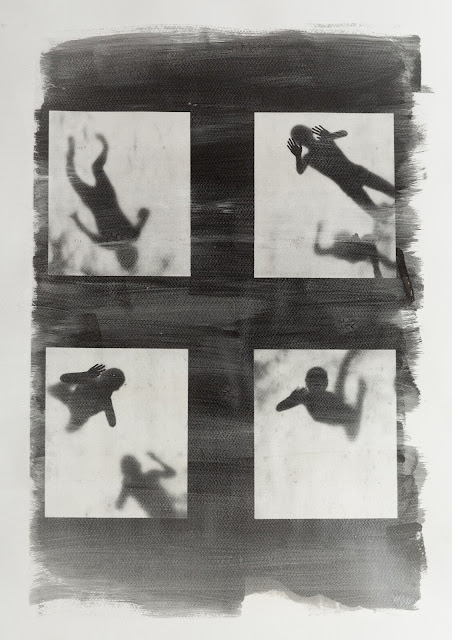
The works in Sammy Hawker’s Experiments in Living [Melt] encompass text, documentary video and negative prints produced in collaboration with the chemical activity of rain, hailstones, seawater and open flame. This is now familiar territory for Hawker, who challenges us to reconsider the illusion of control we hold over the natural world. These images do not disappoint.

Because we are limited, finite, beings subject to dying, vulnerability to trauma is a necessary and universal feature of our human condition. Hawker’s images speak to this, identifying the importance of nurturing our relationship to the world, and reminding us that our everyday experience is illusory, never the reality itself, of non-human forces shaping our lives.


Tom & Pyrocumulus © Sammy Hawker

Eunie Kim says she is grateful to have found her life’s calling in photography and is excited to see what comes next, embracing every opportunity. In Surface Appearances, Kim has used ‘Liquid Light’ photographic emulsion painted onto varied papers and brought her current Australian life into conversation with the traditional aesthetics of her Korean heritage. This is most evident in three beautiful “paintings” on sugarcane paper, looking at flowers, birds and insects.

Using materials and subjects from a contemporary Australian setting whilst simultaneously conjuring the aesthetic of traditional Korean painting, Kim explores her immigrant experience. Applying the emulsion via brushstroke, on differing thickness and texture of paper, has produced varying works. They reflect Kim’s process of learning, regretting and then correcting mistakes, and taking chances.


Cells, captured in 2015, recreated in 2021 © Eunie Kim

Light Materials is a series of video works deconstructing and recombining film materials through a process of digital or analogue weaving, Caroline Huf explores the exhaustion and re-invention of settler Australian myths about the mystery and threat of the bush.

Huf’s work, It's No Picnic, disrupts Peter Weir’s iconic movie Picnic at Hanging Rock, a key cultural expression of early colonial anxieties in the unfamiliar Australian landscape. Each scene is pulled apart, altered in speed, scale, and moved out of time to appear as woven patterns and twills. The film’s pan pipes become an industrial sound and the threads slowly disappear, suggesting a worn-out myth.


It’s no picnic- 2021, video still © Caroline Huf

And Let’s Get Lost presents Huf’s personal engagements with local landscapes, wearing dresses she created from strips of 16mm film to remind us of the, often, fleeting nature of our experiences with landscapes. The film dress unravels as she moves through the landscape before being fed through the projector and into the gallery. Both the dress and its experience become an ephemeral memory. Watching these works, particularly the digital video projected onto sandstone, is a somewhat mesmerising experience.

Aloisia Cudmore’s works span multiple mediums including photography, video, sound and installation. She investigates the notions of intimacy at the threshold between physical and virtual space.

398 comprises personal black and white digital images in which Cudmore captures intimate moments of physical proximity with her friends, family and community, during a time when travel restrictions, prohibitions on gathering and ultimately lockdowns separated us emotionally from those most important to us. These quite simple images of moments are a testament to the people that keep us connected.


4, 2021 © Aloisia Cudmore

We are fortunate to have these four photomedia workers amongst our quality emerging and established artists in the A.C.T. It is no surprise they were chosen to receive the awards that led to these works.

This review was first published in the Canberra Times here. It is also on the author's own blog here.
Saturday, April 24, 2021

Olive COTTON Max DUPAIN


Photography | Brian Rope

Olive COTTON Max DUPAIN

FYREGALLERY, Braidwood | Until 30 April 2021

All serious Australian photographers, and lovers of photography, know about Olive Cotton and Max Dupain. They know about their relationship. They are familiar with much of their work, particularly the famous images. They have probably read some books about one or other or both of them. If not, I heartily recommend the 2019 biography Olive Cotton, A Life In Photography by Helen Ennis. It tells much about Dupain as well as Cotton.

For everyone who appreciates the works of these two pioneering Australian photographers, this exhibition provides a great and joyful opportunity to see 39 of their images displayed in the one place. In addition, the quality of the silver gelatin photographs on display is excellent.

The exhibition catalogue, reproduces FYREGALLERY’s Manifesto for the Arts, quoting Rosamund Stone Sander & Benjamin Sander, ‘Art is ….. about rearranging us, creating surprising juxtapositions, emotional openings….’. That may be somewhat too esoteric with respect to this exhibition. These works mostly do not create surprising juxtapositions. They do not rearrange us. In my view they are, for the most part, straight forward images.

Cotton’s half of the exhibition includes some excellent nature imagery, such as her exquisite Seed Head, 1990. Also on show is the beautifully detailed photograph - Skeleton Leaf, 1964. The former is in the collection of the National Library of Australia, the latter in the National Gallery of Australia.


        Olive Cotton - Seed Head, 1990, Silver gelatin photograph © Josef Lebovic Gallery


Olive Cotton - Skeleton Leaf, 1964, Silver gelatin photograph © Josef Lebovic Gallery


There are various delightful portraits, including the wonderful Only To Taste The Warmth, The Light, The Wind, in which the model’s face says it all – we know immediately what she is experiencing. The title is a line from a poem ‘O summer sun’ by English poet Robert Laurence Binyon.


Olive Cotton - Only To Taste The warmth, The Light, The Wind, 1939, Silver gelatin photograph © Josef Lebovic Gallery

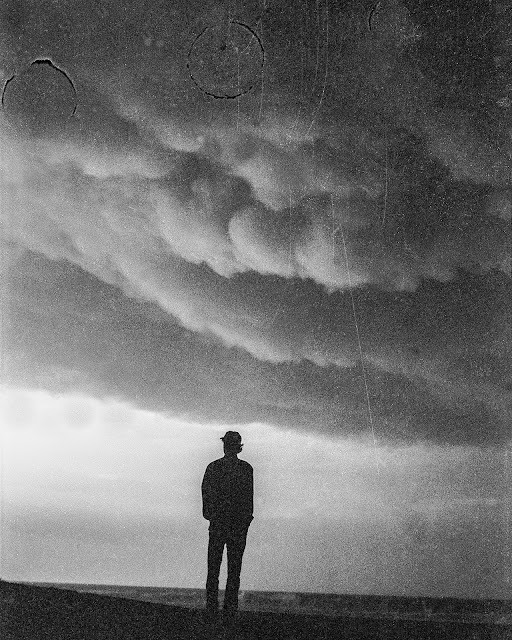
Bright Cloud, 1939 is another highlight, portraying exactly that beyond the crest of the road ahead.


Olive Cotton - Bright Cloud. 1939, Silver gelatin photograph © Josef Lebovic Gallery

There is also the superb abstract Moths On The Windowpane taken in 1985 when Cotton was 84 years old. The Ennis biography mentioned earlier suggests Cotton ‘would have thought about it for a long while, watching and waiting’. Most of us would not do so – we would either just grab a shot or, at most, take a little time to frame our composition.

Dupain’s half of the show includes several from his Shell Series, printed very small and displayed in much larger mattes. It is a matter of individual preference as to whether one likes small artworks framed this way. Those who want something larger can find these images on websites by searching for Dupain’s name and their titles.

There are also various images of Sydney landmarks, one of performers with the Ballets Russes, and one of his fashion shoots – titled Beach Fashion Shoot, 1938.


Max Dupain - Beach Fashion Shoot, Cronulla, 1938, Silver gelatin photograph © Josef Lebovic Gallery

And there is Two Girls At Bowral [Olive Cotton and Jean Lorraine], 1939. It is a nice touch to have a Dupain image of Cotton included in the show.


Max Dupain - Two Girls At Bowral [Olive Cotton and Jean Lorraine], 1939, Silver gelatin photograph © Josef Lebovic Gallery


It is interesting to read when the images were taken and when they were printed. In many cases we are told who signed the prints – mostly by Dupain’s son Rex, or Cotton’s daughter Sally. And we read where copies are held and used as illustrations in Ennis’ two books about Cotton. Having received a copy of the 2019 biography as a gift last Christmas and read it earlier this year, this exhibition provided me with a most timely opportunity to further enjoy the works of these two iconic photographers.

It is well worth the drive to Braidwood for Canberrans to see these works in a modest gallery in that historic country town. A day out to see the exhibition and enjoy some of the other delights nearby is a day well spent. FYREGALLERY is to be congratulated on arranging to show these works in association with Sydney’s Josef Lebovic Gallery.

This review is also on the author's own blog here.