Showing posts with label Portraiture. Show all posts

Thursday, June 22, 2023

Photography - 2023 National Photographic Portrait Prize (various artists)

Photography Exhibition Review | Brian Rope

National Photographic Portrait Prize 2023 | Various artists

National Portrait Gallery (Canberra) | 17 June 2022 to 2 October 2023

In this year’s NPPP, there is pathos and  humour, striking colour and sombre black and white. There are images of famous people and those known only to their families and friends, of indigenous people and of refugees, of people living in Australia and some who live elsewhere, and of people from different cultures. There are also many and varied approaches to the genre of portraiture, ranging from traditional to contemporary.

As in previous years, the diversity of the quality artwork delivers a powerful visual exhibition. Indeed, I consider the 47 works on exhibition this year to be an excellent selection well worth viewing. The three judges would, as is always the case with such successful competitions, have had a tough challenge in making their selections from almost 2400 entries. I acknowledged that when speaking briefly with judge Daniel Boetker-Smith at the very well attended media preview (whilst jokingly noting that they didn’t select any of mine).

It is of interest that the subject of the winning image Ruby was also a finalist, with a self-portrait so there are two photos of her in the exhibition.

Ruby (left view), 2022 by Shea Kirk
(The winning image)


Sisters or Friends, 2022 by Emma Armstrong-Porter

(The self-portrait by the subject of the winning image)

The winner of the Art Handlers Award, David Cossini, has both it and another work amongst the finalists on display.
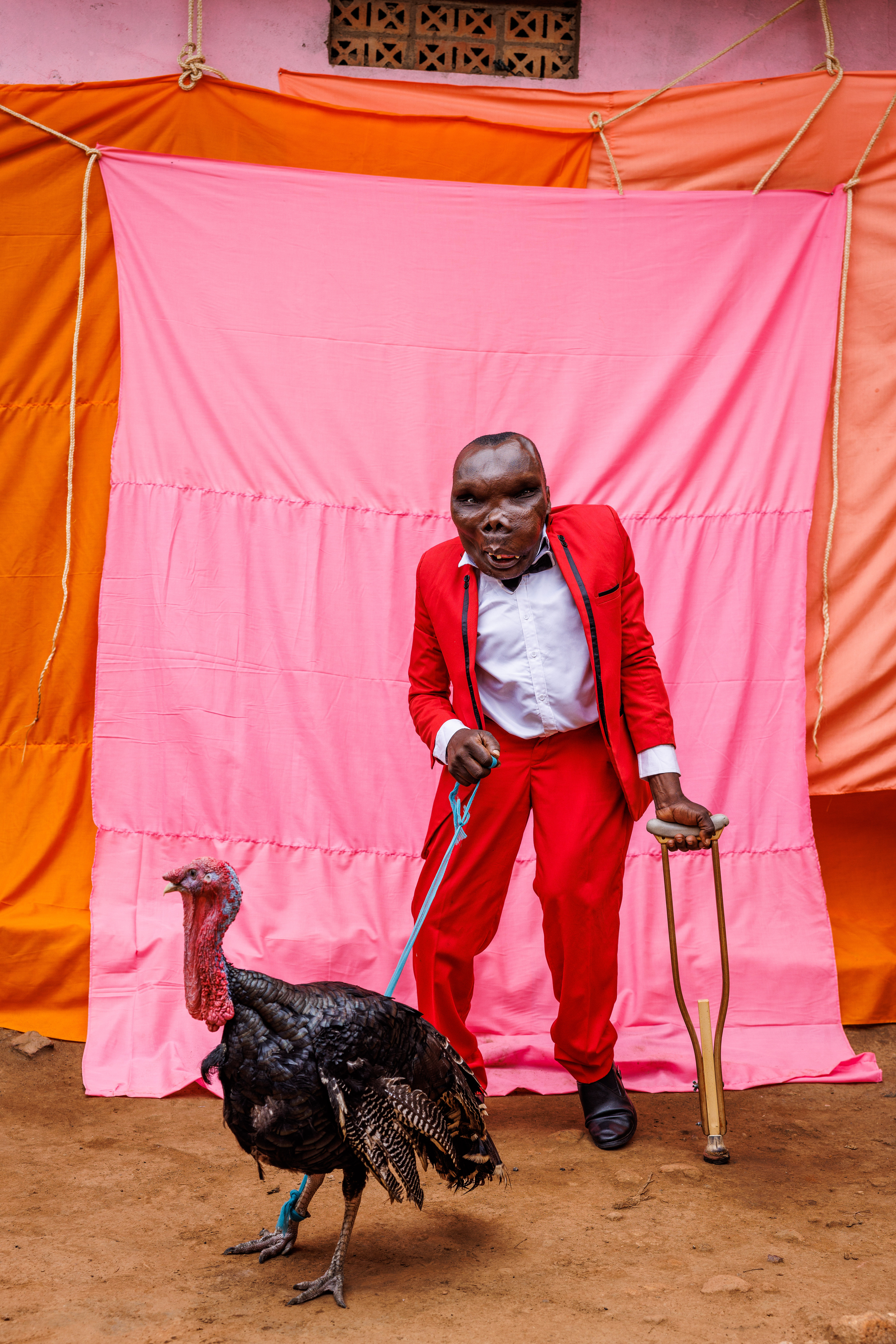
Ugandan Ssebabi, 2022 by David Cossini (Winner of the Art Handlers Award)

In my dreams I am dirty, broke, beautiful & free, 2022 by David Cossini

The finalists include a number of Canberra photographers, demonstrating once again that Australia’s capital city has many fine photo artists. Amongst them, Grace Costa, well-known for her corporate work and her imagery of horses, had Portrait of Zachary selected. She confesses that after seeing her subject at a campsite it took her around 45 mins to work up the courage to ask if she could photograph him.

Portrait of Zachary, 2023 by Grace Costa

Another Canberran, Brenda L Croft (with assistance from Prue Hazelgrove) had blood/memory: Brenda & Christopher i (Gurindji/Malngnin/Mudburra; Mara/ Nandi/Njarrindjerri/Ritharrngu, 2022 selected.

blood-memory. Brenda & Christopher  Gurindji-Malngnin-Mudburra. Mara-Nandi-Njarrindjerri-Ritharrng by Brenda L Croft, Prue Hazelgrove

Another fine, but quite different, portrait of an indigenous young woman is Yarnangu, 2022 by David Darcy.

Yarnangu, 2022 by David Darcy

Amongst some wonderful images of people from a variety of the many cultures we have in this great multicultural country, I particularly enjoyed Mela 2022 by Bahram Mia, which portrays four young women from Afghanistan celebrating birthdays together in this country where they have the freedom to enjoy such moments as once were the norm in their home country.

Mela, 2022 by Bahram Mia

I also loved Portrait of My Mother as an ethno-Futurist icon, 2023 by Sammaneh Pourshafighi. The artwork is of the artist’s mother, an Iranian migrant. The work is colourful and engaging, revealing much of the subject’s personality and identity.

Portrait of My Mother As An Ethno-Futurist Icon, 2023 by Sammaneh Pourshafighi

‘Sunju Calabrese’ #2, 2022 by Renato Colangelo portrays a man who is “unique, flamboyant with an expressive character.” This is a great contemporary artwork.

'Sunju Calabrese' #2, 2022 by Renato Colangelo

Amongst the images of famous people is Aunty Helen, 2021 by Charlie Ford. The subject is the highly successful Australian author, Helen Garner. The artist has successfully captured her in an “unspectacular act” – shutting  a gate – to reflect his aunt’s celebration of beauty in ordinary moments when she authors her works.

Aunty Helen, 2021 by Charlie Ford

I cannot close without mentioning Adam Ferguson’s emotionally moving portrait of Ukrzaliznytsia (Ukrainian Railways) employee, Sumy Oblast, Ukraine, May 2022. It is a poignant reminder of the terrible ongoing conflict there.

Ukrzaliznytsia (Ukrainian Railways) employee, Sumy Oblast, Ukraine, May 2022

by Adam Ferguson

The judges have said the winning work is a “celebration of photography”, and  the Highly Commended has “exceptional cinematic quality”. The art handlers who chose their Award described their selection as “confident and joyful.”

As always, the NPPP is an exhibition not to be missed if you are able to get to it - to see on a gallery wall both the images I’ve mentioned and those I haven’t, either now at the National Portrait Gallery or later when it tours to other Australian locations. If that is not possible for you, all the finalists can be seen here.

 This review is also available on the author's blog here. And now also in the July 2023 issue of The Printer, the online magazine of the Australian Photographic Society's Print Group here.


Saturday, July 16, 2022

National Photographic Portrait Prize 2022

Photography Review | Brian Rope

NPPP 2022 | Various artists

National Portrait Gallery | 25 June – 9 October 2022

As I noted when reviewing the 2021 NPPP here, group exhibitions can be awkward to review because of the diversity of imagery subject matter and quality. In a major show such as this though, there is unlikely to be poor quality work. Furthermore, with a focus on portraiture the diversity is diminished. That’s not to suggest there is a sameness as there are many approaches to portraiture on display here. As in previous years, the diversity of the quality artwork delivers a powerful visual exhibition.

The winning work Silent Strength 2021, by well-known Indigenous photo artist Wayne Quilliam, is a fine portrait, beautifully portraying Culture through the rich colours in the ochres and feathers of his indigenous subject, and also his sense of pride. Quilliam is a lovely modest man and very proud of his prizewinning artist daughter who was with him at the media preview I attended. And he’s giving the $20,000 worth of gear he won to Indigenous communities and organising for them to learn to use it.


Silent Strength - Wayne Quilliam

As always, in such shows, I look for works by locals and other people whom I know personally, as well as images by artists whom I follow. Canberrans in the show include Cat Leedon, with a powerful, perhaps confronting, self-portrait titled Breast Cancer, aged 37. It clearly shows the anguish she was feeling after her second breast surgery.


Breast cancer, age 37 - Cat Leedon

Fiona Bowring has a delightful Family Portrait, incorporating another shot of the same family hanging behind them. This again is a story which, no doubt, includes pain – it relates to palliative care and to love of family.


Family portrait - Fiona Bowring

Greg Stoodley’s contribution is another self-portrait Greg & Orbit that I had seen previously on his website. The image was taken during lockdown and features a cat looking at his apparently bored face and supine body.


Greg & Orbit - Greg Stoodley

And then there is Lauren Sutton’s work Lauren and Poppy. Yes, another self-portrait during lockdown. All work cancelled, the artist took this and other selfies to document the time spent with her four-month-old daughter.


Lauren and Poppy - Lauren Sutton

There are various other images made during restrictions, including Andrew Rovenko’s The Shuttle, a delightful shot of four-year-old astronaut Mia wearing her homemade space suit and helmet.


The Shuttle - Andrew Rovenko

There are also other good portraits of Indigenous people, such as Cordy in the Clouds by Adam Haddrick.


Cordy in the Clouds - Adam Haddrick

There are people from other cultures, an Olympian, well-known people such as Barry Jones, a survivor of a lifetime of abuse and mistreatment, a 6’ 9” tall man, neighbours, lifelong friends, a dancer, music journalist Bob Gordon, and a young woman in transitional housing after a period of homelessness.

One of the represented photographers whose work I always appreciate is Michael Bowers. His work Stella is of a grandmother whose grandson was last seen where she is seated on the banks of the Gwydir River.


Stella - Michael Bowers

As in previous years, there are numerous works in this diverse exhibition that we all need to study and explore, such as Matthew Newton’s Indigo, featuring an activist, dressed as an endangered wedge-tailed eagle, heading into the Tarkine forests in Tasmania, where they spent a bitter winter to halt development of roading to access a planned tailings dam – yet to be built.


Indigo - Matthew Newton
 

This is far more than pretty pictures, far more than high quality portraits. There are so many stories, so many varied aspects of our Australia and its peoples, so many identified issues for us to think about – all revealed through the talented story-telling photographers using their insights and artistic skills to depict their subjects.

We who view the works are privileged to gain access into the personal lives and emotions of the people portrayed.

This review was first published on page 23 of The Canberra Times of 11 July 2022 and online here. It is also available on the author's blog here.

Tuesday, June 28, 2022

CITY COMMISSIONS - PORTRAITS

 Photography | Brian Rope

CITY COMMISSIONS - PORTRAITS | SAMMY HAWKER

Tuggeranong Town Centre (on windows of Lakeview House & under the Soward Way Bridge) | Until 4 July 2022


Installation shot - Under Soward Way bridge (supplied)

Sammy Hawker is a visual artist working predominantly on Ngunawal Country. She works predominantly with analogue photography techniques and often works closely with Traditional Custodians, scientists and ecologists.

In 2021 Hawker had two highly successful solo shows as part of a PhotoAccess darkroom residency. She is currently an artist-in-residence with the CORRIDOR project and is also preparing for another solo show before year end.

Over the last six months Hawker worked closely with nine young people from Headspace Tuggeranong exploring ways they could co-create photographic portraits. This was part of a City Commissions project delivered by Contour 556, one of seven artsACT initiatives in the Creative Recovery and Resilience Program.

Headspace is a safe space that welcomes and supports young people aged 12–25, their families, friends and carers, helping them to find the right services. Learning the Headspace motto “clear is kind”, Hawker realised her project was also about finding clarity as a form of self-compassion - shining light on what for many was a particularly dark and confusing time.

Hawker challenges the notion that a photograph constitutes the moment that a shutter is released. She explores ways of making, rather than taking, images. She wanted the project to be empowering - with no right or wrong and where the final photographs celebrated identity and experience beyond just the way her subjects looked in the frame. It was an opportunity to realise we always have some choice whether we repress difficult experiences.

The portraits of the young people were captured on a large format film camera. Commonly, in photographic practice, touch and marks on negatives are to be avoided. But Hawker invited her subjects to handle, manipulate, scratch or even bury negatives in order to introduce something of themselves. The young folk wrangled puppies, dived into rivers, got dressed up, sprinkled bushfire ash on negatives and processed film in the Headspace carpark.

Each participant was invited to use the project to reflect on their experiences of difficult times. Their statements relating to the images reveal resilience and hope.

Chanelle reflected about living in the moment. The negative of her portrait, showing her immersed in the Murrumbidgee River, was processed with water from that river, ocean water and permanent marker.


Chanelle © Sammy Hawker

Sophie spoke of learning to embrace everything in life. Her portrait’s negative was processed with bushfire ash and the word Embrace scratched into it. The ash creates a frame that embraces her.

Sanjeta really likes her photo with jellyfish manipulations as metaphors for how she now goes with the flow of her life journey. Her expression conveys a “so be it” attitude. The negative was processed with Murrumbidgee water, rainwater, seaweed and chemical stains.


Sanjeta © Sammy Hawker

Ray wanted to keep connected and bring some joy into the lives of others. The portrait’s beaming smile conveys joy. The idea of processing the negative with Whiz Pop Bang bubble mixture and wattle pollen adds to the joy.


Ray's Statement

Jazzy is photographed with her much loved dog Milo. So, of course, the processing of the negative utilised Milo’s pawprints.


Jazzy © Sammy Hawker


Devante © Sammy Hawker


Installation shot - Under Soward Way bridge (supplied)

When I reviewed her Acts of Co-Creation show (for which she received a Canberra Critics Circle Award) in this publication, I wrote of Hawker’s then newly formed relationship with Ngunawal custodian Tyronne Bell who helped her to learn about sites she was working with. For this project, Hawker arranged for Bell to escort her subjects walking Ngunawal Country, providing a healing experience for them.

I strongly recommended readers to visit City Commissions - Portraits - and reflect on your own difficult times.

An edited version of this review was published in The Canberra Times of 28/6/22 on the Capital Life page, and the full version online here. It is also on the author's blog here.

Saturday, May 28, 2022

WE BLEED THE SAME

 Photography, Documentary & Installations | Brian Rope

WE BLEED THE SAME | TIM BAUER & LIZ DEEP-JONES

Research School of Social Sciences, ANU | Until September/October 2022

Whilst reporting on conflicts, acclaimed journalist Liz Deep-Jones, was deeply disturbed that they unfolded in the name of religion or racism.  Inspired by a community-led, grassroots initiative ‘Racism Not Welcome’, Deep-Jones joined forces with portrait photographer, Tim Bauer, to present this exhibition ‘We Bleed The Same’.

Deep-Jones grew up in a Lebanese, Arabic-speaking household trying to figure out how she belonged in Australian society where she experienced bigotry. She says the exhibition is “about you, me, humanity!” Bauer is the child of a refugee European father and an Australian mother who taught him to love and respect all human beings.

Thirty-nine women and men from varied backgrounds, religion and race feature in Bauer’s images. And in an accompanying documentary produced by Deep-Jones, they share personal and emotional stories about their diverse cultures and experiences with dangerous and demoralising racism. Like them, we should all be seeking to defeat racism.

As he is a pre-eminent Australian portrait photographer, it is no surprise that Bauer’s diverse images here are simply superb. The people he has wonderfully portrayed include former Race Commissioner Tim Soutphommassane, First Nations Elder Leetona Dungay (whose son David died in custody) and refugee Marcella Kaspar.


Tim Soutphommasane © Tim Bauer


Leetona Dungay © Tim Bauer


Marcella Kaspar © Tim Bauer

Lovemore N'dou, one of the other incredible people featured, had a successful early career in boxing but, due to South Africa’s apartheid policies, was not allowed to compete internationally. He migrated to Australia and continued his boxing career before becoming a lawyer.


Lovemore Ndou © Tim Bauer

There is Australian-born Uyghur woman Subhi Bora, indigenous Torres Strait Islander author and union official Thomas Mayor, and Filipino migrant Brenda Gaddi. Also South Sudanese refugee Deng Adut, proud Australian Muslim woman Maryam El-Kiki, and human rights advocate and refugee activist Thanush Selvarasa.


Maryam El-Kiki © Tim Bauer


Thanush Selvarasa © Tim Bauer

Accompanying each wonderful Bauer portrait are the subjects’ deeply personal stories in words assembled by Deep-Jones - explaining who they are, what their personal racism experiences have been, and how they are involved with seeking to combat bigotry. Those words take the already powerful images even further - they are profoundly moving. It is highly probable that studying the images and reading the words will make most viewers quite emotional.

From Mayor, we learn “Indigenous people experience racism in this country every day. Racism makes me feel less than human, insignificant, like I’m not even there but we need to stand up and be proud of who we are. We are on our country and that can’t be ignored.”

The exhibition also features various installations - including the interactive Kizuna (Japanese  - meaning ties or bonds) in which family photographs submitted by the local community are being hung from a red Hills Hoist using red strings. The threads of photos represent the connectedness between Australians whilst reflecting our diversity. Deep-Jones hopes this exhibition that she has produced will convey that message and spark visitors into ongoing conversations about racism in Australia.

Another installation comprises vials of fake red blood, each labelled with a name of a portrait subject and, so, symbolising them and shouting, ‘We Bleed The Same.’

There are opportunities for visitors to share their personal experiences of, and views about, racism by writing in red alongside images of a “blood-soaked arm.” And a Cedar Tree of Lebanon installation, inspired by Deep-Jones’ family roots, seeks to touch our souls and ignite our hearts to inspire positive action for humanity.

Deep-Jones expects the exhibition will continue until at least September 2022. It is in the foyer and also the first floor of the RSSS building at the ANU. I urge everyone who can to see this important presentation.

For a great interview with Deep-Jones check here.

This review was published by the Canberra Times on 28/05/22. It is also available on the author's blog here.

Friday, May 27, 2022

Voices of Veterans

Photography | Brian Rope

VOICES OF VETERANS | MICHAEL ARMSTRONG

National Press Club Building, | Until 19 June 2022 - by appointment only – bookings to view the exhibition or to experience insights with the artist can be made at https://voicesofveterans.com.au/events

Molasses! A viscous substance primarily used to sweeten and flavour foods. A major constituent of fine commercial brown sugar. And a primary ingredient used to distil rum.

I’ve eaten food containing molasses, seen photographs of it, even found a photography business with the word molasses in its name. Never before have I seen portraits of people covered with molasses with its thick, sticky consistency. Glue-like, tacky, treacly, and slimy might also be used to describe this substance.

Voices of Veterans, created by artist and veteran Michael Armstrong, is a collection of photographic works that visually represent individual experiences of living with Post Traumatic Stress Disorder (PTSD). So is this an exhibition of artworks or is it simply about supporting a Veterans’ cause?

The exhibits are most definitely photo artworks and very fine ones indeed. But the exhibition is also part of an important project. Every sale contributes to the Voices of Veterans Fund, supporting veteran health and directly funding grassroots arts programs in Australian veteran communities. And it is always great to see art being used to highlight important issues.

So why use molasses, covering large expanses of the subjects’ bodies with it? Armstrong says "Molasses behaves in a manner that mirrors many of the symptoms of PTSD. Its weight and dark enveloping form, it's staining and sticky qualities mark everything it touches. The manner in which it mirrors qualities of light and dark around it. My models naturally resonated with the experience of working with molasses and found the medium profoundly evocative".

There are both monochrome and colour images - dark and brooding portraits, some where facial expressions are not easy to interpret, others where the molasses reminded me of bleeding wounds.


Mike Armstrong #3, 2022

Mike Armstrong #1, 2022

A very powerful one features a hand hanging down alongside part of a torso, richly coloured molasses clinging to it yet also dripping. Indeed all the images featuring hands stand out.


Mike Armstrong #5, 2022

A PTSD survivor himself, Armstrong was motivated by personal experience. Each veteran subject in the exhibition has a story, and their stories are told, expressed, felt and heard through his use of a challenging and rewarding creative process with molasses as a metaphor. The works show both sides of lived experience - the dark emotions of challenging moments and the light feelings of healing, release and hope.

Subjects’ own words are shared alongside artworks. One speaks of “the feeling of being dragged down into the thick, welcoming abyss until you are choking and drowning. Being able to barely keep your head up enough to catch a breath.”

So, the choice of molasses is enormously successful. The resultant images almost force you to study them. They are at once poignant and haunting, dark and evocative, graphic and expressive. They will bring strong memories or feelings to the minds of people who have family or friends who have suffered the effects of PTSD. They will remind others of different, yet also traumatic, experiences.


Mike Armstrong #2, 2022


Mike Armstrong #6, 2022


Mike Armstrong #4, 2022

Indeed, the created artworks have resonated with veterans deeply. When posted on Armstrong’s social media they reached a broad audience, creating high levels of engagement and many conversations. This sparked the need to create widespread awareness - and the project was born.

The exhibition will tour Australia raising awareness of the individual experiences of veterans living with PTSD, and veteran art-based workshops will support the creation and growth of healthy communities. Community events will be offered during the Canberra exhibition, including trauma-informed movement classes with health practitioners and veteran art workshops with Armstrong.

There is a gallery of the artworks online at https://voicesofveterans.com.au/art-gallery.

This review is also on the author's blog here.


Saturday, September 4, 2021

Negotiating the Family Portrait

Photography | Brian Rope

Marzena Wasikowska | Negotiating the Family Portrait

Canberra-based photo artist Marzena Wasikowska has built a name for herself over the years. Since 2000, when she completed her Master of Visual Arts at the ANU, she has had more than a dozen solo exhibitions (as well as being in numerous group exhibitions). Her works are in several public collections, and she also has been publicly commissioned on a number of occasions. Wasikowksa has been successful in various major competitions, including being a finalist in the National Photographic Portrait Prize (NPPP) five times.

Now, Wasikowska has been selected as one of the winners in the 2021 Lens Culture Street Photography Critics’ Choice Awards. Joanna Milter, Director of Photography at The New Yorker selected the series Negotiating the Family Portrait 2011-2021 for an Award. Experts, such as Milter, explored entries from across the globe to select their top three personal favourites. There’s no jurying as a panel; just choices made individually by each of the expert critics.

Images were submitted by photographers from over 150 countries and twenty-one critics chose individual photos and series that captured their hearts. Explaining her choice of Wasikowska’s series, Milter described the images as lively and noted that the artist “purposely captures those instances before everyone is in place. Yet she understands that the presence of a photographer changes everything; even in seemingly offhand moments, her subjects are performing for her camera.”

The ten images in the series have been captured over a decade – indeed it is five of them that have been finalists in the NPPP. Wasikowska says the series title summarises how she thinks about the act and procedure of making family portraits for public viewing. As we all should be, she is keenly aware of the discussions and negotiations of private and public - what to exhibit and what to keep private. She suggests, and I agree with her, that image makers tread a fine line when contributing to the dialogue of family portraiture while revealing something candid but not uncensored.

We have all experienced difficulties taking photos of getting people to smile, not hold fingers above heads, and not hide behind taller folk. Wasikowska has solved those problems. Whilst saying she longs for them to be the actors in her images, she also expresses her hope that each photograph holds the essence of a genuine, personal event, for herself and each of them. These annual portraits of her immediate family are a highlight of her portrait photography, summarising the previous twelve months.

In one image, every family member has brought their year’s story to the table.


Negotiating the Family Portrait 2015-16 - A study of history, myth and identity family
© Marzena Wasikowska

In another, one of two young children appears to be struggling in the arms of the adult holding them, most probably longing to be put down and set free to again explore the camera equipment now being used to capture them.


Negotiating the Family Portrait 2018 – Chaos © Marzena Wasikowska

And then another image is filled with visual symbols for the conflicting extremes associated with this dreadful pandemic affecting each and every one of us in various ways; some the same for us all, others different for particular individuals.


Negotiating the Family Portrait 2020-21-A COVID Kind of Day © Marzena Wasikowska

It is a delight to see these ten images together. They start with a relatively simple, yet exquisite, image of just two of the family.


Negotiating the Family Portrait 2010 - Long Distance Conversation 1 © Marzena Wasikowska

Along the journey we see far more complex groupings of much larger gatherings of family members, in which the theatricality and performance style truly shines through.


Negotiating the Family Portrait 2012 © Marzena Wasikowska

We are members of an audience. Some may wish they were videos rather than just one still image of a moment frozen in time. But these are the precise moments that the artist selected and wants us to see.

This article was first published in the Canberra Times on 4/9/21 here. It is also on the author's own blog here.