Friday, November 3, 2017

BRIGADOON


Directed by Jason Langley - Musical Direction by Michael Tyack
Choreographed by Cameron Mitchell - Set designed by Christina Smith
Costumes designed by Isaac Lummis - Lighting designed by Matt Scott
Presented by The Production Company – State Theatre, Melbourne
28th October to 5th November 2017.

Performance 1st November reviewed by Bill Stephens

"Waitin' for My Dearie"
Genevieve Kingsford (Fiona MacLaren) and female ensemble.

If your only acquaintance with Lerner and Loewe’s charming 1947 musical about two American tourists who accidently wander into a mysterious Scottish town to discover that it only appears once in every 100 years, is through the vapid 1954 film version, which starred Gene Kelly and Cyd Charisse, then Jason Langley’s muscular revival for The Production Company will be a revelation.

Even for those familiar with the stage version, this production bristles with so many innovative ideas that it is sure to inspire a whole new interest in this musical which, unfathomably, seems to have been neglected in recent years.

"Brigadoon" - The Market Scene 


“Brigadoon” contains one of Lerner and Loewe’s most engaging scores, which here sounds magnificent, played by a large orchestra and beautifully sung by the ensemble, under the direction of Michael Tyack, who, while keeping the show moving along at a brisk tempo, allows the cast space to revel in the romance of the lyrics and melodies.

Rohan Browne (Tommy Albright)  Mathew Manahan (Charlie Dalrymple) and male ensemble

Honouring the creator’s intentions, Langley has set his production in the present day, so that Tommy Albright (Rohan Browne) and his companion Jeff Douglas (Luke Josling) now use mobile phones to try and negotiate their way out of the Scottish forest before bumbling into Brigadoon. Further contrast is added by Isaac Lummis’s bold Braveheart-inspired costume designs which, unlike other productions, have the men sporting primitive leather kilts, and the women in earthy tones. The tartans being reserved for the wedding scene.

"Brigadoon" - Jean and Charlies Wedding 

Dozens of floating crosses give an air of mystery to Christina Smith’s flexible setting in which elevated central rostrums, together with clever use of projected imagery and a superb lighting design by Matt Scott, morphs effortlessly into any number of locations, leaving the stage uncluttered for Cameron Mitchell’s exuberant dance routines.

The casting throughout is impeccable. A gorgeous singer, Genevieve Kingsford is quite stunning as the beautiful red-headed, Fiona MacLaren, busily engaged in the preparations for her sister Jean’s wedding to local boy Charlie Dalrymple, when she catches the eye of Tommy Albright. 

Rohan Browne is sensational as Tommy Albright. Not only does he sing magnificently, he’s also an unusually gifted actor/dancer, with the ability to phrase both his lyrics and his dancing as extensions of his dialogue. Their scenes together are beautifully managed, especially “Heather on the Hill” and “Almost Like Being in Love”, both of which are pure joy.

Nancye Hayes (Mrs Forsythe), Genevieve Kingsford (Fiona MacLaren, Rohan Browne (Tommy Albright)


It was an inspired idea to cast Nancye Hayes as Mrs Forsythe to tell the story of how Brigadoon became an enchanted town. A genuine living treasure, Hayes, who played Meg Brockie in Hayes Gordon's Menzies Hotel production of “Brigadoon” back in 1966, and after whom The Hayes Theatre in Sydney is named, demonstrated her considerable theatrical flair by making this speech a magic moment, and a reminder of the old adage, “There’s no such thing as a small role”.


Luke Joslin (Jeff Douglas) and Elise McCann (Meg Brockie)

Elise McCann as the over-enthusiastic, Meg Brockie, is well teamed with Luke Josling as Tommy’s hard-bitten friend, Jeff Douglas, and her renditions of “The Love of My Life” and My Mother’s Wedding Day” provide two of the highlights.  

Stefanie Jones (Jean MacLaren) and Matthew Manahan (Charlie Dalrymple) charm as the young engaged couple in the beautifully staged, “Come To Me, Bend To Me”.
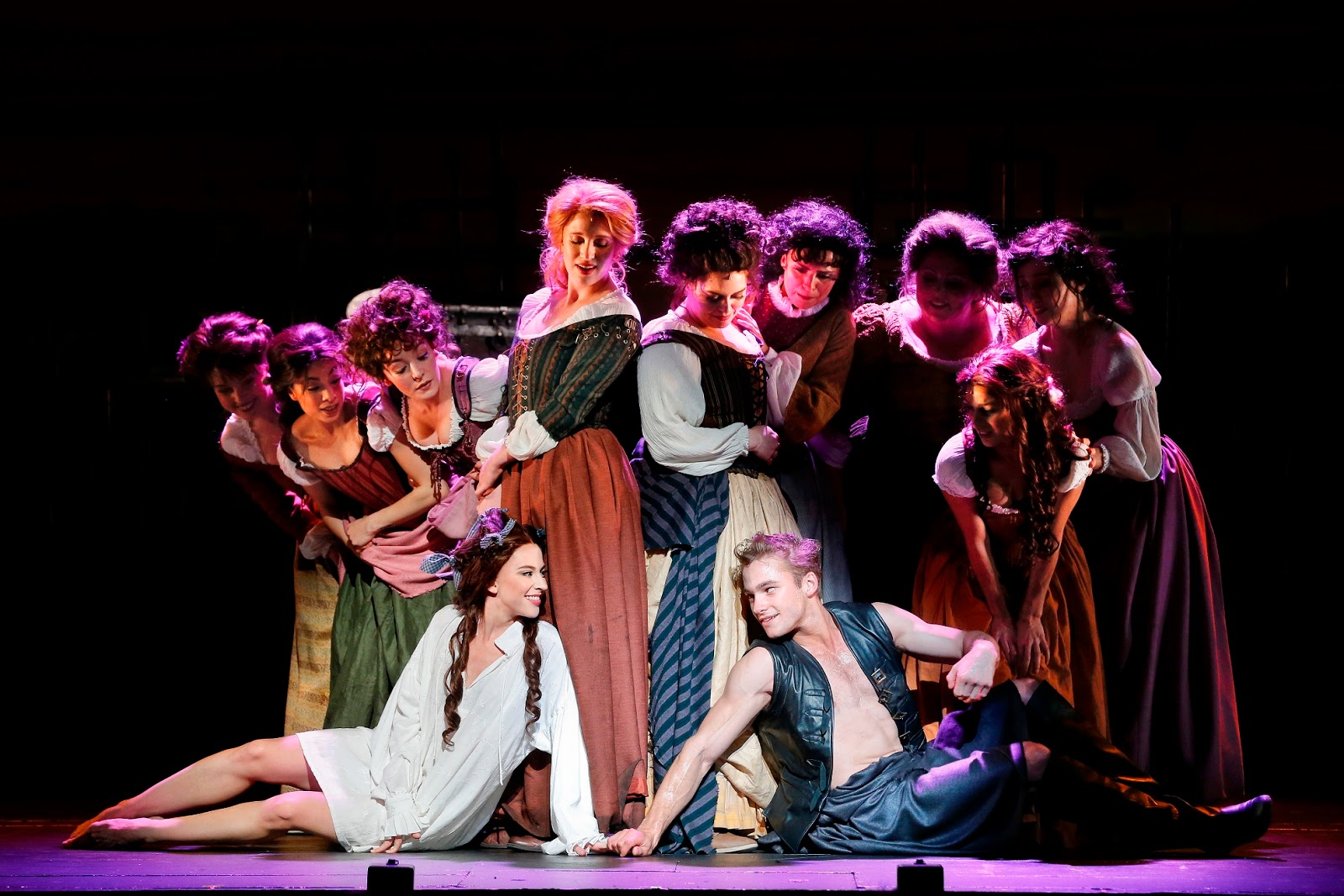
Stephanie Jones (Jean MacLaren), Matthew Manahan (Charlie Dalrymple) and ensemble
"Come to Me, Bend to Me"

Sally Bourne as Alice Maclaren, the mother of Fiona and Jean, and Stephen Hall as Archie Beaton, the father of the tragic Harry Beaton, both imbue their roles with affecting gravitas, with the well-drilled ensemble impressing with its energy and commitment throughout.

The Male ensemble - The Chase 

This inspired production of “Brigadoon” is yet another example of The Production Company’s success in rescuing such shows as this from obscurity. It deserves to be seen by a much wider audience than will have the opportunity during its brief season in Melbourne.


                                              Images by Jeff Busby.

This review also appears in Australian Arts Review. www.artsreview.com.au

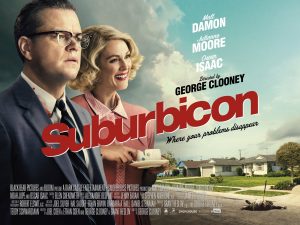
SUBURBICON


Reviewed by © Jane Freebury

It can’t be as bad as all that, can it? I mean, Suburbicon is directed by the sophisticate George Clooney. Those brilliant, witty purveyors of comedy noir, Joel and Ethan Coen, wrote the original screenplay and Matt Damon is in the lead. All are men of discernment, with talent to spare.

Yet the news just in from the box office this week is that ticket sales for Suburbicon are poor. The reviews aren’t good either. Something has gone quite wrong here.

It’s not like Clooney is an inexperienced director. This is the 6th film he has directed in a decent body of work, of which Good Night and Good Luck is the standout.

As an actor in the Coen brothers’ films O Brother, Where Art Thou?, Burn After Reading and most recently on Hail, Caesar!, Clooney has worked a treat. One of the reasons I’ve looked forward to their collaborations is their work together seems organic, probably because they have a shared vision.  One can only imagine what a hoot it is on set.

From an original Coen brothers' script from the 1980s, developed by Clooney and his co-writer Grant Heslov, Suburbicon knocks down the picket fence and strips the neat and tidy surface off contented domesticity in the typical, unremarkable suburban bungalow. To show us what suburbanites are really like. Welcome to Suburbicon, the ‘perfect place to raise a family’.

Located in the 1950s America, when vast tracts of new suburbs were spreading outside the cities, attracting residents with the promise of affordable housing and the benefits of city life without the disadvantages, the film really looks the part.

From the featureless suburban streetscapes to the television sets and kitchen utensils inside the home, the meticulous sets and period perfect detail are a joy. From the tie that Gardner Lodge (Damon) keeps on at home, to the striped t-shirts worn by his son Nicky (Noah Jupe, an excellent young actor), to the heels and flared skirts that women wear as they do the housework and the grocery shopping.

It might be a problem for Gardner and his family that the new neighbours over the back fence, the Mayers and their young son, are African-American. But he doesn’t actually connect with this, a situation that is a critical issue for the rest of the neighbourhood - and the shopkeepers and the postman. Small town racial prejudice is rife in Suburbicon, and it’s not at all pretty.

Like the main character in the Coen brothers’ classic dark comedy, Fargo, Gardner is preoccupied with how he can get rid of his wife Margaret (Julianne Moore), wheelchair bound as a result of an accident when he was driving, and install her sister Rose (also played by Moore) in her place.

To achieve this, he and Rose descend into a murderous mayhem, even despatching one of the film’s best characters, the insurance assessor played by Oscar Isaac. Young Nicky bears witness to it all.
Suburbicon is sometimes hard to watch, with its 1950s television score on the soundtrack, underlining critical points with heavy handed emphasis.

When all is done, a neighbour complains that none of this sort of thing happened before the Mayers moved in.

As that’s the point Clooney says he wants to make to bring the film into the current day - that mainstream American society blames the minorities for its own issues - then why didn’t he work the Mayers into his narrative, instead of leaving them in the background with barely any speaking roles?

Mob at the fence taunt Mrs Mayers (Karimah Westbrook)
Clooney has said he didn’t feel qualified to write narrative for African-Americans, and it has turned out a misjudgement because this timidity has skewed his film. He doesn't have the Coen brothers' light comedic touch either.

Suburbicon is set in the pre-dawn before the sixties civil rights movements that swept the country. Unmasking the evil in suburbia is nothing if not a familiar trope in countless films, and that includes teen horror films.

Some films like American Beauty, Blue Velvet, Pleasantville, and The Truman Show have made satirising suburbia an art form. Suburbicon is instead a harsh lesson with heavy messaging, the kind of thing that rarely works.

Rated MA 15+, 105 minutes

2.5 Stars

Also published at Jane's blog and broadcast on ArtSound FM 92.7


Thursday, November 2, 2017

THE POPULAR MECHANICALS


By Keith Robinson, William Shakespeare and Tony Taylor
Directed by Sarah Giles
A State Theatre Company South Australia Production
The Playhouse, Canberra Theatre Centre to 4 November

Reviewed by Len Power 1 November 2017

Taking its inspiration from Shakespeare’s ‘A Midsummer Night’s Dream’ and its play-within-a-play, ‘Pyramus and Thisbe’, this Australian play, ‘The Popular Mechanicals’, details the rehearsals and eventual performance of the bumbling group of amateur actors – the rude mechanicals - chosen to perform the play before royalty.

A highly theatrical piece, it’s cleverly written with opportunities for clowning, vaudeville, farce, slapstick and a unique and recognizable Australian sense of rough anarchy that works well with the real and pretend Shakespeare-type dialogue.

Director, Sarah Giles, has the show moving at break-neck speed and there are some inspired sequences, including fun and games with the word ‘bottom’, an extended fart joke that really is very funny and a hysterical puppet show involving chooks and recognizable classical tunes that is worth the price of admission alone.  Costumes and props were colourful and imaginative and the show was cleverly lit.

The strong acting ensemble of Holly Austin, Lori Bell, Julie Forsyth, Charles Mayer, Nathan O’Keefe and Rory Walker presented individually delightful characters with their polished physical and vocal comedy skills and they all displayed excellent comic timing.

However, right from the start, there was a sense of remoteness about it all.  Their smallish stage set was positioned too far back from the front of the Playhouse stage, creating a large gap between audience and players.  There would be greater involvement in a more intimate venue.

There were long sequences where it was not possible to understand what the actors were saying and there were times where, although the actors were working hard, the comedy seemed forced and less funny than it should be.

It’s a funny and enjoyable show with moments of brilliance and originality but it’s a bit lost in the Playhouse theatre.  However, don’t miss the chooks sequence.  You’ll never forget it.

Len Power’s reviews are also broadcast on Artsound FM 92.7’s new ‘On Stage’ program on Mondays from 3.30pm and on ‘Artcetera’ from 9.00am on Saturdays.

Wednesday, November 1, 2017

THE POPULAR MECHANICALS


The Popular Mechanicals

By Keith Robinson, William Shakespeare and Tony Taylor.

Original direction by Geoffrey Rush. A State Theatre Company South Australia Production. Directed by Sarah Giles. The Playhouse. Canberra Theatre Centre. November 1 – 4 2017. Bookings: 62752700 or www.canberratheatrecentre.com.au

Reviewed by Peter Wilkins

Crude, rude and ever so funny, the State Theatre Company South Australia’s production of The Popular Mechanicals is a textbook lesson in the uproarious art of coarse acting. The six rustic mechanicals of Shakespeare’s A Midsummer Night’s Dream gather to rehearse their performance of the The Most Lamentable Comedy and Cruel Death of Pyramus and Thisbe for the palace.
Holly Austin and Nathan O'Keefe in The Popular Mechanicals
Photo by David James McCarthy

It would be easy to denounce director Sarah Giles’s  production of this fantasized account of behind the scenes shenanigans as pandering to the groundlings “who, for the most part are capable of nothing but dumb show and noise” Not so; this highly disciplined, brilliantly comical display of clowning, performed by an ensemble of eccentric, idiosyncratic and simpleton bumpkins frolics merrily through ninety minutes of outrageous puns, slickly choreographed slapstick, spouting doggerel from the lip and conjuring moments of clever invention, such as an orchestra of sewing machine, glass bottles with water, a xylophone and even a brush upon a wooden dog. A highlight of the evening was the march of the red-combed plucked chooks ending in a fiery spray of feathers.
Julie Forsyth in The Popular Mechanicals. Photo David James McCarthy

Gag on gag is met with gales of laughter from those whose fancies have been tickled and funny bones rubbed. The Popular Mechanicals may not be to everybody’s humour, but there is no denying the skill of the actors, the discipline of the business and the energy of a cast that bring freshness and fun  to a piece that could easily have been relegated to the dustbin of dated revue material. It is spared the fate of so many flash in the pan ideas of their time by Giles’s direction, Jonathan Oxlade’s set and costume design, David Heinrich’s composition, sound design and musical direction and Gabrielle Nankivell’s choreography.
Lori Bell in The Popular Mechanicals. Photo: David James McCarthy

The State Theatre’s cast handle the Shakespearian text as deftly as they do the various comic genres of the work. Nathan O’Keefe, Charles Mayer and Rory Walker are regular identities on the State Theatre stage, and newcomer Lori Bell joins with the multi-talented Holly Austin and the veteran Australian performer, Julie Forsyth, to make up a cast that observes Hamlet’s advice to the players with impeccable timing, sparkling energy and a vivacious sense of fun. I imagine that rehearsals would have been a heap of fun, but the production is never allowed to lapse into self-indulgence, and from the opening veiled attack on the audience with the number We love ya to the final funny performance of the play within the play, The Popular Mechanicals is good time entertainment with a capital E. 
The cast of The Popular Mechanicals. Photo: David James McCarthy

Selby and Friends – Quattro – Concert 5, October 31st, 2017; Fairfax Theatre, NGA, 7.30pm. Music Review by Jennifer Gall


At a time when the daily news seems to be increasingly bizarre or distressing, it was a great comfort to enter the world of Kathryn Selby and her colleagues and have equilibrium restored in an exceptional concert – the final for the year. Andrew Haveron, Violin, Tobias Breider, Viola and Umberto Clerici, Cello joined forces with Selby to perform a richly contrasting program of works by Turina, Mozart and Dvořák. This was chamber music as it should be: a lively exchange of musical ideas and creative energy; each musician contributing their unique voice and yet utterly responsive to the balance required to maintain the unified ensemble.

It’s hard to fathom why Mozart’s Piano Quartet No. 1in G minor, K.478 met with such a cool reception when it was first published in 1785. To 21st century ears the work is thrilling, with the piano working as hard as the strings to contribute an independent voice as well as offering sympathetic and sophisticated accompaniment. Breider’s phrasing with the viola was particularly communicative in the Allegro ensuring that this important voice was heard, and the piano passages with their complex interweaving in relation to the strings showed off Mozart’s compositional skill to great effect. The subtle string syncopation in the Andante provided another moment to admire the composer’s gift of delicate variation.

Joaquín Turina’s Piano Quartet in A minor brought the creative tumult of the 1930s to life. The Lento – Andante mosso played in unison by the strings opened with a sultry theme taken up by piano and cello. There was a dramatic restlessness in the unfolding thematic material throughout the Andante mosso, as the emotional flavor of the music shifted from reflective to almost violent, tossed between the instruments. While the Vivo continued to contrast contemplative and lively material, the mood was more playful with the strings offering precision pizzicato passages and resounding bass chords from Clerici’s cello. Broader string phrasing and more expansive piano chords accentuated the physicality of the final Andante-Allegretto movements as the ensemble created an impressionist atmosphere haunted by romantic Spanish thematic echoes.


There is a particular magic that transforms a performance when each musician in an ensemble really wants a work to reach the most perfect standard possible, and this occurred in the performance of Dvořák’s Piano Quartet No, 2 in E flat major, Op. 87. As we heard in the Mozart quartet, the skill of the musicians animated Dvořák’s consummate compositional craftsmanship.  The Allegro con fuoco opened with robust energy, punctuated by the striking dynamic contrasts. Clerici’s cello solo introduced the exquisite Lento movement, so moving in the mood of tranquility sustained by each instrument. What began as a seemingly uncomplicated waltz in the third movement was developed to reveal the traditional essence of the source melodies and the idea of dancing continued in the Finale. Allegro, non troppo. Haveron really shone in this work, leading the string ensemble in communion with the piano. The infinite colorations described in the variety of bowing and changing rhythmic emphases made the work live and breathe.


With such a musical gift as this final Selby and Friends concert for 2017, it seems that Christmas has come early!