Showing posts with label Wouter van de Voorde. Show all posts

Tuesday, December 19, 2023

Nucleo

Photography Book Review | Brian Rope

Title: Nucleo

Author: Wouter Van de Voorde

Publisher: AREA Books (Paris)

Format: 240 pages (all with foldout), 32 x 23.5 cm, softcover (with dustjacket)

ISBN: 978-2-4935-0911-6

Having become aware of Wouter Van de Voorde’s photography, Laure-Anne Kayser of AREA Books (Paris) approached him to do a book. Like his previous sold-out book Death is not here (published by Void, another European company), sales of Nucleo have been excellent since it was first launched on 8 November 2023 in Paris at an Art Book Fair. 

The Foundation Henri Cartier-Bresson named Nucleo as a Book of the Month for December 2023, saying “Like the fantasized nuclear family to which the book’s title refers, the photographer’s family watches the forest burn, plays in the water and stirs up dust. Bureau Kayser’s ingenious layout delicately crystallizes a tale of family self-sufficiency and autarky.”

At the Canberra launch of the book National Gallery of Australia Photography Curator Anne O’Hehir was effusive in her praise for the book, describing it as having a great sense of “isolation being separate” and suggesting that life seems random and chaotic - a series of events only connected by our experiencing them. The word success comes to mind!

C and F at Lightning Ridge, Wouter Van de Voorde, 2019

F throwing sand in the air, Wouter Van de Voorde, 2023

Announcing the book’s publication, Area Books described it as an “emotionally charged photobook, this work encapsulates a decade of artistic evolution, exploration, and the essence of family life set against the backdrop of the Australian landscape.” As I explored the book I found myself very much agreeing with the description. It reveals so much of the artist’s journey and, simultaneously, his family’s life experiences whilst his art has changed and evolved.

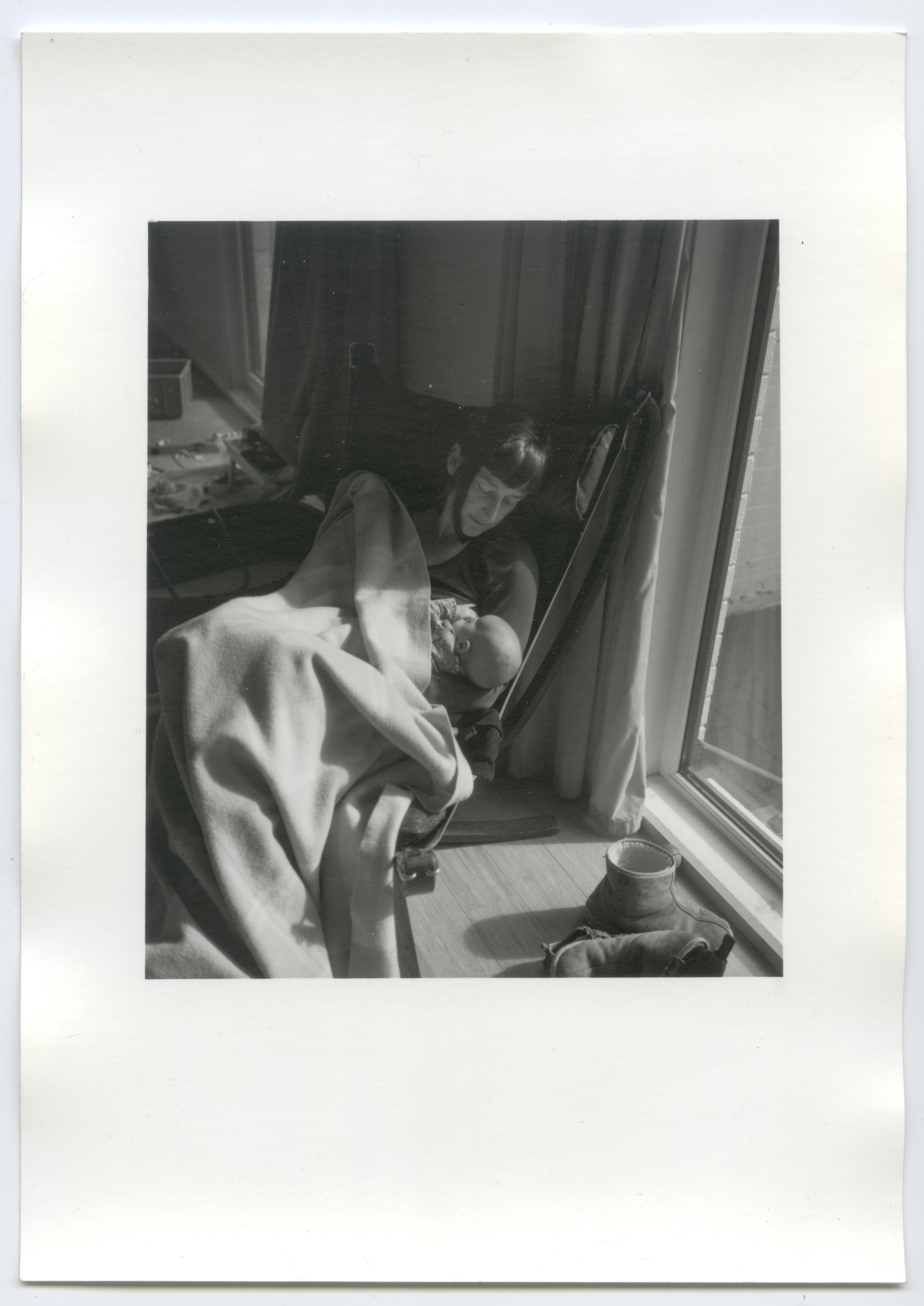
Originally a painter in his Belgian homeland, after moving to Australia in 2008 Van de Voorde found his creative sanctuary in photography – which he has suggested provides the advantage of speed over painting. The artist considers his adopted home country through his camera lenses. The photobook is a visual odyssey tracing the life of his family, starting from the birth of his son, Felix, and continuing to their most recent moments captured during a twilight walk on Cooleman Ridge, a nature reserve close to home. It reveals 10 years of the family’s shared experiences, organized chronologically.

C, F and F on Cooleman Ridge at Sunset, Wouter Van de Voorde, 2023

It is certainly not a traditional family photo album though. Members of the family have been photographed exploring parts of the land on which they live or are visiting for some reason. There are images where their faces are not visible, images taken in an ordinary backyard and others where family members might be seen as exploring a nondescript place. There are no photographs of the artist himself. Rather, his presence is evoked through his observations. Exploring the pages I sometimes wondered what I was looking at, or what the children were doing. All of this adds to the intrigue. His wife’s family lives at a considerable distance, his family on the other side of the world. The book reveals his immediate family’s shared moments in Australia.

A Ngunnawal elder explained to Van de Voorde how the land looks after people who live on or even just pass through it. He now has a clear understanding of how the land provides solace, nourishment, and a deep sense of belonging. The artist poetically explores this relationship, drawing parallels between a trig point’s archetypal house shape and the skeletal remnants of a house. He sees this as a metaphor for his family’s life - being inside a house without walls but feeling protected and cared for by the landscape.

C and F on Mount Arawang, Wouter Van de Voorde, 2023

The book’s design utilizes a horizontal layout folded in two. Opening the book at the central fold subverts the typical chronological flow, instead delivering a most Japanese approach to layout. I first saw the latest image, from September 2023, then read in reverse order. This folding technique enables juxtaposition of visual and natural patterns whilst challenging the conventional concept of time. You can get a great feel for the book at https://area-books.com/en/nucleo. As a bonus for purchasers, each copy of the book has a numbered print signed by the artist slipped into the front cover. And just look at this image showing something of the wonderful structure of the book:

At the local launch, O’Hehir suggested Nucleo is, a legacy for the artist’s children. She is right. This artist has assembled and shared a very successful portrait of his art and his family’s life.


This review is also available on the author's blog here.


Saturday, February 4, 2023

Death is not here

Photography Book Review | Brian Rope

Title: Death is not here

Author: Wouter Van de Voorde

Publisher: Void | Australian Distributor: Perimeter Books

Price: AUD$105

Format: Softcover with dustjacket

ISBN: 978-618-5479-25-1

Students of theology, medical practitioners, poets. All have reflected for centuries on the nature of death. Is it “good” or “bad”? A famous death poem often spoken at funerals, Death is nothing at all (Henry Scott-Holland), includes these words “It does not count. I have only slipped away into the next room. Nothing has happened”.

Death is not here, a new photobook by Canberra’s Wouter Van de Voorde, is a photographic reflection on the topic. Published by Void, an Athens-based independent photobooks publisher, last November, it has been reviewed and commented on by others on websites and in publications from various countries. Australian distribution commenced in January 2023.

It is, as other commentators have suggested, a mysterious book. It contains no words (in the traditional sense) other than a page of credits and minimal background – itself slightly intriguingly referring to the book as “This is not death”.

The book’s 160 pages are primarily filled with photographs, but also some delightful sketches of fossils. All images and drawings are by the author. Readers – yes, we are reading when we look at photos – are challenged to understand the author’s story for themselves. Or, perhaps, create their own stories about life and death from those images. Van de Voorde himself has written “A peculiar convergence of death/life and permanence/impermanence occurred during the period I made these images. 'Death is not here' is a personal time capsule capturing and preserving this time in my life.”

The subjects include ravens, dug holes, lumps of clay, rings of fire, curtains, a mother and newborn, sculpted pieces, an egg, plus dead or dying animals and plants.


© Wouter Van de Voorde -32 (raven on pole with fixer stain, 2021)

© Wouter Van de Voorde -30 (Round fire hole, 2021)

© Wouter Van de Voorde -33 (cracked egg on fossils sculpture)

But the subjects, per se, are not the story. Readers need to take up the challenge to explore and interpret what the images reveal.

In some ways, many photographs are so unlike it is difficult to see how they belong together. Every so often there is a blank page. For me, these said stop awhile, think about what you have read, review the material already seen before moving on. Some images may generate feelings of anxiety or be difficult to appreciate in the context of the whole story. Or you may simply not like them.

At the time of taking the photos, the author was about to become a father for the second time. He had been making still lifes with fossils.


© Wouter Van de Voorde -31 (mother and newborn)

When his son wanted to play a real-life version of video game Minecraft, they began digging in their backyard. The hole grew deeper and wider.


© Wouter Van de Voorde -29 (Felix and Leo playing with mud in the garden, 2021)

Van de Voorde began experimenting - drawing the outlines of holes with flames. Unearthing the grave of a chicken, bones visible, they harvested clay and used it to fire small objects, including a skull. Images of empty backyard spaces are interspersed with others of the artist's son in an eroded gorge. Were the father and son together exploring what lies beneath. Remember the supernatural horror thriller film of that name?


© Wouter Van de Voorde -34

The philosopher Epicurus famously asserted that death should not be feared. His argument has been summarised. When we die, we no longer exist and can feel neither pain nor pleasure. Therefore, there is nothing to fear in death, as death literally is nothing. Or, if you prefer - Don’t worry, as long as we’re alive, Death is not here!

But isn’t death everywhere? In Ukraine and other battlefields, in various Californian shootings recently, on our roads regularly when vehicles crash, sometimes in hospital operating theatres, in the funeral notices pages. The nature of death is highly variable. Despite Epicurus, many do fear it.

How do you perceive life and death?

This review was first published by the Canberra Times - online here and on page 5 of Panorama in the print edition of 4/2/23. It is also available on the author's blog here.

Monday, February 14, 2022

VIEW2022

Photomedia Exhibition

VIEW2022 | Annette Fisher, Catherine Feint, Fiona Bowring, Greg Stoodley, Isaac Kairouz, Izaak Bink, Jemima Camper, Tom Campbell, Wendy Dawes, Xueqin Yi

Photo Access | 4 February - 5 March 2022

This show features emerging, or re-emerging, contemporary photographers. Technically, an emerging artist – no matter how old or how long they’ve been at their chosen medium - has not yet been recognised by major critics, galleries and museums. More generally, the term tends to be used when artists have been practising for less than 10 years, haven’t been acquired by a gallery, and have a low profile in the art market. A re-emerging artist is one whose career was interrupted by circumstances and is now resuming. I understand one of these exhibitors is 80. Yes, artists can emerge at any age.

Ten photographers, each producing works in their own distinctive styles, using diverse materials and exploring many subjects. You might appreciate different artists/works than those that stand out for me. I am confident, however, that every gallery visitor will find delight here and enjoy contemplating all exhibits. 

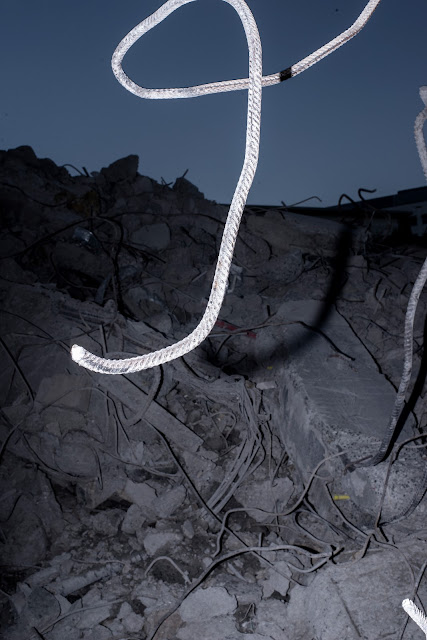
Accompanied by a video showing demolition, Annette Fisher’s powerful Demolition print captures light coming from the rubble, surprisingly revealing beauty in the site.


Demolition, 2021 – Annette Fisher

Greg Stoodley’s two Small Worlds prints delightfully reflect on how animals, in this case a cat, may be real supports during lengthy periods spent at home.


Cat TV, 2021 – Greg Stoodley

Isaac Kairouz’s Hek! BIDEO installation includes video, collage and painting. Each element needs to be explored individually, whilst the whole wonderful installation also needs to be contemplated in the context of the ways a person’s various social identities come together.


GolDen sHowASs, 2020 – Isaac Kairouz

Catherine Feint’s Childhood Home is a set of monochrome film shots of the house in which she grew up. The twist though is that they are actually photographs of her created cardboard models of the house. The quality of the shots is such that I did not realise that until reading the catalogue.


Figure 4 – Catherine Feint

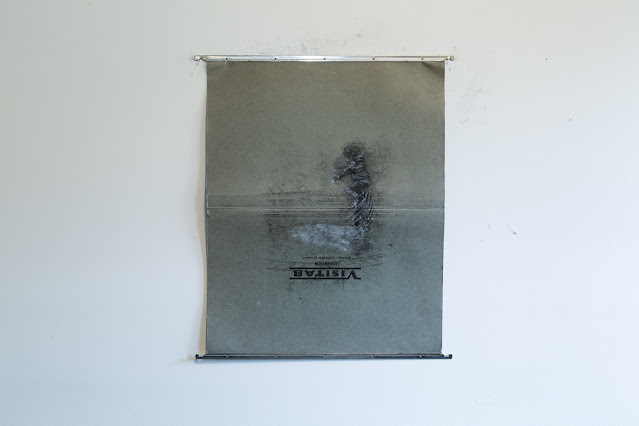
Suspension, by Wendy Dawes, also took me by surprise. The catalogue refers to the rotoscope technique and drawing on suspension files. I know of rotoscoping, but it did not occur to me that the reference to suspension files meant just that – two artworks have been created on those ugly holders that we suspend in filing cabinets to hold documents. A much more creative use!


Suspension Trampoline, 2021 – Wendy Dawes

Jemima Campey’s two related video works explore the growing use of scripted and performed apologies, designed to minimise damage to the person’s “brand”. We can all quickly bring to mind certain politicians.


Still from digital video Crocodile Tears, 2021 – Jemima Campey

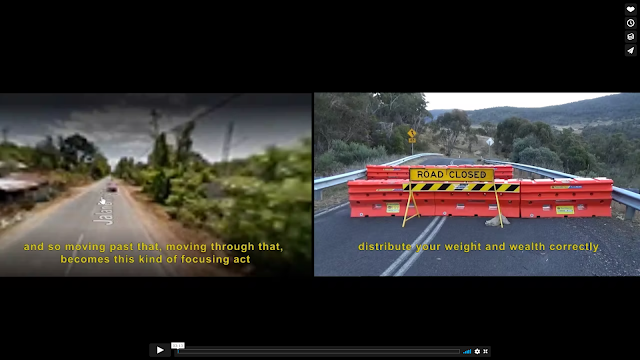
Tom Campbell’s split-screen video work tells two simultaneous stories, investigating the impact of border closures on our connections with places and family. I had to view this a few times to take in all the words on each screen but doing so reinforced the message.


Still from split-screen video – not that hill as a site of dominion 2021, Tom Campbell

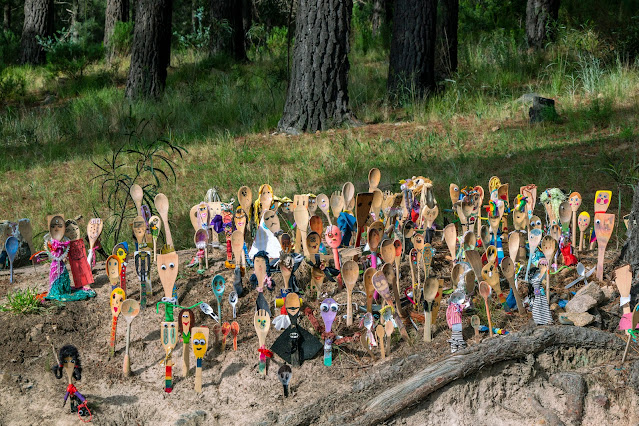
Fiona Bowring’s Spoonville is another quality print of a whimsical feature. Having seen this work previously on social media (as well as other folk’s images of other Spoonville installations) reduced its impact for me.


Spoonville-7719, Fiona Bowring

Xueqin Yi’s Plants Chant images resulted from using her camera to escape boredom and, so, becoming intensely interested in and gaining comfort from observing plants. There is much more than just plants in the images though, as she has included their, sometimes odd, surrounds.


Untitled, 2018 – Xueqin Yi

The catalogue says Izaak Bink’s I want you, because I can’t have you uses found images to draw attention to the exaggerated masculinity gay men can be forced to emulate – and forces us to ask, “whose place is it to decode this work?” Whilst not feeling any need to ask such a question, I nevertheless thoroughly enjoyed the graphic style of these two works.


Ride Em Cowboy – Izaak Bink

Thoughtfully curated by Wouter van de Voorde, this exhibition explores alternative processes and offers fresh perspectives on current issues, from early-career artists.

This review was published in the Canberra Times on 14/2/22 here. It is also available on the author's own blog here.