Showing posts with label cinema. Show all posts

Sunday, August 2, 2020

Australian movies, where to from here?


By Jane Freebury

It’s been a treat catching Gillian Armstrong on ABC TV’s Home Delivery this week. Her reminiscences of her student days in the early 1970s are a reminder that there once was a time when ‘there was,’ the celebrated film director pauses for emphasis, ‘… no Australian film’.

Could this conceivably occur again? There hasn’t been much this year.

When and on what platform will we get to view Babyteeth, The Dry, and the others pending? Screen Producers Australia say there are 120 projects impacted during the current health emergency.

Without ongoing government support for the exceptional creative talent that we have in the Australian screen industry, we will all be very much the poorer.

While Armstrong was at the Australian Film and Television School (now AFTRS), one among the first intake, an Aussie accent on screen was disconcerting, it was so rare, and local news was delivered in accents the BBC would have approved of.

Armstrong’s resolve to pursue a career in an industry that had not yet been established, is really admirable.

There were a few local films around, relating the sexual exploits of characters like Barry McKenzie and Alvin Purple, but two seriously powerful Australian stories by overseas directors appeared on screen in 1971. Walkabout and Wake in Fright still resonate today.

By the end of the decade, there were so many Australian films of fantastic quality, including Armstrong’s exquisite My Brilliant Career – that screened at the Cannes and New York festivals – that  the surge downunder was hailed as a new wave.

The first Mad Max, Picnic at Hanging Rock, Newsfront, Storm Boy, The Devil’s Playground, Long Weekend, Caddie, Don’s Party, and The Chant of Jimmie Blacksmith all appeared in the 1970s. Along with plenty of others well worth a mention.

The bilateral government support for a film industry that began in the late 1960s was realised by Australia’s screen industries, and they have continued going strong.

A stocktake of more recent films is very surprising and rewarding, a reminder of how richly we benefit from the film and television made in this country.

The 2000s kicked off with Andrew Dominik’s Chopper, based on a real-life criminal still serving time for murder. It certainly had impact, but I preferred the mockumentary indie about an underworld hitman that arrived a few years later from Scott Ryan, The Magician. It was cheeky, smart and less visceral.

Serenades, a dead-pan comedy from Shirley Barrett appeared the same year, with the tagline  ‘Two sisters will do anything to hook the right man’. It won a Camera d’Or at Cannes for best first feature.

Can it really be nearly 20 years since Lantana showed how subtle and compelling a local adult drama could be?  There was an abundance of talent involved on the project and it won many awards here and overseas, including a best screenwriter gong for Andrew Bovell. Director Ray Lawrence’s next film Jindabyne traced contentious territory but was also excellent.

Phillip Noyce’s The Quiet American in 2002 was given unaccountably short shrift by critics and audiences here, although it was a fine drama that captured the spirit of Graham Greene’s novel. I was glad to see it win prestigious awards in the UK and US.

The 2000s were an immensely productive time for writer-director Rolf de Heer, whose The Tracker with actor David Gulpilil in the lead appeared in 2002. It was quickly followed by Alexandra’s Project, a masterwork in the suburban thriller genre. His unique collaboration with the Yolngu people, Ten Canoes, audacious and whimsical by turns, was released in 2007.

Gulpilil’s performance was outstanding in The Tracker. He also had a small role in The Proposition, the brilliant outback western directed by John Hillcoat and written by Nick Cave that was released to general acclaim, though some took exception to the violence.

Did others take exception to the sex in Jane Campion’s psychological thriller, In the Cut? It certainly divided critics and audiences but this intense, sensual, psychological thriller deserved much more recognition than it received.

Rachel Perkins’ One Night the Moon appeared, as she was consolidating her career in Australian film and television. A collaboration with singer-songwriter Paul Kelly, it had a running time of under one hour but it was certainly compelling. In recent times, Perkins has directed the first season of Mystery Road and miniseries Total Control. Both exemplary TV drama.

Another Indigenous writer-director, Ivan Sen, arrived. His very impressive work includes the features Toomelah, Goldstone, and Mystery Road the film that inspired the popular television series of the same name. Sen made his fiction feature debut in 2003 with Beneath Clouds.

Australian comedy had an uneven run during the noughties but it doesn’t mean there wasn’t some first class work. Getting’ Square from Jonathan Teplitsky and Kenny by Shane Jacobson were equally hilarious.

The hard-to-pigeonhole asylum seeker drama, Lucky Miles, directed by Michael James Rowland, was a hoot. I also really enjoyed Ali’s Wedding, directed by Jeffrey Walker and written by Osamah Sami, very definitely a comedy, that was released in 2017. Sami has called it the first Muslim rom-com.

Teplitsky also had an international hit in The Railway Man, that elicited sensitive, intimate performances from major stars Colin Firth and Nicole Kidman.

Writer-director Sarah Watt Look Both Ways, also about a couple dealing with trauma, was a miniature in comparison, and beautifully rendered at that.

Jane Campion’s Bright Star appeared in 2009 to a lukewarm reception. I thought it terrific though I’d admit to being a bit of a die-hard when it comes to this filmmaker.

I was also hugely impressed that same year by Rachel Ward’s Beautiful Kate, an intense, disturbing family drama in the gothic style.

And in 2014, The Babadook announced a bold new talent in director Jennifer Kent. It’s held in very high esteem by cinema horror cognoscenti. I just thought it was one of the most effective scare fests I’d ever watched.

Director Jocelyn Moorhouse returned in 2015 with The Dressmaker, an outback western in which a stranger arrives in town with a sewing machine on her hip. It’s a flamboyant revenge comedy drama that, for all its colliding elements, works brilliantly.

That same year, George Miller took us on another exhilarating journey into the post-apocalyptic desert in Mad Max: Fury Road. It won wild praise from many critics and now holds the record for achievement by an Australian film at the Oscars, bypassing the previous record held by Campion’s The Piano.

Lion, directed by Garth Davis and based on a screenplay by Luke Davies and with a wonderful performance by Dev Patel, was another huge success here and overseas. Who didn’t love this film?

Another home grown favourite of the 2010s was The Sapphires. Impossible not to respond to its bouncing with irrepressible joy.

The 2010s have also seen the emergence of David Michod as a major creative talent. His pitch-black crime-family drama, Animal Kingdom, shook us up and launched the international careers of Ben Mendelsohn and Jacki Weaver. Michod’s The King last year was equally impressive.

Although there are so many contenders, my pick for the most outstanding Australian film of the last two decades has to be Warwick Thornton’s Samson and Delilah. When I reviewed the film in 2009 I wrote that it announced a major new talent and could be come a modern classic. I think, as it turns out, that was the right call.

First published in the Canberra Times on 4 July 2020. Also published on Jane's blog

Featured image: Rowan McNamara in Warwick Thornton's Samson and Delilah (2009) 


Friday, January 10, 2020

PORTRAIT OF A LADY ON FIRE


M, 119 minutes

5 Stars

Review by © Jane Freebury

A boat with a young female passenger on board makes its way along a rocky coastline. When a piece of luggage falls overboard she jumps in to rescue it, petticoats, boots and all. It might have been end of story in late eighteenth-century France where this film is set but, surprisingly, she can swim.

Artist Marianne (Noemie Merlant) is on her way to take up a new commission, painting the portrait of a young aristocrat who lives in a chateau on an island off Brittany. The new client, the Countess (Valeria Golino), needs a likeness of her daughter Heloise (Adele Haenel) to send to a prospective husband, a Milanese nobleman, so the wedding can go ahead.
it's not possible to watch this ravishing period piece without thinking of The Piano, but there are significant differences
An arranged marriage in times past, stirring scenes on a beautiful, empty beach, a woman who expresses herself in the arts. It’s not possible to watch this ravishing period piece without thinking of Jane Campion’s The Piano. But there are significant differences. This is a love story between two women, and as the filmmaker points out, they are equals.

Correcting the pose: Heloise (Adele Haenel) on left and Marianne (Merlant)

It seems to me no accident that the writer-director, Celine Sciamma has set her story before the onset of the French Revolution, at a liminal moment for freedom and equality. She makes nothing of it, however.

Heloise, just out of a convent is refusing to marry, and she won’t cooperate for any portrait because the result will be marriage. Marianne learns that her elder sister didn’t wish to marry the Milanese nobleman either, and it seems she took her life on a walk along the cliff edge.

With instructions from the Countess to become her daughter’s companion, Marianne spends her days observing Heloise and taking mental notes as they go on walks together. She then paints by candlelight in the evening.

With little else to do but walk, talk and read, a relationship begins to develop between the artist and the aristocrat. In particular, they love to read and re-read the myth of Orpheus and Eurydice, wondering about the motivations behind the tragic ending.

Although Heloise becomes aware of the deception she agrees to be painted anyway and during the sittings the two women spar, circle each other and eventually fall in love. The scenes as their relationship develops are exquisitely written by Sciamma, who won best screenplay at Cannes.
men are scarcely present, though still operating outside the frame
We don't see much of men here. After Marianne's arrival at the isolated castle, they are scarcely present though they are still operating outside the frame. Like the Milanese nobleman directing events from afar, or the local swain who has made the diminutive maid, Sophie ( Luana Bajrami), pregnant.

The absence of men allows Portrait to concentrate exclusively on a world of women in which the female sensibility and solidarity rules. It is expressed with intensity one evening when Marianne and Heloise join a group of local women gathering in the fields around a bonfire. It isn’t really clear what the gathering is about, but when the women join in an exquisite capella chorus and sing in Latin, it becomes a moment of surreal beauty and a celebration of feminine unity.

The painterly imagery is beautiful if rather stern and uncluttered and the soundtrack, with little music, is simply content to heighten the realism of the domestic world the women inhabit, with its crackling hearth and rustling, breathy silences. It is all the more powerful for it, more than making up for the minimalism with a few sublime musical moments like the ethereal capella singing.

On another occasion we hear ‘Summer’ from Vivaldi’s Four Seasons when Marianne bumbles through it on a harpsicord. She doesn’t do it  justice, but the scene lays the foundation for the amazing and intense concert finale.

the sea plays its part: can Heloise (Adele Haenel) swim too? 

This intelligent and sensuous film is special. An intimate and delicate study of how two people can fall in love. Marianne and Heloise could be any two individuals who fall in love, and the world that their story builds is rich reward to those who are willing to enter.

First published in the Canberra Times on 29 December 2019. Also published on Jane's blog

Sunday, January 5, 2020

SORRY WE MISSED YOU


MA 15+, 100 minutes

3 Stars

Review by  © Jane Freebury

Ken Loach is into his 80s now, still powering on as a firebrand for social justice with films about ordinary people up against the system. He has been an activist all his life, from the theatre, to TV to the cinema. No story has been too big or too small, as long as it got the point across.

Director Loach and his frequent collaborator and screenwriter here, Paul Laverty, have a reporter’s instinct for the social realist stories that will expose injustice and tell it how it is. They are directed with a naturalistic aesthetic as though they were the unvarnished truth, just like documentary.

There have been exceptions, like the charming love story Ae Fond Kiss and hallucinating soccer fandom in Looking for Eric, but Loach is strict with himself and likes to keep clear of indulgences that filmmakers allow themselves with sound, or music or special effects.

When he won the Palme d’Or at Cannes a few years ago for I, Daniel Blake, it was the second time he had received the honour. The first was a decade earlier for The Wind That Shakes The Barley, set at the time of Irish independence and the ensuing civil war.

on the other side of the desk sits Gavin who is right across hollow management­-speak

If the accolades in 2016 were like the culmination of a life’s work for Loach, and the moment to put his feet up, he didn’t. The gig economy is upon us and he has found that there is still no time to rest, and with this painful and touching story about a delivery van driver and his family, it’s hard not to agree. Like I, Daniel Blake, it’s set in Newcastle, England.

Vindaloo for dinner: (from left) Ricky (Kris Hitchen), Liza Jane (Katie Proctor), Abbie (Debbie Honeywood) and Seb (Rhys Stone) 

From the moment Ricky Turner (Kris Hitchen) has his interview to join parcel delivery company PDF as a courier, it is impossible to imagine that things could go well for him. Predictability in the narrative is the big problem here.

On the other side of the desk sits Gavin Maloney (Ross Brewster) who is right across hollow management­-speak. Ricky won’t be working ‘for’ PDF, he’ll be working ‘with’ them. As an owner-driver he will get a ‘fee’ for his services, rather than a wage, but it’s all spin that hides the fact that Ricky has to put $1,000 down on the van he will drive, work 12 hour shifts during which his movements will be reported by his tracker or ‘preciser’, and he will be treated as though he has no life outside work.

To get set up with the van, Ricky and his wife Abbie (Debbie Honeywood) must sell the car that she relies on for her work as a home-care nurse. She sees elderly clients who are difficult to manage, and now she has to take the bus. The upshot is a lot less family time with their teenage son Seb (Rhys Stone) and 11-year-old Liza Jane (Katie Proctor).

 in between sounding like a man and looking like a boy, Seb appears set to inherit his father’s disadvantage

This saddens Liza while it angers Seb. He skips even more school and spends even more time on his graffiti rounds. Of all the family members impacted by Ricky’s job, it is Seb’s plight that speaks the loudest. Caught in between sounding like a man and looking like a boy, Seb appears to be heading out of school without quals, and set to inherit his father’s disadvantage.

It’s a relief when the gloom and mounting tensions clear once in a while. With a family get-together over a takeaway curry when a vindaloo gets the better of Ricky, and when proud dad takes his daughter along on his delivery rounds. It is, however, only a temporary diversion with a trajectory primed from the start. There are few energising surprises for audiences here.

Were Loach to be anything other than true to his socialist worldview, we would be surprised, and he’s hit on a rich, new seam here with people like Ricky who are entrapped on the service economy roundabout. It also shows how, in a wider sense, workers with pride and aspiration can get crushed by an automated system which elides rights and entitlements, operates strictly by the book, and refuses to acknowledge that ‘service providers’ have a life and responsibilities outside work.

Sorry We Missed You has that blunt urgency Loach often displays, but his actors are very good, and with this forensic job on the system, he has made his point.

This review, first published in the Canberra Times on 31 December 2019, is also published on Jane's blog
  • Featured image: a lighter moment for Ricky (Kris Hitchen) and daughter Liza Jane (Katie Proctor)

Thursday, December 26, 2019

MARTY SCORSESE AMONG THE SUPERHEROES


The director's director up against the comic book heroes

By © Jane Freebury

Every city has to have one. A film festival.

Just about every region on earth hosts a film festival, including Oceania where there’s one for very short films in Vanuatu, and one for documentaries in French Polynesia. Antarctica has claimed one too, for filmmakers ‘left out in the cold’.

The festival and the space it makes is great for film creatives to open, and say what they think.

Film festivals happening everywhere yet superheroes dominate box office

Fall in the north marks the start of the season of international film festivals. Venice, Montreal and Toronto have been and gone, and New York and London have recently wrapped. It’s different Down Under, of course, where the superhero movies are out in force at the same time as the venerable big two, Melbourne and Sydney.
In 2019 movie studios outdid themselves, again, as Avengers: Endgame, from Marvel Cinematic Universe, became the highest grossing film of all time
The names of marquee events roll off the tongue. It’s no surprise that the United States has the most, Seattle, Sundance, Telluride, Tribeca, SXSW and all the rest. Making movies on an industrial scale began in New York, before the entrepreneurs decamped to the West Coast for the sunshine and freedom from interference, from where today they still dominate the international box office.

Despite it all, the festivals known as the big three - Berlin, Venice and Cannes - take place over on the other side of the Atlantic. In Europe, filmmakers have more scope to make movies the way they want to, putting a stretch of ocean between themselves and the home of blockbusters.

This year the movie studios outdid themselves, again. In 2019 Avengers: Endgame, from Marvel Cinematic Universe, broke box office records to become the highest grossing film of all time, beating Avatar and Titanic. Its sister film, released last year, Avengers: Infinity War is the fifth highest earner ever, and one of a handful that have grossed in excess of two billion in cinemas worldwide.

After endgame and apocalypse, where to from here?

This year the movie studios outdid themselves, again. In 2019 Avengers: Endgame, from Marvel Cinematic Universe, broke box office records to become the highest grossing film of all timesuperhero apocalypse of endgames and wars into the ever after has won, hands down, but, honestly, where to from here?

Before this century when they began to appear in earnest, the movie superhero made an occasional appearance. Their goofy, impossible heroes could be treated with indulgence, but the explosion in pseudo-serious superhero in the 21st century is something entirely new, where plot and character driven by technology rather than story-tellers interested in human drama.

Why so? It’s a question for the sociologists, but interesting that they first appeared early in the early years of the Second World War when superheroes like Superman, a Batman, and Captain Marvel joined the war effort, one way or other.

As another summer of blockbusters draws to a close, the guardians of film culture have the opportunity to nurse serious cinema back to health. With injections of new work by the ingenue directors, with a selection of classics digitally restored, and with the latest work from the established auteurs.

Martin Scorsese On The Tonight Show with Jimmy Fallon in 2014

The red carpet rolls for films in competition, fans throng to see the talent in the flesh, and cineastes hang out to hear what the filmmakers have to say for themselves. This year we have heard from Martin Scorsese, whose new film The Irishman opened the festival in New York (that I was able to attend in 2019), and closed the festival in London.

It is a rare treat to hear from filmmakers directly. Too often, new work is introduced to us by the marketers, by the jargon of the business, or by fragmented reviews that try to tell a complimentary story. When filmmakers with serious intent articulate what they were doing in their own words it is an altogether different matter.

A new outing from Martin Scorsese, generally considered one of the world’s greatest living directors, is a big event in any filmgoer’s calendar.

His Irishman takes place in New York, of course. The city that has been the set for more film and television than any other in the world, where, on any given day, New Yorkers can feel that they are on a film set. They can play it up and revel in the theatre of life in one of the world’s great megapolises, or play it down.

In an interview with Empire magazine at the time, Scorsese was drawn on the subject of superhero movies. The living godfather of modern cinema said what he thought, and then doubled down on it in London.

He had tried to watch them, really he had, but found he couldn’t. They were theme park experiences, they were not cinema, didn’t tell stories, and didn’t communicate emotional and psychological experience. With that, Scorsese drew a line in the sand.

The superhero movie industry may not much like what he said. Some like New Zealand director, Taika Waititi, who had the helm for Thor: Ragnarok and will direct Thor: Love and Thunder), have spoken up. Of course it’s cinema, you see it at the theatre, don’t you?

Fans of superheroes won't be bothered, though they did Scorsese in media studies
Fans of the genre may not be much bothered by Scorsese’s views, even though his classics such as Raging Bull, The King of Comedy, Cape Fear and The Departed will have been on their media studies curriculum.

Waititi is of course also the creator of the terrific indie hit, Hunt for the Wilderpeople. It has been an interesting crossover. Why did the moguls ask him to direct? What were they looking for?

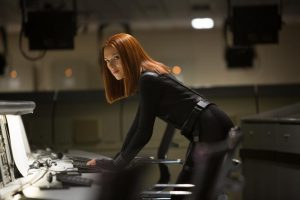
Scarlett Johansson in Captain America: The Winter Solder (2014)     
Image courtesy Marvel Studios

He is not the only one, either. Talented indie writer-director originally from Canberra, Cate Shortland (Somersault, Lore), has also been scooped up by the superhero industry. She is directing MCU’s Black Widow with Scarlett Johansson and Rachel Weisz, due out next year.

In interview, Scorsese is a beguiling, mild-mannered man. Mild mannered for a man whose powerful, disturbing and beautifully made films about brooding, conflicted men have shaken us up, and he has stuck his neck out here.

The Irishman, a three hour thirty minute epic delving into the familiar subjects of organised crime, family and corruption, and is distributed by Netflix, the movie juggernaut for the small screen. The director’s latest film has benefited somewhat from this behemoth and other developments, like ‘de-aging’ visual effects, but no one could counter that his films skate the surface.

Reporting what Scorsese thinks about the competition at the box office for the movie dollar is a bit of a beat-up, but sincerity is a powerful tool these days. After all, there is only that much that you can say about movie superheroes, hey.

First published in the Canberra Times on 15 November 2019. Also published on Jane's blog

* Featured image: Chris Hemsworth in Thor (2011)

Monday, November 25, 2019

THE REPORT


M, 120 minutes

4 Stars

Review by © Jane Freebury


The missing middle word in the title of this strenuous and thoughtful film is torture. The inconvenient truth of it redacted, just like the videotape records of CIA ‘enhanced interrogation techniques’ destroyed in the years after September 11.

No, not a spoiler. Just letting you know about the really unsavoury backstory to this 7,000 page report into CIA activities.

Based on real events post 9/11
Based on real people and real events, The Report is about how researchers working for the Senate Intelligence Committee compiled an official report inhouse into the methods used by the government’s intelligence agency while interrogating terrorists and terror suspects detained after 9/11.

A lot of young Americans stepped up to join the defence forces or otherwise help after that national catastrophe, including a young graduate student, Daniel Jones (Adam Driver), who switched his studies to security overnight.

the real Dan Jones has set up an organisation to promote transparency and good governance internationally

As a young everyman who wanted to help protect the homeland, Driver is an inspired choice. We already had him pegged as an engaging, versatile and intelligent actor, and though we get to see little other dimension to his personality outside of work, he is always interesting to watch.

Adam Driver as Dan Jones
Late in the piece we see him jogging through a Washington park, and that’s about it, but Driver is a nuanced and expressive actor as the bureaucrat whose job became his all.

Incidentally, the real Dan Jones has left the public service and set up an organisation to promote transparency and good governance around the world.

As a Senate staffer, Jones led the team investigating the CIA use of torture in the wake of 9/11. It may well have been the last thing a patriotically inclined young citizen sought, but he was lucky to be under the guidance of Senator Dianne Feinstein (Annette Bening), an admirable, thoughtful and supportive boss. After a long a distinguished career, the real Feinstein is the oldest serving member of the US Senate.

CIA videotape records had been disappeared
The tapes of interrogations had been disappeared or destroyed, but, incredibly, the written records still existed, and it was these that Jones and his tiny team trawled through for years to come up with the facts. It was no easy job. They had to face bureaucrats disinclined to help, or simply resistant, and work in the windowless bowels of some departmental basement.

When has torture ever worked? Did it ever work in Vietnam or South America?

What they found on the page is translated to scenes that are mercifully short. Feinstein and the team found themselves asking if torture ever worked. Did it ever work in Vietnam or South America? The film leaves you in no doubt, and has a dig along the way at Zero Dark Thirty for concluding that it had led to Bin Laden.

If waterboarding works, then why was it necessary for a prisoner to undergo it 183 times, Feinstein asks. A reasonable question, no one had thought to ask it of the two contract psychologists who were freelancing its use. This notorious method and mock burials and the rest has become ‘a stain on the values and history’ of the US in the years since.

The Report is written and directed by Scott Z. Burns, whose writing credits include The Bourne Ultimatum, Side Effects and will soon include the new Bond film, No Time To Die.

Despite the welcome presence of Bening, there is nothing glamourous to this shadowy world of intelligence gathering. With its chilly palette and serious, weighty tone, The Report is in the tradition of work in the wake of the Watergate scandal, like All the President’s Men, and after the release of the Pentagon Papers (on US involvement in Vietnam), like The Post.  Typically, it’s mostly chilly interiors and the forbidding facades of impenetrable Washington government buildings in the frame.

A stain on American history and values
When the report is released, other senators, including the late John McCain, (famously a former long-term prisoner of the North Vietnamese) lend their support to it and condemn the use of torture, and its stain on American values and international standing. The noticeably warmer glow in the frame at this point, is unfortunately undercut by some final revelations.

This is smart stuff, wordy and engrossing - and non-partisan - with a great message for governments to own their mistakes. It can feel like sitting on a jury, listening to the arguments back and forth, but in the final analysis, The Report is in no doubt about the position it takes.

First published in the Canberra Times on 17 November 2019, and also published on Jane's blog


PAIN AND GLORY


Eduardo (Cesar Vicente) with young Salvador (Asier Flores)

MA15+, 114 minutes

5 Stars

Review by © Jane Freebury

The actor Antonio Banderas and director Pedro Almodovar first worked together in the 1980s and helped make each other famous with sexy, taboo-breaking films like Law of Desire, Women on the Verge of a Nervous Breakdown, and Tie Me Up! Tie Me Down! It was the post-Franco era in Spain and time to tear down decades of fascist repression.

Pain and Glory reflects on the central relationships in Salvador’s (Banderas) life – mother, lovers and actor collaborators. It’s a very personal collaboration between the actor and filmmaker, like a confessional from a couple of famous men of the big screen.

We first see Banderas, as successful film director Salvador Mallo, holding a pose while meditating at the bottom of a swimming pool.  The watery world draws memories of his early childhood to the surface, memories of laundry day at the river’s edge with his young mother (played in these scenes by another Almodovian muse, Penelope Cruz).

A gift for directors, fromTarantino to Almodovar, Banderas has had health issues of his own
As he catches up with an old friend, Salvador reveals that he has stopped writing and directing. Her surprise that he, of all people, has become reclusive and inactive, is a clue to the kind of person he was.

In later flashbacks, while in conversation with his elderly mother, he listens in such a touching way to her complaints that he disappointed her. Later, in a sweet scene between Banderas and Julieta Serrano, who plays Jacinta in her old age, she explains exactly how she wishes to be laid out when she dies.

In conversation with his long lost friend, Salvador recounts his various ailments, a list of enemies within that have beset him. His asthma, headaches, tinnitus and the sciatica that has given him a bad back. It’s a scary anatomical collage of medical imagery, almost as arresting as the opening titles over melting images that turn from solid to liquid before our eyes.

The state Salvador is in is a million miles from the irresistible hunk Banderas played in Almodovar’s early films, or from the swaggering hero he has played in Hollywood.

Another key relationship, not so explicitly referenced, is with the gay lover Salvador had when they were young men, before Federico (Leonardo Sbaraglia) left for Argentina and took a wife. The scenes between them 30 years later at Salvador’s apartment in Madrid, including the prominent kitchen with its bright red cupboards that looks a lot like the director’s own, are lovely to watch too.

Yet another key relationship is the actor Alberto (Asier Etxeandia) from whom Salvador has also been estranged many years. Both Etxeandia and Sbaraglia give terrific performances too.

Handsome, tousle-haired, with a shy twinkle in his eye, Banderas has always been a welcome sight on screen. A gift for directors, from Quentin Tarantino to Almodovar, looking for a swashbuckler with devil-may-care (Desperado) or for a man for women to desire. Yet, here in Pain and Glory the presence we became used to is barely present. Banderas has been chastened by a real-life health issues of his own – a recent heart attack.

These life stories of these two creative collaborators, the film director and his alter ego, wind around each other like a double, double helix. Except that Banderas isn’t gay.

Almodovar's witty, naughty, exuberant early work has developed and matured

It is like two of them put their heads together to create an intelligent, amusing and moving film with deep meaning for them both. Their energy coalesces around the wonderful performance that won Banderas the best actor award at Cannes earlier this year.

Salvador (Antonio Banderas) and Alberto (Asier Etxeandia)
Since I became captivated by Almodovar’s witty, naughty, exuberant early films, he has remained one of my favourite filmmakers. All the while, his distinctive filmmaking - Volver and All About My Mother and Talk to Her among his best - has evolved, developed more depth and matured.

It isn’t surprising to hear in interview that another key relationship in Almodovar’s life has been the cinema, the world in which he says he still lives today. It’s a place of warmth and sensuality, of wit and wisdom, and as we see here, not without regrets.

Pain and Glory is a superior work from Pedro Almodovar with an intensely sensitive performance from Antonio Banderas. Both men may have been the bad boy and seen it all, but we didn’t know about this gentle, reflective side deep within.

First published in print and online by the Canberra Times on 9 November 2019, and also published at Jane's blog


Thursday, November 7, 2019

BALLOON


M, 125 minutes

3 stars

Review by © Jane Freebury

This is the story of two young families, the Strelzyks and the Wetzels, and a brightly coloured hot air balloon. It’s fantastic but true that in 1979 they used one to escape from East Germany, the former GDR, a daring act that lends new meaning to the image of balloons aloft.

On a September night when conditions were right, a balloon with eight on board, four adults and four children, drifted across the border into Bavaria. It flew at a height above 2,000 metres, high enough to be detected but not identified and out of reach of the guns of border guards. It landed just over the border.
East Germans who left were by definition enemies of the state
Before the Berlin Wall was torn down 30 years ago, the news about people being shot by East German border guards as they tried to escape to the West was a regular occurrence. After this, the revelations about the activities of the Stasi, the Communist regime’s secret police, were just about as bad.

Gunter Wetzel (David Kross) in a race against time

East Germans who took it upon themselves to leave were by definition enemies of the state, to be ‘apprehended or liquidated’. It’s ironic that as she and husband, Peter (Friedrich Mucke), are  on the point of leaving their home in the GDR forever, young wife and mother, Doris Strelzyk (Karoline Schuch), tidies up before she turns to leave. Says she can’t bear to be thought of as a bad housewife once she has gone, but she is destined to be thought of as far, far worse.

The incredible escape story has been made into a film before so I went along thinking it might have already had its day. Disney released Night Crossing with British actor, the late John Hurt, in 1982, just a few years later. But as I watched this German-language drama unfold, I came to think about its relevance differently.

It’s no spoiler to acknowledge that the families made it. That’s well known. It’s the journey that counts here, and knowing the ending doesn’t detract from this well-constructed and tense drama about a highly improbable flight to freedom from a totalitarian regime.
Get out or get arrested, there was no alternative
However, when they realise that the Stasi will discover Doris’ medication in the balloon’s wreckage and eventually be able to trace them, and when Gunter Wetzel (David Kross) and his family realise they have also been compromised, it becomes a matter of urgency. Get out or get arrested. There was no alternative but to start again.

Buying vast quantities of fabric,  some 1,300 metres, is difficult without inviting curiosity. Just how many tents or flags could you claim to be making? Then there’s the challenge of sewing it together and giving it a test run on the quiet somewhere. The odds against getting the work done and kept a secret from small children, nosey neighbours and government spies alike, were huge.

Actor Thomas Kretschmann, seen in American action films and on TV in Berlin Station, is the Stasi lieutenant in charge of operations to track down the elusive balloonists. His character’s moral complexity suggests Balloon could have been taken in an even more interesting direction had it played the story less for its action and thrills and more for its political and psychological drama.

Still, it’s a remarkable story about the lengths people will go to, for freedom.

Balloon is directed by Michael Herbig, a well-known German comedian and director/producer, who co-wrote the screenplay with Kit Hopkins and Thilo Roscheisen. It is a gripping drama with solid lead performances about a crazy-brave feat of courage.

A version of this review was first published in the Canberra Times on 3 Nov 19. It is also published on Jane's blog