Saturday, November 20, 2021

Congruent - Incongruent

Photography and Art Exhibition Review | Brian Rope

Eva van Gorsel and Manuel Pfeiffer | Congruent - Incongruent

M16 Artspace | Until 21 November 2021

Eva van Gorsel is a photographer who uses numerous diverse techniques and approaches to create varied, interesting imagery - her background in environmental sciences and scientific photography always there. Her imagery here does not disappoint. As usual they are excellent artworks, pleasing to look at, contemplate and think about.

Manuel Pfeiffer is a painter who uses an extensive range of materials, including acrylics, pencils, charcoals and much more. His works here are of mixed media, including acrylics, pencils, even plaster of Paris. They are equally pleasing to explore.

The gallery sheet informs visitors that these artists feel our lives have changed, that harmony has been disrupted by climate change and pandemics globally. Few would disagree. The artists suggest many of us have been striving for balance more consciously - in our friendships and workplaces, and in how we interact with our environment.

Here was their starting point to create an exhibition addressing congruence (in agreement or harmony) and incongruence. The artists have creatively investigated their concept, exploring balance, harmony and disharmony, symmetry and asymmetry.

They have also used the mathematical concept of congruence – figures, identical in form, coinciding exactly when superimposed. In geometry, two figures or objects are congruent if they have the same shape and size, or if one is a mirror image of the other.

So, in these works, we see reflected, rotated and translated shapes and lines overlaid on a variety of landscapes. Whilst art lovers generally enjoy the aesthetics of congruent images, they also do not mind some tension – it keeps us looking and exploring the artwork.

The depicted landscapes are from diverse Australian places, including New England, Lake Burley Griffin, Kosciusko, Cocoparra National Park, the Flinders Ranges, and the Devils Marbles. They include mountains and seas, sunrises and night times. Some include circular shapes that may be either the sun or the moon – or something else?

Van Gorsel has an interest in how colour and geometry shape landscapes. She examines moods created by warm and cold colours, the direction of light and how it changes, transitioning colours painted on skies or reflected in water. Here, her diptychs are congruent - despite focussing on contrasting concepts. They are displayed as pairs of works side by side. All the images are based on photography. Each panel is the same size, each is a pigment ink print on archival paper.

Her Mountain Ranges diptych shows the same scene overlaid with the same triangles and lines – each a reflection of the other, one warm toned, the other cool.
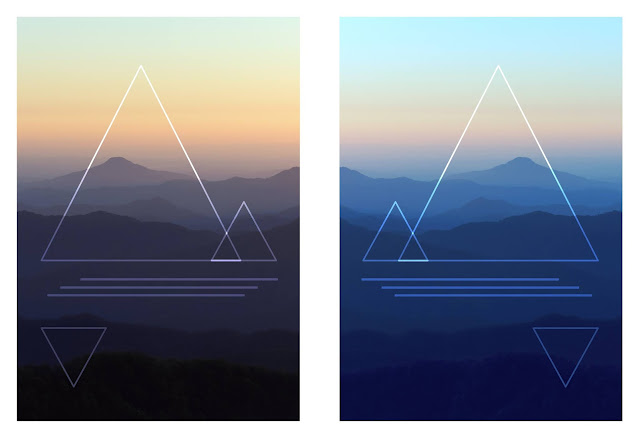

MountainRanges i & ii © Eva van Gorsel


And the two images in her Lake Lights diptych are again reflections of each other, except that the circle in each varies in density or hue.


Lake Lights i & ii © Eva van Gorsel

Pfeiffer’s works are, on the one hand, based on incongruence: every diptych, in itself partly congruent, is different in technique and the materials used reflect the wide variety of possibilities available to artists. On the other hand, all works are of the same size (some in portrait, others in landscape format) and mounted the same way, in the mathematical sense of the word congruent.

The left-hand side of his Lake Burley Griffin diptych is a monochromatic version of the coloured and inverted right hand side.
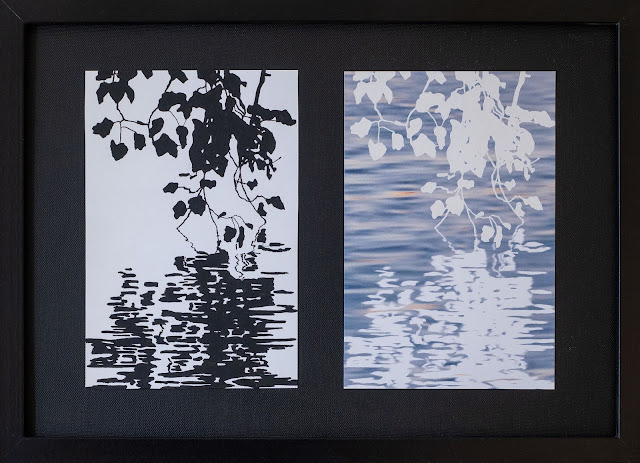

Lake Burley Griffin © Manuel Pfeiffer


View From Cocoparra is presented in an analagous way but is much more graphic with delightful contour lines and a simple and subtle tree.
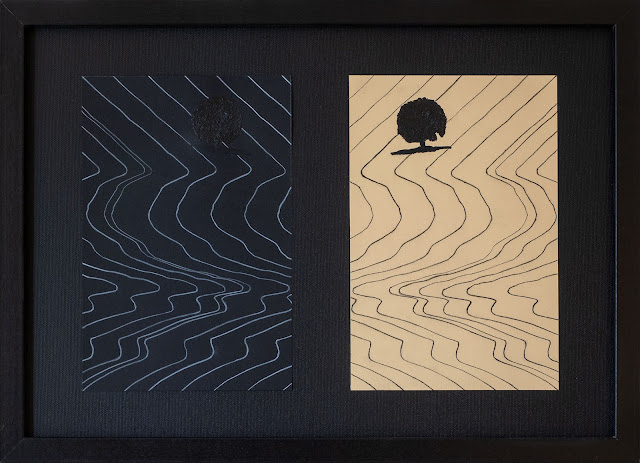

View From Cocoparra © Manuel Pfeiffer

Two sets of works play off each other perfectly. These artists have again produced a fine exhibition as they did with their previous joint show Facets in 2020.

This review was published in the Canberra Times of 20/11/21 here and on the author's blog here.

Thursday, November 18, 2021

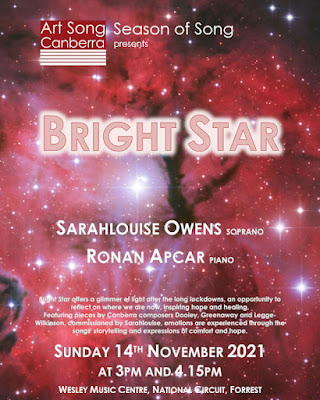
BRIGHT STAR - ART SONG CANBERRA

Sarahlouise Owens, Soprano

Ronan Apcar, Piano

Art Song Canberra

Wesley Music Centre, Sunday 14 November


Reviewed by Len Power


For the first concert after the Covid lockdown, Art Song Canberra presented soprano, Sarahlouise Owens and pianist, Ronan Apcar, at the Wesley Music Centre in Forrest in “Bright Star”, a concert of songs by living Australian composers.  Two of the composers, Michael Dooley and Margaret Legge-Wilkinson were present at the performance.

Sarahlouise Owens explained at the start of the concert that the songs had been chosen in a spirit of optimism and hope at the end of the lockdown.  They promoted connections with each other and the environment and a sense of looking forward as life goes on.

The first song, “Hymn To The Trinity” by Michael Dooley was a sensitive work with a Christian message that we are all one and need to unite in brotherhood.  Sarahlouise Owens sang it with warmth and clarity as well as a restraint that nicely underlined the emotions in the song.  There are some especially beautiful melodies in this work and they were well-played by pianist, Ronan Apcar.

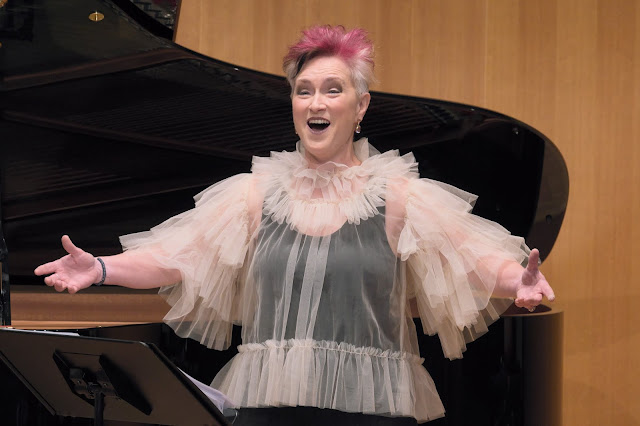
Sarahlouise Owens


The second work, by Margaret Legge-Wilkinson, was “Girls And Horses In the Fire”, based on a poem by Lisa Jacobson, written in a response to the Black Saturday bushfires of 2009.  This highly dramatic work full of intense emotions was very well sung by Owens and there was notably fine piano playing of the challenging score by Apcar.

Michael Dooley’s “Bright Star”, based on the poem by John Keats is a hauntingly beautiful work.  The music brings out the sensitivity of the words perfectly and it was given a luminous performance by Owens and Apcar.

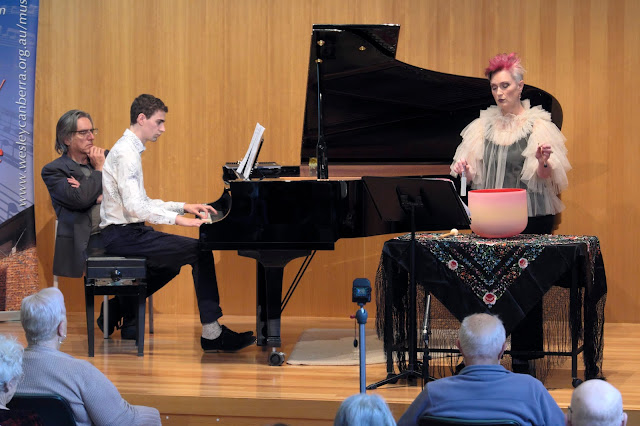
Sally Greenaway’s “Cocooned For Breathing” was an unusual work for soprano, piano and singing bowl.  The bowl was played by Sarahlouise Owens while she sang.  The sounds produced by the bowl give the work a meditative quality and the overall effect of voice, piano and bowl was haunting and ritualistic.  It was an excellent performance of this unique and memorable work by the Canberra composer.

Ronan Apcar (piano), Sarahlouise Owens


The final work, “To A City Cousin”, by John Martin celebrated the environment and was given a joyful and sunny performance by Owens and Apcar.  For an encore, Sarahlouise Owens gave a sensitive, heart-felt performance of the Irish song, ‘Bonny Portmore’.

This was a performance where all the elements came together especially well.  Ronan Apcar played superbly, Sarahlouise Owens sang beautifully and really connected with her appreciative audience.  It was a highly memorable concert.

Photos by Peter Hislop 

This review was first published in the Canberra City News digital edition of 15 November.

Len Power's reviews are also broadcast on Artsound FM 92.7 in the ‘Arts Cafe’, ‘Arts About’ and ‘Arts Starter’ programs and published in his blog 'Just Power Writing' at https://justpowerwriting.blogspot.com/.


Wednesday, November 17, 2021

REMEMBERING THE STAGE MAGIC OF BRIAN SUDDING.


By Bill Stephens

With the passing of Brian Sudding last week, the Canberra theatre community lost a passionate creative artist who devoted a lifetime to the art of creating stage magic, and who throughout his career designed no fewer than 77 stage productions.

Born in Southern Rhodesia in 1939, Sudding's design career started as a display artist. His interest in theatre was piqued by his involvement with the Bulawayo Children’s Theatre and a production of a Christmas pantomime, “Alice in Wonderland”. Little did he know that he would repeat this show in Canberra many years later (1971) with a production of “Alice on the Lake” produced by Stage on Springbank Island.

Sudding migrated to Australia in 1957 to pursue a career as a sea cadet, but it wasn’t long before the opportunity to join the ABC as a Designer’s Assistant provided him with the pathway to follow his passion for design.

As a Design Assistant he worked on many notable ABC television series including “The Lorrae Desmond Show”, “Australian Playhouse” and the historical drama, “The Hungry Ones”.

However it was as a Producer/Director that he shone, and during his ABC career Sudding produced several influential ABC productions, among them, “A Big Country”, “Four Corners”, “Nationwide”, “Statewide” and “The Carlton/Walsh Report”.

Sudding always regarded theatre design as his hobby and his opportunity to express himself on a “large canvas” in a more relaxed atmosphere. The opportunity to indulge this hobby came in 1968, with an invitation from the Canberra Repertory Society to design its production of “East Lynn” for presentation in the new Canberra Theatre Centre playhouse.

So successful were his designs for this production, that he was tasked with designing Rep’s productions of “Childermas” (1969), and “Hotel Paradiso” (1972), both for The Playhouse. Later when Rep moved into Theatre 3, Sudding designed its production of “How Does Your Garden Grow (1977.

In 1969 Sudding accepted an offer from The Canberra Philharmonic Society to design its production of “Calamity Jane”, also for presentation in the Canberra Theatre Playhouse. This commenced a long association with the Canberra Philharmonic Society which saw Sudding  provide a succession of distinctive settings for Philo’s productions in the much larger Canberra Theatre, and over the years he designed productions of “Brigadoon” (1970, “Rose Marie” (1970), “Kismet” (1971), “Oklahoma” (1980), “The Sentimental Bloke” (1984), “Mack and Mabel” (1986), “Show Boat” (1987), “Ruddigore” (1988) and “Oliver” (1989).

After retiring from the ABC, Brian set up his own set-building business, “Sudset” in Queanbeyan, and became the go-to designer not only for theatre productions, but for exhibitions, displays and events such as Floriade, Candles by Candlelight and The Folk Festival.


This tribute first published in the digital edition  CITY NEWS on Saturday 6th November 2021.

Tuesday, November 16, 2021

Norm and Ahmed


Norm and Ahmed by Alex Buzo.  Riverside Theatre, Parramatta (Sydney), November 15 – 20, 2021.

Reviewed by Frank McKone
November 15

Cast
Laurence Coy as Norm
Rajan Velu as Ahmed

Creative Team
Production Director – Aarne Neeme
Associate Director – Terence Clarke
Lighting Designer – Lucia Haddad
Stage Manager & Production Manager – Emma Paterson
Producers – Grant Dodwell, Peter Hiscock & Raj Sidhu
Associate Producers – Lucy Clements & Emma Wright
Publicity – Sean Landis
Photographer – Becky Matthews


Norm and Ahmed at Riverside still stirs the melting pot after 50 years.

A CONTROVERSIAL BEGINNING
When nascent playwright Alex Buzo returned to his Sydney flat from the pub late one
night in 1969, the phone rang. It was the artistic director of a Queensland theatre
company. The Vice Squad were threatening to have one of the actors in “Norm and
Ahmed” arrested for using obscene language. The next night, the actor was arrested
and charged, as were others involved in productions around the country, igniting a
much-publicised campaign against censorship that spanned three states and ended in
the Supreme Court in 1970. In a 2005 television interview, Buzo said:
 

“my aim as a writer was to put Australian drama on the front page. I didn't anticipate this
sort of front page treatment but, I thought it did have a good result in the sense that
people knew that Australian drama was alive and well, whereas up until that point it had
no publicity whatsoever...I'd be disappointed if people didn't think the play had
something to say about racism and generational envy...it is a literary play, it is an art play,
it's meant to be humorous and imaginative, it's meant to have other things going for it
other than the final two words.”
 
Emma Buzo [ https://www.alexbuzo.com.au/downloads/files/NormTeaching09.pdf ]

In her 2009 Teaching Notes, Emma Buzo also records:
When it was produced in Sydney in 2007, director Aarne Neeme set the action in the
present day, merely changing Norm from a WWII veteran to a Vietnam veteran and giving Ahmed a backpack instead of a briefcase.

------------------------------------------------------------------------------------------------------

Laurence Coy as Norm
Rajan Velu as Ahmed

In 2010, Norm and Ahmed became a Higher School Certificate study text.  Last night there clearly were students making up a fair proportion of the audience, so my focus is on the production as a “literary play…an art play”.  But it’s still a play of theatrical impact.

It’s fair to refer back to the original production which I saw at the Old Tote at University of New South Wales, which I believe police attended with a threat of possible arrest for foul language (unless my octogenarian memory has confused me with the Queensland episode).  It’s the power of the drama in the real world which is my concern.

I hadn’t seen the play since 1968, so I was surprised to hear Norm’s story of fighting in Vietnam.  In 1968 it was obvious that Norm was bull-shitting in calling himself a “Rat of Tobruk”, pretending to the naïve Pakistani student that he, Norm, had such iconic standing in Australia’s history.  When this speech was about Vietnam, although Norm was obviously and improperly boasting, because the play (in 2021) is clearly set in the past, it seemed he could have been there with such aggressively awful racist views.  He simply became a rat.

Go to Trove in the National Library to find the digital copy of the original script to see, and understand the difference between World War II and the Vietnam War.  Young people last night could have treated Norm as genuine, even though he ended up boasting a bit too much.

On this point and elsewhere in Coy’s performance of Norm, it was too often possible for us in the audience to find some sympathy for Norm.  In Ron Hadrick’s day as Norm, the serious foreboding menace from the very beginning, asking Ahmed for a light – after just having stamped his own cigarette out – was unrelenting.  In this presentation, for example, Norm could have been genuine in suggesting Ahmed go to a club to mix socially.  In fact, of course, he knew he was very deliberately suggesting Ahmed go into a terrible threatening situation.

Now I come to the literary-art play question.  In 1968 it was obvious that Alex Buzo, and surely Ron Hadrick, were under the influence – for the right reason – of the great British playwright Harold Pinter.  Wikipedia records:

The Birthday Party (1957) is the first full-length play by Harold Pinter. It is one of his best-known and most frequently performed plays.

In the setting of a rundown seaside boarding house, a little birthday party is turned into a nightmare when two sinister strangers arrive unexpectedly. The play has been classified as a comedy of menace, characterised by Pinteresque elements such as ambiguous identity, confusions of time and place, and dark political symbolism.


The essence of Pinter’s dramatic technique was to build in pause…after pause…after pause.  In the often long pauses, the audience hears what’s been said and then goes on to imagine what the meaning is supposed to be, coming from the speaker who paused, and being understood – or not – by the person spoken to.  The effect, even though the characters do nothing physical to attack each other, is a building sense of menace until violence is inevitable.

In Laurence Coy’s presentation of Norm, he was too voluble, the lines coming without the building up of threatening pauses – in which the audience bit by bit feel they have to be on Ahmed’s side, even though on the surface Norm has done little (beyond a few little things) which are seriously violent.  Until the last line, where the foul language and violent action come together.

I noticed that the running time last night was quite a bit shorter than I was expecting.  I think the full use of Pinteresque pauses would have added maybe ten minutes to the 45 minutes the play ran.  Whether this was a directorial matter, or a first night effect for the actors, I can’t say.  Of course, the acting in itself was excellent – but I have to say violence at the end in 1968 was a huge frightening shock.

This Norm and Ahmed is certainly well worth seeing because the play is still relevant – perhaps even more so compared with 50 years ago as our multicultural society has become more complex and issues of individual rights are prominent on social media as well as in daily life.  The line which highlights racism comes when Norm taunts Ahmed, saying he isn’t really black, but could get on well in this country because he might – just – pass as white!

Norm and Ahmed by Alex Buzo: Norm's claim to be
"one of the rats of Tobruk"
Digitised original script at Trove, National Library, Australia
https://nla.gov.au/nla.obj-37314951/view?partId=nla.obj-37314967 


"Secret Garden" reveals calming mystique


The Secret Garden for piano trio 

by Sally Greenaway

Live Music Stream, November 12


Reviewed by Tony Magee


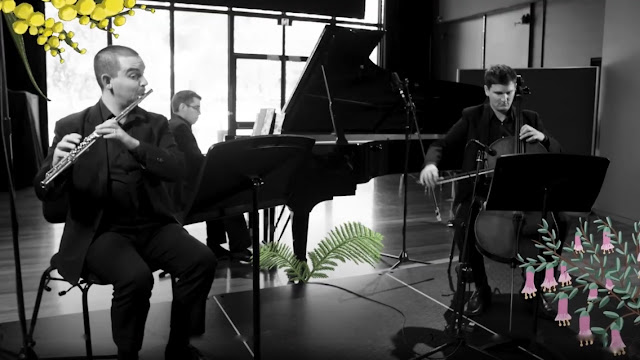
IN THIS second piece of a musical triptych entitled “The Strawberry Thief”, Canberra composer Sally Greenaway takes the listener on another magical programatic journey with “The Secret Garden”, scored for piano, flute and cello.


L-R: David Shaw, Edward Neeman and Samuel Payne in the Larry Sitsky Room, ANU School of Music.
Botanical animation by Marisa Martin. Video still by Luke Patterson.


This live stream with excellent sound production and camera angles, also included discreet and beautiful botanical animation by Marisa Martin.


Flute and cello murmurs combine in gentle interaction, also serving as a statement of musical theme, later joined by glorious flowing arpeggios from the piano.


A second main theme is taken over by cello and then by piano in contrasting octaves.


The flute compliments this beautiful melody with flutterings and other musical ornamentation. Perhaps these are birds and also leaves dancing in a breeze.


Conceived as an Australian bush setting, Greenaway also hints at an English garden, possibly neglected and overgrown, hidden away somewhere. The Englishness extends to remind the listener of Delius and Vaughan Williams at times.


Edward Neeman on piano, Samuel Payne on cello and David Shaw on flute all played with immense beauty and tenderness, luxuriating in a softly spoken E flat minor, the musical phrases contrasted with delicate tierce de Picardie cadence points in A flat major, the gentle melody enveloping the listener in a soothing wash of mystical sounds.


One can imagine a visitor to the secret garden entering cautiously, only to have their curiosity rewarded with wonder, peacefulness, serenity and calm.


What a joyous experience it must be to have such a place to retreat to.


“The Secret Garden” is available on Greenaway’s forthcoming CD, “Delights and Dances” or for purchase via unlimited streaming from sallygreenaway.bandcamp.com


First published in Canberra City News Digital Edition, November 12, 2021


Sunday, November 14, 2021

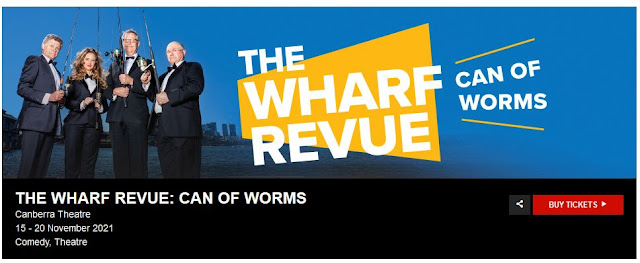
Wharf Revue: Can of Worms


Wharf Revue: Can of Worms by Jonathan Biggins, Drew Forsythe and Phillip Scott presented by Soft Tread at Canberra Theatre November 8-20, 2021

Reviewed by Frank McKone
November 14


    Writers: Jonathan Biggins, Drew Forsythe and Philip Scott
    Co-Directors: Jonathan Biggins and Drew Forsythe
    Musical Director: Philip Scott
    Lighting Designer: Matt Cox
    Video and Sound Designer: David Bergman
    A Soft Tread production
    Performed by Jonathan Biggins, Mandy Bishop, Drew Forsythe and Phillip Scott


I quote Pauline Hanson, at least according to Drew Forsythe in this Can of Worms: “We must get back to our roots!”  That’s exactly what the born again Wharf Revue team have done, to great acclaim from an audience of Ken Behrens.  I’m sure that’s how Amanda Bishop’s Jacinda Adern would pronounce it.

The essence of great satire is to observe the public face of people in power, filter out the cover-up, and exaggerate the core of truth.  It’s hard work for the writers and actors; it’s fun to watch; but beyond making us laugh – in top quality performers – there’s a level of understanding.  For the audience this may be (1) enlightening as a critical judgement; (2) excruciating, even embarrassing for the politician – when we may laugh feeling as if perhaps we shouldn’t; and (3) occasionally even heartwarming, when we laugh with the character rather than at them.

In Can of Worms, Amanda Bishop achieved levels (1) and (2) in her portrayals of Michaela Cash and Jacqui Lambie and (3) for Jacinda Adern.  But perhaps the most remarkable achievement in this year’s Wharf Revue is Drew Forsythe’s levels (1), (2) and (3) all in the one characterisation of The Queen, as she approaches 70 years on the throne – the longest reigning monarch in British history.

I’ve reviewed The Wharf Revue often over the past ten years.  In recent years it was beginning to turn into a more ‘slick’ presentation, mainly in the use of multimedia and even to some degree in the acting style.  Can of Worms is straightforward, you could even say old-fashioned, satirical revue – and it works a treat.

Open the Can of Worms for yourself as it tours here in Canberra and out of our bubble to the rest of the real world.  All praise to the longstanding team of Phil Scott, Drew Forsythe, Jonathan Biggins and Amanda Bishop for striking out on their own from the Mother Wharf at the Sydney Theatre Company.  May their wharves flourish forever.

Saturday, November 13, 2021

Experiments in Living [Melt], Surface Appearances, Light Materials, & 398

Photography | Brian Rope

Experiments in Living [Melt], by Sammy Hawker (ACT)
Surface Appearances, by Eunie Kim (ACT)
Light Materials, by Caroline Huf (ACT)
398, by Aloisia Cudmore (ACT)

PhotoAccess Huw Davies Gallery | Until 27 November 2021

Each year, PhotoAccess awards local and interstate artists, both emerging and established, assisting them to expand and develop their photo-media practices. They are provided with mentorship to produce solo exhibitions in the Huw Davies Gallery. The four ACT exhibitors this year were recipients of the Dark Matter, Emerging Artists Support Scheme, and Wide Angle residencies.

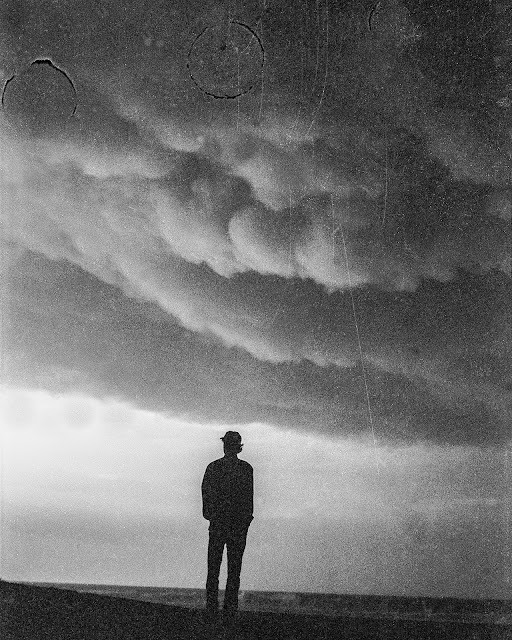
The works in Sammy Hawker’s Experiments in Living [Melt] encompass text, documentary video and negative prints produced in collaboration with the chemical activity of rain, hailstones, seawater and open flame. This is now familiar territory for Hawker, who challenges us to reconsider the illusion of control we hold over the natural world. These images do not disappoint.

Because we are limited, finite, beings subject to dying, vulnerability to trauma is a necessary and universal feature of our human condition. Hawker’s images speak to this, identifying the importance of nurturing our relationship to the world, and reminding us that our everyday experience is illusory, never the reality itself, of non-human forces shaping our lives.


Tom & Pyrocumulus © Sammy Hawker

Eunie Kim says she is grateful to have found her life’s calling in photography and is excited to see what comes next, embracing every opportunity. In Surface Appearances, Kim has used ‘Liquid Light’ photographic emulsion painted onto varied papers and brought her current Australian life into conversation with the traditional aesthetics of her Korean heritage. This is most evident in three beautiful “paintings” on sugarcane paper, looking at flowers, birds and insects.

Using materials and subjects from a contemporary Australian setting whilst simultaneously conjuring the aesthetic of traditional Korean painting, Kim explores her immigrant experience. Applying the emulsion via brushstroke, on differing thickness and texture of paper, has produced varying works. They reflect Kim’s process of learning, regretting and then correcting mistakes, and taking chances.


Cells, captured in 2015, recreated in 2021 © Eunie Kim

Light Materials is a series of video works deconstructing and recombining film materials through a process of digital or analogue weaving, Caroline Huf explores the exhaustion and re-invention of settler Australian myths about the mystery and threat of the bush.

Huf’s work, It's No Picnic, disrupts Peter Weir’s iconic movie Picnic at Hanging Rock, a key cultural expression of early colonial anxieties in the unfamiliar Australian landscape. Each scene is pulled apart, altered in speed, scale, and moved out of time to appear as woven patterns and twills. The film’s pan pipes become an industrial sound and the threads slowly disappear, suggesting a worn-out myth.


It’s no picnic- 2021, video still © Caroline Huf

And Let’s Get Lost presents Huf’s personal engagements with local landscapes, wearing dresses she created from strips of 16mm film to remind us of the, often, fleeting nature of our experiences with landscapes. The film dress unravels as she moves through the landscape before being fed through the projector and into the gallery. Both the dress and its experience become an ephemeral memory. Watching these works, particularly the digital video projected onto sandstone, is a somewhat mesmerising experience.

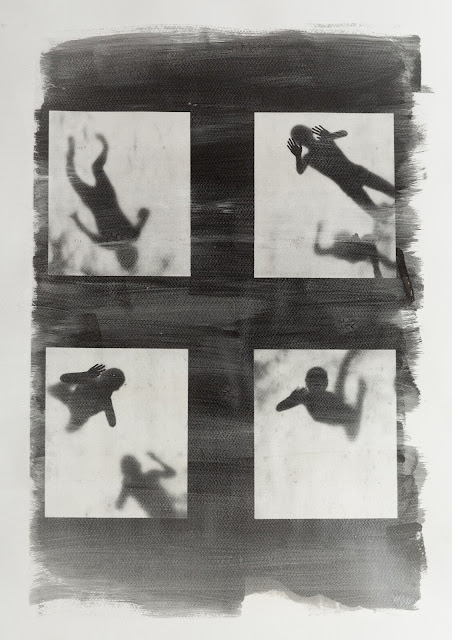
Aloisia Cudmore’s works span multiple mediums including photography, video, sound and installation. She investigates the notions of intimacy at the threshold between physical and virtual space.

398 comprises personal black and white digital images in which Cudmore captures intimate moments of physical proximity with her friends, family and community, during a time when travel restrictions, prohibitions on gathering and ultimately lockdowns separated us emotionally from those most important to us. These quite simple images of moments are a testament to the people that keep us connected.


4, 2021 © Aloisia Cudmore

We are fortunate to have these four photomedia workers amongst our quality emerging and established artists in the A.C.T. It is no surprise they were chosen to receive the awards that led to these works.

This review was first published in the Canberra Times here. It is also on the author's own blog here.