Saturday, July 27, 2019

THE ART OF COARSE ACTING


Written by Michael Green, Rupert Bean and Jane Dewey
Directed by Chris Baldock
Canberra REP, Theatre 3 to 10 August

Reviewed by Len Power 26 July 2019


Like the director, Chris Baldock, one of the books in my collection that I treasure most is Michael Green’s ‘The Art Of Coarse Acting’.  First published in 1964, it is still in print and the phrase ‘coarse acting’ has gone into the language.  While it’s hilariously funny, it really does provide a textbook on what not to do as a performer.

Four of the plays presented are by Michael Green.  The other two plays, ‘Present Slaughter’ by Jane Dewey and ‘Pride At Southanger Park’ by Rupert Bean had their origins in English Coarse Acting competitions.

Chris Baldock and his large ensemble of enthusiastic players have obviously had a lot of fun putting this collection together.  You need good actors to make this work and his team all show how skilful they are.  Chris Baldock never misses a trick with his nimble and inventive direction.

Six plays of differing styles in one evening need an extraordinarily clever set design that’s able to be changed swiftly.  Set designer, Andrew Kay, has excelled even himself here with colourful and necessarily clichéd sets full of rib-tickling tricks.  Set coordinator, Russell Brown, and his team have carried out the mechanics of the design perfectly.  Jeanette Brown and Antonia Kitzel have come up with a great set of costumes and Antonia Kitzel must be run off her feet backstage looking after the myriad of props.

Photo: Canberra Times

The plays are bookended with a very theatrical director, nicely lampooned by Steph Roberts, leading us through a ‘Best of British’ evening of plays by the Poon River Players.  Sour puss stage manager, Liz St Clair Long, is a delight in her fleeting appearances from backstage eventually leading to a very funny emergency fill in onstage for an indisposed actor.

The plays that work best in this collection are those where a problem on stage has the actors trying to cover up and continue, hoping the audience won’t notice.  ‘A Collier’s Tuesday Tea’ and ‘Present Slaughter’ were, for this reason, the funniest and most truthful of the collection.  The jokes come thick and fast in the other plays but the plays themselves are a bit long so even the jokes feel a bit laboured after a while.

Still, it’s a fun evening and everyone in the audience had a good laugh.  There was even an amazing coincidence.  The lucky door prizes handed out during the evening were all won by the local Canberra critics, including myself!

Len Power’s reviews are also broadcast on the Artsound FM 92.7 ‘In the Foyer’ program on Mondays and Wednesdays at 3.30pm.

The Torrents

Program Cover
Celia Pacquola as Oriel Gray

This image has been sourced from Doollee.com
      Oriel Gray
https://www.austlit.edu.au/austlit/page/A10651
This image has been sourced from Doollee.com


The Torrents by Oriel Gray.  Co-Production Black Swan State Theatre, Perth WA, and Sydney Theatre Company, at Sydney Opera House Drama Theatre, July 18 – August 24, 2019.

Reviewed by Frank McKone
July 24


Photos by Philip Gostelow

Cast and Creatives

Claire Watson’s directing presents us with a tantalising light-hearted comedy of manners in which a ‘New Woman’ brings sense and sensibility to the self-destructing chaos of the male-dominated conventions of her time.  The Torrens is tightly intelligent – a play of ideas, played out in comic form.

Where have I come across this before?  In theatre, in plays by George Bernard Shaw like Mrs Warren’s Profession and Major Barbara; in David Williamson’s Dead White Males and the more recent When Dad Married Fury; all looking back, of course, to Aristophanes and Shakespeare.  Yet here is one that I had not known about before.

Why not, when in 1955 it was joint winner of the Playwrights' Advisory Board Competition with Summer of the Seventeenth Doll by Ray Lawler?  In this production of The Torrents,  Celia Pacquola, comedian, provides us with a Puckish prologue, not so much along the lines of ‘Think but this, that you have slumbered here while these visions did appear” while The Doll has appeared in every school classroom and in thousands of productions.  She insults us by assuming that we haven’t read the program (who ever does?), and finally admits that The Torrens has had only one professional production – before this one, of course! – in Adelaide in 1996.

As Jenny Milford, writing her application to become a journalist in the 1890s with her presumed male initials J.G., we see Pacquola in a remarkably straight role as a woman of practical intelligence and humorous perspicacity who runs rings around the men – except for the young copy boy Bernie, played sympathetically by Rob Johnson, who carefully avoids allowing slapstick to make the role less important than I’m sure Oriel Gray intended.  He represents the young generation, learning fast about the changing role of women; just as we see beginning to happen for the other woman in the play, Gwynne.  One lunch with feminist Jenny, and Gwynne will not marry for money: only for love.

The production is carried off with panache – made especially enjoyable by the skilful acting and directing at the perfect level of comedy without falling into the trap of farce, nor the opposite trap of post-modern absurdism.  The 1950s script has a kind of innocence about its use of stock funny characters which could seem out of kilter with the serious issues in a genuinely independent woman’s life.  But this production gets the balance right.

The Torrens, as good as Summer of the Seventeenth Doll though it may be, is not up to Pygmalion or the best of David Williamson, but certainly deserves many more productions of this quality.  It definitely should be in all those classrooms where Pearl and Bubba are regularly studied, because Jenny Milford is a character who does not brook sentimentality, either about herself as a person and certainly not about how she is treated as a woman.  She is a person to be respected in her own right, and should be as much a centre of discussion by young people today as at any time in the past.

Among the other characters, the interest centres on the editor of the Koolgalla Argus, Rufus Torrent, and his relationships with his journalist son, Ben, and the paper’s owner, John Mason, for whom profitability takes precedence over originality and even truth.  I have to disclose my bias when saying I was pleased to see my one-time student, Steve Rodgers, allow Mason’s hard-line character just enough self-doubt to save him from being pure Rupert Murdoch; while also equally praising Tony Cogin and Ben Davies for revealing their human common sense as Pacquola’s Jenny made good sense against Mason’s prejudice and obstinacy.

The one character under written by Oriel Gray, I think, is Kingsley, the proponent of a water supply for an agricultural future for the dying gold mining industry of Koolgalla (i.e. Coolgardie/Kalgoorlie in real life).  Luke Carroll did his best and gave Kingsley our sympathy, but he remained a one-note character dependent on Jenny Milford’s capacity and generosity.  Perhaps Gray should have taken Kingsley to the point of suicide, as really happened in the model for his character – Charles O’Connor, whose 530-kilometre-long pipeline Eastern Goldfields Water Supply Scheme in Western Australia was finally completed, but only after his death.  Maybe Gray could not see how to put that story into her comedy.

Bringing Oriel Gray to the stage today – and including the program which we all should indeed read for its history of Pioneering Female Journalists of Australia, Alexina Wildman (1867-1896), Stella Allen (1871-1962), Leontine Cooper (1837-1903) and Louisa Lawson (1848-1920); and remembering her work performing and writing at the Australian Communist Party’s New Theatre, which took her on to becoming “the first paid playwright-in-residence in an Australian theatre” writing the Party’s weekly radio segment on station 2KY – is an important project for modern Australian theatre, especially for national status companies like Sydney Theatre Company.

On my arrival in this country in 1955, the theatres I found as my theatre interest grew were Doris Fitton’s middle class Independent in North Sydney, the Genesians doing Shakespeare (I remember Poor Tom in King Lear presented with Christian sympathy), the Elizabethan Theatre Trust showing the American Eugene O’Neill’s Long Day’s Journey Into Night, and the New Theatre.  Their production of The Good Soldier Schweik, adapted from the anti-war novel by Jaroslav Hasek, was a high point of political satire as the birthday lottery system sent 18-year-olds to war in Vietnam in 1967.  What better introduction to my new land could I have had?  How good was that!

The essay in the program for The Torrents, “Oriel Gray, New Theatre and ‘the new woman’” is powerful history to follow her light-hearted comedy.  Enjoy the play, and read the program!


Steve Rodgers and Gareth Davies
as
Koolgalla Argus owner John Manson and Ben Torrent

Emily Rose Brennan
as
Gwynne, socialite engaged to marry Ben Torrent

Luke Carroll
as
Kingsley, contributor to Koolgalla Argus
on water supply scheme

Celia Pacquola and Tony Cogin
as
J.G. (Jenny) Milford and Koolgalla Argus editor Rufus Torrent

Sam Longley, Geoff Kelso and Rob Johnson
as Koolgalla Argus staff
Jock McDonald (manager), Christy (print compositor) and Bernie (copy boy)


Friday, July 26, 2019

A View from the Bridge


A View from the Bridge by Arthur Miller.  Red Line Productions at Ensemble Theatre, Sydney, July 24 – August 24, 2019.

Reviewed by Frank McKone
July 24

Director – Iain Sinclair; Set Designer – Jonathan Hindmarsh; Costume Designer – Martelle Hunt; Lighting Designer – Matt Cox, Associate – James Wallis;  Sound Designer – Clemence Williams, Associate – Dana Spence; Dialect Coach – Nick Curnow; Fight Director – Scott Witt

Eddie Carbone – Anthony Gooley; Catherine – Zoe Terakes; Beatrice – Janine Watson; Louis & Various – Giles Gartrell-Mills; Marco – David Soncin; Rodolpho – Scott Lee; Alfieri – David Lynch

David Lynch as Alfieri
A View from the Bridge

Photos by Prudence Upton

You know when you’ve got your Arthur Miller right when, at the final blackout, a deep overwhelming silence fills the theatre full with a feeling of loss and an awful sense of waste.

Though the characters are fictional and the setting is not yours personally, you know the tragedy is real.  Director Iain Sinclair and his team of actors and designers have achieved perfection in their A View from the Bridge.

An absent friend, the founder of the Ensemble Theatre, Hayes Gordon, must never be forgotten for his creation of this little theatre-in-the-round – so appropriately in this boatshed on the Kirribilli wharf, which I so often look down on from the over-arching Sydney Harbour Bridge, before eating at the migrant Italian Kirribilli Village Café. 

It may be a lot more up-market than “the scene in the docks of Red Hook, a working-class part of Brooklyn” but I’ll bet there are stories about escaping to freedom in a new country, about cultural conflict, about the tentacles of family obligations – and there’ll be lawyers like Alfieri, sincerely trying to help prevent the worst from happening in the face of legal, social and political reality; maybe often working pro bono for Amnesty International. 

I feel self-conscious – as a migrant myself who still remembers struggling through unpleasantly officious customs on Pyrmont 13 wharf in 1955, the year Miller wrote A View from the Bridge – knowing how lucky I have been to enjoy the kind of life that Catherine and Rodolpho hope for, and even Beatrice can imagine for them, but will never happen now that her husband Eddie Carbone could never let his niece have her freedom; and is now dead by the hand of her cousin, Marco, in a fight for honour.

I have often wondered how Arthur Miller, born in 1915 in Harlem, NY, with such a British sounding name, could identify so closely with Italian dockworkers and the fears of migrating illegally.  But his own parents ‘of Polish and Jewish descent’ may well have faced the same kinds of desires and fears – and then “lost their successful coat manufacturing business in the Wall Street Crash of 1929”, and “had to move from Manhattan to Flatbush, Brooklyn”, which looks down on Red Hook. 
[ https://www.biography.com/writer/arthur-miller ]

Obviously, the anti-immigration politics of our day make this play even more significant, perhaps, than in 1955.

So let’s look at how Sinclair and Co broke the rules to make this work so telling.  Iain Sinclair is not the first to do something like what Laura Barnett describes in her review in The Guardian (April 13, 2014): Here, in his first production for London's Young Vic, Van Hove turns his talent for reappraisal to Arthur Miller's claustrophobic 1955 tale of a Brooklyn longshoreman, Eddie Carbone, and his obsession with his niece, Catherine. The effect is startling.

The most daring decision taken by Van Hove and his designer, Jan Versweyveld, is to dispense with Miller's precise stage directions (this was a playwright whose notes to his actors and directors were often as poignant and exacting as his dialogue). The production opens not on a Red Hook tenement, but with a stark black box that lifts to reveal a bare thrust stage, bordered by a low Perspex wall.


But in the Ensemble Theatre, with “two lighting effects, two props [and] one chair”, we are not outside peering in at  a stark black box.  We are in-the-round, in the box, with Alfieri surreptitiously watching us from near A15 as we dribble down to fill the few rows of seats in this compact 200 seat space:


As we hushed seemingly to no obvious signal, Alfieri took the chair towards centre and began to speak to us.  In B26 it seemed he spoke directly to me.  I remained, attention locked in, for 2 hours without interval.  People usually quote Peter Brook’s The Empty Space at this point, but Iain Sinclair, referring to Jerzy Grotowski, writes “We created a show firmly in the ‘poor theatre’ aesthetic following Lope de Vega’s dictum that all great theatre needs is actors, a stage and some passion”.

And passion is what we got:


Anthony Gooley as Eddie Carbone

Janine Watson as Beatrice


Scott Lee as Rodolpho, David Soncin as Marco


Zoe Terakes as Catherine, with Anthony Gooley

Anthony Gooley and Janine Watson


Zoe Terakes as Catherine with Scott Lee as Rodolpho
Anthony Gooley and Janine Watson


Zoe Terakes and Scott Lee

Giles Gartrell-Mills as Louis, with Anthony Gooley as Eddie Carbone


L:R Scott Lee, Janine Watson, David Soncin, Zoe Terakes, Anthony Gooley
as
Rodolpho, Beatrice, Marco, Catherine, Eddie Carbone
A View from the Bridge


You have until August 24 to see A View from the Bridge by Arthur Miller at Ensemble Theatre, Sydney.


David Lynch as Alfieri
A View from the Bridge


Sunday, July 21, 2019

PARASITE


MA 15+, 2 hrs 11 mins
Dendy Canberra Centre, Palace Electric New Acton
4 Stars

Review by © Jane Freebury

Writer-director Joon-ho Bong makes bold and confident films with tremendous visual flair. The Palme d’Or he received at Cannes for this film last year suggests that the venerable film festival is at last catching up with the quality of cinema from South Korea.
Films by female directors are taking a little longer.

As you might expect from a best film at Cannes, Parasite looks good, very good. Even the scenes that take place below street level, in the basement where Ki-taek (popular actor Kang ho Song) lives with his wife Chung-sook (Hye-jin Jang) and two adult children, are constructed with visual flair and in long takes that allow the details to resonate. And it is shot through with Bong’s bleak humour.  He co-wrote with Jin Wan Han.

The family lives pretty much hand to mouth, scrounging and swindling. The best place in their flat for using their neighbours’ wifi involves a squat near the toilet. Fumigation from the street is another opportunity. They leave the windows open for the fumes to billow in to rid their home of pesky bugs, though they will contaminate the pizza boxes they are folding for a bit of cash.
they are a family of consummate grifters, fun to watch as their moves go undetected
No sooner does the son Ki-woo (Woo-sik Choi) get a job tutoring in a wealthy family, the Parks, than the rest of his tribe pile on board. Ki-taek replaces the driver, Chung-sook the housekeeper and daughter Ki-jung (So-dam Park), whose forging skills enabled the opening for her brother in the first place, also nabs a job tutoring the Park’s little boy.


The Ki-taeks are a family of consummate grifters, fun to watch as their moves go undetected by the Parks, who seem to operate in a world of their own, which is, of course, the point.

One day, Mr (Sun Kyun Lee) and Mrs Park (Yeo-jeong Jo) leave their extraordinary modernist marvel of a home in the care of their servants. It seems they don’t suspect the Ki-taeks belong to the same family, even though little Da-song (Jung-heon Jun) remarks that all of them smell ‘the same’.

Then, during a downpour, the former housekeeper returns to feed her husband who lives hidden in the bomb shelter below. The encounter between the grifters and this pair, their class allies, is rich with savage social satire. Below ground or under the radar, it's the only way to survive.
a vertiginous descent from high society to the underclass below
Then, the Parks return early, their camping holiday washed out by the heavy rain, but the servants just still manage to escape detection.

The moment of reckoning arrives at a very fancy party in the Park's garden when vicious violence erupts. All the more ghastly for taking place in a garden in bright daylight and within a colourful, celebratory mise en scene.This is another film from a director whose social satire carries a sharp edge.

Bong’s futuristic thriller in 2013, Snowpiercer, saw social privilege get its just deserts, though who deserves what here will be more debatable.
And like another recent South Korean film, Burning (that used the same cinematographer, Hong Kyung-pyo), Parasite makes reference to the widening social divide in Korean society and societies everywhere.

With its graphic violence and creepy threat from the basement, Parasite could easily have tipped into horror mode. Awards for genre at Cannes are rare, but this is largely black comedy with wit and humour, and enthralling camerawork that takes in the vertiginous descent from  high society to the underclass below.

Jane's reviews are also published at her blog, the Film Critics Circle of Australia, and broadcast on (Arts Cafe) ArtSound FM MHz 92.7

YESTERDAY


Rated M, 1 hr 55 mins
Dendy Canberra Centre, Capitol Cinemas Manuka, 
Palace Electric New Acton
3.5 stars


Review © Jane Freebury

The concept for Yesterday is terrific. It’s hard to imagine a better reason for getting the Beatles’ back catalogue into a movie, played one by one and in each song’s entirety, as though only just composed. The very idea that no one in the world has ever heard of the Beatles is a great excuse, and Yesterday is based on a brilliant idea with great comic potential.

After a collision with a bus while cycling through an electrical storm, Jack Malik (Himesh Patel), wakes up in hospital minus two front teeth, but his cultural memory intact.

When he’s recovered, Jack sings 'Yesterday' for his friends at the pub with his new guitar, but they act like they've never heard it before, and regard it as his composition. It’s not that they are overwhelmed by it either. ‘It’s not Cold Play.’ In another scene, he tries to do a rendition of ‘Let it Be’ on piano for his parents and their friends, the Beatles generation after all, but they are hilariously inattentive.

In a global outage during the storm, the Beatles were erased from everyone’s memory, and somehow deleted from cyberspace, along with band Oasis who emulated them. ‘That figures,’ mutters Jack. But the Stones roll on.

Before this happened, Jack had given up a lot for his own music – his teaching job, his independence, and something of his father’s respect – and now he has suddenly found himself in sole possession of a treasure trove of songs that changed the world.

Actually it’s a sheer pleasure to hear the songs in Patel’s hands, as he performs them really well. It’s a reminder that voice and accompanying guitar or piano is all you need for melodies so good they stand on their own, without the video or the elaborate backing.

Finding a manager with imagination and vision who recognises a great song when he hears one takes a little time. Time in which managing Jack’s potential passes from his manager, and would-be girlfriend, Ellie (Lily James) to Ed Sheeran , who in a big-hearted performance plays himself, a lessor songwriter than the Beatles.

Ellie is a sweetie, but Jack’s roadie Rocky (Joel Fry) is more entertaining, and so is the rapacious agent in LA, Kate (played brilliantly by Debra Hammer), for whom Jack has to suffer the indignity of a makeover. It’s the support characters in Yesterday who are by far the most fun.

The slick marketing campaign for Jack’s ‘One Man Only’ album is a marvel of cultural engineering that can only be spot on. And the sales pitch of a sole genius is a reminder of how the chemistry of collaboration made the Beatles incandescent.

The songs catch on eventually and Jack staggers into stardom with his guilty secret.

As an exponent of the Beatles' golden oldies, Patel's Jack Malik does what’s called for in a character to whom amazing things happen, yet something is missing.


Even though Yesterday has a dream team at the helm. Writer Richard Curtis and director Danny Boyle who were behind some of the biggest movie hits in recent memory – Four Weddings and a Funeral and Notting Hill (Curtis) and Trainspotting and Slumdog Millionaire (Boyle).


It is a joyous experience, sprinkled with sweet moments, and infused with warmth and fuzzy feeling, but Yesterday is mildly disappointing.


As a tribute to the Beatles, it only tells half the story. We don’t remember the band just because they were cute or their songs were sweet, they could sneer. There was so much more to them and the wave of social and cultural change they rode.


Yesterday is like biting into a scrumptious delicacy, as in high concept to die for, only to discover there isn’t much substance in the middle.


Jane's reviews are also published at her blog, the Film Critics Circle of Australia, and broadcast on (Arts Cafe) ArtSound FM MHz 92.7

KINKY BOOTS


Directed by Derek Walker – Assoc. Direction and Choreography by: Michelle Heine        
 Musical Direction by Nick Griffin - Set Designed by: Cate Clelland
Costume Designed by Fiona Leach - Lighting Designed by Phillip Goodwin
Sound Designed by Dillon Wilding
Presented by Free Rain Theatre – The Q, Queanbeyan, 11th – 28th July 2019

Reviewed by Bill Stephens.

With a book by Harvey Fierstein and music and lyrics by Cyndi Lauper, “Kinky Boots” is a musical about a young man who saves his father’s shoe factory from closing down by making boots for drag queens. In the hands of director, Derek Walker and his associate, Michelle Heine, this unlikely scenario proves a surprisingly charming, disarming and downright entertaining exploration of the power of inclusiveness and goodwill.

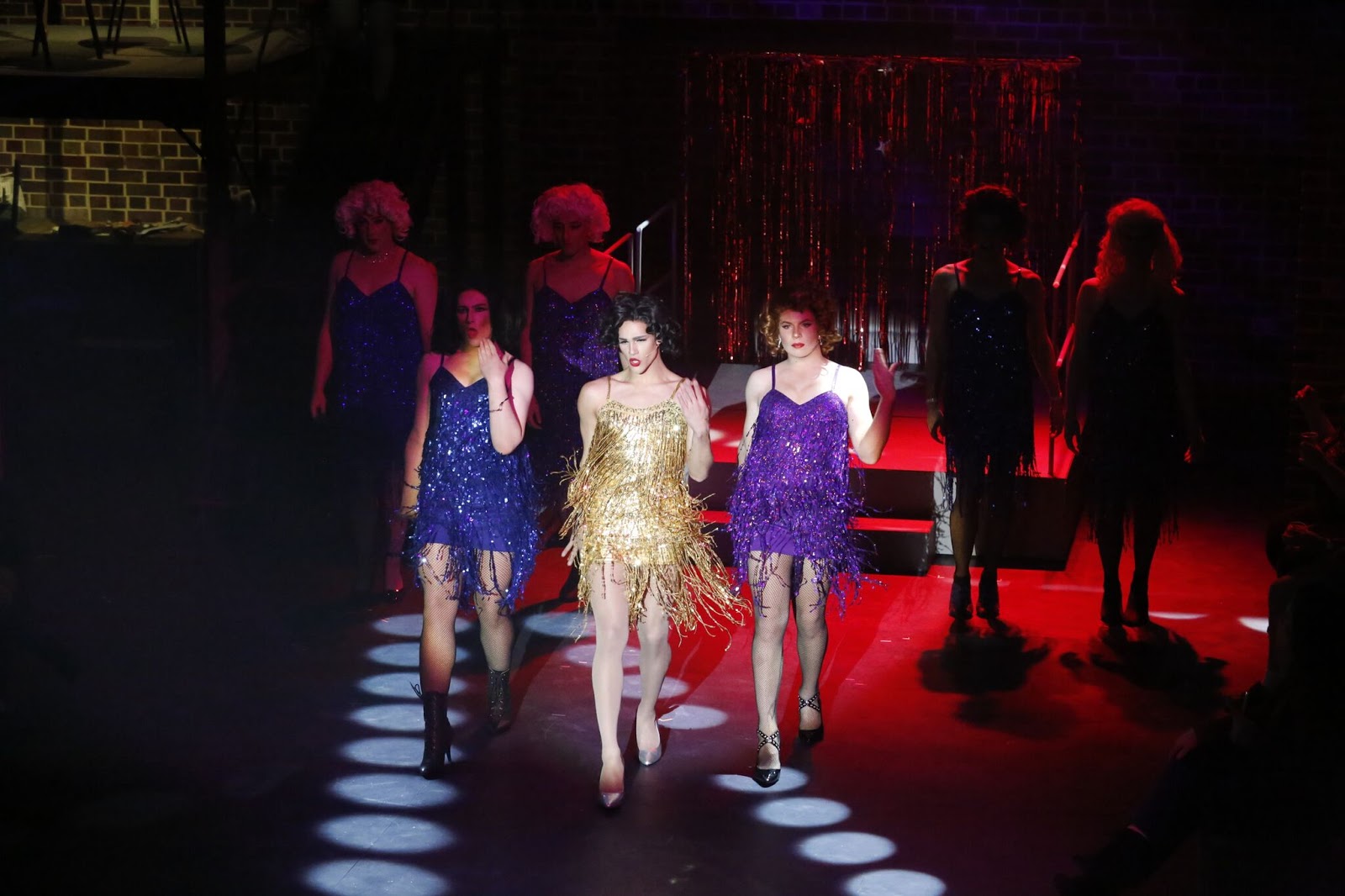
Lola (Rania Potaka- Osborne) and her angels.

Inventive direction, brilliant choreography and top rate performances by an enthusiastic cast together with excellent scenery and costume design combine to draw the audience into the world of young Charlie Price (charmingly portrayed by Martin Everett) who’s reluctantly taken over the reigns of his late father’s  failing shoe factory. In an effort to fulfil his father’s dream for the factory, Charlie resists  the advice of his ambitious girlfriend, Nicola ( a very good performance by Hannah Lance) who’s sourced a developer to convert the factory into apartments, in favour of a suggestion from factory employee, Lauren, (Brittanie Shipway) that he seek out a niche market.  A chance meeting with drag queen, Lola (Rania Potaka-Osborne) provides Charlie with his solution.


Lola (Rania Potaka-Osborne) and Charlie Price (Martin Everett) 

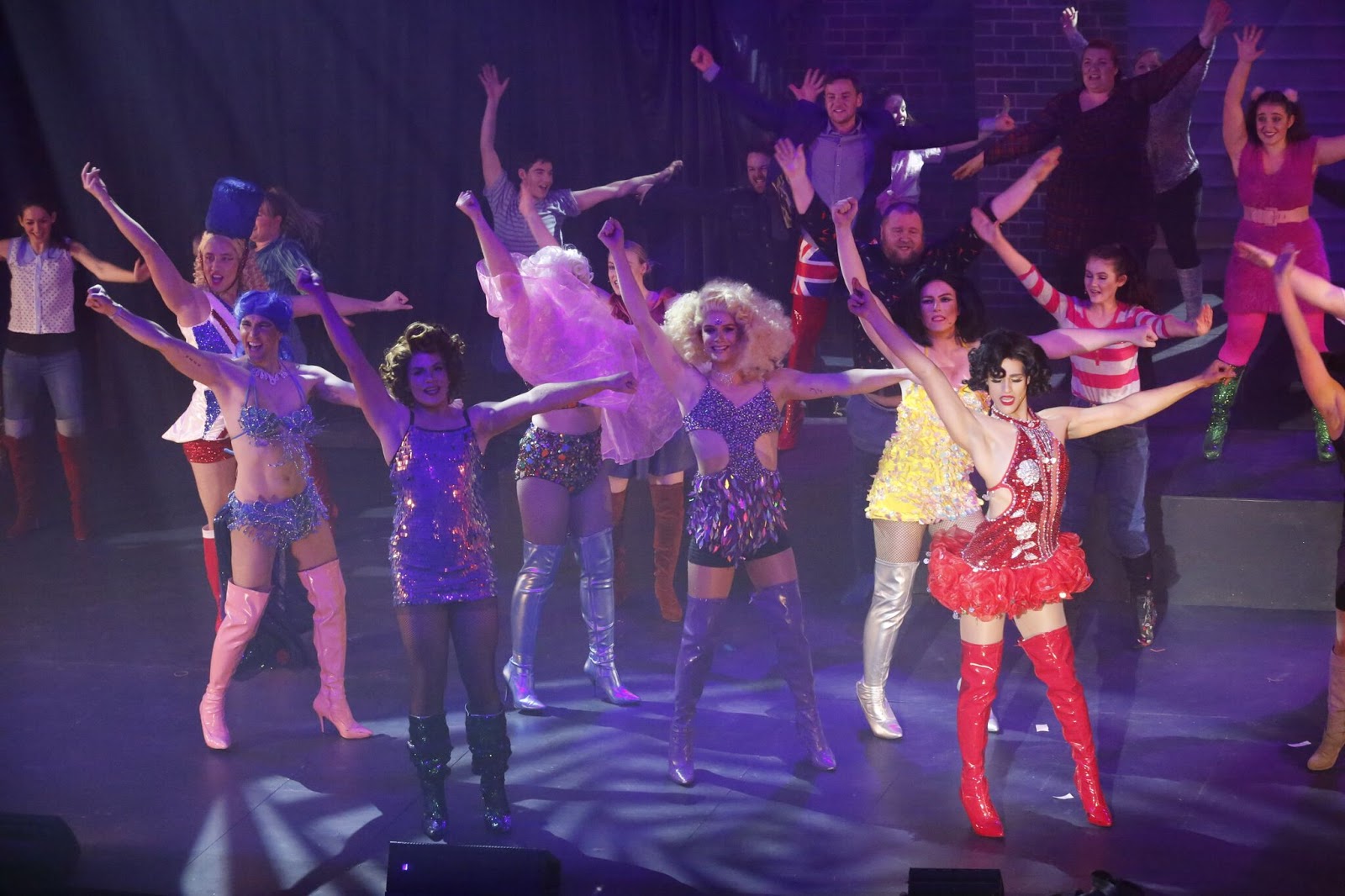
The linchpin of any production of “Kinky Boots” is the casting of the role of Lola, because it’s Lola who provides the sparkle and drive for the show.  A fine actor/singer/dancer, Rania Potaka-Osborne has sparkle and drive in spades, and his superbly nuanced performance also reveals the insecurity  behind Lola’s apparent brashness. His duet with Charlie, “Not My Father’s Son” is one of the highlights of the show. He’s also a brilliant dancer and the dazzling dance sequences, threaded throughout the show, for which he’s backed by his “angels”, provide sparkle and spectacle aplenty.
Michelle Heine has excelled herself with her choreography for this show, which is perfectly in-sync in style and mood, as are Fiona Leach’s costumes for the “angels”, Lachlan Agett, Ashley Jefferys, Garrett Kelly, Jordan Kelly, David Santolin and Alexander Thorpe, all of whom perform with style and chutzpah.

Lola (background) and her Angels 

The strength of Derek Walker’s direction is evident in the fine performances he has drawn from his cast, especially the ensemble who all perform with confidence and commitment. Brittanie Shipway gives a fine comedic performance as the company spokesperson, Lauren, and her big number, “The History of Wrong Guys” is a show-stopper. Kara Sellars and Chelsea Heaney both delight as outspoken factory employees, Pat and Trish. Their rendition of “What a Woman Wants”, for which they are joined by another stand-out, Tim Stiles as Don, provides another memorable highlight.
Peter Dark impresses with his carefully understated ghostly presence as Charlie’s deceased father, Mr. Price, and Michael Heming oozes efficiency as the factory foreman, George.

Also particularly impressive is Dillon-Willding’s excellent sound design which insures the balance between the singers and Nicholas Griffin’s stylish band does full justice to Cyndi Lauper’s clever lyrics and catchy score. Phillip Goodwin’s imaginative lighting design allows the audience to appreciate the cleverly devised set changes in Cate Clelland’s excellent setting, as well as providing oomph and atmosphere throughout.


Lola and the "Kinky Boots" ensemble 

Free Rain Theatre has excelled itself with this beguiling production. Refreshingly free of coarse language, this artfully realized production of “Kinky Boots”; packed as it is with excellent performances, clever staging and catchy music, is a family treat not to be missed.
  

                                        Photos by Craig Burgess -Family Fotographics.


Saturday, July 20, 2019

30 YEARS IN SIXTY FIVE THOUSAND

Tyrel Dulvarie as West Wind in "Unaipon" 

Choreographed by Frances Rings, Jiri Kylian and Stephen Page for Bangarra Dance Theatre.
Canberra Theatre 18th – 20th July

Reviewed by Bill Stephens

There is a compelling sense of spirituality and mission that separates the work of Bangarra Dance Theatre from other dance companies. Nowhere is this better demonstrated than in the exquisite final sequence of the Frances Ring work “Unaipon” in which the whole company performs to the haunting “Miserere”. Entitled “Religion” it is but one of many highlights in this outstanding program which celebrates the 30 years of existence in which Bangarra Dance Theatre, under the clear-eyed stewardship of Stephen Page, has established itself as a world leader in indigenous dance.

Canberra is only the second city to see “30 Years of Sixty Five Thousand” following its inaugural five-week season in the Sydney Opera House, after which it will be presented in every Australian Capital City.

The program consists of three individual works. Frances Ring’s “Unaipon”, originally created for the company in 2004, is a perfect example of the work for which Bangarra is justly celebrated.

Stunningly costumed by Jennifer Irwin, an evocative set design by Peter England, and gorgeously lit by Nick Schlieper, “Unaipon” consists of a number of visually arresting sequences inspired by the studies of aboriginal inventor, philosopher and storyteller, David Unaipon, whose image is featured on the $50.00 note.

Each sequence is a visual feast. In “Sister Baskets” bare legs protrude unexpectedly from under woven baskets. Young men perform intricate patterns with strings in “String Game”. Bodies collide and bounce off each other in “Motion”, and superbly costumed dancers represent the "Four winds", among which Tyrel Delvarie in an amazing costume fashioned from long reeds as the West Wind, is a standout.
  
Tyrel Dulvarie - Rika Hamaguchi in "To Make Fire" 

Similarly the final work in the program “To Make Fire” also consists of a series of favourite  sequences drawn from three of Bangarra’s previous programs, “Mathinna”, “About” and “Clan”, and cleverly reworked by Stephen Page as a compelling stand-alone showcase. Particularly memorable among many highlights was a dramatic trio from “Mathinna” entitled “Adoption” powerfully danced by Lillian Banks, Rikki Mason and Tara Gower.

Tara Gower - Rikki Mason - Lillian Banks  in "Adoption" 

Perhaps the most intriguing work in this program is the one which wasn’t built on the company, Jiri Kylian’s “Stamping Ground” which was preceded by a short film that included images of an extraordinary corroboree which inspired the work, and the comment from Kylian that he had carefully avoided copying any of the dancer’s movements, but only their inspiration.
 
Ryan Pearson - Tyrel Dulvarie - Ella Havelka - "Stamping Ground" 


Kylian’s idiosyncratic movement palette, impressively danced with meticulous attention to detail, by Tara Gower, Baden Hitchcock, Rika Hamaguchi, Ella Havelka, Tyrel Dulvarie and Rikki Mason, at first surprised, then delighted at the realization that Kylian’s particular inspiration may have been the more larrikin dancers in the throng, prompted bursts of laughter among the audience at the delightful larrikin twinkle in the animal shapes and cheeky combinations which bought a welcome injection of humour to this inspiring program.    


                                                 Photos by Daniel Boud    


 This review first published in the digital edition of CITY NEWS on 19.07.19