Wednesday, November 27, 2019

HOT TO TROT - 2019


"Bus Stop" choreographed by Jett Chudleigh 

Project Director and Provocateur – Ruth Osborne
Lighting design by: Guy Harding
Presented by QL2 Dance – QL2 Studios – Gorman Art Centre – 23rd, 24th November 2019.

Performance 23rd November reviewed by Bill Stephens

“Hot to Trot” is an annual program, staged by QL2 dance, which provides young budding choreographers with the opportunity to try their hand at choreographing a short work. Having participated in previous QL2  activities, under professional choreographers, the budding choreographers are provided with dancers, studio time and mentors, but must come up with a concept, organise rehearsals, costumes and lighting plot, as well as guide and rehearse their dancers to a short work to be performed for two performances in front of a paying audience.

The program consisted of five staged works, and two short films, “Lens” by Hollie Knowles, and “We’ll see how long that Lasts” by Christopher Wade – both of which demonstrated an admirable  grasp of the possibilities now available with modern technology to produce interesting dance works on film.

The first staged work was entitled “Decisions” for which Danny Riley and Penny Amoore combined talents to choreograph and perform an intense duet, which commenced quietly, then gathered   momentum as they challenged each other in a series of nicely executed unison sections.

Amalia Socha and Ela Parsons also chose to perform their own work, “Behind the Rack”, a thoughtful two-person piece examining the consequences of cheap throwaway fashion, from manufacture to point of consumption.

Sarah Long incorporated lemons, the music of George Gershwin, and shadow play, into an amusing duet for Alexandra Postai and Pippi Keogh entitled, “Citrus Limon”, in which she explored the response of changing emotions, attitudes and feelings when confronted with a new experiences.

Danny Riley’s work, “Outside the Box”, was the most ambitious work of the evening, involving six dancers, himself, Clare Daly, Hannah James, Jett Chudleigh, John Judd and Sofie Nielson. Although how the movement choices represented the theme of career choices was not always clear, the work did contain some inventive group movement, and a particularly interesting section in which dancers responded to puppeteer-like movements.
 
The most transparent work however was Jett Chudleigh’s “Bus Stop”, performed to an original score by her father, James Chudleigh, depicting the reactions of four travellers stranded at a bus stop.

Stylishly staged under the watchful eye of Ruth Osborne, each work was introduced by the respective choreographers, sensitively lit, with quick, well-managed transitions between  works. At the end of the program, the choreographers and dancers returned to the stage to answer questions from an obviously engaged and interested audience.
 
To communicate  complex ideas through dance is a daunting task for any choreographer, and  given the ages and experience of this year’s group, all of whom, with one exception, were making their first work, the results, though predictably variable, still provided a diverting evening of interesting dance works for the capacity audience.  But more important is the invaluable opportunity “Hot to Trot” provides the young choreographers and their dancers to explore their ability to create and perform meaningful dance.
  

                        Photo: Andrew Sikorski (Art Atelier Photography)


Monday, November 25, 2019

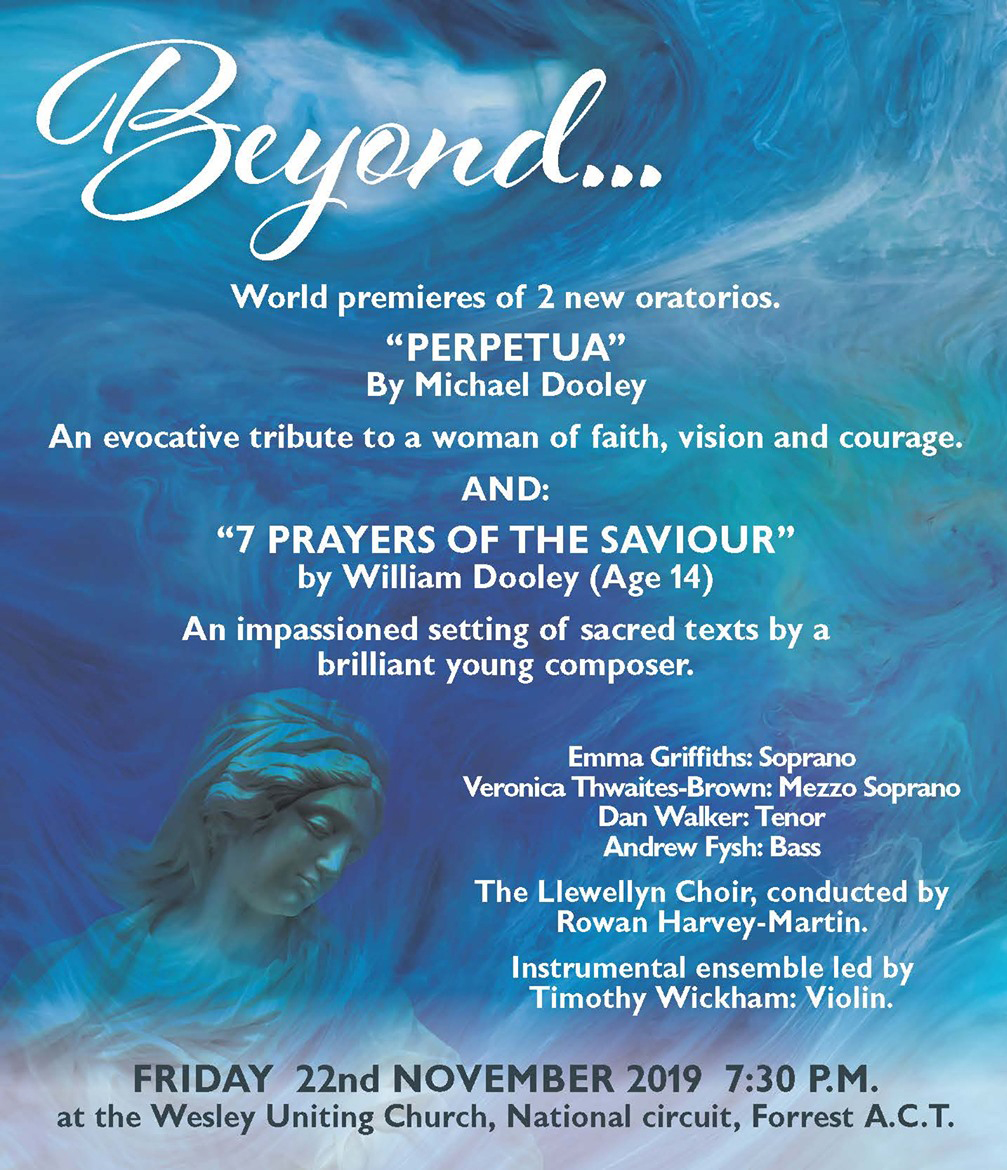
BEYOND...


World premieres of two new oratorios
“Perpetua” by Michael Dooley
“7 Prayers of the Saviour”  by William Dooley
Llewellyn Choir conducted by Rowan Harvey-Martin
Wesley Uniting Church, Forrest 22 November

Reviewed by Len Power

Llewellyn Choir’s latest concert featured three works by two members of Canberra’s musical Dooley family.  “7 Prayers of the Saviour” was an oratorio by up and coming fourteen year old William Dooley and there were two works by his father, Michael Dooley, “The Land That Is Very Far Off” and an oratorio, “Perpetua”.  Both oratorios were world premieres.

The concert commenced with Michael Dooley’s “The Land That Is Very Far Off”.  Described as a celtic rhapsody for violin and piano, it was performed by Timothy Wickham on violin and the orchestral ensemble with Michael Dooley himself on piano.  It was a sweeping, melodic work of great beauty, wistful and nostalgic and it was especially well-played by Timothy Wickham.

Rowan Harvey-Martin then conducted William Dooley’s oratorio, “7 Prayers of the Saviour” with the Llewellyn Choir, four vocal soloists and the ensemble.  This ambitious work with recognizable influences from composers of the past commenced with rather tentative singing by the choir.

Rowan Harvey-Martin with William Dooley

It was most successful in the simpler vocal lines of “Prayer For Lazarus” and “Thy Will Be Done”, sung very well by bass, Andrew Fysh.

An opportunity to hear his work fully produced, it would have been of enormous help for this young composer on his journey to finding his own distinctive style in the years to come.

After interval, the choir presented Michael Dooley’s new oratorio, “Perpetua”.  The story of Perpetua is from the oldest existing document known to be written by a Christian woman, “The Passion Of Saints Perpetua and Felicity”.  It was a good choice for the oratorio as it has a strong and emotionally gripping storyline.  It tells of an educated woman who converted to Christianity and was ultimately martyred for her beliefs in the year 202 AD.

Michael Dooley

Michael Dooley produced a work of great beauty throughout.  From the haunting and atmospheric setting of the opening, “Soli Deo Gloria”, the work progressed from one highlight to another.  His underscoring of the recitatives was especially notable.

The beautiful, clear soprano of soloist, Emma Griffiths, who sang the role of Perpetua, was most effective in her recitatives and soared above the choir in the “Agnus Dei”.  Her singing of “Confitibor Tibi” towards the end was heart-felt and memorable.

Mezzo soprano, Veronica Thwaites-Brown, was a standout with her singing of the very moving “Felicity” lullaby.  Tenor, Dan Walker, was in fine voice with his singing of “Saturus Vision” and bass, Andrew Fysh, sang an excellent Narrator 2.  He gave an especially well-judged level of drama to his singing in “Day Of Victory”.

The choir sang the work with great confidence and clarity.  Rowan Harvey-Martin conducted the whole work extremely well.  The standing ovation at the end of the performance was well-deserved.

Photos by Peter Hislop
 
This review was first published in the Canberra City News digital edition of 23 November 2019

Len Power’s reviews are also broadcast on the Artsound FM 92.7 ‘In the Foyer’ program on Mondays and Wednesdays at 3.30pm.


JOURNEY'S END - ART SONG CANBERRA


Christina Wilson, Mezzo-Soprano
Alan Hicks, Piano
Wesley Music Centre, Forrest 24 November

Reviewed by Len Power


‘Journey’s End’ was a well-chosen title for the final Art Song Canberra concert for 2019.  A well-chosen romantic program of works by Duparc, Schumann, Debussy, Granados and Sculthorpe, it offered a sense of life, love and destiny that would have resonated differently for everyone in the audience.

Performing to a near-capacity Art Song Canberra audience, husband and wife duo, Christina Wilson, mezzo-soprano, and Alan Hicks, piano, have a deservedly strong following in Canberra.  They have also had busy international careers and teach at the ANU and the Sydney Conservatorium of Music.

The program commenced with a striking performance of ‘L’Invitation au Voyage’ by Henri Duparc.  A romantic and colourful work, it was sung with great appeal by Christina Wilson and Alan Hicks’ playing of the complex accompaniment was excellent.

This was followed by all 12 songs of Robert Schumann’s song cycle, ‘Liederkreis Op. 39’ which was composed in 1840.  These songs were set to the poems of Joseph von Eichendorff, a Prussian writer and poet of the era of Romanticism.  The highly descriptive words give a strong sense of nature and its impact on the human condition and Schumann’s music is sublime.  They were beautifully sung by Christina Wilson, especially the emotional “Intermezzo’, the haunting ‘Moonlit Night’ and ‘In A Castle’ with its disturbing undercurrents.

Christina Wilson

The second half of the program commenced with three ‘Songs of Bilitis’ by Debussy which were based on the 1894 collection of erotic poetry by Pierre Louÿs.  Debussy’s music creates a romantic, slightly forbidding and fascinating world of emotion around these poems and they were sung with great feeling by Christina Wilson.  ‘The tomb of the water-nymphs’ was especially enjoyable and Alan Hicks provided a particularly fine accompaniment as well.

Alan Hicks and Christina Wilson

Moving from haunting and ethereal works to the more passionate works of Enrique Granados, Christina Wilson performed the three songs of ‘La maja dolorosa’ with an impressive emotional restraint that subtly and effectively displayed the passion behind the words.

Four Shakespeare songs set by Peter Sculthorpe were then wistfully sung to complete this fine program.

Christina Wilson is not only a superb singer technically, she also sings with great emotional depth and a clear understanding of the intent of the songs.  Alan Hicks is a brilliant accompanist.  Their performances together are not to be missed.

Photos by Peter Hislop
 
Len Power’s reviews are also broadcast on the Artsound FM 92.7 ‘In the Foyer’ program on Mondays and Wednesdays at 3.30pm.

THE REPORT


M, 120 minutes

4 Stars

Review by © Jane Freebury


The missing middle word in the title of this strenuous and thoughtful film is torture. The inconvenient truth of it redacted, just like the videotape records of CIA ‘enhanced interrogation techniques’ destroyed in the years after September 11.

No, not a spoiler. Just letting you know about the really unsavoury backstory to this 7,000 page report into CIA activities.

Based on real events post 9/11
Based on real people and real events, The Report is about how researchers working for the Senate Intelligence Committee compiled an official report inhouse into the methods used by the government’s intelligence agency while interrogating terrorists and terror suspects detained after 9/11.

A lot of young Americans stepped up to join the defence forces or otherwise help after that national catastrophe, including a young graduate student, Daniel Jones (Adam Driver), who switched his studies to security overnight.

the real Dan Jones has set up an organisation to promote transparency and good governance internationally

As a young everyman who wanted to help protect the homeland, Driver is an inspired choice. We already had him pegged as an engaging, versatile and intelligent actor, and though we get to see little other dimension to his personality outside of work, he is always interesting to watch.

Adam Driver as Dan Jones
Late in the piece we see him jogging through a Washington park, and that’s about it, but Driver is a nuanced and expressive actor as the bureaucrat whose job became his all.

Incidentally, the real Dan Jones has left the public service and set up an organisation to promote transparency and good governance around the world.

As a Senate staffer, Jones led the team investigating the CIA use of torture in the wake of 9/11. It may well have been the last thing a patriotically inclined young citizen sought, but he was lucky to be under the guidance of Senator Dianne Feinstein (Annette Bening), an admirable, thoughtful and supportive boss. After a long a distinguished career, the real Feinstein is the oldest serving member of the US Senate.

CIA videotape records had been disappeared
The tapes of interrogations had been disappeared or destroyed, but, incredibly, the written records still existed, and it was these that Jones and his tiny team trawled through for years to come up with the facts. It was no easy job. They had to face bureaucrats disinclined to help, or simply resistant, and work in the windowless bowels of some departmental basement.

When has torture ever worked? Did it ever work in Vietnam or South America?

What they found on the page is translated to scenes that are mercifully short. Feinstein and the team found themselves asking if torture ever worked. Did it ever work in Vietnam or South America? The film leaves you in no doubt, and has a dig along the way at Zero Dark Thirty for concluding that it had led to Bin Laden.

If waterboarding works, then why was it necessary for a prisoner to undergo it 183 times, Feinstein asks. A reasonable question, no one had thought to ask it of the two contract psychologists who were freelancing its use. This notorious method and mock burials and the rest has become ‘a stain on the values and history’ of the US in the years since.

The Report is written and directed by Scott Z. Burns, whose writing credits include The Bourne Ultimatum, Side Effects and will soon include the new Bond film, No Time To Die.

Despite the welcome presence of Bening, there is nothing glamourous to this shadowy world of intelligence gathering. With its chilly palette and serious, weighty tone, The Report is in the tradition of work in the wake of the Watergate scandal, like All the President’s Men, and after the release of the Pentagon Papers (on US involvement in Vietnam), like The Post.  Typically, it’s mostly chilly interiors and the forbidding facades of impenetrable Washington government buildings in the frame.

A stain on American history and values
When the report is released, other senators, including the late John McCain, (famously a former long-term prisoner of the North Vietnamese) lend their support to it and condemn the use of torture, and its stain on American values and international standing. The noticeably warmer glow in the frame at this point, is unfortunately undercut by some final revelations.

This is smart stuff, wordy and engrossing - and non-partisan - with a great message for governments to own their mistakes. It can feel like sitting on a jury, listening to the arguments back and forth, but in the final analysis, The Report is in no doubt about the position it takes.

First published in the Canberra Times on 17 November 2019, and also published on Jane's blog


PAIN AND GLORY


Eduardo (Cesar Vicente) with young Salvador (Asier Flores)

MA15+, 114 minutes

5 Stars

Review by © Jane Freebury

The actor Antonio Banderas and director Pedro Almodovar first worked together in the 1980s and helped make each other famous with sexy, taboo-breaking films like Law of Desire, Women on the Verge of a Nervous Breakdown, and Tie Me Up! Tie Me Down! It was the post-Franco era in Spain and time to tear down decades of fascist repression.

Pain and Glory reflects on the central relationships in Salvador’s (Banderas) life – mother, lovers and actor collaborators. It’s a very personal collaboration between the actor and filmmaker, like a confessional from a couple of famous men of the big screen.

We first see Banderas, as successful film director Salvador Mallo, holding a pose while meditating at the bottom of a swimming pool.  The watery world draws memories of his early childhood to the surface, memories of laundry day at the river’s edge with his young mother (played in these scenes by another Almodovian muse, Penelope Cruz).

A gift for directors, fromTarantino to Almodovar, Banderas has had health issues of his own
As he catches up with an old friend, Salvador reveals that he has stopped writing and directing. Her surprise that he, of all people, has become reclusive and inactive, is a clue to the kind of person he was.

In later flashbacks, while in conversation with his elderly mother, he listens in such a touching way to her complaints that he disappointed her. Later, in a sweet scene between Banderas and Julieta Serrano, who plays Jacinta in her old age, she explains exactly how she wishes to be laid out when she dies.

In conversation with his long lost friend, Salvador recounts his various ailments, a list of enemies within that have beset him. His asthma, headaches, tinnitus and the sciatica that has given him a bad back. It’s a scary anatomical collage of medical imagery, almost as arresting as the opening titles over melting images that turn from solid to liquid before our eyes.

The state Salvador is in is a million miles from the irresistible hunk Banderas played in Almodovar’s early films, or from the swaggering hero he has played in Hollywood.

Another key relationship, not so explicitly referenced, is with the gay lover Salvador had when they were young men, before Federico (Leonardo Sbaraglia) left for Argentina and took a wife. The scenes between them 30 years later at Salvador’s apartment in Madrid, including the prominent kitchen with its bright red cupboards that looks a lot like the director’s own, are lovely to watch too.

Yet another key relationship is the actor Alberto (Asier Etxeandia) from whom Salvador has also been estranged many years. Both Etxeandia and Sbaraglia give terrific performances too.

Handsome, tousle-haired, with a shy twinkle in his eye, Banderas has always been a welcome sight on screen. A gift for directors, from Quentin Tarantino to Almodovar, looking for a swashbuckler with devil-may-care (Desperado) or for a man for women to desire. Yet, here in Pain and Glory the presence we became used to is barely present. Banderas has been chastened by a real-life health issues of his own – a recent heart attack.

These life stories of these two creative collaborators, the film director and his alter ego, wind around each other like a double, double helix. Except that Banderas isn’t gay.

Almodovar's witty, naughty, exuberant early work has developed and matured

It is like two of them put their heads together to create an intelligent, amusing and moving film with deep meaning for them both. Their energy coalesces around the wonderful performance that won Banderas the best actor award at Cannes earlier this year.

Salvador (Antonio Banderas) and Alberto (Asier Etxeandia)
Since I became captivated by Almodovar’s witty, naughty, exuberant early films, he has remained one of my favourite filmmakers. All the while, his distinctive filmmaking - Volver and All About My Mother and Talk to Her among his best - has evolved, developed more depth and matured.

It isn’t surprising to hear in interview that another key relationship in Almodovar’s life has been the cinema, the world in which he says he still lives today. It’s a place of warmth and sensuality, of wit and wisdom, and as we see here, not without regrets.

Pain and Glory is a superior work from Pedro Almodovar with an intensely sensitive performance from Antonio Banderas. Both men may have been the bad boy and seen it all, but we didn’t know about this gentle, reflective side deep within.

First published in print and online by the Canberra Times on 9 November 2019, and also published at Jane's blog