Thursday, June 4, 2020

BEAUTY AND THE BEAST

Book by Anna Ledwich

Music & Lyrics by Richard Taylor

Director Dale Rooks

Chichester Festival Youth Theatre

2017 production streaming free from Chichester Festival Theatre’s website to 19 June

Reviewed by Len Power 3 June 2020


The original story of Beauty and the Beast was written by Gabrielle-Suzanne de Villeneuve in 1740.  A shortened version of the tale was published in 1756 by Jeanne-Marie Leprince de Beaumont.  Beaumont pared down the list of characters of Beauty and the Beast and simplified the story to transform it into a quintessential fairy tale.  This is the version that readers are most familiar with.

It tells the tale of a prince cursed and transformed into a hideous beast and the young woman imprisoned by him in his castle who grows to love him in spite of his appearance.

The 2017 Chichester Festival Youth Theatre production has been adapted from the original story by Anna Ledwich.  It has original music and lyrics by Richard Taylor. and it has been impressively directed by Dale Rooks with lots of character depth and skill in moving so many players around this stage.

This is a high standard and elaborate production with a large cast of performers aged under 25.  Everyone in the cast right down to the massive ensemble has notable stage presence and performs the show with energy and fine singing and dancing.

The striking production design by Simon Higlett is colourful and makes good use of the revolving stage.  It’s complemented by a moody lighting design by James Whiteside.  The costume design by Ryan Dawson Laight is excellent with lots of quirky characters spectacularly and originally dressed.  The show requires multiple costume changes and with the size of the cast, it must have involved designing hundreds of costumes.

The music and lyrics by Richard Taylor are charming with a couple of big numbers performed with gusto by the full cast as well as some appealing solos and duets by the leading players.

The major leads of Beauty and the Beast are performed and sung with great appeal by Mia Cunningham-Stockdale and Hal Darling respectively.

Nick Barnes has designed a massive puppet for the Beast that is very impressive. Hal Darling as the Beast works inside the puppet and creates the perfect illusion of this fearsome but strangely appealing character.  His transformation at the end of the show back to human form is cleverly done.

This is a fine show that will captivate children and adults alike.  It’s available for free streaming from the Chichester Festival Theatre’s website until the 19th of June.

 Len Power’s reviews are also broadcast on the Artsound FM 92.7 ‘In the Foyer’ program on Mondays and Wednesdays at 3.30pm.

‘Theatre of Power’, a regular podcast on Canberra’s performing arts scene with Len Power, can be heard on Spotify, ITunes and other selected platforms or at https://player.whooshkaa.com/shows/theatre-of-power.


Tuesday, June 2, 2020

Traces Unseen

Photography Review by Brian Rope
Various artists: Traces Unseen
PhotoAccess Online Gallery (http://www.gallery.photoaccess.org.au/)
Until 20 June 2020

Traces Unseen features three interstate artists Damien Shen, Todd Johnson and Tara Gilbee, all working at the cutting edge of photomedia.

Shen has created and etched tintypes to respond to archives documenting his rich heritage of mainland China and the indigenous Ngarrindjeri people. Johnson has studied the effects of the geographical environment on our emotions and behaviour. Gilbee contributes solargraphic works capturing a forensic digital tracing of a quarantine site. Each has explored contemporary questions relating to personal identity.

In her catalogue essay, exhibition curator Aimee Board writes “Each exhibited artist calls into question the essence of the photograph as an imprint of light, while at the same time uncovering the historical role and narrative of the image."

Renowned for his skills as a draughtsman and explorations of his personal heritage, Shen combines traditional imagery and the archival source to create his works. His practice is to deconstruct the world around him to understand his identity. Here, he has drawn on archival images of paintings sourced from various Dynasty periods, tying in with family heritage from China. He shows us himself as Emperor mounted on horseback, but in his Ngarrindjeri homeland. This work strongly resonated with me, just a year after seeing some aspects of various dynasties whilst touring China.


Damien Shen, Never Venture, Never Win, 2020, etched tin type, 4 x 5 inches. Courtesy of MARS Gallery.

After making charcoal drawings of relatives as he recorded their oral histories, Shen photographed them. He overlaid the resultant images with intricately etched lines, exploring darker aspects of Australia’s complex past. The resultant masks are quite fascinating to look at, although I didn’t find them quite as compelling as some of his previous “vintage style” portraits.

Gilbee has a multidisciplinary approach to art making. Her practice moves between individual studio work to the exploration of interesting sites and context for making and presenting work, with a focus on the intervening spaces.
Using solargraphy, a pinhole photographic method for recording the marks of the sun rising and falling, she tells the story of the Old Quarantine site at Point Nepean in Victoria, set up in 1852 to protect the local population. Ships carrying diseased passengers were required to land and disembark, where luggage and people were disinfected before heading to Melbourne. Another appropriate exploration given the quarantine arrangements most recently used because of COVID-19. Gilbee says, With the pinhole,..it's like the porthole that you look out in a ship or a guard looking through to the inside of a cell. It has a really strong ocular and pupil effect…
  

Tara Gilbee ‘Untitled’ (Solagraph – Nepean Quarantine Station (1) 6 months) 2017-2019
Digital scan of original photographic record. Dimensions variable.

Johnson employs analogue techniques to explore the materiality of photographic images resulting from a physical exchange between the body, film, and elements of the environment. His ongoing series, Eighty Lakes, documents numerous Australian lakes including Burley Griffin. Once developed, the film is later submerged in water collected on site, for durations of up to two months. Gradually, the film becomes malleable, as minerals, bacteria and pollution of the water create unpredictable abstractions. The shapes and patterns in these images are wonderful to explore.


Todd Johnson, 1 week, 3 days, 2 hours, 2020, archival giclee print, 80 x 80 cm

Johnson considers film to be an obsolete medium and sees a three parts connection between the obsolescence of film images, the technology itself, and landscape in an age of environmental instability. He speaks of “decaying slide film” productively performing the material embodiment of environmental deterioration. Many people scanning their old slide collections during COVID-19 isolation will have discovered decay in them, so should relate to that.
As curator Board writes “As luminous inscriptions of light, the works presented in Traces Unseen investigate the intangible aspects of histories and of place. They also capture, indirectly, points at which the producer and the produced converge.”

This review was also published in The Canberra Times and in Brian Rope Photography’s blog at https://brianropephotography.wordpress.com/, both on 30 May 2020.

Sunday, May 31, 2020

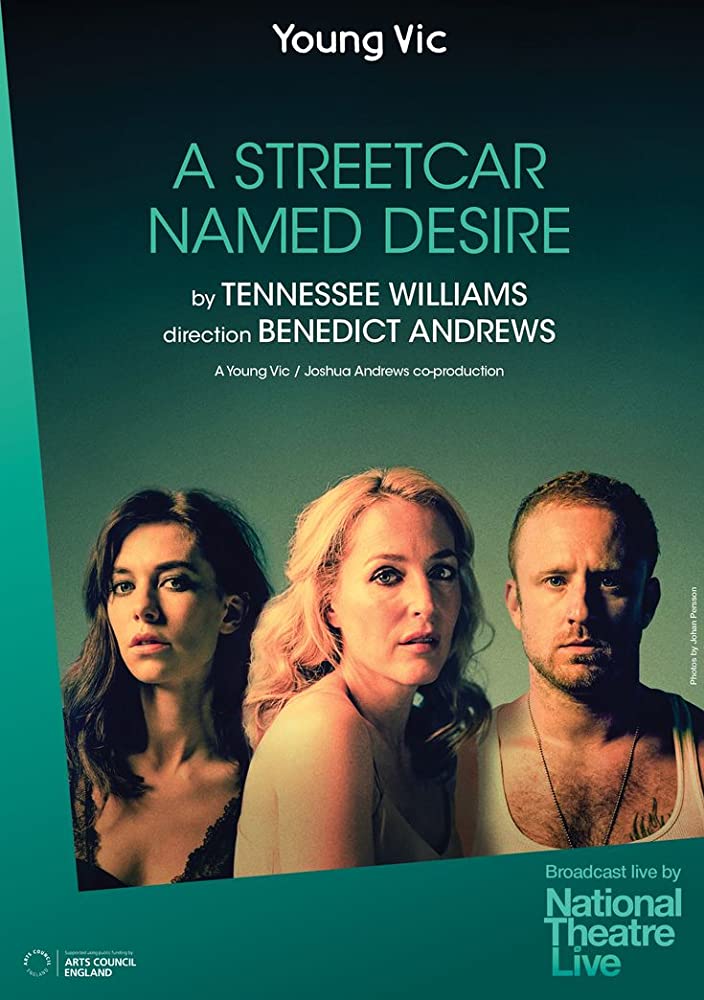
A STREETCAR NAMED DESIRE


Written by Tennessee Williams
Directed by Benedict Andrews
The Young Vic 2014
National Theatre Live streaming

Reviewed by Len Power 26 May 2020

A Streetcar Named Desire, written by Tennessee Williams, first opened on Broadway in 1947.  It’s now considered one of the great American plays of the 20th century.

It focusses on Blanche Dubois, a fading Southern Belle, who visits her sister, Stella, in a rundown neighbourhood of New Orleans.  Soon, her aristocratic airs and graces begin to aggravate Stella’s brutish husband, Stanley.  When he confronts her with some uncomfortable truths he’s learned about her recent life, the mentally fragile Blanche loses her grip on reality and descends into madness.

The play brought the young Marlon Brando to prominence in a performance now considered definitive.  The 1951 movie version of the play, in which he repeated his role with Vivien Leigh in a formidable performance as Blanche, set a benchmark that is arguably almost insurmountable for other performers attempting these roles.

In the Young Vic’s 2014 production, streamed as part of the National Theatre Live program recently, Gillian Anderson of The X Factor fame on TV tackles the role of Blanche and Ben Foster takes on the role of Stanley.  Both are skilful players but the decision by the director, Benedict Andrews, to update the play to the present day has a negative impact on their performances.

Gillian Anderson gives a strong, unflinching performance as Blanche but her dialogue sounds ludicrous in the present day.  It was understandable in the original 1940s period of the play that Blanche would have grown up instilled with the southern manners and morals of the past, but that’s unlikely if she had been born in the 1970s as this Blanche must have been.  We just can’t believe in her.

Ben Foster fares better as Stanley but his attitudes and behaviour seem decidedly out of period as well.  However, Vanessa Kirby was excellent as Blanche’s sister, Stella, as was Corey Johnson as Blanche’s mild-mannered suitor, Mitch.

Directed in the round by Benedict Andrews, it had a practical, but lacking in atmosphere set, by Magda Willi.  Slowly revolving most of the time, it was a bit annoying on film but maybe it enhanced the show for a live audience.

It’s still a powerful play in spite of the updating problem and it wasn’t hard to stay with it right through its lengthy running time.  Worth seeing but could have been so much better.

Len Power’s reviews are also broadcast on the Artsound FM 92.7 ‘In the Foyer’ program on Mondays and Wednesdays at 3.30pm.

‘Theatre of Power’, a regular podcast on Canberra’s performing arts scene with Len Power, can be heard on Spotify, ITunes and other selected platforms or at https://player.whooshkaa.com/shows/theatre-of-power.

FRANKENSTEIN


Adaptation by Nick Dear of the Mary Shelley novel
Directed by Danny Boyle
National Theatre, London
Streaming on You Tube from the National Theatre Live 30 April 2020

Review by Len Power 4 May 2020

Mary Shelley’s novel ‘Frankenstein; or, The Modern Prometheus’ was first published in 1818.  It was written as part of a contest between herself, her future husband, the poet, Percy Bysshe Shelley and Lord Byron, the poet and politician, to see who could write the best horror story. The topic of galvanism and occult ideas had been recent themes of conversation among her companions and informed her story.

Since publication, her novel has had a considerable influence in literature and popular culture and spawned a complete genre of horror stories, films and plays.

It tells the story of a scientist, Victor Frankenstein, who creates a creature from the body parts of deceased persons and then brings it to life.  He is horrified by what he has created and flees but is confronted by the creature years later.

Adapted from the novel by Nick Dear, a production of ‘Frankenstein’ was a huge hit for the National Theatre in London in 2011.  Taking incidents from the original novel and also from the famous films and embellishing them with his own ideas, Nick Dear created an exciting and thought-provoking play.  Although played in period, this treatment of the story made us question how we react to people with severe disabilities in our supposedly enlightened times.

The production was directed by Danny Boyle with a cast including Benedict Cumberbatch and Jonny Lee Miller.  The two lead actors alternated the roles of Victor Frankenstein and the Creature.

The live filmed original production was made available for streaming on Youtube by the National Theatre Live season of plays.  The.alternate performances were available for streaming on successive nights. Both performers gave superb performances in both roles.  Benedict Cumberbatch was especially impressive in his physical performance of the Creature.

The scenic design by Mark Tildesley was spectacular, using the vast open thrust stage and the revolve in the Olivier extremely well. There was an eye-popping lighting design by Bruno Poet that used hundreds of pendant lights above the stage and auditorium to give an amazing atmosphere to the production.

Nick Dear’s adaptation by the Ensemble Theatre in Sydney toured their production of ‘Frankenstein’ to the Street Theatre here in Canberra in 2013.  I gave it a rave review at the time.  It was very interesting to see the original from the National Theatre which had been produced on a much more elaborate scale.  The play was no less powerful in the Ensemble Theatre’s smaller scale production.

This was theatre that really delivered.

Len Power’s reviews are also broadcast on the Artsound FM 92.7 ‘In the Foyer’ program on Mondays and Wednesdays at 3.30pm.

‘Theatre of Power’, a regular podcast on Canberra’s performing arts scene with Len Power, can be heard on Spotify, ITunes and other selected platforms or at https://player.whooshkaa.com/shows/theatre-of-power.

Thursday, May 28, 2020

Ensemble Conversations

Ben Wood in his upcoming role as Kenny
Ensemble Theatre Conversations  http://www.ensemble.com.au/discover/ensemble-conversations/

Media Contact: Susanne Briggs 0412 268 320 or susanne@ensemble.com.au


Commentary by Frank McKone
May 28

Led by Ensemble Theatre’s Artistic Director Mark Kilmurry, each week people can tune in on Facebook for Ensemble Theatre’s latest news and a glimpse behind the scenes.

Ensemble Conversations features interviews with actors and creatives, exclusive scene reads, interactive Q&A sessions and more. Ensemble Ambassadors Georgie Parker, Todd McKenney, Kate Raison and Brian Meegan, writer Melanie Tait, director Priscilla Jackman and actor Ben Wood were the first to start the brand new series answering questions about the world of theatre and television
followed so far by actor Sharon Millerchip, writer Joanna Murray-Smith, director Kate Champion and this year’s Sydney Festival director, proud Noonuccal Nuugi man, Wesley Enoch.


Georgie Parker
Mark Kilmurry, Ben Smith
Melanie Tait, Priscilla Jackson

Kate Raison, Brian Meegan


Todd McKenney

Mark Kilmurry, Sharon Millerchip

Mark Kilmurry, Kate Champion
Joanna Murray-Smith appeared on a separate screen
While theatres are unable to stage shows for full-audience live performances, many like The Street, in Canberra, and Sydney Theatre Company, Belvoir and others in Sydney, are presenting live-streaming events.  Ensemble’s Conversations are not performances, in the ordinary sense, so this is not a formal review, and I admit my bias here.

Ensemble Theatre, “Australia's longest continuously running professional theatre group, having given its first performance in Cammeray Children's Library on 11 May 1958. ... was founded by Hayes Gordon AO OBE along with the Ensemble Studios acting school, which introduced Stanislavsky-influenced method acting to Australia” has always been a place where I have felt personally connected – including having a nephew who trained there, a student who teched there in the 1980s, and one-time student, now actor/writer/director Steve Rodgers who performed in The Odd Couple at the Ensemble last November and is currently adapting for stage the Jacobson Brothers’ Kenny, in rehearsal now but delayed by coronavirus.

Though I was never directly involved in the company, in the late 1960s I took students to see Hayes Gordon directing in rehearsal, and sat on a NSW Department of Education panel chaired by Sandra Bates (to whom Hayes later passed on the role of artistic director) to design the state’s first high school drama teaching studios.  This experience helped inform my work in the 1970s setting up and teaching drama in Canberra; while more recently as a reviewer I have followed David Williamson’s productions at the Ensemble which has become his favoured small theatre especially since Sandra directed Face to Face in 2000.  (https://frankmckone2.blogspot.com/2000/03/2000-face-to-face-by-david-williamson.html)

So I am happy, and certainly not surprised, to watch the current artistic director, Mark Kilmurry, having such personal family-like conversations with actors, writers and directors.  The atmosphere of friendly cooperation among practical people putting on plays, without being pedantic or seeking fame, is my Ensemble – yet these conversations are anything but mere theatre gossip.

Mark is an interviewer to the extent that he has in mind a series of similar questions for each conversation, but because he has often acted with, directed or worked with each of his colleagues, the questions are put in the context of a particular production,  rehearsal or development process.

For viewers with little if any backstage experience, the conversations are thoroughly enjoyable while also providing a new insight into what writers, actors and directors of live stage works actually do to create quality theatre.

Especially important, I think, is to show how much brainwork is involved in playing roles, knowing the boundaries between role-playing and non-acting states, and in creatively playing with social cues expressed in words and movement.  Georgie Parker emphasises the process of researching a character, for instance, and also spoke about the differences between acting on camera for television or film compared with being on stage with an audience, and explained how she finds stage more satisfying.  Ben Wood talks of how good writers give the actor words with a rhythm and timing which create the moments when a feeling ‘lands’ and spreads throughout the audience, sometimes in laughter, sometimes in silence.  Either is as satisfying for the actor, whether it be written by Shakespeare, David Williamson or for his recent role as Henry VIII in The Last Wife by Kate Hennig (reviewed here September 2019).

Today, May 28, Wesley Enoch – in isolation during Reconciliation Week – says: “I miss being close to people, telling their stories.”  For this, he explains, we need live theatre rather than screens.

The series of Ensemble Conversations continues while Convid-19 rages.

Mark Kilmurry, Wesley Enoch


Tuesday, May 19, 2020

Selby and Friends Online: Let’s Get Personal, May 2020

Haveron, Selby and Clerici

Reviewed by  Jennifer Gall


ONE of the strange ironies of the current Covid situation is that a Chamber Music concert presented online can be an extraordinarily intimate experience for a very small number of people, perhaps more closely reflecting the composer’s original intent – except for that one all important fact – the music in our homes is mediated by a machine and the internet.

Kathy Selby has seized the challenge of presenting her 2020 series in a world without concert halls and created an impressive musical experience for her subscribers. The concert, Let’s Get Personal, was recorded at Sydney Grammar School with a very quick turnaround time. It is a skilful production because it combines the familiarity of Kathy’s spoken introduction with an uninterrupted concert performance, supported by a delightful, informative conversation between the three performers: Kathy Selby, piano, Andrew Haveron, violin and Umberto Clerici, cello. As listeners, we had the best of all worlds by hearing beautiful performances, then the immediacy of hearing an animated and spontaneous interrogation of the program by the musicians themselves. The filming was unobtrusive and panned smoothly between single musicians and the ensemble, just as the eye would move in a more traditional concert.

With the joyous opening Mozart Piano Trio No 3 in B flat major, K502, there was an immediate lifting of the spirits. Composed in 1786, an important and eventful year for Mozart in his career trajectory, the Trio balances youthful exuberance with the confidence of a composer who consummately provides each instrument with an assertive voice in the musical conversation. The three movements, Allegro, Larghetto, Allegretto are neatly contrasted to offer ample time for anticipation, contemplation and resolution. In this performance there was unmistakable warmth in the combined sound of three friends conversing. In the Larghetto, the instruments interwove three distinctive sinuous and lovely melodic threads, the tempo perfectly calculated to offer a slow - but not too slow – unfolding of the thematic ideas. The final, delicate Allegretto was a perfect conclusion of this sparkling work.

In listening to Beethoven’s Piano Trio in E flat major, Op.1 No. I was mindful of Umberto Clerici’s observation that Beethoven wrote to challenge the established forms of his era, always composing music for the audiences of the future, anticipating an era wherein dramatic changes of thematic and dynamic direction would be the spice that listeners were expecting in a concert. Beethoven’s Op.1 fitted very well with the earlier work by Mozart, and one could imagine that both composers would have enjoyed hearing their music played in this sequence. I enjoyed the sparring of violin and cello – the particular tone of these two venerable instruments speaking to each other was proof that the musicians were emotionally and technically invested in producing such fine music.

Dvořák’s PianoTrio No 4 in E minor, Op. 90, the ‘Dumky’, is a familiar work to many Chamber Music lovers. Andrew Haveron explained it as the composition into which Dvořák poured his complete devotion to the language, traditional music and cultural history of the Czech people. The form incorporates 6 ‘dances’ with variations, leading the audience through a kaleidoscope of passionate musical sound, creating rich pictures for the imagination as a heart-piercing violin melodiy is next enfolded in a tender, soaring cello melody, with the piano providing the underlying pulsing heartbeat.

We are indeed lucky at this time to hear the performance presented by Kathy Selby. She has grasped the technology possibilities available and created a lifeline to connect audiences with chamber music until we are able to meet again in more traditional concert venues.