Friday, March 25, 2022

THE KING OF PIGS


Written by Steve Rodgers

Directed by Blazey Best

Red Line Productions & Critical Stages Touring

Q Theatre, Queanbeyan to 26 March


Reviewed by Len Power 24 March 2022


You’d probably expect a play about violence against women to be written by a woman, but ‘King of Pigs’ has been written by male award-winning Australian playwright, Steve Rodgers.

The play tells multiple stories of domestic violence.  If the stories seem familiar, it’s not surprising.  Domestic violence statistics in this country are shocking and partner abuse is still a massively unreported crime.  Many of us have experienced these crimes in our own families or know of friends, neighbours and work colleagues who have suffered through these situations.  Television and newspaper reports of particularly horrific incidents of abuse and deaths occur with appalling regularity.

The stories presented in Steve Rodgers’ play deftly show what a minefield a relationship between a man and a woman can become if the potential for violence is there.  The lies, the promises to change, the shifting of blame and contrite emotional appeals can make it very difficult for a woman in a violent relationship originally based on love and affection to make clear choices about her future.  The fact that the outcomes of the stories presented in the play are hard for the audience to predict mirrors these situations in real life.

One actress, Kate Skinner, plays all of the women subjected to abuse in these stories.  Playing women of various ages, she is totally convincing as each character.  The men in the stories are given sharp and believable characterizations by four actors, Jason Chong, Tom Stokes, Anthony Yangoyan and Sam Alhaje.  On opening night, Nate Sammut gave a fine performance that showed an understanding of the impact on a child caught up in domestic violence.  Kick McKinnon will play the boy at other performances.

Director, Blazey Best, has given the play a strong, controlled production in all aspects.  She has obtained in depth performances from each of her actors and has given the production a striking and original theatricality.  Each scene plays like a snapshot of life with fast blackouts and quick resets by the actors between scenes.  The action within the scenes is smooth and natural and the physical violence, while strong, is artfully performed by the actors and over quickly.

The excellent and complex lighting plot by Verity Hampson is an important element of the atmosphere created by the director.  The simple set and costumes designed by Isabel Hudson are exactly right.

Although the play is about a tough subject that many people prefer to avoid, it does not preach its message.  It is stimulating because it is well-written and structured and has been given a strikingly good production.  If you’re undecided because of the subject matter, go because this play is thoroughly engaging for lovers of good theatre.


Len Power's reviews are also broadcast on Artsound FM 92.7 in the ‘Arts Cafe’ and ‘Arts About’ programs and published in his blog 'Just Power Writing' at https://justpowerwriting.blogspot.com/.

 

Sunday, March 20, 2022

THE GREAT GATSBY


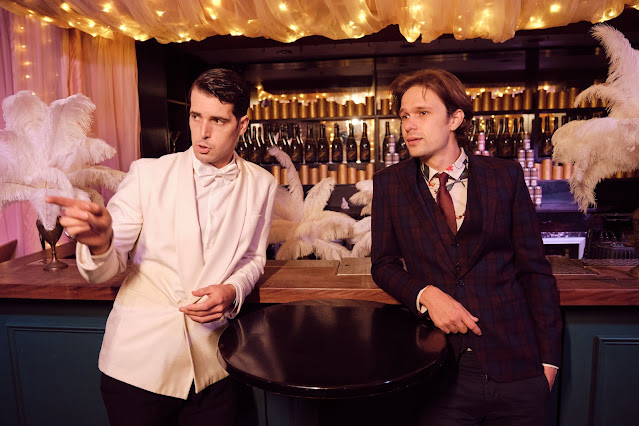
Jay Peardon as Jay Gatsby - Ryan Hodson as Nick Carroway in "The Great Gatsby"

Written and produced by Aaron Robuck – Executive  Producer: Aden Levin.

Directed by Beth Daly - Designed by Brendan de la Hay

Wonderland Bar, Bayswater Road, Potts Point until 26th June 2022.

Performance on 20th February reviewed by Bill Stephens.

It’s not every day a reviewer is invited to review a show in a brothel. Well, to be accurate, a former brothel. However, now re-purposed as Wonderland Bar, this handsome heritage mansion, lavishly tarted-up by designer, Brendan de la Hay provides the perfect environment for this intriguing production of “The Great Gatsby” which offers an immersive experience that doesn’t depend on technology.

Limited in number to 40 patrons, the audience is invited to dress in the period of the play. On arrival each is offered a complimentary glass of champagne before being ushered into a series of rooms, spread over the three storeys of the mansion, where they become voyeurs to the interactions of the actors.

For Aaron Robuck's clever adaptation of the familiar F.Scott Fitzgerald story, the fabulously wealthy Jay Gatsby is played by recent WAAPA graduate Jay Peardon. Tall and handsome, Peardon has a striking presence and confident air of sophistication which makes him perfect casting for this role.

Ryan Hodson plays Nick Carroway, the naïve young visitor from Minnesota whose unconventional friendship with Gatsby forms the nucleus of the story.  Hodson, who as Carroway also narrates the story, manages to achieve an appealing balance between naivety and curiosity for his character as he observes the decadent behaviour of the hangers-on with whom Gatsby surrounds himself, as he too becomes inexorably drawn into their shenanigans.

Jessica Redmayne as Daisy Buchanan - Jay Peardon as Jay Gatsby in "The Great Gatsby"


Jessica Redmayne is also charismatic as Carraway’s mysterious cousin Daisy Buchanan, who’s in love with Gatsby but married to the controlling and immensely wealthy Tom Buchanan, played with a louche charm by Joshua Ralph McElroy

Among the coterie of friends who surround Gatsby, Hannah Raven is a stand-out as the sophisticated 1920’s new woman and competitive golfer Jordan Baker. Alicia Rose Quinn is also memorable as Tom Buchanan’s lover and flamboyant burlesque performer, Myrtle Wilson, who enlivens one of the parties with a spectacular strip routine performed in front of a giant mirror.

Various other characters, including entertainers at the parties, are performed with panache by Adam Di Martino, Kristina McNamara, Cody Ross and Sebastian Nelson.


Hanna Raven - Ryan Hodson -Joshua Ralph McElroy - Jay Peardon in "The Great Gatsby"


What separates this production from usual restaurant concepts is that the actors take their roles seriously so that it is possible to get caught up in the story. All admirably maintain concentration, despite the close proximity of the audience, only occasionally interacting in character with the audience as a fellow guest at one of the parties, or perhaps gently requesting someone to vacate one of  the impressive velvet lounges or antique furniture props they may have inadvertently occupied when it is needed for the performance.  Otherwise audience participation is minimal and discreet.

Production values are excellent, as is the direction and the performances, making “The Great Gatsby” highly recommended for anyone interested in experiencing a unique, unusual and highly enjoyable theatrical experience.  

The Cast of "The Great Gatsby"


                                             All images by Aaron Lyon iota Media.


    This review also published in AUSTRALIAN ARTS REVIEW. www.artsreview.com.au

Saturday, March 19, 2022

KIRSTY WEBECK SILVER LININGS


Kirsty Webeck -Silver Linings. 

 The Piglet Room. Gluttony. Rymill Park. Adelaide Fringe  March 8-14 2022

Reviewed by Peter Wilkins

The Adelaide Fringe is in full swing and in the Piglet Room at Gluttony  Kirsty Webeck is on top form. For those who don’t know, the Piglet Room is an old container on its side, lined with lights and open to the audience who sit on chairs in Adelaide’s shining sun. It’s not the usual place for a comedy act, but Webeck could turn a black box into a shining stage of gags and laughter. It’s been a while since I first saw Webeck at The Front in Canberra. It was the early days of a career that has taken off and at her latest show, Silver Linings, it’s easy to see why. Webeck is just naturally funny. She exudes a mocking joy of life and a healthy disrespect for anything serious. Silver Linings is about managing expectations, negotiating conversations and winding her way through tricky situations and difficult relationships. It is this bounding enjoyment of the absurd and the ridiculous that Webeck weaves into her comedy act and draws in her audience by inviting them to judge the way she deals with confrontation and negotiation. Thumbs up if she has managed the tricky topic well. Thumbs down if she has made a hash of it. The audience in the Covid safe open air played along and Webeck kept her act rolling along.

You can’t help but be swept along by Webeck’s sense of fun. She is having the best time, laughing along with her material and giving her audience license to laugh. The nervous comedian at The Front has become assured and expert at the challenging career of stand up. Her stories are personal and even the funeral of a drag racing mate can be a source of ironic comedy. It is in the account of her proposal to her partner that Webeck has her audience in the palm of her hand. Her partner is a nurse, dealing daily with the challenges of Covid and Webeck had carefully planned a romantic proposal which naturally went wrong. That’s what makes comedy, and Webeck knows how to turn a serious situation into a barrel of laughs. How do you pop the question and present the sparkle when the first words your girlfriend says are “Your feet stink” That’s sure to put a dampener on things, but not for Webeck. This is one time when her natural honesty and love can turn the situation around.

Comedy is taking risks and stand up is knowing how to be prepared for anything. Telling her audience how much she dislikes first aid workers who have conjured up a first aid certificate, she asks how many in the audience have first aid certificates.  Whether she expected so many I don’t know, but undaunted Webeck carried on. If nothing else, you need to be fearless as a stand up comedian, and Webeck, who takes everything with a rumbling laugh is certainly fearless and the audience is in stitches at the account of a pompous first aid certificate holder edging in on Webeck’s partner to treat an injured player.

You can’t help but like Webeck. She is everybody’s mate, the kind of person you would want to have  a drink with when things were feeling a bit rough. She puts you at ease because whatever the problem, however gloomy the day, Webeck will always see the silver lining. Her show is not a Gatling gun of gags. It is about ordinary situations. It is about being who you are and being comfortable with it. It’s not all laughter and her thumbs up thumbs down routine gives an audience pause for thought. Above all Silver Linings is original, personal and innocently funny. Like all good comedy we see the ridiculous in ourselves and laugh at someone else reminding us that every cloud has a silver lining if only we can manage our expectations.  It is easy to see why when Webeck  listed her show as the last one for an audience to judge they all gave her an in the air thumbs up.

Kirsty Webeck will be performing Silver Linings at The Street Theatre for one night only on Thursday March 24 at 7 p.m.  Tickets are $32. Bookings: 62471223


Friday, March 18, 2022

MANIFESTO ADELAIDE FESTIVAL 2022


Manifesto. 

Choreographer Stephanie Lake. Composer Robin Fox Lighting designer Bosco Shaw. Set designer Charles Davis. Costume designer Paula Levis. Dancers: Rachel Coulson, Marni Green. Samantha Hinea. Melissa Pham. Harrison Ritchie-Jones. Robert Tinning. Osie Welse. Kimball Wong. Jack Ziesing., Understudy. Franky Drusioti. Drummers: Robbie Avanaim, Nat Grant, Alon Ilsar, Maria Moles, Tina Nguyen, Rama Parwata, Rohan Rebeiro, Alex Roper, Jen Tait. The Dunstan Playhouse. Adelaide Festival Centre. Adelaide Festival. March 17-20 2022

Reviewed by Peter Wilkins. 

Stephanie Lake. Choreographer of Manifesto
 

“There is something primal about this show (Manifesto)” Stephanie Lakes writes in her program note. “It is to be experienced, not intellectualized or analyzed. It is unmediated energy and force”

It is that and much more. On Charles Davis’s set reminiscent of the setting for the big bands of the Golden Age, nine drummers sit against a bright orange backdrop. On the stage, nine dancers in white costume sit on chairs, waiting to burst into life. A single loud beat of the drum and the bodies twitch into a frozen moment. Another and as though charged with electric current the dancers change pose. The control is extraordinary, the movements instantaneous and precise, the bodies switching on the current of vibrant response to the percussion and Robin Fox’s remarkable orchestration of the multi-timbral percussion ensemble.

 And suddenly the stage bursts into life as the dancers leap, twist, roll and gyrate. What follows to the sound of the incessant percussion coursing through the body is a series of perfectly choreographed and beautifully sculpted movements. The air comes alive with the grace of the ballet. The floor rebounds with the assault of break dance, the stage leaps to the darting movements of hip hop and suddenly the ensemble comes together in a community of solidarity or comforting security or defiant rebellion. Fox’s composition finds the emotional heart and the dance becomes a stunning synthesis of sound and movement.

Lake is a choreographer who not only has an instinctive appreciation of the power of contemporary dance but also an obvious love of her dancers. Each drummer and each dancer is given a solo moment to shine. The dance finds antithesis in its changing form. There are moments of contemplative stillness, expressions of joy and frolic and eruptions of chaos. Human nature finds expression in the skilfully choreographed patterns of the dance. There are moments of sadness, moments of conflict, moments of elation and moments of sheer ebullience. The use of the drums as a soundtrack to the dance is a brilliant concept that lends Manifesto an unabashed and ground-breaking celebration of the art. There is no pretension. Manifesto is celebration, it is ritual, it is worship and it is community. Above all it is a joyous celebration of being alive, an unforgettable life-affirming force. At the end of the performance one leaves replenished, embraced by the original and imaginative talent of Lake’s highly inventive choreography and Fox’s ingenious composition for drums. This is dance that does not ask you to work out what it’s all about. Watching such phenomenally flexible and expressive dancers on stage is cathartic. Listening to the rhythms of the drums is uplifting and by the end of this extraordinary performance one is left with a shared feeling of communal joyfulness and hope.

 The one hour performance resounds with the brilliance of creative collaboration and percussive and physical agility. As the company takes its final jubilant bow, there is an air of joie de vivre that makes Manifesto one of the Adelaide Festival’s unforgettable highlights


Thursday, March 17, 2022

Nearer the Gods


Nearer the Gods by David Williamson.  Ensemble Theatre, Sydney, March 4 – April 23, 2022.

Reviewed by Frank McKone
March 16

Director – Janine Watson; Assistant Director – Rachel Chant

Cast:
Violette Ayad
Jemwel Danao
Rowan Davie
Gareth Davies
Sean O'Shea
Sam O'Sullivan
Shan-Ree Tan


Understudies: Lloyd Allison-Young; Claudia Ware


Set & Costume Designer - Hugh O'Connor; Associate Set & Costume Designer - Veronique Benett; Lighting Designer - Matt Cox; Composer & Sound Designer - Clare Hennessy

If William Shakespeare in 1600 could present plays based upon what research he had available about historical figures – Richard III, Henry IV and Henry V – whose influence was still highly significant after a century or two, why should David Williamson not do the same for Isaac Newton and Edmond Halley today?

At least Williamson will not face questions of political bias as we have seen about Shakespeare’s representation of King Richard, say – but maybe some will have concerns about matters of Faith in God denied by those who believe in Universal Force of Gravity.

Nearer the Gods is a different kind of play from Williamson’s more usual comedies of middle-class manners.  It reminds me, though, of his Heretic – in which Margaret Mead and Derek Freeman argue about the truth of their research into South Sea Islands’ culture.

In Nearer the Gods it is womaniser King Charles II who would love to escape his kingly responsibilities and travel to the South Seas with Edmond Halley chasing comets – not for the astronomical observations but for the ‘dusky’ ladies to add to his collection of Nell Gwynns.  Did I say Nearer the Gods is not a comedy?  But there is much arch humour here in the story of The Royal Society  which was founded in 1660 to bring together leading scientific minds of the day, and how “In the end it fell to two of history’s great heroes, Edmond Halley and his wife Mary to sort the mess out” of Isaac Newton’s on-the-spectrum personality and Robert Hooke’s revengeful paranoia.  

However important to Shakespeare were those kings from whom his Queen Elizabeth was descended, nothing matches the importance of the calculus, the inverse square law and the theory of the universal force of gravity to our world today.  But when it came to publishing Newton’s Philosophiae Naturalis Principia Mathematica without what Hooke completely unreasonably demanded as his due recognition as the ‘father’ of Newton’s mathematics, King Charles – in Williamson’s play at least – had to point out that the Royal Society was, after all, ‘My’ Society and he wanted the book without further delay – finally in 1687.

Does this make Williamson a modern Shakespeare?  I think it does.  As we still remember that Mark Antony said “Lend me your ears” we will not forget what Edmond really did say about Isaac: “Nearer the gods no mortal may approach” because, as Williamson puts it in his Writer’s Note, “Isaac Newton gave the world the greatest leap in knowledge we’ve ever been gifted.”

David Williamson’s gift to us is to bring these historical mathematicians, mysterious to most of us, to life by focussing on Mary’s need for faith in her God and Edmond’s coming to understand how we all need our own faith in ourselves and in each other, because we are mortal.  That is the universal gravity that keeps us together.  

This is the level, or perhaps the depth, which takes Nearer the Gods, his fourth-last play, written in 2018 approaching the 80 years he reached as this production was about to open, into a greater realm, where our personal experience of love is equally as important as our intellectual understanding of the forces of the universe.  Science and the Arts come together in an extraordinary way in Nearer The Gods by David Williamson.

The style of the production is new too, for Williamson.  Short snappy scenes make it clear from the beginning that this is a play, a designed piece of theatre.  A fully costumed 17th Century figure tells us in the first minute that the actors will not be dressed in his finery, but in ordinary modern dress.  

After a flash of disappointment, I felt as soon as the very next encounter of characters was underway that I understood the purpose: to take us out of being fascinated by the fakery of extravagant costumery immediately into the presentation of the relationships in our own language.  Oddly enough, Shakespeare had done the same in his day and age.  

One term often used to describe the bard’s performance style is ‘presentational’.  Yet Williamson’s skills did not mean falling into something like Brechtian distancing effect.  We were kept on the outside as observers of the action, yet were quickly engaged in recognising the feelings of each character and why they reacted as they did – and this became the ever-shifting platform on which the story was laid out.  We even applauded when Newton was at last accepted into the Royal Society (1672)

The stylistic approach made great demands on all the actors, where timing and detailed expression in voice and movement had to dovetail perfectly, even as several actors played more than one role.  Just as timing is essential in comedy, Williamson makes the comedic method work here for a serious purpose.

Ending with the announcement of the resolution of Mary and Edmond’s likely marital trials and tribulations as it actually happened in history – in 54 years of marriage, it was a relief to know the fictional was factual.   

In other words, Nearer the Gods is an original work in the proper sense, and no-one but David Williamson can claim to be the father of its combinations and commutations.  Not to be missed.


©AZ QUOTES


WUDJANG:NOT THE PAST ADELAIDE FESTIVAL 2022


 Wudjang:  Not the Past.

Directed and choreographed by Stephen Page. Written by Stephen Page and Alana Valentine. Composer Steve Francis. Set design by Jacob Nash. Costumes by Jennifer Irwin. Lighting by Nick Schlieper. Language consultant Donna Page. Bangarra Dance Theatre, Festival Theatre. Adelaide Festival Centre.  Adelaide Festival. March 15-20. 2022

Reviewed by Peter Wilkins.

There is a sombre tone to Karl Telfer’s greeting to Country and the reading of his late mother’s poem calling the old spirits home.  He echoes the theme of Bangarra’s new work, Wudjang: Not the Past for here in the spirits of his First Nation people the past is the present and the present is the past.  Artistic director Stephen Page’s epic new work is powerful and authentic truth telling, visceral in its artistry, an inspiring fusion of music, song and dance and an anthem to survival and resilience. 


Page and writer/dramaturg Alana Valentine have created a narrative arc, embracing traditional stories with a contemporary scenario. As a prologue, gentle bush sounds of birds and running water fade as flashes of light dart through the auditorium and the ominous rumble erupts in a violent explosion and blackout. The explosion tears the heart out of Country to construct the white man’s dam. It augurs the brutal rape of the land of spirits and ancient culture.  The curtain rises on the vast clawed wheel of a digger, the symbol of destruction.  On a raised platform evocatively lit by Nick Schlieper’s lighting design sits Yugambeh man, Bilin (Kirk Page). In Mununjali language he sings the song of The Metal Mouth, a lament for the destruction of his land. With his niece, Nananhg (Jess Hitchcock) he slowly uncovers the ancestral bones of Wudjang, meaning mother, and mesmerizingly danced by Elma Kris, and Gurai meaning wonder (Lilian Banks). Wudjang is released from the earth and so begins the lesson that Nananhg can learn. In eight scenes, in which the soaring spirit of song, music and poetry and dance combine  Nananhg is guided by Maren, a representation of the ancestral maternal line, and performed with enormous stage presence and powerful voice by Elaine Crombie. Nananhg learns of her past traditions and relationship with Country. She witnesses again the cruel invasion of colonialism, its devastating oppression and rape and massacre of her people. She struggles to bestride two cultures as a woman in the modern age, seeking an understanding of Wudjang until she too can know her story and sing her ancient tongue. In a final moving act, Wudjang is returned to Country and spirit, endurance and resilience have triumphed. The figure of the white man’s wrongs, Duggai (Justin Smith) Judas like repents of the atrocities of the past, laying open a possible path to reconciliation.

On the Festival Theatre stage, Wudjang: Not the Past assumes the epic stature of opera and Greek tragedy.  Steve Francis’s composition of Page and Valentine’s poetry is imbued with the spirit of resistance and resilience. It is the proud story of a defiant people, struggling against horrific crimes of rape, murder and dispossession. These are songs of resistance and of hope, striving for restoration and healing. With musical director Alan John, the band and the haunting melodies of the violin, Francis’s composition embraces First Nation tradition and contemporary compositions creating music that aptly underscores such a work of vast magnitude.

If the production’s music is the expression of the soul, Bangarra’s dancers are the magical storytellers of their art. Their athleticism, their fluidity, their emotion and their spirit combine in a bewitching display of storytelling through the art of dance.  Wudjang: Not the Present  is neither obscure nor abstract in its storytelling.   Lyrics and dance present a narrative that is powerfully and clearly told, visually dynamic, aurally transformative and spiritually arousing. It is a salutary experience of ancient truths and contemporary shame. As rich and uplifting as it may be as a theatrical spectacle, it is essentially a lesson that we too must learn with Nananhg.

This is Stephen Page’s deeply personal story.  It is the story of a proud Yugambeh man who lives with the white man in a land that still calls out for healing and reconciliation. It is the tale of invasion, of persecution and enslavement, of the Nerang massacre under Frederick Wheeler, of a stolen generation and the loss of language, culture and exploitation. It is also a story of hope and as the feathers fall from above onto the stage below and Nananhg and the cast celebrate Wudjang’s endurance with the final chorus of resolve;

While the land is here we are

While the land still breathes we are

While the rivers run we are

We will never leave.

( I would have liked surtitles to completely  immerse me in the beauty and the power of the language).


Wudjang: Not the Past is more than a story, told in dance, music and song. It reaches out beyond place and time to teach, to learn and to understand. Bangarra Dance Theatre has created a work that will stand forever as an anthem to the human spirit. It is an ode to collaboration and cooperation. It is the voice of First Nations culture and the hope for the future. Wudjang: Not The Past is a theatrical triumph and a spiritual awakening.

If Wudjang: Not the Past is Stephen Page’s swansong as artistic director of Bangarra Dance Theatre before handing over to Frances Rings, then this is a song that hits the highest note. It is a gift not only to his clan, but to all First Nation people and the nation.  

Photos by Daniel Boud


Wednesday, March 16, 2022

BEAUTIFUL WORLD - FRANCES MADDEN and her All-Star Band


Frances Madden and her All Star Band performing in The Street Theatre.

The Street Theatre – 12th March 2022.

Reviewed by Bill Stephens


Making her first appearance in Canberra as part of a five-city tour to launch her latest album also entitled “Beautiful World”, Frances Madden, performing in a sophisticated modernistic setting provided by the Street Theatre, turned out to be a real surprise packet.

A consummate musician, gifted composer and arranger, with a sweet voice and relaxed, engaging presence that exudes the joy of singing, Madden and her band performed an engaging program, of songs featured on her new album, new songs not yet recorded sprinkled with exciting arrangements of familiar standards.

Frances Madden performing at The Street Theatre.


The standards included an upbeat arrangement of  “Dancing in the Street” to open the show;  a lush arrangement of Oscar Peterson’s “Give Me The Simple Life” which provided Madden with the opportunity to show off her formidable jazz piano technique; a joyous romp through Gershwin’s “S’Wonderful”; and a gorgeously performed arrangement  of Leonard Cohen’s ubiquitous “Hallelujah” .

However it was Madden’s virtuosity as a composer and song stylist that were the most impressive aspects of this concert. Surrounding herself with musicians of the ilk of guitarist Carl Dewhurst, trumpeter Ray Cassar, Brett Hirst on double bass and Tim Geldens on drums, with Borbala  Bodonyi and Jo Fabro providing exquisite backing vocals, Madden, seated at piano and keyboards,  followed the rousing opening with a gentle new song, not yet recorded, entitled “Bless the Day”.

Unfortunately most of the lyrics for this song were lost in the poor sound mix which took some time to find the correct level. This problem also affected the performance of Madden’s charming ballad, “You’re doing so well”, and even the title song, an infectious, toe-tapping cover by Madden of the Adam Crossley song “Beautiful World”.

By the time we got to her rather wonderful arrangement of the Lerner and Lowe song, “On the Street Where You Live”, all had found their correct sound levels, allowing the audience to relax and savour Madden’s captivating vocal stylings.

In addition to her jazz credentials, Madden is also a brilliant classical pianist, often references classical compositions in her introductions for her own compositions. A few bars of Debussy’s “Clair de Lune” evaporates into a seductive rocking blues rhythm for “Change in Your Eyes” for which Carl Dewhurst contributed exquisite guitar interpolations. A long Liberace-ish flourish precedes the tango rhythm for the catchy, “The Tango Never Lies” which Ray Cassar embellished with a stylish trumpet solo.

Not the least of Maddens talents is her ability to charm her audience with her introductions to each item. To the point and thankfully devoid of unnecessary waffle, whether confiding a charming family revelation about ‘the chosen one’ to introduce her gentle lullaby “Made for You”, or a cheeky  red-herring about a temperamental orchid to explain the motivation for “You’re Doing so Well” , her gentle, confidently delivered introductions gave just enough information to enhance the enjoyment of each song.

Following a standing ovation at the end of her performance, which she rewarded with two encores, Madden declared that she would be back. She also mentioned that she was about to go overseas to explore further performance possibilities. She certainly has everything she needs to succeed.

But don’t wait for the world to discover her.  If she comes your way, be among the first to discover this prodigiously talented entertainer for yourself.


                                     Images by The Creswick Collective.


  This review also published in AUSTRALIAN ARTS REVIEW. www.artsreview.com.au