Saturday, June 25, 2022

AND THEN YOU GO - THE VALI MYERS PROJECT ADELAIDE CABARET FESTIVAL 2022


And Then You Go – The Vali Myers Project. 

Devised and directed by Victoria Falconer. Frank Ford Commission. Adelaide Cabaret Festival. Space Theatre. Adelaide Festival Theatre. June 24-25 2022.

Reviewed by Peter Wilkins

We peer intently in search of our seats in the dimly lit shadows of the Space Theatre at the Adelaide Festival Centre. There is an air of mystery, a sense of unusual expectation. On the floor between the colourful circles of light flame-haired  performers in the dress of Eastern European gypsies welcome audience with their conversation. A wolf boy, wild and abandoned leaps through the auditorium, occasional emitting the unrestrained yelp. Raised on the stage the musicians wait while above them on the screen images of the art work and writings of Vali Myers conjure a spirit world. We are cast back to another time, a time of strolling players, outsiders and free willed creators of their art.

Vali Myers

And Then You Go – The Vali Myers Project is a new and highly original work created, composed and performed by award winning musician and artist Victoria Falconer and inspired by twentieth century cult figure Vali Myers. With the aid of the Frank Ford commission for emerging and innovative artists Falconer has devised an intriguing multi-disciplinary and visceral account of the life of the uniquely creative Vali Myers. The performers all assume the character of Myers at various times in her life. One of them performs the contemporary dance, swaying with Dionysian liberation, a spirit unconfined by conformity. At other times she plays the flute, while other performers also weave an hypnotic spell of choral work, music and dance as they display Myers' chimera. Falconer has composed a score and set Myers words to music and the song of her soaring, unrestrained spirit. In a storytelling circle, the performers give an account of Myers life with occasional choral unison to avoid the recitation of fact. This is less effective except in the choreographed ritualistic conclusion to the narrative.

Victoria Falconer
 Falconer makes no attempt to construct a real and linear narrative. That would be contrary to the spontaneous creative passion that lures Myers from her bushland home to the artistic inspiration of Paris’s Left Bank to the idyllic charm of Positano and eventually back to Melbourne. Sartre, Dali, Tennessee Williams, Joni Mitchell and Andy Warhol all passed through her life, feeding her imagination and nurturing her artistic soul. These are the snippets of information that inform our understanding of Falconer’s fascinating and alluring Myers. And it is the fascination and the allure that is so captivating in this work.  We are fascinated by the psychedelic and mood-filled seduction of the lighting. The eclectic nature of the music and song channels the mercurial life force of this woman of the bush, a disciple of Nature, a lover of animals and her beloved Foxy and a woman whose practical view of existence coexisted with a palette of rich, unconfined and expressive experience.

 Her life’s metaphor is played out by a bare breasted aerialist, a creature of Nature who climbs the rope in an attempt to live her dreams, only to return from the sky to the dust, having lived a life “burning fast and burning bright.”, unconcerned with what people might think or say, and living life her way. And Then You Go – The Vali Myers Project is an experiential glimpse at the life of a woman who lived without fear and followed her passion and her dream. I have no programme to single out the exceptional musicians or the names of individual performers. Falconer is central to the work and guides the work through momentary impressions. The work still needs dramatic scrutiny. It is at times too repetitive, such as the scene with the rescued fox or the dance. The transitions need to be tighter so that the narrative can be clearer to avoid momentary confusion. There is such talent and such fascination in this commission that skilful dramaturgy could enhance.

On the wall outside the space, the company has displayed a time chart of Myers’ life interspersed with photos of a strikingly beautiful and fascinating woman and copies of her writings and philosophy on life. It is intriguing viewing and a necessary complement to a performance that is more about touching the human spirit than relating the incidents of her life. And Then You Go – The Vali Myers Project illuminates and intrigues, a commission well worth its support and worthy of further development and performance to a wider audience..   

MOMENTS IN THE WOODS - SONGS AND STORIES OF SONDHEIM. ADELAIDE CABARET FESTIVAL 2022


 Moments in the Woods – Songs and stories of Sondheim.

Directed by Mitchell Butel.Musical director. Josh van Konkelenberg. Arranger: Daryl Wallis.John McDermott on Drums. Alana Dawes on Bass. Christina Guala and Vashti Tyrell on Woodwinds. Her Majesty’s Theatre. Adelaide Cabaret Festival in association with the Adelaide Festival Centre. June 23rd. 2022

Reviewed by Peter Wilkins

Stephen Sondheim’s death last year, even at the age of 91, sent shock waves through the musical theatre world. It seemed most fitting then that  the festival should include a tribute concert in honour of the great composer, lyricist, and mentor. And who better than five of the finest exponents of Sondheim’s songs in the country to celebrate his genius?

Josie Lane, Queenie van de Zandt and Mitchell Butel in Moments in the Woods

Director Mitchell Butel is joined by Queenie van de Zandt, Josie Lane, Geraldine Turner and Philip Quast to perform Sondheim’s  songs, including many that they have performed in his musicals in Australia and internationally. What follows is a concert that would make the great man proud. From the moment the performers and the musicians join together with Hey Old Friends from Merrily We Roll Along they fill the theatre with love. Moments in the Woods – Songs and stories of Sondheim is more than a tribute concert. It is a joyous celebration of Sondheim’s vast talent and profound humanity. Each performer and I suspect most members of the audience have been touched, moved and inspired by the man and his work. Sondheim is the Musical’s Shakespeare. 


Queenie van de Zandt and Mitchell Butel
In an evening of sheer elation, Sondheim’s spirit soars upon the voices of the five performers imbued with his inspiration. Sondheim is the actor’s composer and the evening is far more than brilliant renditions of Daryl Wallis’s faithful arrangements of Sondheim’s songs. Each singer embodies the character of the song, breathing life into each note and playing the storyteller of life’s intricate tapestry. In a show with too many glittering gems of the master’s genius to mention, each artist is given the opportunity to shine. 


Josie Lane
The delightfully vivacious Josie Lane enchants with her rendition of Red Riding Hood’s number from Into the Woods and displays her comedic talent with the opening number of Sunday in the Park with George, sung with Philip Quast as artist, George Seurat. Queenie van de Zandt captures every ounce of vitriol and nastiness as the witch in Into The Woods.

Philip Quast and Geraldine Turner
Butel celebrates Sondheim’s skill as a lyricist with a cocky performance of Darryl Wallis’s rather strange and uncharacteristic arrangement of Something’s Coming from Leonard Bernstein’s West Side Story. Audiences are gifted with Send in the Clowns from A Little Night Music by the legendary Geraldine Turner, who blew me away when she sang The Miller’s Son, Petra’s song in A Little Night Music in Her Majesty’s Theatre in 1978. The legendary grand dame of Sondheim’s musicals and the first person to release a solo album of his songs, Turner’s Ladies who Lunch from Company brought the house down.  Butel announced that it was her birthday and the entire audience joined in to sing a stirring rendition of Happy Birthday. Thanks to the blessing of NT Live many may have seen Philip Quast’s performance of the famous Benjamin Stone from Follies. On stage Quast’s moving rendition of Ben’s Song exhibits the private anguish and self doubt of the celebrity. The familiar and the unfamiliar make up a fascinating evening of songs to celebrate the prolific life of an extraordinary and innovative talent. From solo renditions to duets such as Butel and Quast’s hilarious Agony from Into The Woods and Lane and van de Zandt’s Take Me To The World from Evening Primrose to full company numbers ending in a finale of Sunday from Sunday in the Park With George, this night of tribute sparkles with song and stories.

Geraldine Turner
It is an unforgettable night of reminiscences told adoringly by performers who knew Sondheim personally. “Bring your talent and observe the punctuation.” Sondheim told Turner. He would do the rest. “And he did.” she added. Quast recounted the time that he was doing fishing knots in his dressing room (“As one does”) and the ever curious composer asked him to show him how. A besotted Butel proudly showed a letter that he received from the prodigious letter writer. 


After interval the gems just kept sparkling brighter in the Ballad section of the night. Those who were there to witness will never forget Turner’s wonderfully cockney rendition of Mrs Lovett’s A Little Priest from Sweeney Todd or Butel’s sensitively sung Nothing Else Will Harm You from the same musical. Van De Zandt’s Who’s That Woman from Sondheim’s  Follies. And who will ever forget Lane’s brilliant, triumphant There Won’t be Trumpets from Anyone Can Whistle

The cast of Moments in the Woods
In his little known musical Evening Primrose Sondheim reveals his mantra in the song Take Me To The World. As a fitting finale to the programme Quast sings a combined version of Shakespeare’s song Fear No More the Heat of the Sun and Caesar’s speech to Calpurnia from Shakespeare’s Julius Caesar : “It seems to me most strange that men should fear seeing that death a necessary end will come when it will came.” It came as it does to Sondheim last year and the company read out some of the tributes that poured in to mourn his loss to the world of musical theatre. But Moments in the Woods- the Songs and Stories of Sondheim will remain for all fortunate enough to be at Her Majesty’s Theatre on June 23rd as a lasting testimony to the great man and the artists who so powerfully and lovingly brought forth their amazing talent to do Stephen Sondheim proud.     

Photos by Claudio Raschella    


Thursday, June 23, 2022

APCAR'S HOLLAND - CANBERRA SINFONIA

Ronan Apcar, piano

Rowan Phemister, harp

Conducted by Leonard Weiss

Canberra Sinfonia, Wesley Uniting Church, Forrest 19 June


Reviewed by Len Power


It’s not often that you have a concert showcasing two world premieres and one Australian premiere.  In addition, one of Australia’s most exciting young pianists, Ronan Apcar, was performing and there was even Rowan Phemister on harp as well.  All conducted by Leonard Weiss, this Canberra Sinfonia program at the Wesley Uniting Church, entitled ‘Apcar’s Holland’, proved to be one of their most exciting so far.

The concert began with the Australian premiere of “The Light That Breaks Through”, a 2020 composition by Chinese-American composer, Bobby Ge.  In three movements played continuously, this meditation on nature starts with a three note motif sounding like an improvisation that suddenly expands in unexpected directions.


Leonard Weiss conducting the Canberra Sinfonia with Ronan Apcar on piano

It was exciting, frenzied, unpredictable, full of atmosphere and very enjoyable.  The playing by Ronan Apcar and the orchestra of this challenging work was excellent and you could see how much Apcar was enjoying playing it.

Ronan Apcar

The second work, “June Again”, a suite of music from Australian composer, Christopher Gordon’s score for the 2020 movie of the same name, was a world premiere.  A movie about a woman’s adventure with family during a temporary reprieve from her dementia, the music is melodic, thoughtful and sunny.  There are undercurrents of tension in the music but also a sense of joy as well.

It was beautifully played by Ronan Apcar and the orchestra with harpist, Rowan Phemister, adding an extra enjoyable dimension with his masterful harp playing.

Rowan Phemister

The final and major work presented was another world premiere.  Australia’s Dulcie Holland composed a number of concert works and wrote music for Government films.  She was well-known for her work with the Australian Music Examination Board as well as writing theory books and technical exercises.

Her “Concertino for Piano & Strings” was composed in 1983, but there is no record of it ever being performed.  She died in 2000.

It was fitting that Ronan Apcar should be the first to perform the work as he is a champion of Holland’s music, having produced a popular recording of her works, “Dulcie Holland Crescent”, in 2021.

The work is in four movements.  It’s a complex work that is nevertheless very accessible.  It has a richness and subtlety with moments of high emotion.  The opening to the second movement with just piano and cello is especially memorable.  Melodic and reflective passages give way to a highly dramatic and grand final movement.  The work is a showcase for a pianist and Ronan Apcar’s performance was superb with great accompaniment from the orchestra.


Photos by Peter Hislop 

This review was first published in the Canberra CityNews digital edition of 20 June.

Len Power's reviews are also broadcast on Artsound FM 92.7 in the ‘Arts Cafe’ and ‘Arts About’ programs and published in his blog 'Just Power Writing' at https://justpowerwriting.blogspot.com/.


Wednesday, June 22, 2022

Life is indeed worth living!

Let the Rainbow Sing

Canberra Gay and Lesbian Qwire

Queanbeyan Bicentennial Hall

June 18, 2022


Reviewed by Tony Magee


Canberra Qwire demonstrated they are still in fine voice, singing a wonderful range of music during their concert “Let the Rainbow Sing”.


Opening with a Ngunnawal Welcome Song, Qwire continued with “Over the Rainbow” in a beautiful arrangement by Andy Beck, accompanied stylishly by the Canberra Gay and Lesbian Ukulele Band (GLUB).


Canberra Qwire in performance at "The B". Photo: Peter Hislop

“Earth Song” by Frank Ticheli showcased the first of several a capella pieces, Qwire handling this more demanding choral format well, demonstrating they have a good sense of pitch.


Rich vocal harmonies were a frequent feature of the concert and this was ably demonstrated in their excellent performances of “Sunday” by Stephen Sondheim, “Lean on Me” by Bill Withers, “Proud” by Heather Small and Peter-John Vettese and “Hold On” which was reprised as an encore.


“Good Job”, in an arrangement by Roger Emerson showcased four vocal soloists, backed by the choir and three piece band, who all did a fine job singing their respective parts.


“Let the Rainbow Shine” by Judy Small featured a lovely vocal and guitar performance by former musical director Karen Wilden, Qwire providing subtle backing harmonies. 


Current musical director Lachlan Snow and assistant musical director Jenny Sawer were both in fine form, adding humorous and entertaining dialogue between pieces, Sawer also showcasing her songwriting skills in a fine performance of “Now I’ve Got You”.


A moving tribute to Richard Rogers and Oscar Hammerstein II revealed “Climb every Mountain” weaving within “You’ll Never Walk Alone” in which Qwire elevated the afternoon even further, singing in an uplifting and joyous manner to rapturous applause.


“I Sing Because I’m Happy” by Civilla D Martin and Charles H Gabriel and “Thank you for being a Friend” by Andrew Gold closed the show, both pieces ably delivered in a cheerful and enthusiastic manner.


Canberra Qwire’s great strengths are their excellent harmonies and joyous and entertaining delivery. A few moments of doubt exist sometimes at entry points and in rhythmic accuracy, elements to be honed further in rehearsal. 


During many of the pieces performed, the singers were ably backed by the wonderful trio of Jessica Stewart on piano, George Cora on drums and Hayley Manning on bass.


An inspiring and heartwarming afternoon of song that left all who attended feeling that life is indeed worth living.


First published in City News online edition, June 19 2022


Thoroughbass classical - Home and Hearth

Diana Weston, piano

Tara Hashambhoy, violin

Daniell Grant, soprano

Wesley Music Centre, June 19 2022


Reviewed by Tony Magee


THROUGH discoveries from the Sydney Living Museums collection, harpsichordist Diana Weston and her colleagues have put together a program of music that would have been performed and enjoyed by the early white-settler inhabitants of New South Wales.


The domestic piano of the day - the square piano - so named for its rectangular shape, was imported in large quantities, roughly ten per ship, which made the performance of lieder, other songs, sonatas and chamber music possible in the home. 


Thoroughbass Classical. Photo: Peter Hislop

So formed the basis for this concert featuring Ms Weston on piano, Tara Hashambhoy on violin and soprano Danielle Grant.


Putting aside the mainstream lieder repertoire of Schubert using texts from Goethe and Schiller, the players instead presented his lesser-known lieder from texts of McDonald, Scott, Spiker, Mayerhofer, Claudius, Lappe, Rückert, Rochlitz and Schlegel.


Grant sang these gently reflective pieces well, her soprano voice filling the room with ease. “An die Laute D905” told an amusing little story of a young man wooing his lover with soft strains on his lute, entreating the instrument to play softer, softer, so as not to alert the neighbours!


In “Lachen und Weinen D777”, Grant achieved the high-point of her repertoire with impressive double forte high register passages. Throughout the Schubert songs, her German diction was admirable.


“Sonata in A major for piano forte and violin” by Ignace Pleyel, also a noted French piano manufacturer, is a bright and happy piece. It was an enjoyable performance by Weston and Hashambhoy and unusual in that the piano takes the dominant role for most of the sonata, the violin following.


“12 Variations in E flat major for piano” by Joseph Haydn was played satisfactorily by Weston, executing musical ornamentation well, however her honed harpsichord technique does not transfer well to the piano. Lack of expression and unimaginative phrasing marred the enjoyment of this piece. Some of this was also evident in the Schubert accompaniments.


Closing with a selection of Scottish Folk Tunes, researched and made into an accessible volume by Haidee B. Harris, the players were at their best in these. 


“MacGregor Aruaro” and “Ca’ the ewes to the know” were both delightful, the violin part being an added obligato by Ann Carr-Boyd. The three players acquitted themselves well, the latter piece being a most beautiful song.


An encore of Schubert’s “An die Musik” with text by Schober rounded out the afternoon, the very small audience giving appreciative applause.


First published in City News online edition, June 20 2022


Sydney Symphony Orchestra dirigent Roger Benedict


Sydney Symphony Orchestra

Roger Benedict - conductor

Andrew Haveron - violin

Llewellyn Hall

June 17, 2022


Reviewed by Tony Magee


BEETHOVEN composed the “Coriolan Overture” in 1807 to introduce the play of the same name by Austrian dramatist Heinrich Joseph von Collin.


The orchestra delivered a smooth and elevating sound. Cellos and violas played some demanding phrases well, with nice work from trumpets and french horns, the piece closing with a well executed pizzicato motif played in pianissimo. 


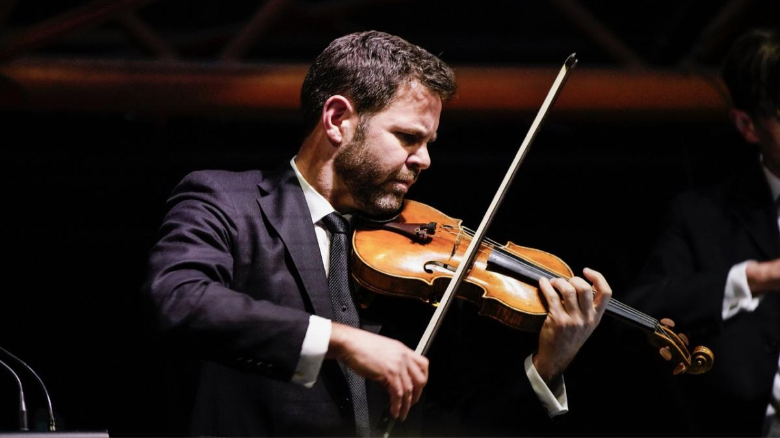
Violinist Andrew Haveron


The Bruch Violin Concerto is one of the most beloved in the repertoire. Composed in 1866 and revised in 1867 it is unusual in construction in that the first movement is a prelude to the second, the two being played without break.


Stepping out from first chair, violinist Andrew Haveron is also widely experienced both nationally and internationally as a soloist. His opening lines were mournful and beautifully measured.


It was a creditable performance by all, although I felt more projection from the soloist would have been appropriate.


Australian composer Katy Abbott, who was present in the audience, penned her piece “Fanfare for the Melancholy” as part of the Sydney Symphony Orchestra’s “50 Fanfares Project”.


It was the highlight of the evening, in particular, a real showcase for the brass section. The players seemed to embrace the piece with more conviction, joy and commitment than anything else performed during the concert. Ms Abbott graced the stage at its conclusion taking a very well deserved bow.


Drawing inspiration from the Bohemian folk music that he loved, "Dvořák's Symphony No. 8" is joyful, lyrical and optimistic.


The familiar themes and passages were very well played. It was great to hear it again.


A guide to players on the inside cover of the program mentions “Players listed in grey, are Permanent Members of the SSO, not [italics added] appearing in this concert”. There are 47 of those. Those that did appear are a mixture of remaining permanent members, guest musicians, contract musicians and Sydney Symphony Fellows. I guess we could call this the “Touring” version of the orchestra.


The concert was very well received by the audience, lots of cheers and shouts, with conductor Roger Benedict being called back three times.


First published in City News online edition, June 18, 2022


Monday, June 20, 2022

BAD GUY HAYDEN TEE ADELAIDE CABARET FESTIVAL 2022


Bad Guy  

With Hayden Tee. Musical director on piano Nigel Ubrihien. Band: Drums Chris Neale. Bass Nick Sinclair. Cello Jacqui Finlay. Violin. Sonya Mellor. Guitar. Sam Leske. Adelaide Cabaret Festival. Dunstan Playhouse. Adelaide Festival Centre. June 19 2022.

Reviewed by Peter Wilkins

Hayden Tee enters from behind down the aisle of the Dunstan Playhouse singing Michael Jackson’s BAD  “I’m bad”. I’m Baaad. I’m really really bad,”. With a demonic segue he chills with Eartha Kitt’s I wanna be evil.  He hits the final note with threatening glee and a deliciously malevolent jig. . And then the performer’s unexpected confession: “I’m not really bad. I’m really nice” Tee says apologetically.

But nice is not what people have come to see in his cabaret show Bad Guy. “Maybe we should have called it just Guys” Tee says to musical director Nigel Ubrihien at the piano. But there is too much devilish charm in his performance, too much riveting power in his voice and too much to relish at the thrilling evil of his villainy. From Miss Trunchball in Tim Minchin’s Matilda the Musical (The Smell of Rebellion) to the seductive serpent in the Garden of Eden from The Apple Tree (Forbidden Fruit) to South Carolina governor Edward Rutledge in 1776 (Molasses to Rum to Slaves) and the classic villain Javert in Les Miserable Tee is born to play the bad guy. Everybody loves a villain and Tee gives a performance worthy of musical comedy’s nastiest and meanest, cruelest and crudest. And there are few characters meaner and nastier than Ursula from Disney’s A Little Mermaid . Tee raises hackles down the spine with his thoroughly sinister rendition of Pat Carroll’s Poor Unfortunate Souls

Tee’s Bad Guy is more than a grippingly performed selection of classic songs of villainy. In a surprise twist, Tee, a passionate campaigner for LBGTQI+ people and a fervent advocate of human rights posits the question  “What is good? What is bad? Is it really only a matter of perspective?” Bad Guy becomes a platform for introspection. A proud descendant of the Maori people of the North Island of New Zealand and an openly gay performer, Tee’s compulsion is to confront prejudice and stereotype. We are jolted into another dimension of response. For Tee the evil exists in the subtext. In 1776 Governor Rutledge exposes the hypocrisy of the evil slave trade. Tee reveals the shocking statistic that 40 million people still live in slavery today. Radiohead’s Creep becomes a plea for understanding for anyone who is different and faces the prejudice of a society that regards them as weird. “Worse than bad is apathy” Tee tells his audience before his haunting rendition of I Don’t Care Much from Kander and Webb’s Cabaret

 For Tee it is the apathy that destroys the will to combat evil; that makes the uncaring cry So What. Bad Guy  becomes cabaret with a sting. “Say it out loud. Takatapui” Tee calls out. It is the Maori term for the acceptance of homosexuality in societies that still differentiate and oppress those of a different sexuality. Memories of the six year old self who was searching for the truth bring tears to the eyes as he cries out Takatapui to all six year olds who might be struggling with their sexual identity in a world where many are still regarded as bad guys. In the words of The Human Heart from the Broadway production of Once On This Island, Tee’s heartfelt tenor voice offers hope and love and reassurance that all who suffer from the actions and the attitudes of the bad guys are still part of the human heart.

Bad Guy is cabaret of the unexpected. Tee, backed by his excellent band is its Bad Guy conniver, the master of our emotions, the songster with the big Broadway voice that can thrill and ensnare, charm and beguile and finally move to tears. Tee is a titanic talent. Entertaining and enlightening, Bad Guy is cabaret that packs a mighty punch with the power to make a difference.  

Photos by Claudio Raschella