Friday, February 24, 2023

THE WHITE MOUSE ADELAIDE FRINGE


The White Mouse by Peter Maddern. 

Kryztoff at the Goodwood Theatre. February 17-26. 2023 Adelaide Fringe.

Reviewed by Peter Wilkins.


Writer Peter Maddern has a penchant for exploring the lives and achievements of remarkable Australians. Last year I saw his production of The Eye of Wilkins that recounted the adventures of explorer, journalist and photographer Hubert Wilkins. This year he has remounted his production of The White Mouse,  the amazing story of  Australian World War 2 Resistance fighter, Nancy Wake, known as the White Mouse. Maddern’s play focuses on the final stages of the war when Wake was parachuted into France to assist the resistance fighters with their struggle against the Nazi occupation forces. Her exploits are the stuff of legend and the forthright, courageous White Mouse was eventually decorated with an AC in recognition of her part in turning the tide of the war against the enemy. Maddern introduces us to Wake, played with confident assertion by Emily-Jo Davidson when she arrives in France. The play then segues in a flashback to a Riviera café scene when she agrees to marry her French lover, Henri. It then returns to wartime and the capture of a young German soldier. The play concludes with an account by her French compatriot of Nancy Wake’s return to Australia, her decision to return to England where she is recognized and her eventual death in 2011 at the age of 98.

Emily-Jo Davidson as Namcy Wake

Unfortunately this production does not live up to the drama of the legend. Maddern’s writing is expository rather than imbued with a sense of danger and urgency. Narration is used to inform and although it offers insight into the nature of an exceptional woman, it lacks the force of theatre and interaction between characters. Only the café scene with its affectionate relationship between Wake and Henri strikes a heartwarming chord. The scene is also effectively complemented by film of prewar café society and recorded French song. There has been a conscious attempt to embellish the dialogue between Wake and Henri with atmosphere. The wartime scenes are appropriately stark but they fail to capture the atmosphere of circumstance.

It is not surprising that Davidson should occupy the central role in the play. Wake was by all accounts a feisty battler for the preservation of freedom and violently opposed to the Nazi quest for world domination, a philosophy Wake held and is clearly expressed in Maddern’s final confrontation between Wake and a young, arrogant and indoctrinated captured German soldier. Maddern’s script includes two other actors to take on the other various roles. They are not included in the programme. One actor plays Henri and Wake’s French compatriot. The other actor takes on a number of roles. Both actors appear to have difficulty with the French accent and the younger actor is often inaudible. Slow scene changes and unimaginative direction tend to lessen the production’s potential impact.

What Maddern and his actors do achieve is a pervading admiration and respect for a woman who stood for the finest principles and had the courage and the conviction to confront evil irrespective of the peril she faced or potential death. It is the same spirit that is driving the Ukranians in their courageous and morally right opposition to Russia’s evil invasion under an autocratic and obsessed leader. Whatever the failings of the production, its message is relevant and necessary at a time when the example of the White Mouse shines brightly in the Ukranian heart. Hopefully Wake’s prediction that the flawed man will always fail comes true.


KIRSTY WEBECK - A BIT OF FUN


Kirsty Webeck- A Bit of Fun. 

Presented by Laughing Stock Productions. Rhino Room – Drama Llama. Adelaide Fringe. Until February 25 2023.

Reviewed by Peter Wilkins

Kirsty Webeck must be the most unassuming stand-up comedian I know. What you see in this very natural comedian is what you get. The title of her latest show A Bit of Fun is a total misnomer. It’s a lot of fun, not in a hit you over the head humour kind of way or a dollop out the sex, sleaze and sarcasm punchline kind. It’s much more subtle than that and much more natural. It’s original and delivered direct from the head and straight from the heart. It’s ironic that Webeck who studied marketing at uni has a tendency to undersell herself, and let her show do the selling of an unique talent on the stand up comedy circuit.

Born and raised in the political epicentre of the nation, Webeck avoids the political absurdities that Canberra’s cartoonists have honed into a biting art form. Her comedy is highly personal as she regales her dislike of ballet and Swan Lake in particular. “It’s too long.” She would never make a good parent. “  I require a minimum of 71/2 hours sleep every night.” And there’s her name. How many times do people say Kristy? “Kirsty means of Christ and Kristy is just risky Kristy which doesn’t rate next to thirsty Kirsty. What is quite amazing about Webeck’s ability to get my laughometer rising is her phenomenal ease of segueing into her next subject. Names make excellent fodder for a swipe at the ridiculous. Babies names, shark names, her own name, her scooter’s name, dogs names and bigger than them all, the mighty Sperm Whale. This is Webeck at her funniest. I am amazed at her agility and ability to simply segue from one routine to the next while also being able to reference earlier jokes in a later context.. Her show seems effortless, the butt of her humour unexpected but instantly resonating with the audience in the Drama Llama space of the Fringe’s comedy hub, the Rhino Room.

If there was any doubt about Webeck’s ability to surprise and astound her account of a rat that ran up her leg only to turn out to be a ring tailed possum with a possible case of thrush should be enough to make anyone think that Webeck can turn the most unlikely stories into stand up comedy gold. It is impossible not to warm immediately to Webeck’s friendly manner, relaxed performance and very funny kind of comedy. Webeck is making a name for herself on the stand up comedy stage and I predict that in the not too distant future she will be too big a name for the small space at the Rhino Room. If you have never been to a Kirsty Webeck show, get along soon. Her shows are heaps of fun!

Thursday, February 23, 2023

THE ROCKY HORROR SHOW - 50th Anniversary Production.


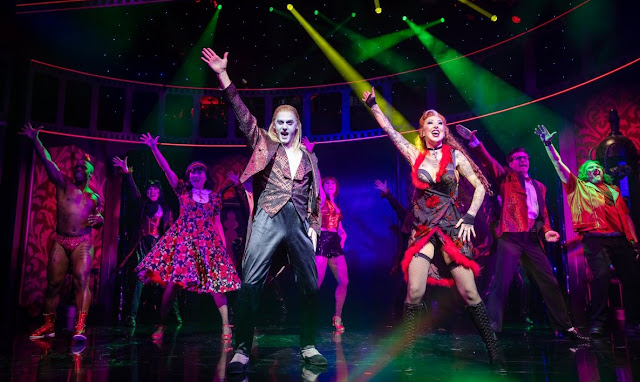
Henry Rollo (Riff Raff) - Stellar Perry (Magenta) leading the cast in "The Rocky Horror Show"


Directed by Christopher Luscombe – Choreographed by Nathan Wright

Musical Direction by Jack Earle – Set Design by Hugh Durrant

Costume Design by Sue Blane – Lighting Design by Nick Richings

Theatre Royal, Sydney 18th February – 2nd April 2023.

Opening Night performance on 18th February reviewed by Bill Stephens


Deirdre Khoo (Janet) - Ethan Jones (Brad) in "The Rocky Horror Show"


Is it really 50 years since Reg Livermore scandalised and delighted Sydney with his joyously outrageous cavorting as Frank N Furter in Harry M. Miller’s production of The Rocky Horror Show in the less-than-salubrious New Arts Theatre in Glebe? 

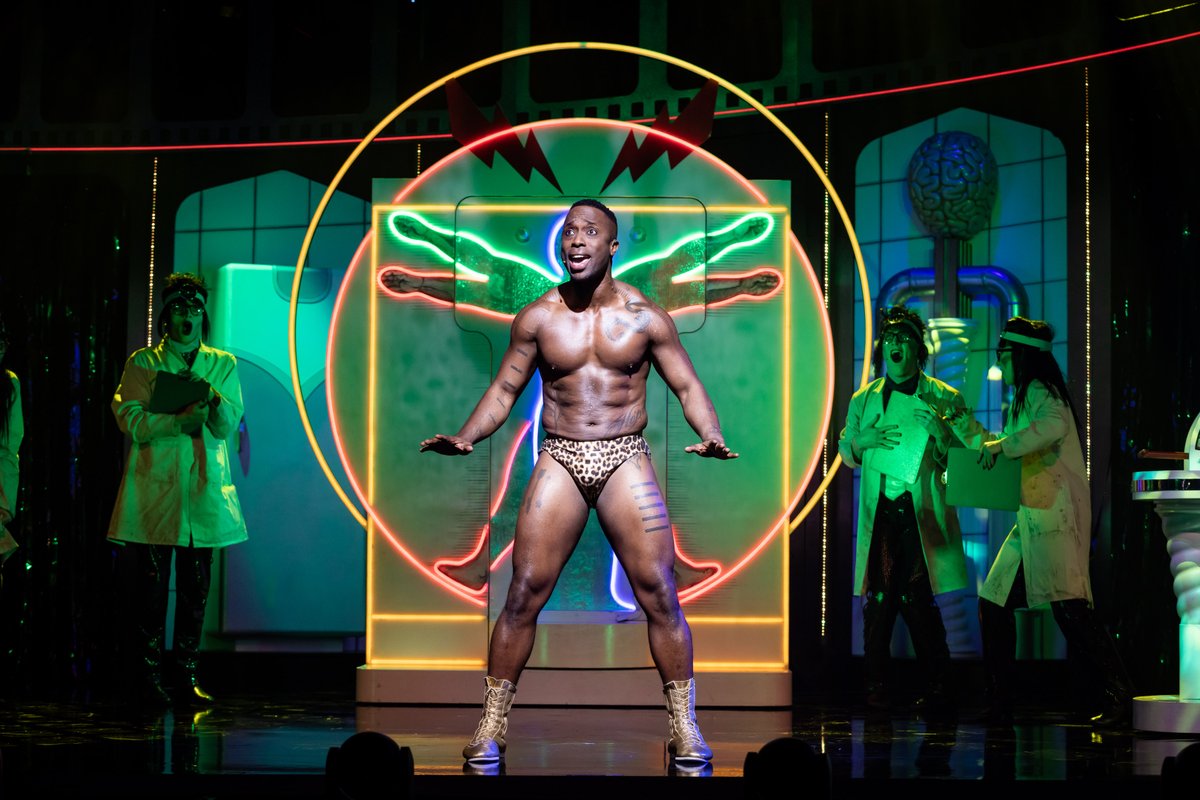
Well a lot has happened in that 50 years and what was then subversive and shocking when we first met Frank N Furter is now mainstream. The show is much prettier than it was in the days of the New Arts Theatre, and Rocky is no longer the artificially made, fully grown, physically perfect muscle man complete with blonde hair and a tan that Frank N Furter originally created for his own pleasure. In this production he’s an artificially made, fully grown, physically perfect, black muscle man with black hair and indeterminate sun tan, charmingly and exuberantly performed by Loredo Malcolm.

Jason Donovan as Frank N Furter in the 50th Anniversary Production of
 "The Rocky Horror Show"


Australia’s favourite boy-next-door, Jason Donovan, now a little less boyish, but a West End veteran who played Frank N Furter in the 25th Anniversary production of “The Rocky Horror Show” still brings a shapely pair of legs, a fine singing voice and a knowing louche charm to his interpretation of the iconic role. His domain has been given a spruce-up with a fresh new setting by Hugh Durrant, colourful costumes by Sue Blane and state-of-the-art lighting design by Nick Richings replacing the beguiling tackiness of the original production.

The talented cast includes Ethan Jones and Deirdre Khoo as the previously wholesome and naïve Brad and Janet. Henry Rollo (Riff Raff), Stellar Perry (Magenta) and Darcey Eagle (Columbia) portray Frank N Furter’s associates, with Ellis Dolan in the dual roles of Eddie/ Dr Scott. All perform their roles with energy and commitment supported by four hard-working dancers, Josh Gates, Catty Hamilton, Jackson Reedman and Erica Wild who stylishly execute Nathan Wright’s natty choreography.

Myf Warhurst as the Narrator in "The Rocky Horror Show" 


As the narrator, Myf Warhurst, of “Spicks and Specks” fame, read her script efficiently but looked uncomfortable, substituting an engaging smile and a “what-am-I-doing here” attitude for any perceivable hint of stagecraft.

All the favourite Rocky Horror songs are included; “The Time Warp”, “Sweet Transvestite”, “I can Make You a Man”, “Touch-a-Touch-a-Touch Me”, all performed with gusto by the talented cast and Jack Earle’s tight quintet. 

Loredo Malcolm as Rocky in "The Rocky Horror Show"


However, despite the enthusiastic attempts of the ‘influencers’ noisily demonstrating how much they were enjoying the show, the response by most of the first-night audience, perhaps a generation or two older than the target audience, was surprisingly subdued.

So much so that it was hard to escape the impression that given how much attitudes have changed over the last 50 years, many in the audience were finding much of the on-stage sexual horse-play more worrying than entertaining; therefore raising the question that, at 50, has the once-subversive “Rocky Horror Show” lost its relevance?


                                                         Images by Daniel Boud


      This review also appears in AUSTRALIAN ARTS REVIEW. www.artsreview.com.au

DONE TO DEATH, BY JOVE ADELAIDE FRINGE


Done to Death, By Jove by Nic Collett 

 Presented by Nicholas Collett and Gavin Robertson in association with Virtually Creative. Kryztoff at the Goodwood Theatre – Main Theatre. Adelaide Fringe Until February 26 2023.

Reviewed by Peter Wilkins

Done to Death, By Jove could well refer to the puns, gags and malapropisms that bounce around this hysterically funny parody of the British Repertory Whodunnit, Except that there is nothing done to death about this very cleverly conceived spoof. The conceit may also be familiar to many. Two actors are ready to appear in a crime mystery in the traditional style of an Agatha Christie when they learn that the other members of the cast and crew are held up on the freeway and won’t be able to make the show, But as they say in showbiz “The show must go on” and so each actor assumes the many roles in a gobsmacking dervish of changed costumes, different characters, mixed up dialogue and a fair dose of performance panic. Actors Nicholas Collett and Gavin Roberstson are consummate character clowns in the tradition of Morecombe and Wise, Laurel and Hardy, Abbott and Costello and the Two Ronnies. In Done to Death, By Jove we have another first class comedy duo Robertson and Collett or should that be Collett and Robertson. Collett, who has written this Agatha meets Arthur Conan Doyle romp is the fall guy to Roberstson’s more physically dominating straight man. While Collett plays Watson, Miss Marples and the Matron of the Home of Peace and Care. Roberston takes on the more authoritative roles sof Sherlock Holmes and Hercule Poirot.

Both succumb to the frenzy of farce, dropping out of character in moments of hilarious confusion as they fumble and bumble their way through the play and a cavalcade of incongruous characters to the obvious delight of an audience that relishes the slapstick and the silliness of a well-crafted farce . Missed cues, jumbled lines, funny accents, hat swapping routines and utter incongruity, performed by two excellent and in sync actors in the tradition of Music Hall and Vaudeville clowning make Done to Death, By Jove a welcome panacea in times of distress and uncertainty. The audience is privy to the best of bloopers and backstage bugles.

Collett and Roberston are in total control slipping in and out of character with alacrity and a change in vocal tone cleverly distinguishing the drama of Lady Fanshaw’s murder with the desperate attempt by two confused Repertory actors clinging to some semblance of control. The result is delightful farce and ridiculous clowning and the audience lapped it up. There may be no deep and meaningful message and no moral to this tale but it is good fun at the two actors’ expense. Audiences are guaranteed to have an entertaining sixty minutes of fun and laughter. After all who couldn’t do with a night of laughter at the Fringe. Robertson and Collett deliver in spades.

Monday, February 20, 2023

CHOPIN'S BIRTHDAY CONCERT


Friends of Chopin

All Saints Church, Ainslie 19 February


Reviewed by Len Power


As well as celebrating composer, Fryderyk Chopin’s, birthday, the Friends of Chopin were celebrating their return after three years of hibernation due to Covid.  Their program of works by Mozart and, of course, Chopin included a new work commissioned three years ago from pianist, Penelope Thwaites.  There were three high calibre performers, including Thwaites herself, Kirsten Williams, violin, and Patrick Suthers, cello.  It really was a celebration to the power of ”3”.

Kirsten Williams (piano), Penelope Thwaites (piano) and Patrick Suthers (cello)

 The concert began with Mozart’s Piano Trio No. 3 in B Flat.  Composed in 1786 it is performed on piano, violin and cello in three movements.  The first movement was notable for its brightness and the second was reflective with beautiful melodies.  The brightness returned with the third movement and finished dramatically.  The trio played it delightfully.

Penelope Thwaites then played Chopin’s Ballade No. 2 in F Major.  Composed in 1839, the quiet opening passages led into a dramatic section full of emotion and then subsided into a delicate and sensitive ending.  Thwaites played it superbly.

Elements of this ballade and music from the ballet “Les Sylphides” inspired Thwaites’ writing of the commissioned work “Mazurka: Au Tombeau de Chopin”.  Her skilful composing produced a highly satisfying work that started quietly with the cello and led into a dramatic passionate dance full of emotion.  It ended as quietly as it had begun.  This memorable work proved to be the highlight of the concert.

The final work presented was Chopin’s Piano Trio In G minor.  Published in 1829, it was the first time Chopin included a violin in his work.  It starts dramatically and has a beautiful third movement full of emotion leading to an ending full of brightness.  Played very well by the trio, it was the perfect end to a fine concert.


Photos by Peter Hislop

This review was first published by Canberra CityNews digital edition on 20 February.

Len Power's reviews are also broadcast on Artsound FM 92.7 in the ‘Arts Cafe’ and ‘Arts About’ programs and published in his blog 'Just Power Writing' at https://justpowerwriting.blogspot.com/.


Sunday, February 19, 2023

WHITE RABBIT RED RABBIT


WHITE RABBIT RED RABBIT. 

Conceived and written by Naseem Soleimanpour. Performed at The Mill Theatre by Jay James-Moody.  Wednesday February 15, Thursday February 16, Saturday February 18 Thursday February 23 and Friday February 24th  2023. An Aurora Nova and  Lexi Sekuless Production. Co-=roducer and operator Zeke Chalmers. Major partner Elite Event Technology.  .

Reflections by Peter Wilkins


Playwright  Nassim Soleimanpour

Theatre has many mansions. Nassim Soleimanpour’s White Rabbit. Red Rabbit is a bold and significant attempt to challenge and confront actors and audiences to unravel and interpret the emotional, physical and intellectual impact of certain types of human behaviour. If this may sound rather vague it is meant to as it reflects the theatrical convention of Soleimanpour’s writings and dramatic construct.

Let me explain. Soleimanpour describes his work as an experiment, rather than a play. An experiment is a process of trial and error in pursuit of a phenomenon and final analysis through hypothesis, performance and observation and concrete analysis. So, what are the facts behind White Rabbit Red Rabbit? An actor (Jay James-Moody) is invited to perform the play. The audience is given no prior knowledge about the play. They know that the writer is an Iranian, forbidden to have a passport and therefore resorting to sending his play to other countries and most specifically the Edinburgh Fringe in 2010. A google search will reveal his ethnicity and his age, but nothing of the plot or action of White Rabbit Red Rabbit. It is no mystery, but an exercise in observing, interpreting, intellectualizing, emotionally experiencing and arriving at conclusive analysis.

What is important to know is that prior to entry into the intimate Mill Theatre, neither the actor nor the audience must have any prior knowledge or expectations of the performance. The play has no director and no rehearsal. So, let us examine the phenomenon. The audience enters the 67 seat theate through the stage to takes their seats. On stage they will observe a table with two glasses of water stage right, a chair stage centre and a ladder upstage left.

Jay James-Moody is The Actor

 The actor enters. This is experienced actor, writer, director and producer James-Moody’s first appearance in Canberra. He is the only actor. On the chair is a sealed envelope. He knows that he has to take the envelope, open it and read the enclosed script to the audience. The script contains a comprehensive set of stage instructions which the actor must read aloud and either perform himself or engage particular audience members to enact. The rest is a new and unique experience for every audience member and for the actor. It requires an actor with intelligence, spontaneity, appeal and insight to peel away the many layers of meaning and symbolism contained in the writing. James-Moody is both extremely personable and capable of engaging his audience, exciting their curiosity and inviting participation.

The play ends and the audience leaves the theatre. If the experiment has succeeded opinions will flood their minds with their interpretations of the various stages of the experiment and their perception of the probable meanings contained in the hour long performance. James-Moody’s assured presentation of the writer’s intent should leave little doubt as to the meaning and the effect of Soleimanpour’s specific directions. The actor remains alone in the empty space. It is time for all participants to recover and reflect.

As for the actual content of directions that remains for new audiences to experience afresh. There is no intention to trick or confuse. It is an imaginative device, akin to improvisational theatre, but it is no gimmick. In fact for the thinking theatregoer White Rabbit Red Rabbit is serious and significant theatre. All that is needed is the ability to look, to listen and to learn. Then the conclusions reached will be inescapable. Will you care? Hopefully. Will it change the way you view the world? Not necessarily, but it may remind you of what you hold most dear.

All good theatre in its many diverse mansions will inform and illuminate the human spirit. In the intimate Mill Theatre , producer and artistic director Lexi Sekuless has taken quite a risk staging a work that challenges convention. As well as actor James-Moody, Sekuless has engaged PJ Williams, Stefanie Lekkas, Elliott Cleaves and Zsuzsi Soboslay to perform during the short season. Each actor requires the skill and personality to achieve the writer’s intentions and succeed in leading an audience to an awareness of Soleimanpour’s themes and messages.

Sekuless is a producer with vision and the courage to present theatre that dares to challenge while also entertaining audiences. Not every experiment succeeds. In the case of White Rabbit. Red Rabbit Sekuless has succeeded in bringing a work to Canberra that is new to audiences, challenging for actors and a thought-provoking advocate for change.

Saturday, February 18, 2023

SALT

Photography | Brian Rope

Salt | Sammy Hawker

(including Dark Crystals collaboration | Sammy Hawker, Jessica Hamilton & Sam Tomkins)

Mixing Room Gallery | 9 Feb – 25 Mar 2023

Salt is a new exhibition by ACT-based visual artist Sammy Hawker. A substantial crowd (perhaps 200) at the opening was simply buzzing with conversation and excitement. 

Hawker attracted early attention when her work Boy in Versailles was selected by renowned photographer Bill Henson for the 2010 Capture the Fade exhibition in Sydney. And it was the people’s choice winner.

Then we were all impressed in 2019 with her video Dieback about the eerie phenomena of mass tree extinction - white gums in the Snowy-Monaro. Along her artistic journey since, Hawker has had significant success. This exhibition once again delivers. As Senior Curator of Visual Arts at Canberra Museum and Gallery, Virginia Rigney, said in her opening remarks, Hawker’s use of the familiar substance of salt reveals new mysteries. 

This exhibition includes works from recent trips across Australia, travelling from the East Coast (the Yuin Nation and Arakwal Country) to Kati Thanda - Lake Eyre (Arabana Country). Taking her ‘studio’ with her, spending significant time at each location to understand it, then co-creating art by processing photos where they were exposed using traces of salt found at the sites to lift the emulsion and alter the documentary images. Hawker speaks of places where a quiet magic resonates; where the water leaves the blood sparkling in your veins; where the horizon disappears - and the sound of nothingness compresses around you.

Hawker’s process brings an essence of Country into her work, painting its way onto negatives and sharing deep and mysterious forces around us that transform her photographs. The details in Broulee Salt Sketch from 2020 show that very clearly. So too do Did I Dream You Dreamt About Me? and Everything is Waiting for You.

Broulee Salt Sketch (Details), 2020 © Sammy Hawker

Did I Dream You Dreamt About Me © Sammy Hawker

Everything is Waiting for You © Sammy Hawker

Two Lake Eyre works are amongst the standout images, Epiphanous and Kati Thanda - Lake Eyre, both featuring delicious pastel tones and the latter revealing a selected pattern from high above.

Epiphanous [Kati Thanda - Lake Eyre] © Sammy Hawker

Kati Thanda - Lake Eyre [From the Skies #2] © Sammy Hawker

Amongst the black and white images, Everything is Waiting for You and Did I Dream You Dreamt About Me? each pose numerous questions. The latter demanded I grab a phone shot of someone reflected in it, dreamily exploring. And the inclusion of Hawker’s 2022 Mullins Conceptual Photography Prize winning work, Mount Gulaga, is a bonus for those who have not previously seen it. 

Mount Gulaga © Sammy Hawker

There is also a marvellous collaborative work between Hawker, Jessica Hamilton & Sam Tomkins. It explores the possibilities around generating dialogue between image, sound and form.

Their starting point is Hawker’s image, Dark Crystals, a work processed with ocean water at Mollymook, NSW (Yuin Nation) in 2021. Hamilton has a special connection to the place this image was created and was inspired to use the visual data along the horizon line of the image to create a spectrogram. It picked up the varied textures deposited on the negative by the ocean’s salt. She then converted the spectrogram into a waveform and processed it through a synthesiser to create a sound piece.

Dark crystals Waveform horizon © Sammy Hawker, Jessica Hamilton & Sam Tomkins

Next, Tomkins designed and created a chladni plate (use your favourite search engine for information) to respond to the sounds. When the plate is oscillating with certain frequencies, the salt on top creates distinct patterns. Hawker used an online pitch detector to break down the various notes/frequencies in the sound piece. Played through the plate, the visual patterns formed - such as 1041.8 Hz - C6 are intriguing. 

1041.8 Hz - C6 © Sammy Hawker, Jessica Hamilton & Sam Tomkins

 I look forward to more exciting outcomes from these collaborators.

The exhibition is more than just printed images. There are negatives on display too and, perhaps best of all, a great journal of Hawker’s words along with numerous images worthy of close examination.

This review was first published in The Canberra Times on page 5 of Panorama and online here. It is also available on the author's blog here.