Monday, January 15, 2024

Masterclass - Sydney Festival


Masterclass by Brokentalkers Theatre Company (Ireland) and Adrienne Truscott (New York).  Sydney Festival at the Sydney Opera House Drama Theatre, January 12-16 2024.

Reviewed by Frank McKone
January 13

Writers: Feidlim Cannon, Gary Keegan & Adrienne Truscott.
Creative Producer: Rachel Bergin
Movement Director: Eddie Kay
Costume Design: Sarah Foley
Lighting Design: Dara Hoban
Set Design: Ellen Kirk
Sound Design: Jennifer O’Malley


Cast
Adrienne Truscott and Feidlim Cannon.


I was hoist by my own petard at the end of Masterclass.  Just like Cannon’s self-important character, I stayed on until everyone else in the audience had decided to go; and even when the Opera House staff insisted I had to go, I could not leave without a desperate attempt to interview the actors – who were still refusing to leave the stage.

Adrienne’s female character would not leave because Cannon’s male would not leave because he still believed as a male he must maintain his place in the Master Class.  If he left, then she could too; but as things stood, for her to leave would mean her accepting his patriarchal role and leaving her less than equal.

As a male, was my insistence on holding everything up to the bitter end justified because I was in a journalist role seeking an interview?  Or was I just being another Cannon-style character?

I surrendered, and I left a note for the actors at the stage door before the staff’s politeness might have turned for the worse.

Of course, my story was exactly what the play was meant to be about – the truth about gender equality in the real world.

The play worked in raising everyone’s consciousness of the seriousness of the issue.  Will it make a real difference?  I guess I should have raced after other audience members and interviewed them before they went home.  But by then they had all gone.  

They had laughed at the characters’ twists and turns on stage before the final deadlock.  Would the males now really leave the stage so the females could have equal power from now on?  Or would men think they weren’t really like Cannon anyway?  Or would any women think Adrienne was too obsessed about her feminism?

Publicity describes the set-up: "All-round good guy Feidlim Cannon plays a blazer-clad talk show host interviewing a Hemingway-esque writer (Truscott), espousing a masterclass on playwriting." 

In the beginning Truscott is Adrian, only to reveal herself later as Adrienne.  I thought I heard Cannon called “Alex” – perhaps Alexander the Great?  The technicalities of this highly physical performance made it certainly engrossing, with props and costumes all over the place, as well as sound and lighting everywhere all at once.  

But I have to say I began to find the script beginning to sound too clever-clever, too comedic, even farcical, rather than getting to the guts of the patriarchy-feminism problem.  That’s why I wanted to talk to the actors who were also the writers.

The ending, when neither will leave the stage, says no more than male-female power is deadlocked with no possible solution except for everyone to walk away.  You might say historically it’s an advance to have got to this point, since the rise of the New Woman in European culture in the 19th Century.  

But I suggest that Bernard Shaw offered more in his plays Arms and the Man (1894), Mrs Warren’s Profession (1902) and his major work on the issue, The Intelligent Woman's Guide to Socialism and Capitalism (1928; Pelican 1937), even though, as Wikipedia records, “The book inspired a respectful and detailed reply from Lilian Le Mesurier in The Socialist Woman's Guide to Intelligence: a reply to Mr. Shaw first published in 1929. Le Mesurier objected to Shaw's self-satisfied and condescending tone.”
https://en.wikipedia.org/wiki/The_Intelligent_Woman%27s_Guide_to_Socialism_and_Capitalism

Masterclass has acquired a considerable reputation since its presentation at the Dublin and Edinburgh Fringe Festivals (2021/22) and succeeded in leaving a rather bewildered audience in Sydney as they realised they had to decide to leave the auditorium since the actors wouldn’t leave the stage.

So I can only conclude my review inconclusively.


Saturday, January 13, 2024

Big Name, No Blankets - Sydney Festival


Big Name, No Blankets by Andrea James with Anyupa Butcher and Sammy Butcher (founding member of Warumpi Band).  
Sydney Festival production, Ilbijerri Theatre Company at Roslyn Packer Theatre (Sydney Theatre Company), January 10-14, 2024.

Reviewed by Frank McKone
Opening Night January 12

Writer: Andrea James; Cultural Consultant: Sammy Butcher
Co-Directors: Dr Rachel Maza AM & Anyupa Butcher
Music Director: Gary Watling
Cinematographer & Sound Designer: James Henry
Sound Arrangements & Composition: Crystal Butcher
Sound Arrangements & Composition Mentor: David Bridie
Set Designer: Emily Barrie; Lighting Designer: Jenny Hector
Costume Designer: Heidi Brooks; Video Content Designer: Sean Bacon
Animation: Patricia McKean & Guck; Dramaturg: Amy Sole
Producers: Nina Bonacci & Alexandra Paige
Consultants – Theatre: Sarah Goodes; Creative: Lisa Watts
Production Manager: Nathan Evers; Stage Manager: Celina Mack
Assistant Stage Manager: PJ Rosas & Kira Feeney
Audio Engineer: Daniel Lade

Warumpi Family Consulting: Suzina McDonald & Marion Burarrwanga
Pikilyi painting entitled Yuparli Dreaming by Eunice Napangardi
Yuparli Tjukurrpa (Pikilyi) song sung by Reenie Robertson

Performers

Baykali Ganambarr (Sammy)
Googoorewon Knox (George)
Teangi Knox (Gordon & drums)
Aaron McGrath (Brian & Ensemble)
Jackson Peele (Neil)
Cassandra Williams (Suzina, Mum & Ensemble)
Tibian Wyles (Ian, Ensemble & Understudy)

Core Band

Gary Watling, Jason Butcher, Jeremiah Butcher, Malcolm Beveridge


The idea of a play within a play is always stimulating for going into unexpected meanings.  Big Name, No Blankets is fascinating because it is more an opera within an opera, as the musicians from Papunya tell their own story of their Warumpi Band through their own music.  Opera is often thought of as the most complete art form, in the European tradition of grandiose stage settings, costumes, music, with the story told through song and choreography, usually with minimal spoken dialogue.

The Warumpi Band was begun by Sammy Butcher in 1980 and established an Australia- and World-wide reputation, for their Central Desert interpretations of Rock&Roll, Country and Western, and Desert Reggae, influenced by Midnight Oil for its central political theme, expressed in the finale in this show, with the whole audience standing up and singing Stand Up And Be Counted for indigenous land rights.

This video set design is not grandiose, but has its own grandeur taking us visually on Warumpi’s journey from the Haast Ranges and around the world.  

Yet the story, told with terrific impact by, in his quiet way, Baykali Ganambarr as Sammy, and in an almost over-the-top way by Googoorewon Knox as George, turns out to be a kind of rags-to-riches tragicomedy.  You’ll come to understand what humbug money is all about.

You will feel the strength of Country for these people.  And the real meaning of Call my Island Home – for Saltwater Man, George from Elcho Island (so different from Desert Country); and even for Australia as a whole when that song was used for the opening of the Olympic Games in Sydney in 2000.

Big Name, No Blankets is a truth-telling work of theatre art from people described by the National Museum of Australia this way:

Papunya was established as a government settlement in 1959, when Aboriginal people came in from the desert. Settlements such as Papunya were established by successive Australian governments under the controversial policy of assimilation. They aimed to socialise Aboriginal people into a European way of life.

We felt in the audience filling the Sydney Theatre Company’s Roslyn Packer Theatre at the world premiere of Big Name, No Blankets that it’s time now for assimilation to go the other way, for all of us to benefit.  As they sing, It Doesn’t Matter Wbat Your Name Is – we are all one at heart, with the same need for our place in Country, the same depth of sadness as people pass away too soon; and the same sense of humour as both the exuberant George and the peace-maker Sammy.

If a Festival should bring together our people’s memories and look to the future with resilience and a sense of purpose, it’s all there in the Warumpi Band story Big Name, No Blankets.


Wednesday, January 10, 2024

ALICE IN WONDERLAND - Bonny Lythgoe & Broadway Haus Productions


Eowyn Turner as Alice in "Alice in Wonderland"

Co-Produced by Nate Bertone and Anthony Street,

Adapted and Directed by Penny Farrow – Designed and co – directed by Nate Bertone

Costume Design by Ethan Walker- Music by Evan Jolly

Canberra Theatre Centre 8th January 2024 – Reviewed by BILL STEPHENS.


Simon Burvell-Holmes as the Queen of Hearts in "Alice in Wonderland"


Although she is best known as a judge of the original Australian reality television series “So You Think You Can Dance”, Producer Bonnie Lythgoe has since 2014 been delighting children and adults around Australia with her spectacular traditional pantomimes often starring well known stage and television personalities of the calibre of Todd McKenney, Rhonda Burchmore, Richard Reid, Lucy Durack and Magda Szubanski.

However her choice for the 2024 tour is an enchanting version of the Lewis Carroll classic, “Alice in Wonderland” for which she eschews celebrity casting in favour of accomplished multi-talented character-actors equipped with the talents necessary to bring Penny Farrow’s brilliantly conceived version of this classic tale to life.

For her version of this well-loved tale, writer/ director, Farrow has drawn on characters, dialogue and poems from “Alice’s Adventures in Wonderland”, “Alice Through the Looking-Glass”, “The Hunting of the Snark” and other of Carrol’s writings to create a magical production which joyously captures Carroll’s playful delight in exploiting the quirks of the English language.

Farrow’s production commences with the characters speaking Jabberwocky, a language which no doubt confused her young audience, and many of those considerably older. But as the audience becomes familiar with the parade of quirky characters who take Alice on her wonderful journey down the rabbit-hole, Jabberwocky soon becomes perfectly normal.

Alice (Eowyn Turner) becomes acquainted with Tweedledum and Tweedledee (Justine Anderson & Matilda Simmons)


Eight excellent actors share umpteen roles together with a multitude of adorable puppets, which move through the story so quickly that it feels like a cast of thousands. Eowyn Turner is a perfectly well-mannered  Alice scampering over giant toad-stools with exactly  the correct degree of  delightful insouciance and precocious curiosity to keep the audience on her side as she challenges the gleeful pomposity of Simon Burvell-Holmes’ over-bearing Queen of Hearts, the argumentative silliness of Justine Anderson and Matilda Simmons’ Tweedle Dum and Tweedle Dee, and the wondrously  costumed caterpillar of Anthony Craig whose  transformation into a beautiful butterfly drew spontaneous applause from the captivated audience. 


Anthony Craig as the Caterpillar


The production values through-out are quite wonderful with Ethan Walker providing
  multiple story-book costumes for the characters who inhabit Nate Bertone’s magically  lit settings which enable the succession of gasp-inducing special effects creating the succession of classic scenes. The Mad-hatter’s tea party;  the crazy  croquet game played with flamingos and hedgehogs; the simple, but very effective shrinking of Alice, the marvellous grinning Cheshire Cat and the overly-anxious white rabbit are all there, enhanced by a delightfully evocative musical score by Evan Jolly.

This wonderfully theatrical production is guaranteed to send young readers scurrying to their libraries to obtain the source material and rediscover the many captivating characters emanating from Lewis Carroll’s fertile imagination. It is touring widely, so when it comes your way don’t miss it.


                                                              Images by Robert Cato


This review also published in AUSTRALIAN ARTS REVIEW. www.artsreview.com.au 


Tuesday, January 9, 2024

ALICE IN WONDERLAND


Alice in Wonderland by Lewis Carroll.. 

Adaptation and original direction by Penny Farrow. Executive and Creative Producer Ethan Walker. Executive Producers Bonnie Lythgoe and Christopher Wood. Co-director, designer and co-producer Nate Bertone. Composer Evan Jolly. Puppet designer and builder. Chris Barlow. Props and puppet designer Dieter Barry. Costuming  Gayle Macgregor. Costuming Diana Eden.Diana Eden . Lighting Design Jeremy Dehn. Canberra Theatre. Canberra Theatre Centre. January 8. 2024

Reviewed by Peter Wilkins


Broiadway Haus and Bonny Lythgoe Productions’ touring production of Alice in Wonderland is enchanting storytelling at its very best. From Nate Bertone’s colourful set design to Gayle Macgregor’s sumptuous costuming and Jeremy Dehn’s  luminescent lighting design this is an adaptation that enthrals and delights all those who share Lewis Carroll’s amused sense of the ridiculous, the illogical and the absurd. Director Penny Farrow’s adaptation of Lewis Carroll’s timeless classic is a theatrical delight from start to finish for young and old. In an era when high tech spectacle and digital wizardry tend to catapult  audiences into a world of bedazzling wonderment, this production treats audiences to an equal feast of theatrical imagination. One might almost call the techniques old fashioned or at best traditional, which would do a disservice to their magical effect on an audience’s imagination.


Éowyn Turner as Alice. Lucy Fox as the White Rabbit.
Alice’s descent into the rabbit hole is staged as a beautifully choreographed piece of physical theatre by the ensemble of seven actors who play multiple roles as well as acting as a chorus to the tale. Blue material across the stage immediately becomes a river of tears. Puppet designers and builders Chris Barlow and Dieter Barry breathe life into , a hooting owl, a grinning Cheshire Cat and a skilfully created Dormouse, operated by Anthony Craig. Craig’s hookah smoking caterpillar transmogrifies before our very eyes into a splendid butterfly much to Alice’s amazement Everything about the production is immaculately designed, and staged with a clarity that brilliantly captures the very essence of Carroll’s fertile imagination

In just one hour with no interval, Farrow has managed to capture the nonsensical sense of linguistic playfulness and Alice’s key adventures from meeting the White Rabbit, played with a suitable sense of impatient urgency by Lucy Fox , dancing the Lobster Quadrille to Evan Jolly’s lively composition,, meeting the bumbling Tweedledum (Justine Anderson) and Tweedledee ( Matilda Simmons), attending the madcap Mad Hatter’s Tea Party with the officious Hatter (Catherine Glavicic), the March Hare (Elliott Baker) and the sleepy Dormouse. And of course the Croquet match with a bullying and volcanic Queen of Hearts,  played with the suitable pomposity of a pantomime Dame by Simon Burvell-Holmes). In the midst of this mayhem is the bewildered Alice, perfectly played by  the pristinely- pinafored  ÉowynTurner. Turner embodies everybody’s image of Carroll’s unwitting protagonist thrust into a world of nonsense where words and action bemuse and bewilder and any change brings with it the doubt of true identity. Turner’s innocent naivety reveals a world  where reason has no rhyme and rhyme has no reason, or do they? Director and adapter Farrow and her excellent team of performers and creatives has staged a production of which I imagine Carroll would be immensely proud. She has unravelled a logic that makes sense of the reason for Alice’s adventures and her search for identity and logic in a seemingly illogical world.. 
Anthony Craig as Caterpillar in Alice in Wonderland
 Unfortunately this highly professional and exquisitely staged production of a children’s classic with something for any one as old as Father William only played two performances on the one day. Hopefully this unmissable journey with Alice down the Rabbit Hole and into a wonderland of theatrical delight will return to enchant those Canberra audiences who missed out.
 
Photos by Robert Catto

Monday, January 8, 2024

Vale John Paisley, born October 15, 1938, Dumfries, Scotland; died December 25, 2023, Canberra.


John Paisley on screen


by Helen Musa

ONE of Canberra’s legendary theatre identities, John Paisley, has died aged 85 after a long period of illness.

As an actor, drama teacher, director and writer, Paisley had a notable talent for turning up wherever professional theatre and film-making industries were beginning to flourish.

Paisley was born in Dumfries Scotland into a Protestant family and often said he was a cousin of Northern Irish politician, Ian Paisley.

He graduated from Edinburgh College of Speech and Drama in the mid-1950s, followed by the Royal Scottish Academy of Music and Drama, Glasgow, in 1959, then worked as an actor and stage manager for repertory theatre companies in England, an experience he told a Chinese journalist in 2009 was "the best training ground available to aspiring actors in the United Kingdom during the 1950s and 1960s".

He emigrated to Australia in 1961 and became a teachers’ college drama lecturer in Adelaide, where he sought out theatre companies.

Always a colourful personality known for upstaging his peers, Paisley distinguished himself by sustaining an onstage sword wound during the Theatre Guild’s production of Bertolt Brecht’s “Mother Courage” in 1964, but was soon out of hospital and back performing with the fledgling South Australian Theatre Company Inc.’s production of Max Frisch’s “Andorra” in 1965. In the following year, he joined the company on tour in David Williamson’s production of John Powers’ play, “The Last of the Knucklemen.”

But Paisley’s interests were turning to screen acting and by 1968 he was appearing in series like “Contrabandits” and later “Skippy.”

During the late 1970s he moved to Canberra, where he would teach at Dickson College, also becoming caretaker of the Childers Street Theatre in the huts on Kingsley Street Acton,where he lived in a flat so close to the stage that his disapproval could often be heard through the thin walls of the theatre.

He became an active member of the theatre community and a participant in director Ralph Wilson’s Saturday afternoon intellectual gatherings on the ANU Campus.

In 1979, now working with Fortune Theatre Company, he directed productions of “The Boat” by Jill Shearer, “The Room” by Harold Pinter and “Ashes” by David Rudkin at Canberra Theatre Centre, also acting in “Once a Catholic” by Mary O'Malley, directed by Anne Godfrey-Smith in 1980.

In 1981, Paisley acted in “Uncle Vanya,” directed by Pamela Rosenberg, then directed Chekhov’s “The Bear” at Canberra Theatre for the Canberra Independent Actors Company, earning critical praise for his “natural affinity for Chekhov." He later acted in Dario Fo’s “Accidental Death of an Anarchist” at ANU Arts Centre, directed by George Whaley for Fortune, now renamed Theatre ACT.

In the same year he travelled to Goulburn’s Lieder Theatre to play Bottom in “A Midsummer Night’s Dream,” directed by John Spicer.

But literary theatre was not Paisley’s only forte and in summer productions at the Canberra Theatre in 1982-3, he was seen acting in “Annie,” directed by Terence Clarke and “Treasure Island,” directed by Ron Verburgt.

 Director Lu Chuan talks to John Paisley (right) during the shooting of City of Life and Death in which Paisley plays the lead role of John Rabe.

He also completed a BA in Literature at the ANU, worked in the university’s mail department and drove taxis to support his studies and his acting.

After a period of screen work during the 1990s, including with “A Country Practice” and “Blue Heelers,” Paisley moved to China to lecture at the ‘Peking’ University Department of Foreign Languages from 1999 to 2005, when he met and married Nanjing-born painter Zheng Keying. As he ventured into the fast- developing Chinese film industry, she became his agent, accompanying him on shoots and translating the dialogue into English for him.

Interviewed at the time, Paisley described his many encounters with unscrupulous agents, but he nonetheless proved very successful.

Paisley usually played the Western baddies in films, including the 2006 Jet Li box-office action hit “Fearless.”

By 2009, when he scored the lead role of heroic German businessman John Rabe in Lu Chuan's film about the Rape of Nanjing, “City of Life and Death,” he had acted in more than 15 Chinese films, drama series and documentaries.

He also tried his hand at screenwriting for the 2006 German family animation film, “Felix 2 - Der Hase und die verflixte Zeitmaschine” ( Felix: The Toy Rabbit and the Time Machine.)

After appearing in “Chinese Zodiac,” the 2012 action-adventure comedy film directed by Jackie Chan, his health was failing and Paisley returned with Keying to Canberra.

He died peacefully at a nursing home on December 25, 2023 and is survived by a daughter from an earlier marriage and by his widow, Zheng Keying, whose words of elegy for him are as follows:

Gentle wind through my fingers, nothing left.

White cloud drift the sky, nothing left.

You pass away calmly, lot of memory in my heart left.

I will take you home very soon, you will stay with me, with my love, as long as you want, as I am alive.


First published at Canberra City News, January 8, 2024


Saturday, January 6, 2024

Scenes from the Mall - Photographic portraits in the Belconnen Mall (1989-90)

Exhibition Review: Photography | Brian Rope

Scenes from the Mall - Photographic portraits in the Belconnen Mall (1989-90) | Spiros Coutroubas

West Gallery, Belconnen Arts Centre | 1 December 2023 – 11 February 2024 

The largest shopping centre in the satellite Belconnen area of Canberra opened for business in 1978 as that district reached a critical population mass. It was then known as the Belconnen Mall, and many still refer to it by that name. The portraits in this exhibition were all created there in 1989 and 1990. There are three distinct sets of portraits, each documenting people in different mall spaces. 

The artist, Spiros Coutroubas, has been practising photography since the 1980s, focussing on portraiture and social documentary imagery of people. His images are intended to document the present for the future. So it is most appropriate that these portraits are being exhibited for the first time more than 30 years after they were made. It is also appropriate that the exhibition venue is close by the now “shoppingtown.” 

One set, Portrait of a Stairwell, 1990, captures passers-by pausing for the photographer’s  camera as they made their way through one of the mall’s parking areas. Asked to pose right there and then in front of a portable backdrop they agreed. Except for the artist’s father, who happened to pass by, the subjects are anonymous.

Essentially we just see people in front of a plain backdrop. There is, however, part of the stairs -  showing the shots were not taken in an indoor studio. Some of the people who happened to come by that day have things with them such as different types of bags - contents unknown. In one case, we see the subject’s bicycle. In another a man has a pipe in his mouth. Such elements, plus clothing, tells us about the time period.

Belconnen Mall Parking Area Stairwell, 1990 (1) © Spiros Coutroubas

Belconnen Mall Parking Area Stairwell, 1990 (2) © Spiros Coutroubas

Belconnen Mall Parking Area Stairwell, 1990 (3) © Spiros Coutroubas

Another set, Shoppingtown, 1989 (printed 2023), is very different. Subjects include salespeople, promotional staff and performers in the common areas and supermarkets. These include a Priceline shop assistant, two Encyclopaedia Brittanica salesmen and a young Legacy Day volunteer. There’s a woman staffing a Friskies Buffet dog food display in front of the cat food shelves in Coles (with no barcodes in sight). Presumably, she was not providing free samples for people to taste on the spot. Does anyone recall Larry Keith and his Wonder Dogs, or The Whack-a-doo Show?

Friskies Buffet Pet Food Promotion, Coles Supermarket, Belconnen Mall, 1989 © Spiros Coutroubas 

Larry Keith & His Wonder Dogs,  Belconnen Mall, 1989 © Spiros Coutroubas

The Whack-a-doo Show, Belconnen Mall, 1989 © Spiros Coutroubas

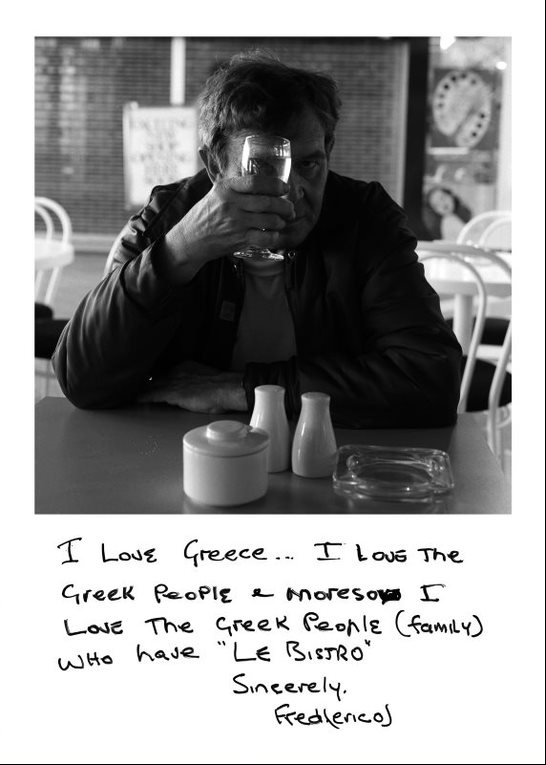
In the final set displayed (a video as well as prints), Lido Bistro, 1989, regular customers of the eatery and bar have complemented their portraits by adding their names and other handwritten words on the prints. That provides an extra dimension of considerable interest.

Fred, Lido Bistro, 1989 © Spiros Coutroubas 

Geoff Young & Sue Young, Lido Bistro, 1989 © Spiros Coutroubas

Harry+Pauline, Lido Bistro, 1989 © Spiros Coutroubas

Many visitors to this exhibition will know the now Westfield Shopping Centre well. These pictures acknowledge and preserve some apparently unexceptional situations that would otherwise fade into the past. Coutroubas’s parents ran the Lido Bistro. He remembers that times were tough – record interest rates and high inflation - the Lido’s books told the story of the decline in people’s spending. Sound familiar?

All the images were taken, with a bulky medium format camera on a heavy-duty tripod, in the mall’s common areas and in a supermarket during business hours without questions from management. They feature people who are socially disadvantaged, people doing jobs they might not boast about, people who didn’t have the opportunity to look their best, and people who opened up to Coutroubas with no clear idea of what would become of his images.

Today, the Belconnen Mall prohibits photography without authorisation and conditions apply to those that get the nod. Coutroubas has noted though that, “ironically …. images of people in malls are more abundant than ever. Social media provides plenty of candid pictures and videos from smartphones and surveillance cameras - people dropping their ice creams, tripping down escalators, pranking, fighting and even stealing.”

As well as the exhibition, the artist has published a book of the prints plus very readable words about the project. It can be purchased from here and at some Canberra bookshops.

This review is also available on the author's blog here.