Friday, August 9, 2024

THE OFFERING


The Offering by Omar Musa and Mariel Roberts.

The Bicentennial Hall. The Q. Queanbeyan Performing Arts Centre. Q Locals.  August 8 2024

 Reviewed by Peter Wilkins

I close my eyes and let the vivid images swirl through my mind. Internationally renowned Hip hop poet, author and rapper Omar Musa has returned to his hometown to present his autobiographical show The Offering to Canberra and Queanbeyan audience in Queanbeyan Performing Arts Centre’s The B Theatre. He is accompanied by acclaimed cellist Mariel Roberts. They have recently married and the show is an opportunity to introduce his wife to his hometown audience.

From the blue plastic sea to the lush jungles of his father’s homeland and family, Musa fills in his richly daubed palette of reminiscence with accounts of his grandmother and the innocent uncomplicated life of relations who live in Sarawak and Sabah. Musa's poetic landscape is a mesmerising terrain of imagery. Assonance sways our emotions. Alliteration evokes the poetic sounds and rhythms of his narrative. Repetition provides fills in the palette of the mind’s imagining with a richness born of passion. Through it all renowned American cellist Roberts provides a soulful accompaniment, drawing her long bow across the strings at times mystical, at times emphatically percussive and always the perfect evocative companion to Musa’s weaving narrative from poetry to hip hop to the rising urgency of rap or the oral tradition of his grandmother’s poetry in the mind.

The offering is a seductive insight into one man’s memory where fact and fiction merge in a whirling kaleidoscope of poetic images. Musa is more than a wizard of words. He is the voice of social conscience. He uses hip hop to lure us into his art and rap to invoke his fervent message. As a water spirit he entices his audience to plunge the depths of the sea to search for the land of his father’s ancestor. Musa is the hypnotist of the heart. He enfolds our emotions in his mastery of language. He takes us with him on a rolling surf of memory and social commentary. Roberts is his Muse breathing life into his performance.

But Musa is more than an artist who uses his poetry to paint pictures in our mind. The recurring image of a plastic sea and a blue bucket washed up from the depths is a harsh reminder of the pollution of pristine waters and humanity’s destruction of the natural environment. His rap is protest. His quest is to restore his humanity through the discovery of his heritage. The answer is in the history of changing colonization in the many flags that adorn Borneo’s exploited past. It is in the grandmother’s poetry, preserving the traditions and legacy of his father’s homeland.

The Offering is Musa’s gift to his Australian hometown. It is also the journey of discovery to unveil through poetry, story and song one man’s identity. It is a message not lost on the land of the Ngunnawal and Ngambri people as much as on the land of the people of Borneo. Musa and Roberts remind us in this captivating and insightful poetry and music performance that we live in an altered and damaged world. And yet, like every great poet, Musa releases the hope to be found in his verse that if we dare to search then the answer of who we are may be revealed.

The Offering had only one performance at the Queanbeyan Performing Arts Centre as part of Q The Locals programme. It is a very special performance that hopefully will return to a much wider audience. It is a poetic and musical feast for every discerning theatregoer.


THE OFFERING


By Omar Musa & Mariel Roberts

Q The Locals at the B Theatre, Queanbeyan 8 August


Reviewed by Len Power


Described as a “spoken word oratorio”, The Offering is an often head-spinning journey on themes such as environmental destruction, climate change, Southeast Asian colonial history, belonging and borderlessness.

Combining storytelling, poetry, hip hop, and live music with sound recordings made in Bornean forests and coral reefs, it’s a sensual and demanding work that requires close attention. A multitude of ideas and reflections jostle with autobiography, a sense of cultural and historical uneasiness and a cry of concern for the state of our world.

Award-winning Australian author, poet and rapper, Omar Musa, and internationally renowned American cellist and composer, Mariel Roberts have combined their strengths in words and music to present an uncompromising, dark, sensual and yet strangely optimistic view of our world.

Omar Musa

Omar Musa is a charismatic performer with boundless energy. Moving easily from storytelling to poetry to song, he has a powerful presence that demands and holds your attention. There is nothing remote about him. He can change quickly from intense orator to local lad in an instant, his disarming smile and down to earth manner is often as surprising as it is unexpected.


Mariel Roberts

Mariel Roberts shows that she is clearly a cellist of international standard. The soundscape she has developed to accompany Omar’s words creates an extraordinary atmosphere that matches and adds another dimension of its own. Watching her playing, the sounds and music that she can produce from her instrument are astounding.

Mariel Roberts and Omar Musa

The Offering is a unique, thoughtful and colourful view of the world through words and music. Cleverly presented in modern forms that appeal to the audience of today, it’s a journey to remember.


Photos by Nana Franck

Len Power's reviews are also broadcast on Artsound FM 92.7 in the ‘Arts Cafe’ and ‘Arts About’ programs and published in his blog 'Just Power Writing' at https://justpowerwriting.blogspot.com/.


The Offering


The Offering by Omar Musa & Mariel Roberts.  Presented by Q The Locals at Queanbeyan Performing Arts Centre, August 8, 2024.

Reviewed by Frank McKone

Performance Poetry – Omar Musa
Cello, live and recorded – Mariel Roberts

The Offering is a substantial work in a highly original form of a public meditation on how to become one with oneself; to be a whole person.  Memory is essential, yet a key thought through the series of poems which make up this hour presentation is “memories are always translations” – of the past before one’s birth, as well as of your past since your birth.

Taking up stories of his immigrant father’s  family and traditions in Sabah, Malaysian Borneo, Omar speaks in role as a water spirit.  He seeks understanding of the unity of land and water, searching in the archipelago of memories for the island which is himself – a Queanbeyan local, Australian, with memories of Borneo – its history as a country and the history of his family he has visited there as child and adult.

The often startling originality of his words, particularly when he tosses in unsuspected surprising rhymes, is matched by Mariel’s equally original creation of a soundscape – often perhaps in the tradition of musique concrète – live on the cello, but also incorporating instant recorded playback.  She provides not just an accompaniment for the poems but a form of music in its own right giving an emotional depth to the images and moods in her husband’s words.

The poems come to seem like major arias in a small opera: the audience spontaneously applauded each poem, and one solo ‘poem’ from the cello without words.  And, again surprisingly, the whole work becomes a drama with its hopes and dreams finally reaching the spirit’s success – as a fictional character which is also Omar Musa finding himself in a real world of human confusion.

Working together in the creation of art, Mariel Roberts and Omar Musa offer each of us the way towards our own one-ness.  Breathe: inhale and search; exhale and find the way.


Thursday, August 8, 2024

BEETHOVEN 9


Canberra Symphony Orchestra and Chorus

Emma Pearson, soprano

Ashlyn Tymms, mezzo-soprano

James Egglestone, tenor

Adrian Tamburini, bass

Conducted by Jessica Cottis

Llewellyn Hall August 7


Reviewed by Len Power


Marking the 200th anniversary of Beethoven’s 9th Symphony, the Canberra Symphony Orchestra (CSO) presented an exciting program that included not only the symphony but a world premiere of a work that took its inspiration from that symphony as well.

The evening commenced with Daughters of Elysium, a new work by New Zealand-Australian composer, Miriama Young. The work took its title and inspiration from Friedrich Schiller’s poem, An die Freude (Ode To Joy). The blissful conception of an afterlife, the glorious Elysian Fields held great significance in the ancient Greek imagination.

Commencing quietly with a heartbeat, the work was a journey through life, both dynamic and reflective, leading to a peaceful and thoughtful conclusion. The idea of universal sister/brotherhood was evident in this colourful and appealing work, and it was given a fine performance by the orchestra, conducted by Jessica Cottis.

Jessica Cottis

The major work of the evening was Beethoven’s 9th Symphony. First performed in Vienna in 1824, it remains one of the best known and loved pieces of classical music two centuries later. Its Ode To Joy melody has become the anthem for the European Union and has entered the public consciousness through many film and television programs.

Joining the CSO was the large CSO Chorus. Tobias Cole was the Chorus Master. Soloists Emma Pearson, soprano, Ashlyn Tymms, mezzo-soprano, James Egglestone, tenor and Adrian Tamburini, bass all came with a formidable list of international credits. Jessica Cottis, with her own international reputation, was the conductor.

Emma Pearson and Ashlyn Tymms

From the first movement, the clarity and dynamism of this performance was evident. The driving rhythms of the second movement gave way to a moment of lightness that hinted at the joy to come in the work’s finale. The beautiful, melodic third movement with its two themes was intensely moving.

The fourth movement with its strong beginning led the orchestra into the Ode To Joy theme and, from then on, the power of the soloists, chorus and orchestra together made this final part of the work an emotionally uplifting experience.

This was a memorable performance of the entire work, clearly bringing out Beethoven’s message of peace, joy and a united humanity. The numerous curtain calls and standing ovation were richly deserved. During one of the curtain calls, Jessica Cottis held up a copy of the music score and pointed to Beethoven’s name, bringing a resounding cheer from the audience. It was a fitting tribute for the great composer’s 200th anniversary of this work.


Photos by Arianne Schlumpp


This review was first published by Canberra CityNews digital edition on 8 August 2024.

Len Power's reviews are also broadcast on Artsound FM 92.7 in the ‘Arts Cafe’ and ‘Arts About’ programs and published in his blog 'Just Power Writing' at https://justpowerwriting.blogspot.com/.


Monday, August 5, 2024

WIRED - The Training Ground


Produced, Directed, Choreographed and Music Editing by Bonnie Neate & Suzy Piani.

Lighting Design by Bonnie Neate, Suzy Piani and Alex Clifford.

Costumes by Canberra Dancewear, Hamilton’s Theatrical.

Videography and 3D animation by Trent Houssenloge & Chris Curran – Cowboy Hat Films.

Erindale Theatre, August 2 & 3, 2024.                        

Performance on August 3rd reviewed by BILL STEPHENS


Jemima Paul (Greta) - Larina Bagic(The Watcher) in "Wired"


Established in 2020 by Bonnie Neate and Suzy Piani, The Training Ground is a self-funded six-month, pre-professional contemporary dance program for advanced contemporary dancers from the ACT and surrounding areas. The program culminates in two public performances of an original full-length dance work.

In previous years these works have consisted of deconstructions of well-known classical ballets, "Giselle", "Romeo and Juliet" and "Coppelia", which have earned the program awards and critically acclaim for its originality, execution and superb presentation.

"WIRED" varies from previous presentations in that it was inspired by a true story from 1980’s, concerning a young person in Massachusetts who hid himself inside the walls of a house to terrorise the occupants.

Released from the necessity of referencing the pre-determined storyline, Neate and Piani have devised a highly effective full-length abstract work which explores the psychological implications inherent in this story, building and maintaining mood and tension through sophisticated complex choreographic sequences that test, explore and showcase the capacity of their dancers.

As in previous years both execution and presentation were highly professional. Eschewing character costuming, the meticulously groomed dancers all wore attractive short-legged unitards. Principal characters were similarly costumed, distinguished by minor details, such as a collar or trousers.


Charlie Thomson (Leo) - Jemima Paul (Greta) - Emily McCoy (Tess) in "Wired"


Jemima Paul, Emily McCoy and Charlie Thompson, portrayed the three inhabitants of the house, named Greta Tess and Leo, while Larina Bagic was the mysterious omnipresent character called The Watcher.

As soloists they carried the narrative, performing the demanding solos, duets and group numbers which linked the meticulously rehearsed ensemble sequences.

Larina Bagic, so impressive in last year’s “Unhinged”, again displayed her remarkable flexibility and command of technique to create an unsettling presence around each of three house-mates, shadowing and surrounding them in a series of virtuosic duets and solos.


Larina Bagic (The Watcher) - Jemima Paul (Greta) in "Wired"


Jemima Paul, sensitive and nervy as Greta, Emily McCoy, bright and carefree as Tess, and  Charlie Thomson, mischievous but attentive as Leo, the only male in the cast, all impressed with their outstanding dancing and  characterisation skills.  

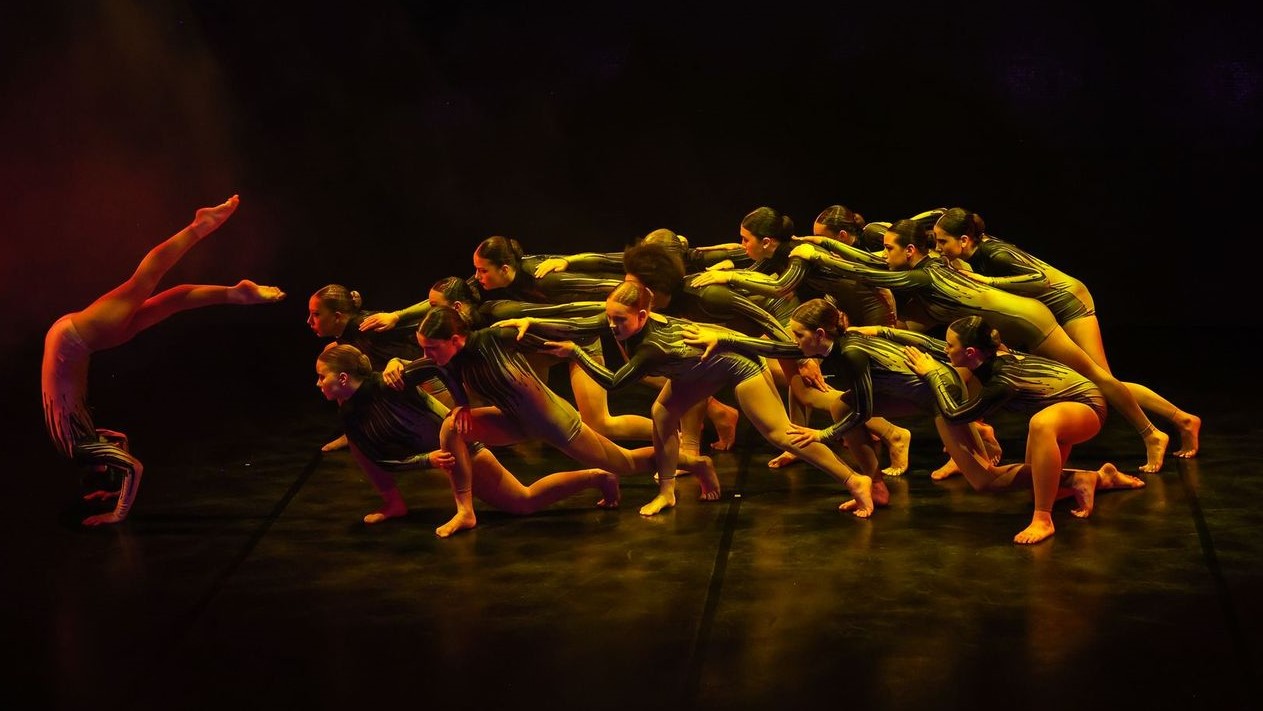
Another remarkable feature of this production was the precision and attention to detail of the ensemble work.  Whole sections of intricately choreographed unison movement left every dancer vulnerable to being exposed should a concentration lapse occur. This however never seemed a possibility given the confidence and accuracy with which each and every dancer performed the demanding choreography. The result was quite thrilling to experience, and a credit to everyone involved.


The "Wired"  ensemble in performance


As with previous Training Ground productions, the sophistication of the scenery and special effects was also outstanding.

An integral character with a personality of its own, the House was brilliantly realised by Trent Houssenloge and Chris Curran in extraordinary videography and 3D animation. It was initially beautiful, but as paintings began to drop off walls, and eyes started to peer through the resultant cracks, it gradually became more and more sinister until finally it disintegrated in a shattering finale.

Dramatic lighting by Alex Clifford, together with other special effects, particularly the moment when The Watcher was suspended in mid-air surrounded by floating stools, and others when walls artfully manipulated by Imogen Addison revealed hidden dancers, were achieved with the professional polish that is the hallmark of the work of Bonnie Neate and Suzy Piani.

These are just some of the reasons why these annual presentations by The Training Ground have become established as among the most eagerly anticipated events in the Canberra dance calendar.   


                                        Photos by Eliza Swiderski of ES Fotografi


                      This review also published in AUSTRALIAN ARTS REVIEW.

MAGNIFICAT


Luminescence Chamber Singers and Children’s Choir

Apeiron Baroque

Wesley Uniting Church, Forrest August 4


Reviewed by Len Power


Joining forces with Apeiron Baroque, the Luminescence Singers and Children’s Choir presented works from the Italian Renaissance and Baroque era, paying homage to the composers of the Ospedali Schools of Venice, where young singers studied under the tutelage of Italy’s finest musicians.

Commencing with Claudio Monteverdi’s 1641 composition, Beatus Vir, the singers and instrumentalists impressed with their haunting performance of this beautiful work.

It was followed by another Monteverdi piece from 1610, Duo Seraphim. It was sung by Lucien Fischer, baritone, Dan Walker, tenor, and Tom Hallworth, tenor. The pleasing blend of their voices made this one of the highlights of the concert.

From a composer who started his career as a music teacher in Venice, Apeiron Baroque then played Giovanni Reali’s Folia from 1709. This work was given a fine performance, especially the very lively finale.

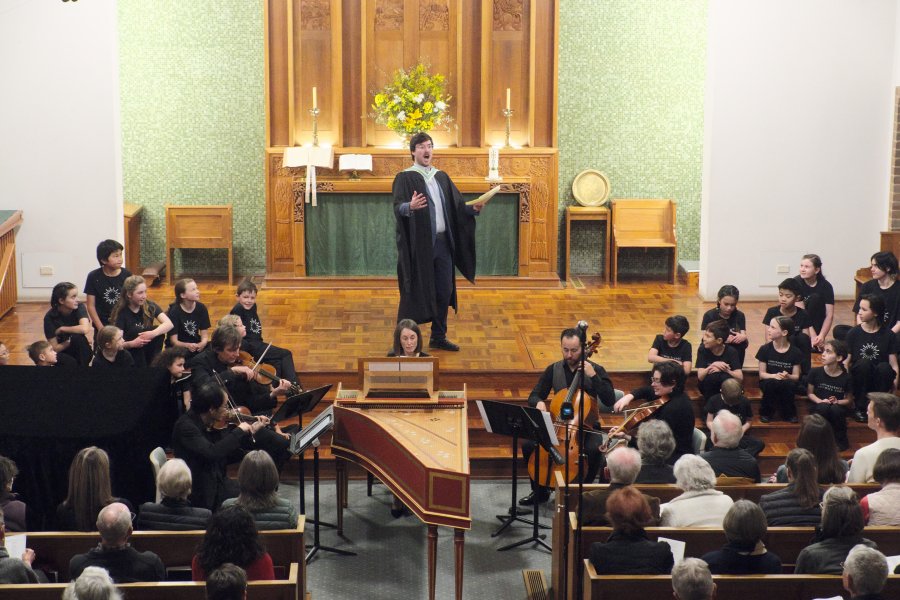
Luminescence Singers with Apeiron Baroque

Francesco Cavalli worked under the tutelage of Monteverdi in Venice. From his collection of sacred works, Musiche Sacre, from 1656, the singers and instrumentalists performed his Lauda Jerusalem. Their voices brought out all the sensitivity in this work, filling the church with glorious sound.

After an interval, the Children’s Choir joined the singers and Apeiron Baroque for a performance of Nicola Porpora’s Magnificat, written in 1745. The children sang with accuracy and warmth, making this another highlight of the concert.

Luminscence Children's Choir conducted by AJ America with Apeiron Baoque

Heinrich Biber’s quirky Sonata Representativa was then presented by Apeiron Baroque. This work imitates various birds and even a frog at one point. John Ma on violin gave an amusing commentary between sections of the work, making this a delightful change of pace for the concert.

Alasdair Stretch as "The Schoolmaster In The Singing School" with the Luminescence Holiday Program Children's Choir and Apeiron Baroque

The final work presented was Christoph Fehre’s 1751 Comic Cantata: The Schoolmaster in the Singing School. It was performed by the Luminescence Children’s Choir Holiday Program participants, with Alasdair Stretch, bass-baritone, as the pompous schoolmaster. This work, full of humour and irony, was given a nicely controlled and amusing performance by the children. Stretch was a delight as the harried schoolmaster.


Photos by Peter Hislop


This review was first published by Canberra CityNews digital edition on 5 August 2024.


Len Power's reviews are also broadcast on Artsound FM 92.7 in the ‘Arts Cafe’ and ‘Arts About’ programs and published in his blog 'Just Power Writing' at
https://justpowerwriting.blogspot.com/.


Sunday, August 4, 2024

Uncle Vanya - adapted by Joanna Murray-Smith


Uncle Vanya by Anton Chekhov, adapted by Joanna Murray-Smith.  Ensemble Theatre, Sydney, July 26 – August 31 2024.

Reviewed by Frank McKone
August 3

Playwright: Anton Chekhov; Adaptor: Joanna Murray-Smith
Director: Mark Kilmurry; Asst Director: Emma Canalese
Set & Costume Designer: Nick Fry; Lighting Designer: Matt Cox
Composer & Sound Designer: Steve Francis
Dialect Coach: Nick Curnow; Intimacy Director: Chloe Dallimore
Stage Manager: Lauren Tulloch; Asst Stage Manager: Christopher Starnawski
Costume Supervisor: Renata Beslik

Cast:
Nanny / Maryia – Vanessa Downing; Telyeghin – John Gaden AO
Yelena – Chantelle Jamieson; Serebryakov – David Lynch
Sonya – Abbey Morgan; Vanya – Yalin Ouzecelik
Astrov – Tim Walter


“I’d adapt a phone book in order to have a show at the Ensemble”, says Joanna Murray-Smith.  And so said all of us in the audience yesterday afternoon.

That’s because Murray-Smith achieved her Writer’s Note aim.  She points out that “the eternal dilemma for contemporary Artistic Directors” is whether “Chekhov’s language needs to change” when “historical language [such as in the standard Penguin translation by Elisaveta Fen ©1954] sometimes doesn’t work for comedic effect.  It sometimes sounds stilted or pompous to modern ears….  So by deftly translating the intention into language that fits it best in this moment now can make the play sing in the way more effectively as it was intended to.”

Of course, it was intended to be a satirical comedy in which Uncle Vanya’s plight in relation to the proposed selling of the family estate would be both a laughing matter and a serious concern for middle class Russians in 1899 attending the Moscow Art Theatre.  And, of course, in 1954 the F- word would never have been allowed to cater for “younger audiences who aren’t used to having to ‘work’ to understand a play”,  as Murray-Smith describes them today.

But, of course, at 83 I laughed along with the rest, many of whom were probably not much younger than me at the Saturday afternoon matinee.  Even attempted homicide made us laugh in nervous reaction – though I wonder how that was received in Chekhov’s time.

And I say that because Mark Kilmurry and the terrific team of actors kept us right on the correct satirical edge so close to reality that often we couldn’t be sure whether to laugh or not.  All the actors were equally in tune with Murray-Smith’s style, so that though we knew we were watching this late-19th Century specifically Russian society, we had no trouble believing these characters were real.

In particular I would like to give a little extra praise to Abbey Morgan.  Her teenage Sonya could so easily be overplayed, especially in her scene with the older Yelena  talking of her unrequited love for the doctor, Astrov.  Yet Abbey made a speech like this:
“O Lord, give me strength…. I’ve been praying all night…. I often go up to him, start talking to him, look into his eyes…. I have no more pride, no strength left to control myself….. etc. etc.”
into both Chekhov’s satire of overblown young love and at the same time was just sad enough for me to feel sympathy when Yelena asked “And he?” and Sonya replied “He doesn’t notice me.”


In other words, Ensemble Theatre has done both Joanna Murray-Smith and Anton Chekhov proud.  

And because of her deftly translating Chekhov’s intention, we see that this is not a play just about Russia in 1899, but a play which through our laughter makes us acutely aware of how the threat of social breakdown – all those F-words – is just as real for us today.  

P.S.
For those confused by Russian names here’s the list of the characters in the standard form.  It’s a bit like a phone book:

Serebriakov, Alexandre Vladimirovich, a retired professor

Yeliena, Andryeevna (Helene Lienochka), his wife, aged 27

Sonia (Sophia Alexandrovna), his daughter by his first wife

Voinitskaia, Maryia Vassilievna, widow of a Privy Councillor and mother of the professor’s first wife

Voinitsky, Ivan Petrovich (Vania), her son

Astrov, Mihail Lvovich, a doctor

Telyeghin, Ila Ilyich (nicknamed ‘Waffles’), a landowner reduced to poverty

Marina, an old children’s nurse, and A Workman

The action takes place on Serebriakov’s estate – which Sonia’s Uncle Vanya claims was given to Maryia when her daughter married Serebriakov, and so cannot be sold by Serebriakov without approval from at least his daughter Sonia (now a young adult) and preferably from her Uncle Vanya as well.