Visual Art Exhibition Review | Brian Rope
Stilleven I Rose-Mary
Faulkner
ANCA Gallery I 14 May – 1 June 2025
A decal is “a plastic, cloth, paper, or ceramic substrate that has printed on it a pattern or image that can be moved to another surface upon contact, usually with the aid of heat or water.” Rose-Mary Faulkner transfers images onto kiln formed glass. She layers several related images before further manipulating the surface and form through multiple fusing or cold working. This expands the imagery beyond the original photograph as the transparency of glass enhances layering for the purpose of depth and overlapping.
 |
| Rose-Mary Faulkner, Six oranges and a Saturday morning ritual, 2024, kiln formed glass with decals, 30 x 20 x 1cm. |
Stilleven exhibits works by glass artist Faulkner, considering connections to places and objects as both self-portraiture and representative of lived experience and narrative. Softly focused compositions of domestic settings form an avenue to explore dynamics of the absence and presence of people and bodies, connection to environments we embody and the way objects can exist as metaphors.
Domesticity,
and artworks depicting inanimate objects found in domestic situations, are domains
that have historically been disregarded. The Dutch-origin term
"stilleven" means inanimate objects. However, disguised symbolism means
domestic objects can be extremely significant revealing the narrative of
people's lives, bearing witness to time and change. That is why many of us
value, and display in our own homes, precious objects inherited from our
forebears.
Sadly, many still consider domestic tasks a domain for women only. This exhibition examines the familiarity and femininity of these topics as ones that possess significance, story, and profound meaning. Faulkner illustrates what is simultaneously familiar, difficult, and valuable amidst the subtle rhythms of everyday.
One particularly delightful work, Snowdon (a study) is a diptych about a much-loved farm house which, I believe, has been in the artist’s family for many generations.
%202023%20kilnformed%20glass%20with%20decals.jpg) |
| Rose-Mary Faulkner, Snowdon (a study), 2023, kiln formed glass with decals. |
Faulkner is based in Australia’s national capital, Canberra. She graduated from the Australian National University School of Art & Design, Glass Workshop, with a Bachelor of Visual Arts in 2015 and then with first class honours in 2016. Since then, her work has been exhibited widely - in Australia, Berlin, America and Japan. It has been acquired for the Wagga Wagga National Art Glass Gallery collection. The artist works as an arts educator and creates art at Canberra Glassworks and in her home studio which she shares with her partner and glass artist, Rob Schwartz.
In 2018 Faulkner won the National Emerging Art Glass Prize (Wagga Wagga) and spent six weeks at Northlands Creative in Lybster, Scotland, taking part in intensive classes. The same year she held her first solo exhibition, with a body of work that developed from the processes and ideas she had explored in her honours year. In 2019, she was a finalist in the inaugural Klaus Moje Glass Award (Canberra Glassworks).
For
me the most interesting piece in the show is an artwork comprising 32 separate
still life compositions gathered from women in her extended family and artists
network of friends. Each contributor provided photographs of objects or spaces in
their own homes which Faulkner has fused into glass. The images are from women who
range in age from 20 to 89. They live in Australia, America and the United
Kingdom. The catalogue describes the collection of pieces as a kind of still
life portraiture. This fabulous artwork is a created composition revealing a
great deal about women’s experiences despite (or because of) the contents being
domestic.
 |
| Rose-Mary Faulkner, three of the 32 works in Tending (quiet testimonies from homes), 2025 – Kilnformed glass with decals, dimensions variable (installation images by Brian Rope) |
There are also a number of works featuring bent glass forms which, again, are about inanimate objects.
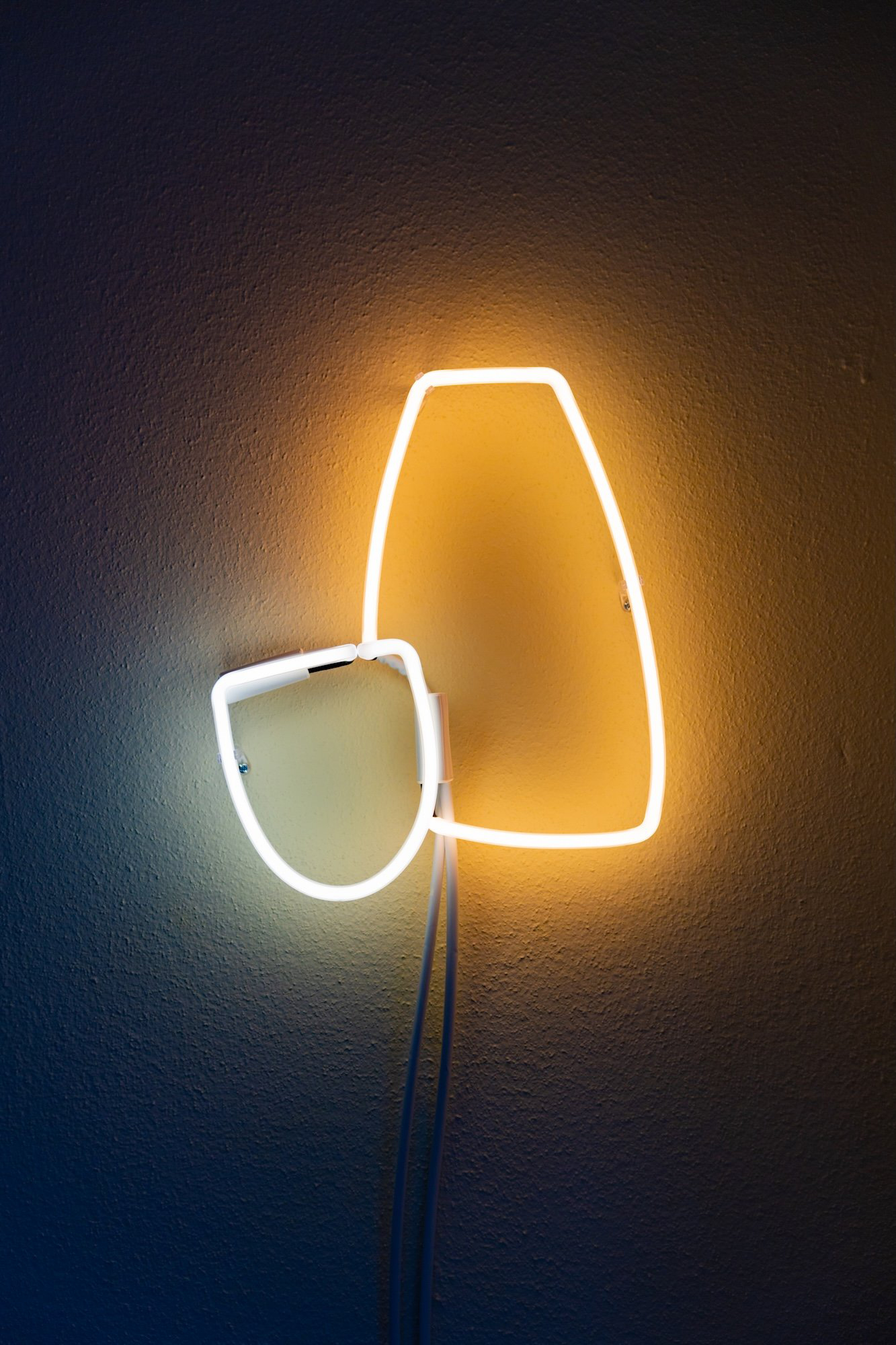 |
| Rose-Mary Faulkner, Two vessels in light, 2024, hand bent neon with argon mercury gas, dimensions variable. |
The
exhibition essay by Dr Jacqueline
Bradley is a beautifully written piece, well worth reading in conjunction with a
visit to the exhibition. Bradley speaks of Faulkner’s “deep consideration of
the still life genre, shifting between the formal and symbolic, the private and
personal.”
This review is also available on the author's blog here.


