Showing posts with label Installations. Show all posts

Wednesday, September 10, 2025

The Camera Unrepair Shop

Exhibition Review | Visual Art | Brian Rope

The Camera Unrepair Shop | UK Frederick

Photo Access | 14 August – 13 September 2025

Entering the gallery my first sight of The Camera Unrepair Shop caused me to wonder just what was being exhibited. Three shelves on the wall filled with an assortment of analogue cameras and a table with a few seemingly random pieces of photo paraphernalia on it. But, when I took a closer look and thought about it, I soon saw a simple photographic shop.

First Sight - The Camera Unrepair Shop Installation Image © Brian Rope 

Promotional material informs us that the exhibition combines installation, cyanotype process and performance to reflect on the nature of photography, its evolution, and the unseen labour behind film-based imagery. And that the artist, UK Frederick, dismantles cameras, creating blueprints of their anatomy, subverting the usual production-to-waste narrative. This experimental work provokes contemplation about the current state of photography amid emerging technologies.

In fact, the artist did that dismantling live in the gallery during the exhibition, then created photograms and cyanotype blueprints from the parts. Those results have accumulated and surrounded the workspace with an evolving collection of “mechanical unmaking”. Circumstances have prevented me from revisiting to see the additions to the archive, but some fine examples were in place when I visited soon after the show began.

Unrepaired Cyanotypes Installation Image © Brian Rope

The-Camera-Unrepair-Shop-UK-Frederick © Fernanda Pedroso

A catalogue essay by Vahri McKenzie sheds further light on what Frederick is doing here. She once visited the Detroit Institute of the Arts and saw some of Diego Rivera’s murals depicting tourists visiting the nearby Ford Motor Company factory and watching the labourers at work creating cars. Visitors to this gallery during this exhibition similarly have had opportunities to watch this artist labouring to create artworks.

So, as the essay says, the artworks created become a collaboration between the artist, the cameras she “unrepairs” and the observers who went to the gallery to watch the creative process happening in the camera unrepair shop.

The-Camera-Unrepair-Shop-UK-Frederick © Fernanda Pedroso


The-Camera-Unrepair-Shop-UK-Frederick © Fernanda Pedroso

The-Camera-Unrepair-Shop-UK-Frederick © Fernanda Pedroso

Frederick herself tells us in the catalogue that her primary modes of art practice are photography, printmaking and video. As an archaeologist, her art practice is informed by her interests in material culture and the way people interact with each other and their worlds.

So, this is a rather different exhibition and well worth visiting and exploring. It is correctly described as a durational performance and mixed media installation of cameras, cyanotypes and photograms. I wish I had had the opportunity to see parts of the performance first-hand, and more of the archive created since I saw its early stage.

It is worth watching the video of an Artist in Conversation: UK Frederick event. You can see gaps in the camera equipment on the shelves and the increase in the quantity of cyanotypes and photograms. During the event Frederick refers to the cyanotypes referencing the blueprint as a process of design, but also as a collection of prints representing the process that goes into making art that eventually goes onto the wall or wherever – in a sense each artwork is a portrait of an unrepaired camera. Her thought processes and discussion of ideas provide much for us to contemplate.

Screenshot from Photo Access video of UK Frederick Artist in Conversation event 30.08.2025

This review is also available on the author's blog here.

Sunday, February 9, 2025

VIEW 2025

Visual Art Exhibition Review | Brian Rope

VIEW 2025 I Cailyn Forrest, Adam Hsieh, Fiona Lee, Aia Solis, Emma Winkler

Photo Access I 23 January – 22 February 2025

VIEW 2025 shares artworks by emerging artists Cailyn Forrest, Adam Hsieh, Fiona Lee, Aia Solis, and Emma Lyn Winkler. It is accompanied by a publication offering insights into current photographic trends.

Cailyn Forrest is a Doctoral candidate in her final year at the National Art School, Sydney. Her practice focusses on examining analogue and alternative photographic processes through a feminist lens.

In her work Darkroom Viscera here, Forrest has transformed the act of photography into a bodily ritual, intertwining artist and material. The results are, in effect, a performance. They show us a female body, but it is not portrayed in a conventional manner. Rather the set of ten seemingly faded prints successfully present the artist’s body very differently. The artist has described them as “little experiments.” An experiment is generally considered to be a careful test used to discover or understand something that is not known. So, it is interesting to look at this series and consider how well Forrest’s experiments, whether little or more substantial, have improved our understanding of the female body.

16122024, 2024 - Silver gelatin print on hand-coated rice paper on board – Cailyn Forrest

Adam Hsieh is a digital artist. Guided by his experience as a queer Chinese migrant, Hsieh’s art practice seeks to explore the dynamic tension between places and place-makers. He uses multi-sensory interventions, manipulating systems of light, sound, moving images, code, and AI.

In I Didn’t Come Here for Love here Hsieh has used juxtaposition – wide-angle views of Hobart’s Mount Wellington alongside exchanges had with others on the geosocial app Grindr. Words from those encounters are superimposed on the well-chosen views of the famous mountain. The resultant video installation runs for 10 minutes showing limited movements in each channel as it screens.

I didn’t come here for love, 2023 - feature image from three-channel video installation
– Adam Hsieh


Fiona Lee is an artist based in Elands, NSW. Using installations, photo media, and sculpture, her practice engages with critical social issues, focusing on climate change and the post-natural world.

In her Future Critical artwork here she seeks to confront ecological loss and political inertia, arising from the experience of losing her home in the 2019–2020 bushfires. Using an inkjet print of video stills, a clock and audio, this work explores the lack of necessary action by political systems through visual disruptions, layering, and fragmented imagery. Their portrayed remnants speak to us of the destruction of our precious forests, reminding us of the terrible impacts the fires had on the natural environment.

VIEW round - inkjet print of video stills – Fiona Lee

Aia Solis is a Filipino artist based in Australia. Her photographic practice explores themes of learning, unlearning, and relearning through an experiential approach. Her work explores emotional tensions experienced in personal and cultural transitions.

In her work Taranta Muna, Solis merges past memories and present realities, using some quite delightful stitching on photo collage plus video. On her Instagram account she has written that this is “an ongoing project that reflects the unspoken dissonance of not fully belonging to the past or being entirely rooted in the present - a state of instability and uncertainty. Threads weave together images of past memories and present realities, creating a layered dialogue between control and chaos, seeking strength not in resolution, but in embracing the uncertainty of the in-between.”

These works were some of my favourites in the exhibition and I look forward to seeing more of this project as it evolves.

01 - stitching on photo collage - Aia Solis

Emma Winkler’s practice uses collage, painting and animation to explore the relationship between anxiety and death. She has a personal yet playful approach, inviting viewers to laugh in the face of death - or at least start a conversation about it.

The exhibition catalogue informs us that, in Shadow Puppets, Winkler fuses painting, photography, and animation into textured narratives infused with “existential absurdity.” I had to do some web browsing about that term, learning (amongst other things) that it underscores the conflict between our desire for order and the chaotic nature of the universe. Certainly, Winkler’s paintings (including a hand-painted stop-motion animation) here are fascinating combinations of diverse things wherein the end compositions to my eyes seemed appropriate.

Sinking Feeling, 2023, oil, acrylic and spray paint - Emma Winkler


This review is also available on the author's blog here.


Monday, August 21, 2023

PALIMPSEST

Exhibition Review: Textiles, mixed media, ephemeral artworks, installations, artist books & photobooks | Brian Rope

PALIMPSEST | Victoria Cooper, Maggie Hollins, Doug Spowart

BAINZ Gallery, Wangaratta Library | 5 – 28 August 2023

The Winton Wetlands are at Winton North in north-eastern Victoria - near to Benalla. I’ve never visited them, but after viewing this exhibition and speaking with two of the artists about it, I have some understanding of what these wetlands now are like.

Three artists from Benalla have collaborated to produce and display a wonderful visual exhibition inspired by the layered human and natural history and contemporary renewal of the wetlands. They have sought to associate the altered landscape with the concept of a palimpsest – one dictionary I checked gives the meaning as “a manuscript or piece of writing material on which later writing has been superimposed on effaced earlier writing” or as “something reused or altered but still bearing visible traces of its earlier form”. The artists are contributing to discussion of different, yet overlapping, stories of the wetlands.

The restoration currently happening at these wetlands has been described as a project of national scientific, environmental and cultural significance. It is the largest wetlands restoration project in the southern hemisphere and has been ranked as a 'wetland of distinction' by the Society of Wetland Scientists.

Victoria Cooper and Doug Spowart have been involved in the arts as practitioners, teachers and commentators for a lengthy time, including having residencies at Bundanon. Maggie Hollins has qualifications in ceramics, leads art workshops and makes music with her fiddle. Unsurprisingly therefore, each and every artwork displayed is of a high standard.

There are unique, handmade textural and sculptural artworks by Hollins that use a diverse variety of materials – including found small branches, knotted bark, dyed cotton thread, solar and rust dyed cotton fabric, metal rings, and found grasses. Some are accompanied by postcard sized images of the same artworks “displayed” on site in the wetlands. Those images were a team effort – Hollins operated the camera, Cooper was location scout and camera assistant, and Spowart did the lighting and Director of Photography duties. 

Hollins montage of works - Photo Spowart

Hollins 'Drifting on a Current' – Photo - a collaboration

Spowart and Cooper commonly work collaboratively with each other and their extensive experience of doing so is clearly on display here in their further collaboration with Hollins. In this show, we see Cooper’s images of Spowart taking other images – and Spowart’s images of Cooper taking other images. They have described the resultant diptychs as Witnessing. In Witnessing winter the smaller of two images shows Cooper photographing a wintry scene along a track, whilst the larger image in the diptych is the photo that she took. Witnessing The Lunette adds a  further witness in that one photographer’s shadow is included in the image of the other photographer photographing the scene.

Cooper+Spowart - 'Witnessing The Lunette' diptych

When visitors stand and look at each diptych they, in turn, become further witnesses.

When we view Hollins piece titled Harmony - small branches, knotted bark and dyed cotton thread, we can also see an image of it at the wetlands being held by the artist with a view of the wetlands behind her. Visitors to the gallery are, therefore, seeing the artwork itself together with a view of how it looked within a wetlands space. This too is “witnessing”. 

Hollins with 'Harmony'  - Photo Spowart

There are also larger standalone photographic prints by Cooper & Spowart conveying stories of witnessing, magnificent 3-metre-wide concertina photobooks by Spowart displayed folded out and attached to the wall, plus artist books and poetry by Cooper.

In a foreword to her artist book A Work in Progress, Cooper says “I have an ongoing exploration of desire paths created by animals and the marks on the land made by …. trees, water and wind”. Over time ….. these agents of change create a palimpsest….”

Winton North Road with Vicky - Photo Spowart


Doug at Ashmead's Swamp - Photo Cooper


Spowart 'Once was' + 'Story Trees' closeup – Photo Spowart


Cooper 'A work in progress' (artist book) from the video by Spowart

Cooper reveals a further strength in her artist’s arsenal through her poem which relates to the Witnessing winter diptych mentioned earlier.


Cooper+Spowart-'Witnessing winter' diptych

The entire exhibition all comes together splendidly, most successfully conveying the messages the artists want visitors to hear. It is a fine illustration of how a number of artists can collaborate and produce a body of diverse work which speaks clearly and loudly to those willing to listen, as well as look at the individual pieces. It is clear that all three collaborators are consummate artists.

If you are in the area, or able to travel to Wangaratta, whilst this exhibition remains in place, it is well worth seeing. You might also visit the Winton Wetlands any time you are in the area.

This review is also available on the author's blog here.

Saturday, May 28, 2022

WE BLEED THE SAME

 Photography, Documentary & Installations | Brian Rope

WE BLEED THE SAME | TIM BAUER & LIZ DEEP-JONES

Research School of Social Sciences, ANU | Until September/October 2022

Whilst reporting on conflicts, acclaimed journalist Liz Deep-Jones, was deeply disturbed that they unfolded in the name of religion or racism.  Inspired by a community-led, grassroots initiative ‘Racism Not Welcome’, Deep-Jones joined forces with portrait photographer, Tim Bauer, to present this exhibition ‘We Bleed The Same’.

Deep-Jones grew up in a Lebanese, Arabic-speaking household trying to figure out how she belonged in Australian society where she experienced bigotry. She says the exhibition is “about you, me, humanity!” Bauer is the child of a refugee European father and an Australian mother who taught him to love and respect all human beings.

Thirty-nine women and men from varied backgrounds, religion and race feature in Bauer’s images. And in an accompanying documentary produced by Deep-Jones, they share personal and emotional stories about their diverse cultures and experiences with dangerous and demoralising racism. Like them, we should all be seeking to defeat racism.

As he is a pre-eminent Australian portrait photographer, it is no surprise that Bauer’s diverse images here are simply superb. The people he has wonderfully portrayed include former Race Commissioner Tim Soutphommassane, First Nations Elder Leetona Dungay (whose son David died in custody) and refugee Marcella Kaspar.


Tim Soutphommasane © Tim Bauer


Leetona Dungay © Tim Bauer


Marcella Kaspar © Tim Bauer

Lovemore N'dou, one of the other incredible people featured, had a successful early career in boxing but, due to South Africa’s apartheid policies, was not allowed to compete internationally. He migrated to Australia and continued his boxing career before becoming a lawyer.


Lovemore Ndou © Tim Bauer

There is Australian-born Uyghur woman Subhi Bora, indigenous Torres Strait Islander author and union official Thomas Mayor, and Filipino migrant Brenda Gaddi. Also South Sudanese refugee Deng Adut, proud Australian Muslim woman Maryam El-Kiki, and human rights advocate and refugee activist Thanush Selvarasa.


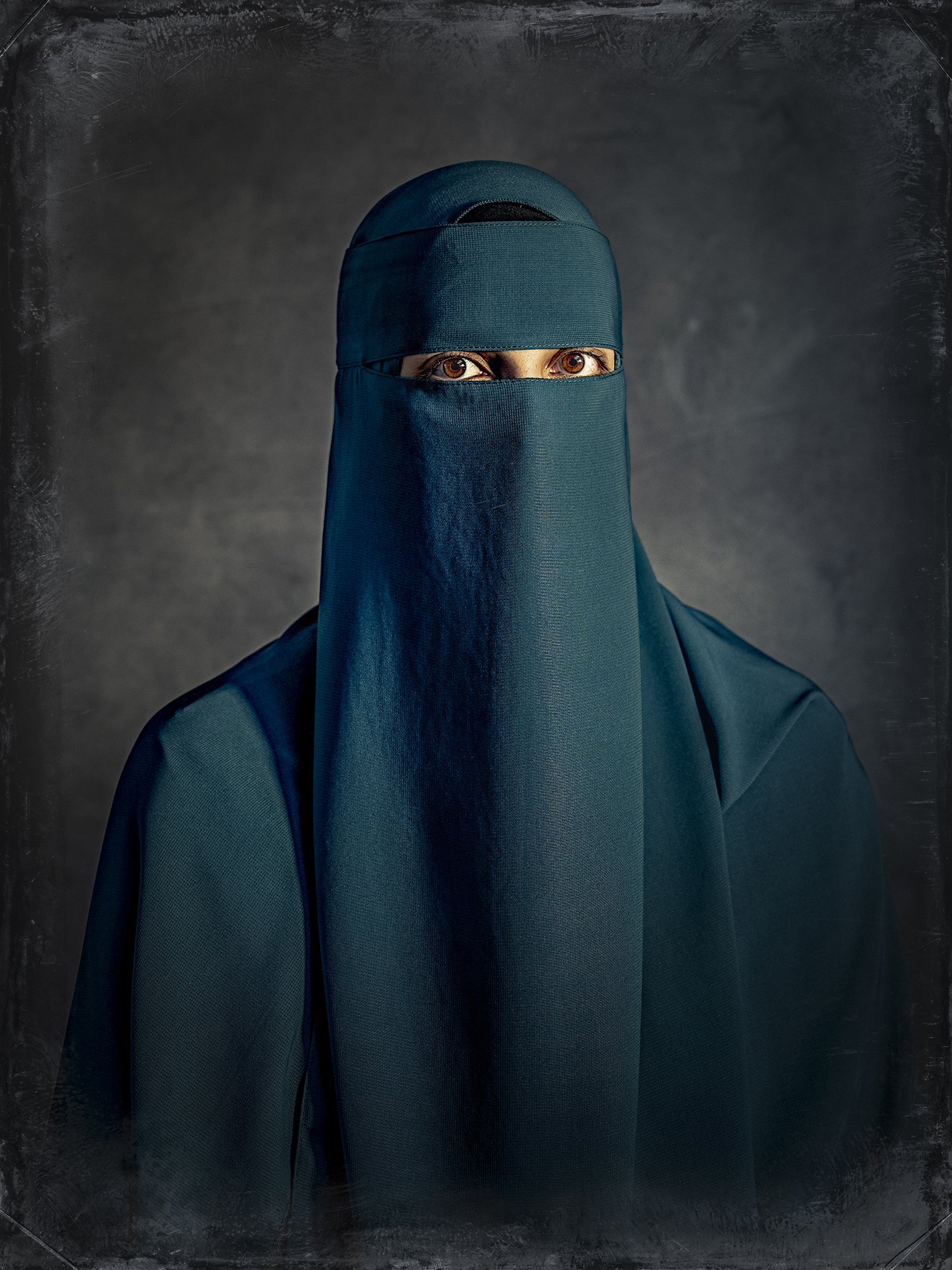
Maryam El-Kiki © Tim Bauer


Thanush Selvarasa © Tim Bauer

Accompanying each wonderful Bauer portrait are the subjects’ deeply personal stories in words assembled by Deep-Jones - explaining who they are, what their personal racism experiences have been, and how they are involved with seeking to combat bigotry. Those words take the already powerful images even further - they are profoundly moving. It is highly probable that studying the images and reading the words will make most viewers quite emotional.

From Mayor, we learn “Indigenous people experience racism in this country every day. Racism makes me feel less than human, insignificant, like I’m not even there but we need to stand up and be proud of who we are. We are on our country and that can’t be ignored.”

The exhibition also features various installations - including the interactive Kizuna (Japanese  - meaning ties or bonds) in which family photographs submitted by the local community are being hung from a red Hills Hoist using red strings. The threads of photos represent the connectedness between Australians whilst reflecting our diversity. Deep-Jones hopes this exhibition that she has produced will convey that message and spark visitors into ongoing conversations about racism in Australia.

Another installation comprises vials of fake red blood, each labelled with a name of a portrait subject and, so, symbolising them and shouting, ‘We Bleed The Same.’

There are opportunities for visitors to share their personal experiences of, and views about, racism by writing in red alongside images of a “blood-soaked arm.” And a Cedar Tree of Lebanon installation, inspired by Deep-Jones’ family roots, seeks to touch our souls and ignite our hearts to inspire positive action for humanity.

Deep-Jones expects the exhibition will continue until at least September 2022. It is in the foyer and also the first floor of the RSSS building at the ANU. I urge everyone who can to see this important presentation.

For a great interview with Deep-Jones check here.

This review was published by the Canberra Times on 28/05/22. It is also available on the author's blog here.