Showing posts with label Art Review. Show all posts

Saturday, February 4, 2023

REFLECTIONS ON NATURE

Photography | Brian Rope

REFLECTIONS ON NATURE | VARIOUS ARTISTS

OLD BARN GALLERY | 2 – 12 FEBRUARY 2023

The Reflections on Nature artist-in-residence project was launched on social media at the end of April 2020. At that time it was described as “designed to encourage artists to connect with nature over the coming months…… observing and creating in response to observations of colour, regrowth, seasonal change and interesting revelations….. for everyone from beginner artists ….. a guided journey of topics and inspirational thoughts….. a safe space …. to share …. sketches, photos, ideas, prose and observations.…… We may even grow this into an exhibition of observations or a publication eventually!”

Well it certainly grew. And now there is an exhibition of works selected from the huge number of observations by the substantial membership of the project - more than 600 people made thousands of contributions. The creative reflections gathered represent a unique and contemplative perspective on the environment during a time when our world changed. 

Before this project was born, the environment had been dreadfully damaged by fire and drought. Then COVID-19 began. As a result, project participants felt a great need to explore the outdoors. They slowed down and looked for ways to create a sense of possibility, and for the promise of healing. 

Photographers, writers, artists, journalers, ecologists and naturalists joined forces exploring the natural environment. Places they often knew well became sources of fresh wonder and delight, as they rediscovered and saw them afresh. Indeed this was a personal experience as I walked around the open areas of my own suburb.

Over a period of twelve months of guided, focussed observations in the Canberra region and beyond, the artists shared purpose around a common interest in nature resulted in a rich record of their experiences.

The exhibition was officially opened on World Wetlands Day (wetlands are being lost three times faster than forests) by Senator David Pocock who described the artworks as incredible and the exhibition as making a massive contribution.

The Senator noted that First Nations people had looked after our environment for thousands of years and that we all need to do so now. He suggested the participants’ engagement with the environment had gathered information that politicians could not ignore, and urged all present to fight for what they love – the bush capital and its landscape – by having hard cultural conversations with other Canberra residents and seeking to engage the next generation.

The many fine artworks on display are diverse – photography, video, drawings, painting, sketched and written journal entries, and more. It is difficult to single out some artworks for individual mention.

However, amongst those to which I was drawn was Bohie Palecek’s delightful and colourful portrait of herself with a bird on her shoulder.


Transformations Theme - Self-portrait by 
Bohie Palecek

Rainer Rehwinkle’s spectacular Grasslands was one of many standout photographic images.


Sense of Place theme - Rainer Rehwinkel - Grassland image-2

I also very much enjoyed David Flannery’s various quality bird images.


Transformations Theme - Choughs - Photography by David Flannery

Amongst the many collages is an excellent one of eucalypt bark abstracts.


Panel of eucalypt patterns - colours and textures by Terry Rushton (Installation shot)

Chris Lockley is showing a colourful image amongst another of the collages.


Waning Theme - Fungi photography by Chris Lockley

Sue Bond shares a delightful photo of a crane fly at a sundew .


Textures and Revelations Theme - A sundew with a crane fly Photography by Sue Bond

There also are many marvellous journal pages to flick through or explore carefully, depending how much time you are able to spend at the exhibition.


Emergence Theme - Nature journaling of grassland forbes by Julia Landford


Julia Landford 1

Waning Theme - nature journaling response by Fiona Boxall (watercolour sketch)

An engaging Nature Video by David Rees is also well worth viewing in its entirety. Images included in the video can be seen on his Flickr site here.

I could go on sharing details of individual artworks here for ever, but it would be much better to visit the exhibition for yourself if possible. If you can’t make it, take a look at the project’s Facebook page here. 

I understand the organisers have been invited to show the work at Canberra Museum and Gallery in 2024, which is further recognition of the importance of our environment and the value of nature. It will provide another opportunity to see the artworks on display.

This review is also available on the author's blog here.


Monday, March 7, 2022

Where Lakes Once Had Water

Audio-visual Art | Brian Rope

Where Lakes Once Had Water | Sonia Leber and David Chesworth

Drill Hall Gallery | Until 10 April 2022 

Where Lakes once Had Water (2020) is a video that runs for 28:14 minutes. Whether gallery visitors see it from start to finish depends on whether they manage to arrive as it commences to play. I arrived around 7 minutes into it, so stayed to see the missed opening scenes after viewing all the rest of the video.

In 2018 and 2019, Melbourne/Naarm-based artists Sonia Leber and David Chesworth travelled with a team of Earth and environmental scientists investigating changes in climate, landscape and ecology in the Northern Territory over millennia. Their resultant video channels this experience, in which Indigenous rangers, Elders and community members collaborate with scientists in spectacular yet challenging environments.

Leber and Chesworth are known for their distinctive video, sound and architecture-based installations that are audible as much as visible. Their works are speculative and archaeological, often involving communities and elaborated from research in places undergoing social, technological or local geological transformation. The works emerge from reality but exist significantly in the realm of the imaginary, hinting at unseen forces and non-human perspectives.

Presented across two screens, this immersive long-form video is a journey encompassing audio-visual realms, scientific endeavour and traditional Indigenous knowledge, stories and custodianship – an amalgamation of efforts to understand this ancient land.

Where Lakes Once Had Water was filmed on the lands and waters of the Mudburra, Marlinja, Jingili, Elliot, Jawoyn and Larrakia communities, with additional filming and editing on Barkindji, Dharawal, Djabugay, Yidinji and Wurundjeri Country. In partnership with Bundanon, it is the first of four art commissions by The Australian Research Council Centre of Excellence for Biodiversity and Heritage (CABAH), which works across disciplinary boundaries, and seeks to garner broad perspectives of the past in order to engage new audiences with the story of ‘epic Australia.’ The aim is to engage artists with aspects of research - to make new work that responds to, questions, and interprets the research for broader audiences.

From fieldwork in deserts to microscopic work in laboratories, scientists sought evidence of Earth's forces over long-term cycles of wet and dry. Many of those forces – wind, temperature, long-term aridification and tectonic movement – were invisible to the human eye or lay beyond human timescales.


Sonia_Leber_David_Chesworth_Where_Lakes_Once_Had_Water_video still 01b

Leber and Chesworth say their project “tests the hypothesis that the Earth is experienced and understood through different but interconnected ontologies. These ways of being, seeing, sensing, listening and thinking can align with art, Indigenous thought, science, ancient and modern cultures, the non-human, and somewhere in between.”

The video introduces Ray Dimakarri Dixon calling to ancestral spirits to watch over Country as scientists excavate the red earth of once-submerged lake beds. The fieldwork is observed by non-human cohabitants, as ecologies of birds, termites, flies and vegetation continue their own struggles of survival. Across the ancient shorelines, everyone is receptive to the signs, signals and rhythms of the land and water.


Sonia_Leber_David_Chesworth_Where_Lakes_Once_Had_Water_video still 07, with Ray Dimakarri Dixon

There are few spoken words – essentially only Auntie Susan Kingston, appropriately using Indigenous language. There are, however, numerous other sounds employed. Was that a created xylophone I saw and heard? Were sounds recorded by microphones and other recording devices scanning termite hills part of the soundtrack I listened to?


Sonia_Leber_David_Chesworth_Where_Lakes_Once_Had_Water_video still 08, with Auntie Susan Kingston and Aara Welz

There is so much to see in this video. Dry landscapes, grains, gorges and ants. Core samples, bottled water, laboratories, measurements, analysis. Geological explorations, erosion, dirt roads, fishing. Cattle, a road freight train. I could go on and on.


Sonia_Leber_David_Chesworth_Where_Lakes_Once_Had_Water_video still 02


Sonia_Leber_David_Chesworth_Where_Lakes_Once_Had_Water_video still 03b


Sonia_Leber_David_Chesworth_Where_Lakes_Once_Had_Water_video still 04b, detail

It is wonderful to see art used to educate artists and art lovers about biodiversity and heritage research and, hopefully, gain at least a little more understanding of these places where lakes once had water.

This review was published on page 37 of The Canberra Times of 7/3/22 here. It is also available on the author's blog here.

Saturday, November 20, 2021

Congruent - Incongruent

Photography and Art Exhibition Review | Brian Rope

Eva van Gorsel and Manuel Pfeiffer | Congruent - Incongruent

M16 Artspace | Until 21 November 2021

Eva van Gorsel is a photographer who uses numerous diverse techniques and approaches to create varied, interesting imagery - her background in environmental sciences and scientific photography always there. Her imagery here does not disappoint. As usual they are excellent artworks, pleasing to look at, contemplate and think about.

Manuel Pfeiffer is a painter who uses an extensive range of materials, including acrylics, pencils, charcoals and much more. His works here are of mixed media, including acrylics, pencils, even plaster of Paris. They are equally pleasing to explore.

The gallery sheet informs visitors that these artists feel our lives have changed, that harmony has been disrupted by climate change and pandemics globally. Few would disagree. The artists suggest many of us have been striving for balance more consciously - in our friendships and workplaces, and in how we interact with our environment.

Here was their starting point to create an exhibition addressing congruence (in agreement or harmony) and incongruence. The artists have creatively investigated their concept, exploring balance, harmony and disharmony, symmetry and asymmetry.

They have also used the mathematical concept of congruence – figures, identical in form, coinciding exactly when superimposed. In geometry, two figures or objects are congruent if they have the same shape and size, or if one is a mirror image of the other.

So, in these works, we see reflected, rotated and translated shapes and lines overlaid on a variety of landscapes. Whilst art lovers generally enjoy the aesthetics of congruent images, they also do not mind some tension – it keeps us looking and exploring the artwork.

The depicted landscapes are from diverse Australian places, including New England, Lake Burley Griffin, Kosciusko, Cocoparra National Park, the Flinders Ranges, and the Devils Marbles. They include mountains and seas, sunrises and night times. Some include circular shapes that may be either the sun or the moon – or something else?

Van Gorsel has an interest in how colour and geometry shape landscapes. She examines moods created by warm and cold colours, the direction of light and how it changes, transitioning colours painted on skies or reflected in water. Here, her diptychs are congruent - despite focussing on contrasting concepts. They are displayed as pairs of works side by side. All the images are based on photography. Each panel is the same size, each is a pigment ink print on archival paper.

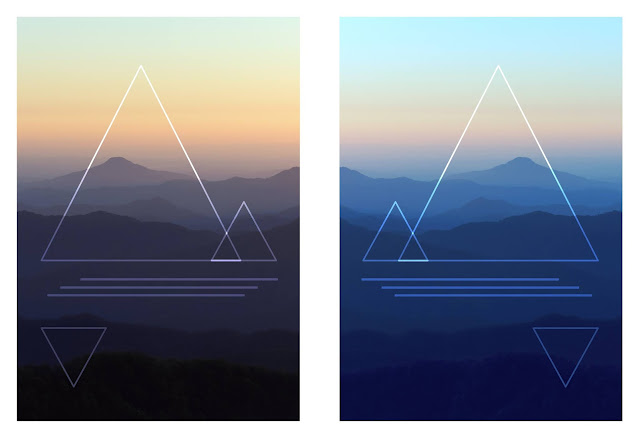
Her Mountain Ranges diptych shows the same scene overlaid with the same triangles and lines – each a reflection of the other, one warm toned, the other cool.


MountainRanges i & ii © Eva van Gorsel


And the two images in her Lake Lights diptych are again reflections of each other, except that the circle in each varies in density or hue.


Lake Lights i & ii © Eva van Gorsel

Pfeiffer’s works are, on the one hand, based on incongruence: every diptych, in itself partly congruent, is different in technique and the materials used reflect the wide variety of possibilities available to artists. On the other hand, all works are of the same size (some in portrait, others in landscape format) and mounted the same way, in the mathematical sense of the word congruent.

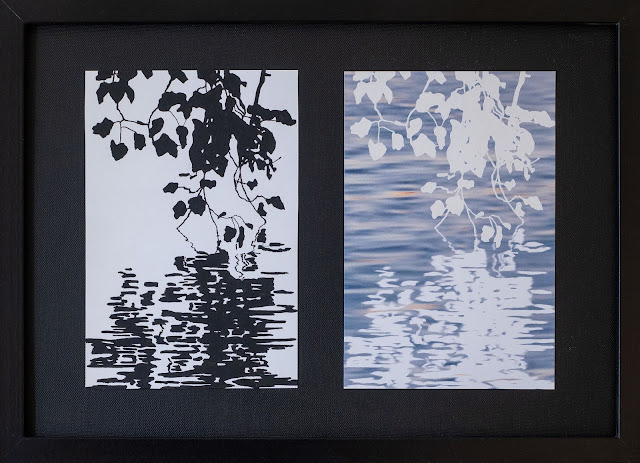
The left-hand side of his Lake Burley Griffin diptych is a monochromatic version of the coloured and inverted right hand side.


Lake Burley Griffin © Manuel Pfeiffer


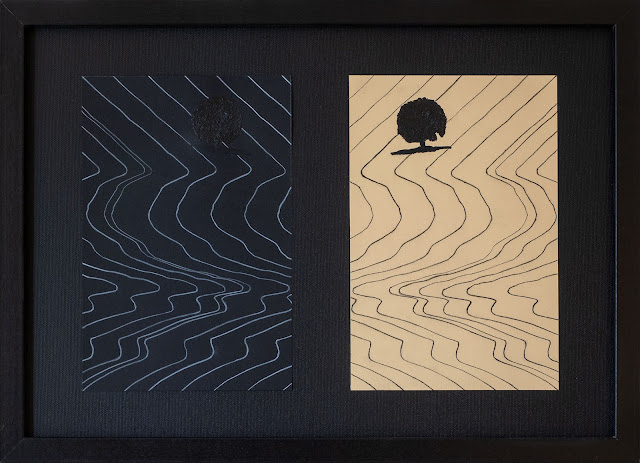
View From Cocoparra is presented in an analagous way but is much more graphic with delightful contour lines and a simple and subtle tree.


View From Cocoparra © Manuel Pfeiffer

Two sets of works play off each other perfectly. These artists have again produced a fine exhibition as they did with their previous joint show Facets in 2020.

This review was published in the Canberra Times of 20/11/21 here and on the author's blog here.