Showing posts with label Manuel Pfeiffer. Show all posts

Friday, April 25, 2025

Emotional Landscapes II

Visual Art Exhibition Review | Brian Rope

Emotional Landscapes II I Margaret Gordon, Manuel Pfeiffer and Alan Pomeroy

ANCA Gallery I 23 April – 11 May 2025

In July/August 2024, ANCA exhibited Emotional Landscapes I by Jenny Adams, Julie Delves, Eva van Gorsel & Delene White. Van Gorsel subsequently received a Canberra Critics Circle award for her imaginative and creative observations and, in particular, her key part in that exhibition.

Emotional Landscapes II featuring artworks by three other artists has the same purpose - questioning the dichotomy of being apart from nature versus being an integral part of it. Photographer and former climate scientist van Gorsel curated this show, in close consultation with the artists.

My initial reaction on entering the gallery was to immediately see the landscape in Pfeiffer’s pieces, but not in the other works. That was my narrow interpretation of landscape. Gordon’s works feature landscapes of nude human bodies, whilst Pomeroy has “set out to re-imagine the contemplative posture as a composite posture figure set against evocative landscapes.” Pfeiffer’s art is not a straightforward representation of landscapes as we might actually see them. Like those of all good artists, they are interpretations of what he saw.

Each artist has revealed something of their personal emotional experiences to a variety of landscapes, enabling viewers of the works to reflect on their own emotional responses to landscapes they explore.

Gordon most commonly produces small sculptural pieces of her models. But here she presents mostly pastel and charcoal drawings, with just one acrylic painting and one ceramic sculpture.

Margaret Gordon, 38 Small Form, 2024, ceramic sculpture, 13.5 x 18.5 x 10cm

Photograph provided by ANCA

All these human landscapes are female. She participates in a variety of workshops sketching both genders, but as selected pieces for this show she felt it appropriate to use only drawings of female models. The drawings are diverse, showing various amounts of detail in differing parts of the sketched bodies. That, plus the variety of body types reveals the diversity of the female body landscape. How we each respond emotionally will depend on our genders, ages, personal body types and more.

Margaret Gordon, 26 Another Seated Form, 2024, pastel and charcoal, 52 x 46cm

Photograph provided by ANCA

Six of Pfeiffer’s works on canvas are painted with acrylic; two are mixed media. All eight vibrantly colourful works are striking in appearance. As always with this artist, they are beautifully composed and executed. One most interesting feature is the inclusion of shapes, such as that of a diamond or an egg. They are paintings of landscapes many of us have visited or, at least, seen in photographs. We can clearly recognise some outback places. My favourite work is of the Devil’s Marbles, but they are all a joy to look at.

Manuel Pfeiffer, 04 Karlu Karlu (Devil's marbles), 2023, Acrylic on canvas, 24x36 inches (61x92cm)

Photograph provided by the artist

Some of the landscapes portrayed are less obvious, but the titles identify them. So, for example, we know the Nullarbor is being portrayed even if we don’t immediately recognise it. I very much enjoyed the clear representation of the long straight stretch of road through a flat landscape with no trees. The magical place known as Larapinta is also delightfully shown, almost demanding we walk on the long trail.

Manuel Pfeiffer, 07 Magic Larapinta, 2024, Acrylic on canvas, 24x36 inches (61x92cm)

Photograph provided by the artist

And then there are Pomeroy’s wonderfully thought-provoking works. Again the catalogue titles arguably provide keys which enable us to open the doors to the material we need to explore in order to properly think about what this artist is saying. Each piece shows figures set against evocative landscapes. They are observing and meditating, fingers pressed against their mouths almost being gnawed. They are sitting on the fence in one work – seeking the wisdom of the three wise monkeys?

Alan Pomeroy 02, On the Fence, 2024, oil on canvas, 76 x 91.5 cm. Photograph, Alan Pomeroy. TBE

All are simply delightful paintings. And there is also a most affordable 40pp book featuring the artist’s own photographs of his art. In it his artist’s statement reveals the inspirations for these works in his continuing artistic inquiry, and his hoping to encourage awareness of the power of thought .

Alan Pomeroy 05, In Too Deep, 2024, oil on canvas, 76 x 112 cm. Photograph, Alan Pomeroy. TBE 

As with its forerunner, Emotional Landscapes I, this exhibition most successfully achieves what its artists set out to do. They have created artworks which cause us to reflect on our personal emotional responses to the natural world in which we live. And invite us to ask ourselves how and whether we can live in harmony with our natural environment.


This review is also available on the author's blog here.


Wednesday, August 31, 2022

Into the Forest

Photography | Brian Rope

Into the Forest | Eva van Gorsel and Manuel Pfeiffer

M16 Artspace, Gallery 1b | UNTIL 4 SEPTEMBER 2022

Partners Eva van Gorsel and Manuel Pfeiffer are regular exhibitors at M16 Artspace. Their 2020 joint show Facets exhibited interpretations of the Australian landscape they had seen during a lengthy journey. Their works complemented each other as they revealed the same facets. Then, in 2021, they brought us Congruent-Incongruent using numerous diverse techniques and media to create varied, interesting and pleasing artworks.

Their 2022 exhibition Into the Forest aims to raise awareness of the role our forests have on our planet, our climate and our lives by showcasing the beauty of mostly regional treescapes and woodlands using imagery, sculpture and a sound installation. Along with growing numbers of people around the world, they recognise that the importance of forests cannot be underestimated.

Pfeiffer has a background in earth system sciences, graphic design and arts and shares a deep appreciation of the environment with Van Gorsel who was a principal research scientist in atmospheric sciences before turning to photography. The two artists asked themselves why it is important to show and appreciate the beauty of our natural environment and have offered an answer.

“In science we have pointed out the dangers of climate change before anyone cared to listen. With climate extremes now so extreme that they are getting hard to ignore many more people are aware that urgent action is needed. Many artists were early uptakers of that message. There is a long tradition of showing natures beauty. But many artists now also show the impact our disrespect of nature has on ecosystems. This is important work that is critically needed. But it is key that we do not get lost in despair. That is why we think it is important to show and appreciate the beauty of our natural environment. I think we are at a turning point where it becomes important to again remind us of what we can keep - if only we set our minds and actions to it.”

Van Gorsel’s works here are, perhaps, more traditional than she has shown in their previous two joint exhibitions. They are fine examples of this genre of photography, showing us numerous wonders of nature in our forests – birds, mist, and understory vegetation are just some examples. In every case, the available natural light is used beautifully - as all photographers should strive to do. Monochrome is used sparingly, but to great effect. Shallow focus is used wonderfully in others.


Eva van Gorsel_Into The Forest II_Namadgi


Eva van Gorsel_Mist_Gundagerra NR


Eva van Gorsel_Last Light_Namadgi NP


Eva van Gorsel_Aglitter 03


Pfeiffer’s contributions are equally pleasing, showing us the sights of the forests through his chosen media. A set of artworks of trees, bark and fungi using colour pencils on paper are simply lovely, with their wonderfully balanced light and peaceful hues. Others painted with acrylics on canvas, such as Dreaming Xanthorrhoeas, are equally successful.


His three pieces using wood are special features in the exhibition. A mixed media piece, The Wise, 2021, is the standout for me. Glass, a suspended small rock gently moving, wood and more combine beautifully into a piece to explore, a piece that also says much about nature.


Manuel Pfeiffer_BarkA


Manuel Pfeiffer_Dreaming Xanthorrhoeas


Manuel Pfeiffer_At The Coast


All the artworks take us into the artists’ views of nature. They make us feel good – enabling us to see the colours, hear the sounds, smell the scents. All give us some comfort. And they make us want to be amongst the calming effects of forests and connecting directly with nature through our senses, seeking to reduce the gap that we have opened between us and the natural world. This exhibition very much invites us to reflect on how we humans have impacted the natural environment, and to ask ourselves what we as individuals must now do.

This review was published online by The Canberra Times on 30.08.22 here. It is also on the author's blog here.

Saturday, November 20, 2021

Congruent - Incongruent

Photography and Art Exhibition Review | Brian Rope

Eva van Gorsel and Manuel Pfeiffer | Congruent - Incongruent

M16 Artspace | Until 21 November 2021

Eva van Gorsel is a photographer who uses numerous diverse techniques and approaches to create varied, interesting imagery - her background in environmental sciences and scientific photography always there. Her imagery here does not disappoint. As usual they are excellent artworks, pleasing to look at, contemplate and think about.

Manuel Pfeiffer is a painter who uses an extensive range of materials, including acrylics, pencils, charcoals and much more. His works here are of mixed media, including acrylics, pencils, even plaster of Paris. They are equally pleasing to explore.

The gallery sheet informs visitors that these artists feel our lives have changed, that harmony has been disrupted by climate change and pandemics globally. Few would disagree. The artists suggest many of us have been striving for balance more consciously - in our friendships and workplaces, and in how we interact with our environment.

Here was their starting point to create an exhibition addressing congruence (in agreement or harmony) and incongruence. The artists have creatively investigated their concept, exploring balance, harmony and disharmony, symmetry and asymmetry.

They have also used the mathematical concept of congruence – figures, identical in form, coinciding exactly when superimposed. In geometry, two figures or objects are congruent if they have the same shape and size, or if one is a mirror image of the other.

So, in these works, we see reflected, rotated and translated shapes and lines overlaid on a variety of landscapes. Whilst art lovers generally enjoy the aesthetics of congruent images, they also do not mind some tension – it keeps us looking and exploring the artwork.

The depicted landscapes are from diverse Australian places, including New England, Lake Burley Griffin, Kosciusko, Cocoparra National Park, the Flinders Ranges, and the Devils Marbles. They include mountains and seas, sunrises and night times. Some include circular shapes that may be either the sun or the moon – or something else?

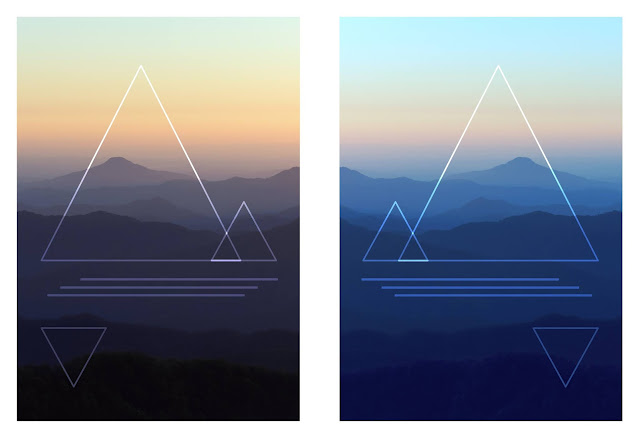
Van Gorsel has an interest in how colour and geometry shape landscapes. She examines moods created by warm and cold colours, the direction of light and how it changes, transitioning colours painted on skies or reflected in water. Here, her diptychs are congruent - despite focussing on contrasting concepts. They are displayed as pairs of works side by side. All the images are based on photography. Each panel is the same size, each is a pigment ink print on archival paper.

Her Mountain Ranges diptych shows the same scene overlaid with the same triangles and lines – each a reflection of the other, one warm toned, the other cool.


MountainRanges i & ii © Eva van Gorsel


And the two images in her Lake Lights diptych are again reflections of each other, except that the circle in each varies in density or hue.


Lake Lights i & ii © Eva van Gorsel

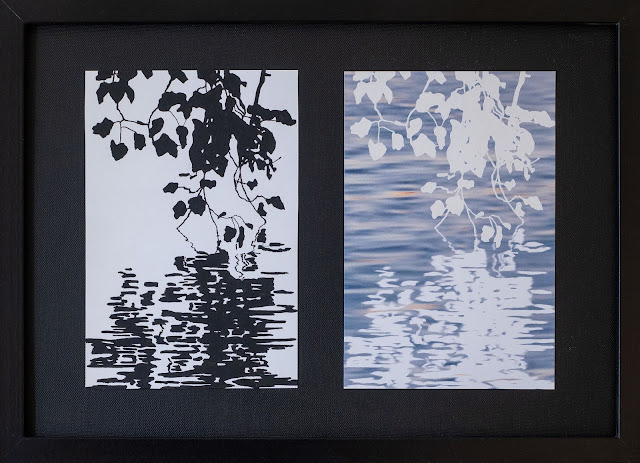
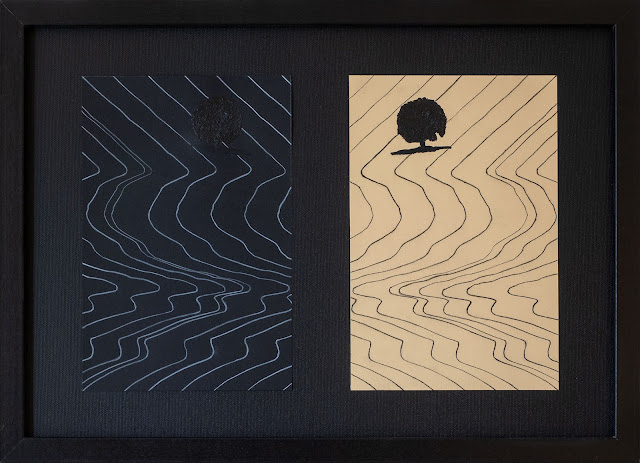
Pfeiffer’s works are, on the one hand, based on incongruence: every diptych, in itself partly congruent, is different in technique and the materials used reflect the wide variety of possibilities available to artists. On the other hand, all works are of the same size (some in portrait, others in landscape format) and mounted the same way, in the mathematical sense of the word congruent.

The left-hand side of his Lake Burley Griffin diptych is a monochromatic version of the coloured and inverted right hand side.


Lake Burley Griffin © Manuel Pfeiffer


View From Cocoparra is presented in an analagous way but is much more graphic with delightful contour lines and a simple and subtle tree.


View From Cocoparra © Manuel Pfeiffer

Two sets of works play off each other perfectly. These artists have again produced a fine exhibition as they did with their previous joint show Facets in 2020.

This review was published in the Canberra Times of 20/11/21 here and on the author's blog here.