Showing posts with label National Portrait Gallery (Canberra). Show all posts

Sunday, May 3, 2026

Deadpan artefacts: creative experiments with facial expression recognition in photographic portraiture

Visual art exhibition review | Brian Rope

Deadpan artefacts: creative experiments with facial expression recognition in photographic portraiture | Melita Dahl

ANU School of Art & Design Gallery, Wed 22 Apr 2026, 10:30 am - Fri 15 May 2026, 3:00 pm

An early graduate of the ANU School of Art & Design, Melita Dahl later undertook postgraduate study at the Academy of Media Arts in Cologne, Germany. Her work is held in major public collections, including the National Gallery of Australia, Canberra Museum and Gallery and the Perth Institute of Contemporary Arts, and has been exhibited widely in Australia and abroad. This exhibition is presented as part of a Higher Degree by Research examination.

In the room sheet, Dahl tells us that “Over the past three decades, photography has evolved from its traditional role as an indexical imprint of the world into a fluid, computational space shaped by digital transformation.”

It is within that context that Melita Dahl has used the photographic portrait as a framework for research exploring “datafication of pose and expression through creative experiments engaging with Facial Expression Recognition (FER) technologies.” A key focus has been the neutral category in FER, which closely aligns with the so-called deadpan expression.

Dahl’s practice has long engaged the portrait as an experimental site where cultural and technological forces intersect with the history of photographic practice. While discussing her 2021 Portrait exhibition at Photo Access, I referred to how we try to interpret facial expressions. And how looking into a person’s eyes can supposedly tell us what that person thinks and feels. In essence, that is what this exploration is all about.

Deadpan portrait photography has frequently been presented as an "objective" form of documentation that gives no clues about what the subject might be thinking. Focusing on the neutral face - found to be measurable through facial expression recognition technologies - Dahl traces a correlation with the deadpan. She has used this interplay as a conceptual bridge in her research, connecting the conventions of analogue portraiture with contemporary data-driven approaches. As a result, her works “explore how neutrality operates across the intersecting fields of portraiture, photography and technology.”

The works on display include ten high-quality pigment ink prints on archival paper. There are also three 4K video loops and an “interactive data visualisation”. The latter is a fascinating Web application. It draws on the National Portrait Gallery’s photographic collection. The portraits have been visually and contextually filtered and sorted, then classified and arranged according to pose and expression, particularly the Deadpan. At the exhibition opening, I watched numerous people standing looking at the tiny reproductions of those portraits moving about the projection with information regarding assessed facial expressions, and the video loops, for lengthy periods. The facial expressions I saw on the viewers’ faces revealed nothing to me about what they were thinking!

So, let’s look at some of the exhibits here. Firstly, a 2019 print titled happy (0.96). When you look at the facial expression, do you see a happy face? If not, what sort of facial expression do you see?

Melita Dahl, happy (0.96), 2019, Pigment Ink Print on Archival Paper, 52.4 x 69.9cm

Next, a 2021 print titled Deadpan 9.980549278246. The portrait here is accompanied by some “scores” which provide us with more information than the portrait alone would.

Melita Dahl, Deadpan 9.980549278246, 2021, Pigment Ink Print on Archival Paper, 80x60cm

Here’s a 2026 image from the Perspective Machine series. A fine piece of art.

Melita Dahl, Perspective Machine 02, 2026, Pigment Ink Print on Archival Paper, 60x80cm

And here’s a still from a 2026 video Deadpan/Neutral – A comparative analysis. A triple Deadpan portrait no less.

Melita Dahl, Deadpan|Neutral – A comparative analysis, video still, 2026

All the prints in the exhibition are very high quality and are fine pieces of art as well as providing much information to viewers about the results of Dahl’s research. Those who have not been Doctor of Philosophy students may be challenged by the research concept and outcomes, but that doesn’t matter. Being challenged is a good thing for us all - and what better way to be challenged than by a great exhibition?

If you are unable to visit the exhibition, I encourage you to check out Dahl’s website https://melitadahl.net/. Those of you who can visit the exhibition should check the opening days and hours and be aware that the gallery will be closed to the public during examination times.


This review is also available on the author's blog and in The Printer June 2026.

Wednesday, December 11, 2024

Carol Jerrems – Portraits

Exhibition Review: Visual Art | Brian Rope

Carol Jerrems – Portraits I Carol Jerrems

National Portrait Gallery I 30 November 2024 - 2 March 2025

Carol Jerrems: Portraits is a major exhibition of images by one of Australia’s most influential photographers. Jerrems’ intimate portraits of friends, lovers and artistic peers have shaped Australian visual culture. Against the backdrop of social change in the 1970s, her practice charted the women’s movement, documented First Nations activism, put a spotlight on youth subcultures and explored the music and arts scenes of the era.

What were you doing in the ‘70s? Some visitors to this exhibition will not have been born then. Others spent those years “wasting their youth”. My wife and I were raising two young children. Some are well past the age that Jerrems was when she was documenting the ‘70s.

Her career spanned only twelve years before a tragic death at the age of 30. Jerrems captured the world around her with curiosity and courage. She photographed her world - a voracious observer yet also intentional in her approach to narrative and composition. Her images play with tension and dramatic impact. They are candid but at times purposefully theatrical, tough and yet vulnerable, revealing both melancholy and joy.

The exhibition showcases 144 photographs Is that a little overwhelming. And why are they all displayed before wide strips of pink paint? Regardless, this show should be seen. It traverses the journey from Jerrems’ lesser-known early work to her iconic Vale Street 1975 and coincides with the 50th anniversary of her landmark publication A book about Australian women. Featuring portraits of cultural figures like Anne Summers, Bobbi Sykes, Evonne Goolagong and Linda Jackson the exhibition examines how the author’s work defined a decade and continues to shape our views of photography today.

But there’s no need to write about her best-known works here. Instead, I want to mention some less-known images. Firstly, Marilyn Monroe, the only portrait of a non-Australian. Is it really a portrait or rather part of a non-descript building on which hangs a framed Richard Avedon print of Monroe?

Carol Jerrems - Marilyn Monroe 1972

National Gallery of Australia, Canberra

Gift of Mrs Joy Jerrems 1981

© The Estate of Carol Jerrems

Then there is Empty Corridor, which is not quite that. There are small silhouettes of unknown people at the corridor’s far end in this most interesting image.

Carol Jerrems - Empty corridor 1979

National Library of Australia

Manuscript collection (MS 10718)

© The Estate of Carol Jerrems

Much more significant is the inclusion of contact sheets providing valuable insights into the artist’s ways of working. Some show empty frames where images have been cut from the negative strips. Jerrems was very interested in the sequential nature of photography and often created contact sheets using strips of images taken on different film rolls, then exhibited those sheets as artworks alongside individual image prints.

Carol Jerrems - Contact sheet (Linda Piper) 1974

National Gallery of Australia, Canberra

Gift of Mrs Joy Jerrems 1981

© The Estate of Carol Jerrems

Jerrems made her name during a time of significant social change. She explored activism by First Nations people, the women's movement, youth subcultures, other artists and musicians. Many of the latter were household names and those who were then young adult Australians will be reminded of times in their lives. There are images of loved actresses Enid Lorimer and Kate Fitzpatrick, of a pioneer of modernist painting in Australia, Grace Cossington Smith, of Aboriginal people including Rosslyn Johnson and David Gulpilil (with a bucket), of youths who became known as Sharpies, and of young friends simply enjoying each other’s company when school was out.

Carol Jerrems - Enid Lorimer and Kate Fitzpatrick 1974

National Gallery of Australia, Canberra

Gift of Mrs Joy Jerrems 1981

© The Estate of Carol Jerrems


Carol Jerrems - Rosslyn Johnson 1973

National Gallery of Australia, Canberra

Gift of Mrs Joy Jerrems 1981

© The Estate of Carol Jerrems


Carol Jerrems - Edols seeing Gulpilil with a bucket 1974

National Gallery of Australia, Canberra

Gift of Mrs Joy Jerrems 1981

© The Estate of Carol Jerrems


Carol Jerrems - Sharpie couple, Melbourne 1976

National Gallery of Australia, Canberra

Gift of Mrs Joy Jerrems 1981

© The Estate of Carol Jerrems 


Carol Jerrems - School's out 1975

National Gallery of Australia, Canberra

Gift of Mrs Joy Jerrems 1981

© The Estate of Carol Jerrems


One image stands out for a number of reasons. Mirror with a memory: Motel room is the only colour image in the exhibition. Along with a shot of Grace Cossington-Smith, it is an example of the artist’s effective use of mirrors. And it is a revealing self-portrait of her and her lifestyle.

Carol Jerrems - Mirror with a memory: Motel room 1977
National Gallery of Australia, Canberra
Gift of Mrs Joy Jerrems 1981
© The Estate of Carol Jerrems

Carol Jerrems - Grace Cossington Smith, OBE 1974

National Gallery of Australia, Canberra

Gift of Mrs Joy Jerrems 1981

© The Estate of Carol Jerrems

The exhibition's last section is a collection of works that Jerrems photographed in hospital whilst battling the rare liver disease which led to her premature death.

This review is also available on the author's blog hereIt has also been published on pp 8-11 of the February 2025 issue of The Printer here.

An abbreviated version has been published online by Canberra City News here.

Thursday, June 22, 2023

Photography - 2023 National Photographic Portrait Prize (various artists)

Photography Exhibition Review | Brian Rope

National Photographic Portrait Prize 2023 | Various artists

National Portrait Gallery (Canberra) | 17 June 2022 to 2 October 2023

In this year’s NPPP, there is pathos and  humour, striking colour and sombre black and white. There are images of famous people and those known only to their families and friends, of indigenous people and of refugees, of people living in Australia and some who live elsewhere, and of people from different cultures. There are also many and varied approaches to the genre of portraiture, ranging from traditional to contemporary.

As in previous years, the diversity of the quality artwork delivers a powerful visual exhibition. Indeed, I consider the 47 works on exhibition this year to be an excellent selection well worth viewing. The three judges would, as is always the case with such successful competitions, have had a tough challenge in making their selections from almost 2400 entries. I acknowledged that when speaking briefly with judge Daniel Boetker-Smith at the very well attended media preview (whilst jokingly noting that they didn’t select any of mine).

It is of interest that the subject of the winning image Ruby was also a finalist, with a self-portrait so there are two photos of her in the exhibition.

Ruby (left view), 2022 by Shea Kirk
(The winning image)


Sisters or Friends, 2022 by Emma Armstrong-Porter

(The self-portrait by the subject of the winning image)

The winner of the Art Handlers Award, David Cossini, has both it and another work amongst the finalists on display.

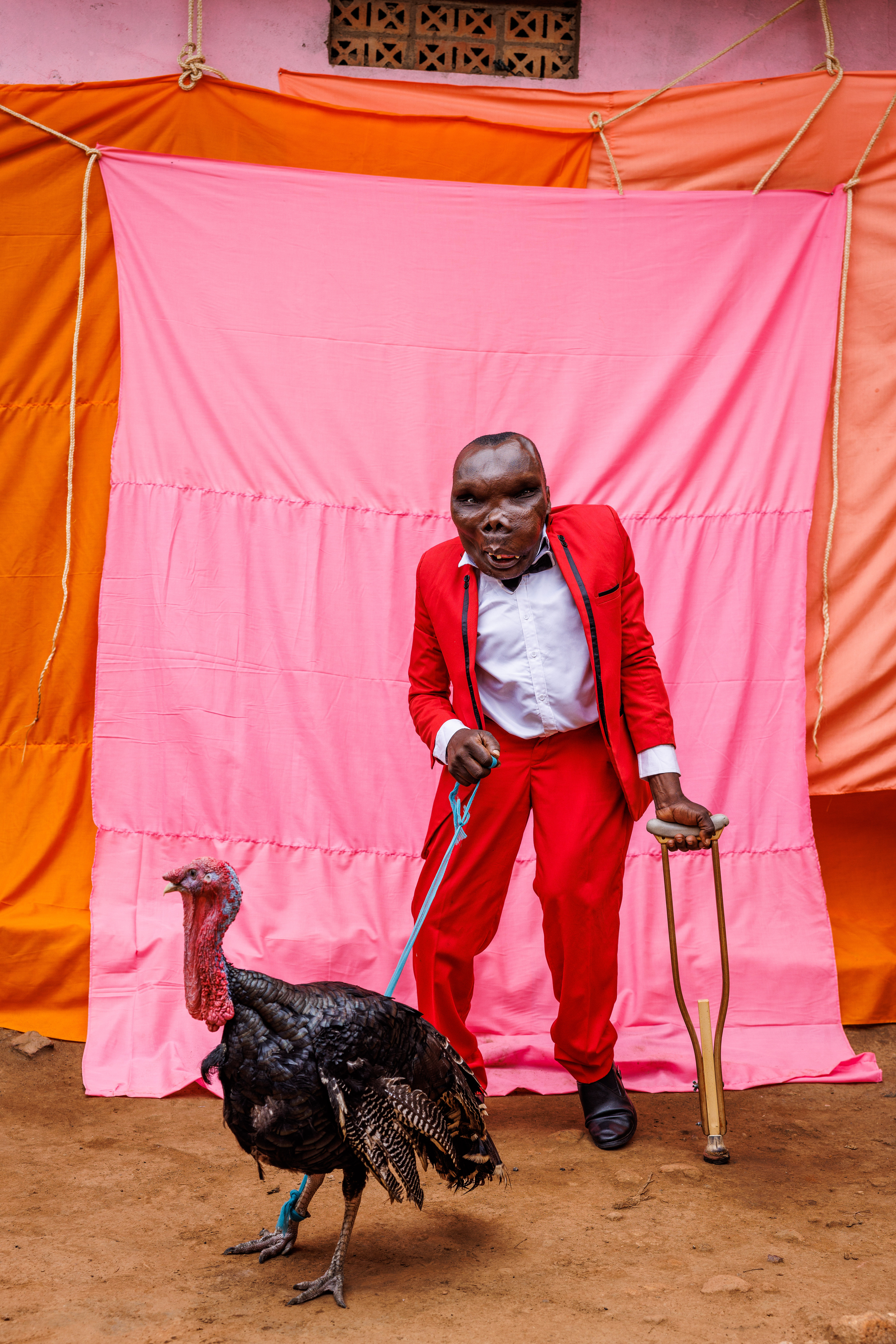
Ugandan Ssebabi, 2022 by David Cossini (Winner of the Art Handlers Award)

In my dreams I am dirty, broke, beautiful & free, 2022 by David Cossini

The finalists include a number of Canberra photographers, demonstrating once again that Australia’s capital city has many fine photo artists. Amongst them, Grace Costa, well-known for her corporate work and her imagery of horses, had Portrait of Zachary selected. She confesses that after seeing her subject at a campsite it took her around 45 mins to work up the courage to ask if she could photograph him.

Portrait of Zachary, 2023 by Grace Costa

Another Canberran, Brenda L Croft (with assistance from Prue Hazelgrove) had blood/memory: Brenda & Christopher i (Gurindji/Malngnin/Mudburra; Mara/ Nandi/Njarrindjerri/Ritharrngu, 2022 selected.

blood-memory. Brenda & Christopher  Gurindji-Malngnin-Mudburra. Mara-Nandi-Njarrindjerri-Ritharrng by Brenda L Croft, Prue Hazelgrove

Another fine, but quite different, portrait of an indigenous young woman is Yarnangu, 2022 by David Darcy.

Yarnangu, 2022 by David Darcy

Amongst some wonderful images of people from a variety of the many cultures we have in this great multicultural country, I particularly enjoyed Mela 2022 by Bahram Mia, which portrays four young women from Afghanistan celebrating birthdays together in this country where they have the freedom to enjoy such moments as once were the norm in their home country.

Mela, 2022 by Bahram Mia

I also loved Portrait of My Mother as an ethno-Futurist icon, 2023 by Sammaneh Pourshafighi. The artwork is of the artist’s mother, an Iranian migrant. The work is colourful and engaging, revealing much of the subject’s personality and identity.

Portrait of My Mother As An Ethno-Futurist Icon, 2023 by Sammaneh Pourshafighi

‘Sunju Calabrese’ #2, 2022 by Renato Colangelo portrays a man who is “unique, flamboyant with an expressive character.” This is a great contemporary artwork.

'Sunju Calabrese' #2, 2022 by Renato Colangelo

Amongst the images of famous people is Aunty Helen, 2021 by Charlie Ford. The subject is the highly successful Australian author, Helen Garner. The artist has successfully captured her in an “unspectacular act” – shutting  a gate – to reflect his aunt’s celebration of beauty in ordinary moments when she authors her works.

Aunty Helen, 2021 by Charlie Ford

I cannot close without mentioning Adam Ferguson’s emotionally moving portrait of Ukrzaliznytsia (Ukrainian Railways) employee, Sumy Oblast, Ukraine, May 2022. It is a poignant reminder of the terrible ongoing conflict there.

Ukrzaliznytsia (Ukrainian Railways) employee, Sumy Oblast, Ukraine, May 2022

by Adam Ferguson

The judges have said the winning work is a “celebration of photography”, and  the Highly Commended has “exceptional cinematic quality”. The art handlers who chose their Award described their selection as “confident and joyful.”

As always, the NPPP is an exhibition not to be missed if you are able to get to it - to see on a gallery wall both the images I’ve mentioned and those I haven’t, either now at the National Portrait Gallery or later when it tours to other Australian locations. If that is not possible for you, all the finalists can be seen here.

 This review is also available on the author's blog here. And now also in the July 2023 issue of The Printer, the online magazine of the Australian Photographic Society's Print Group here.