Showing posts with label Photomedia. Show all posts

Saturday, June 21, 2025

The Lodge, & Am I In Your Way?

Visual Art Exhibition Review | Brian Rope

The Lodge | Amala Groom

Am I In Your Way? | Raquel Ormella

Canberra Contemporary | 3 May – 12 July 2025

Readers who are not familiar with Australia’s national capital city and, in particular, the design and purpose of its central area might like to look at TheWalter Burley and Marion Mahony Griffin Design Drawings of the City of Canberra and/or read material about the design, such as thisWikipedia article.

Am I in your way? extends Raquel Ormella’s career-long focus on the visual cultures of protest and resistance. This exhibition takes as its starting point the location of the Canberra Contemporary gallery in which it is on display - at the centre of the Parliamentary Triangle looking out onto Lake Burley Griffin and across it towards and beyond the base of that triangle - as a site to consider past and present formations of national identities. 

The work activates the view down Walter Burley Griffin’s designed sightline between Parliament House and the Australian War Memorial, passing through the centre of the International Flag Display on Commonwealth Place. Drawings, flags and performance works in the exhibition look at how political protestors have used their bodies as direct forms of passive disruption. 

Inked messages on the front or reverse of, or alongside, found vintage Canberra postcards are both entertaining and significant. Likewise, messages on created banners both challenge and amuse us.

Raquel Ormella, 'One bomb vs many' 2025, installation view, 'Am I in your way_', Canberra Contemporary, 2025, ink on found vintage Canberra postcards, dimensions variable. Photo by Brenton McGeachie

Raquel Ormella, 'Am I in your way_', 2025, installation view, Canberra Contemporary, 2025. Photo by Brian Rope

Raquel Ormella, 'Am I in your way_', 2025, installation view, Canberra Contemporary, 2025. Photo by Brenton McGeachie_2

Raquel Ormella, 'future history #1', 2025, installation view, 'Am I in your way_', Canberra Contemporary, 2025,  nylon, 90 x 170cm. Photo by Brenton McGeachie

In an environment where attitudes towards legitimate disruption and protest are changing, this exhibition is a timely exploration of an emerging criminalisation of what might simply be no more than an inconvenience for passers-by or bystanders.

The second exhibition being shown in the adjacent gallery space is The Lodge, named after the Prime Minister’s residence. It is the third moving image work in Amala Groom’s Raised by Wolves series exploring the relationship between alchemy (spirit) and science (matter), following the belief that life is a marriage of these forces, with the human being as the ultimate construct between them.

This excellent 11:11 minutes single-channel video work connects strongly with Groom’s personal history of direct action at the Aboriginal Tent Embassy located within the Parliamentary Triangle, and her many years of political engagement both inside and outside the walls of Parliament House. Her returning to Ngunnawal country to film this artwork is important; it is both ceremonial and cyclical. In doing so, she has reactivated her ancestral songlines (the Aboriginal walking routes that crossed the country, linking important sites and locations), and this resultant autobiographical (in nature) work is a reweaving of both history and the future.

Wearing a typically long and white wedding dress, Groom herself symbolically weaves and unravels a red rope (commonly used as a symbol of protection, unity, and unbreakable bonds) along Anzac Parade, embodying both the colonial structural constraints Indigenous people faced (and still do) and the profound role ancestors play in spirituality, offering guidance and a sense of belonging. The work culminates in her transformation; empowered by the campfire that burns constantly at the Tent Embassy, she is seen running through Parliament House then ultimately vanishing into the bush as a sovereign Wiradyuri woman.

Amala Groom, The Lodge 2025 production still, single channel video. Image credit Ryan Andrew Lee_10

Amala Groom, The Lodge 2025 production still, single channel video. Image credit Ryan Andrew Lee_2

Amala Groom, The Lodge 2025 production still, single channel video. Image credit Ryan Andrew Lee_4


Amala Groom, The Lodge 2025 production still, single channel video. Image credit Ryan Andrew Lee_7

In this work, Groom has reclaimed what we might think of as “the heart of the Australian state” created by all who came after those we now refer to as our First Peoples. For many, many years previously the area of country now within the Parliamentary Triangle was a sacred place used by those First Peoples for corroborees and tribal indigenous gatherings. Visitors to the exhibition should view the entire video, waiting as necessary to watch it from the start, taking in its significant messages, thinking about the significance of various shapes they see, and admiring the very professional performance and film quality. Then read the artist statement and the exhibition essay to understand more fully what they have viewed.

These two exhibitions both present profound and important messages. Together the messages are enhanced and strengthened.

This review is also available on the author's blog here.

Monday, November 6, 2023

Dark Matter 2023

Brian Rope - Photography Exhibition Review

Dark Matter 2023 | Isabella Capezio, Rowena Crowe, Odette England, Janhavi Salvi

Photo Access | 26 October to 2 December 2023

This exhibition is the outcome of the 2023 Dark Matter Artist Residency. Over nine months, these four artists have explored alternative processes in the PhotoAccess darkroom. With each artist embracing unique creative approaches, their collective works navigate identity, memory, and the resonance of place.

As I left the gallery following my viewing of the exhibition, the Director of Photo Access asked me if I had enjoyed it. My immediate response was that I needed to go home and think about it. I had made just a few notes to assist my thought process, but they were of minimal help. I had not managed to attend the opening so did not have the benefit of having heard words spoken about the show at that time. I did, thankfully, have a copy of the printed catalogue to read.

These works are most certainly varied. Each artist has explored and provided us with quite diverse art. Everything shown here is different from much of what we more usually see in exhibitions. I have no doubt that some visitors would go away asking themselves what it was all about. Others, however, would leave excited by the works they had seen, wanting to tell others about them, continue thinking about and challenging themselves to do something new if they also are artists.

Isabella Capezio is a photographer, artist and lecturer in photography whose research and artwork engages in themes of failure, queerness and landscape. We are told that here they are drawing upon collective memories and colour darkroom printing to forge connections with place.

There are a large number of hand-printed colour photographs in Capezio’s contribution. They are a homage to an iconic 1981 set of 24 images, by Ian North, of Canberra suburbs which featured infrastructure, roads, the streets, the houses, their gardens, the fences,  and other typical views of the time – all devoid of human presence. There is an interesting piece by Paul Costigan about six of those works by North at https://the-southern-cross.com/ian-north-on-canberra/.

On the opposite wall to Capezio’s works are two lengthy recordings that can be listened to through headphones. Both feature various people talking about North and his Canberra Suite. Also on display at the start of Capezio’s works is a copy of a 2-page letter from Capezio to North expressing deep gratitude for his unknowingly collaborating on the homage project.

Isabella Capezio, After North #8, 2023, c-type print, 20 x 25 cm

Janhavi Salvi is an Indian artist based in Canberra, working within the visual and media arts. In this exhibition she has juxtaposed photographs and screen prints from her life in India and Australia, giving voice to her evolving sense of identity. There is also a video projection on a screen.

A series of inkjet prints on envelopes, the type with windows that we all receive from government agencies and the like, are fascinating. The photos on the envelopes are from Salvi’s life in India. The envelopes were received when in Australia. So the end product is all about connecting memories to an evolving self-identity.

Janhavi Salvi, Do you miss home? (detail), 2023,
3x3 envelope grid, inkjet prints on envelopes, 23.5 x 12 cm

Rowena Crowe is a time-based artist whose work involves analogue processes. Here her modified 16mm hand-wound motion camera reinterprets photography, overlaying unexposed film with transparent acetate sheets allowing direct intervention onto the film and creating a space to explore.

Rowena Crowe, Prepared Camera 2, 2023, silver gelatin & RA colour prints,
installation detail, multiple dimensions

Odette England is an Anglo-Australian visual artist and writer. She combines silver gelatin prints and found objects to capture familial ties and vulnerability. Other contemporary photographers also combine assorted objects with their prints, but these are more powerful than many others I have seen. The found materials are things most of us would not even pick up, leave alone use them to block out significant parts of our images.

Odette England, I just want to be old, like a normal person,
from the series To Be Developed, To Be Continued, 2023, silver gelatin print

Odette England, from the series To Be Developed, To Be Continued, 2023, silver gelatin prints & found materials, multiple dimensions (installation image - Brian Rope)


This review is also available on the author's blog here.

Saturday, March 25, 2023

VIEW 2023

Photomedia, Mixed media, Animation | Brian Rope

VIEW 2023 | SEVEN ARTISTS (Emily April O’Neill, Aidan Gageler, Harry Merriman, Gabriela Renee, Aaron Sun, April Widdup and Chenfei Xiao)

Photo access | 2 Mar - 15 Apr 2023

The 2023 edition of VIEW (an annual exhibition celebrating emerging talent) delves into the themes of cultural identity and the queer body. Showcasing seven emerging artists from the ACT region, it includes a diverse array of multimedia installations, traditional and non-traditional photo media, and animation.

Each artist presents a personal exploration of self, drawing upon shared experiences and perspectives in social, digital, and environmental realms. PhotoAccess Director Wouter Van de Voorde says "Their work highlights the strength and diversity of emerging artists in our region, and we are thrilled to provide a platform for their voices to be heard."

Multimedia artist Chenfei Xiao uses digital and augmented reality technologies. Here we see a discussion of a personal experience living as a queer Chinese Buddhist. The resultant three portraits fascinate us as we explore them, discovering features of that experience and delighting in Xiao’s various identities. I encourage you to spend time with these works before reading any explanatory material about them.

Chenfei Xiao, Guan Yin Help You (III), production still, 2022, augmented reality headset rendered images printed on gator boards, 59.4 x 84.1 x 0.5 cm

Aaron Sun is a new media and technology artist. Here he uses 3D modelling, virtual reality photogrammetry and more to create an excellent video work investigating racism in Australia. Watching it forces us to ask ourselves what we might do to remove our own biases. 

Aaron Sun, White Australia 1 (still from video, provided)

Abstract artist Aidan Gageler works on film, but never uses a camera as part of the production process. Happenstance played a major role in determining the end product. The collection of six works here takes us through various senses, emotions and colours (or lack of). Our responses to one work, Old Skin, will reflect how often we have each seen ageing skin in our long (or short) lives. 

Aidan Gageler, Old Skin, 2022, dye sublimation on aluminium

Interdisciplinary artist Emily April O’Neill has viewed how today’s modern technology has affected our lives. How are our public and private lives being modified? Are our personal behaviours, our confidential communications and even what defines us as individuals being permanently transformed beyond recognition? 

Emily April O'Neill, Between Bodies & Screens - interacting with installation image by Maria Koulouris

Harry Merriman’s video artwork Landscape of Light explores physical space and investigates how the alteration of our rural environment through human impact then affects our sense of self. It invites us to consider how various things change our views of the landscapes we are amongst.

Harry Merriman, The Landscape of Light, 2019, Still from Video

Multidisciplinary artist April Widdup explores place and isolation from a queer perspective, focussing on their art’s potential to challenge. They are showing two pieces in memory of Queer lives lost to hate-crimes and suicide. These artworks use numerous materials, including recycled wood, mirrors, hot sculpted glass, LED lights, vinyl and laminated sheet glass.

April Widdup, You lived, and I will remember that (II) (detail), 2022, [In memory of Queer lives lost to hate-crimes and suicide], recycled wood, hot sculpted glass, monitor, mdf, laminated sheet glass, 94 x 141.5 x 163 cm.

Through their immersive installation pieces, Widdup and Gabriela Renee explore complex cultural and personal narratives and challenge critical thinking around identity, mobility, and place.

Gabriela Renee - Gedara Yanava Going Home - installation image by Maria Koulouris

There are points along our journey through this exhibition where we are invited to get down amongst the work, temporarily becoming part of it. Quite near the floor, I peered through a small hole and saw another face looking back at me surrounded by names, including Devanny Cardiel, a transsexual woman ambassador for the state of Guanajuato in Mexico, and Disaya Smith, the 36th Trans American killed in 2021.

Uncomfortably on my back, head inside a space, I immersed myself into Widdup’s everchanging scene. Looking at other visitors doing this, and doing it ourselves, adds an extra dimension to our experience.

This excellently curated (by Gabrielle Hall-Lomax) exhibition of diverse works, and accompanying publication, is challenging to think about. Leaving, I wondered how I’d review it. I needed some time to digest what I had viewed before writing this. The artists should be proud of their work and we should look forward to seeing each of them develop their art.

This review was first published by The Canberra Times on page 10 of Panorama and online on 25/03/23 here. It is also available on the author's blog here.

Wednesday, July 13, 2022

Sky Eternal by Cat Wilson, Up in the Air by Claire Grant, Wild Blue Yonder by Photo Access members

Photography | Brian Rope

Sky Eternal | Cat Wilson

Up in the Air | Claire Grant

Photo Access | 30 June – 30 July

The artists in these two exhibitions have used sky space to explore our human condition. They invite us to reflect on the importance of the surface of our planet and the sky space above - and the care needed to keep everything in good condition.

Blue moon. Blue Monday. Blue blood. Is blue hardwired into our psyche? Did it contribute to our evolutionary development - as hunter-gatherers who learnt to survive among blue skies and oceans? It is the major colour of the works in these shows. Most appropriately, an accompanying Photo Access members’ exhibition has the theme “Wild Blue Yonder.”


Trevor Lund, Exploring Scoresby Sound, 2022

From the “Wild Blue Yonder” members’ exhibition

Across the ages, blue has been used when visualising something from our imagination, out of reach or the divine. As a pigment, blue is extremely rare in nature, despite being found in the environment around us – from the tranquil light blue of a sky to the melancholy deep blue of an ocean. Unlike particular reds, browns and yellows, blue pigment cannot be created from materials within our easy grasp. Arguably, blue represents an entirely new world beyond our own.

Sky Eternal by Cat Wilson is an immersive video installation, which mirrors moving cloudscapes. The immediate reaction on entering the room regardless of the point the video has reached is that one is looking at a Rorschach inkblot. I wonder what Leonardo da Vinci and Sandro Botticelli would make of this slowly changing inkblot. Accompanied by an ambient soundscape, composed by Jamie Saxe, this is a captivating work. The catalogue suggests it “mediates on the ways in which the universal and timeless sky unites us all, a metaphor for innovation, positivity, hope and heaven.” When I joined them, I wanted to ask others viewing it what they saw in the inkblot. As they were transfixed, I couldn’t interrupt.

Cat Wilson - Eternal Sky, 2021 - video still

Up in the Air by Claire Grant includes three things. Firstly, there is a 90 x 400 cm composite of 57 A4-sized cyanotypes each printed on fragile paper ephemera that the artist collected during employment as a flight attendant. The papers originally were crew briefings providing details of routes she would be flying, so amongst the imagery she has created there is text and lines and also creases and marks - as she folded the paper to fit in her pocket during each trip.

The images are aerial vignettes framed by Grant’s 'office' windows, the plane's portholes. They are, truly, landscapes. As the aircraft flew over an outback mine, we can see that open cut mine’s landscape in regional Queensland laid out below us. Some of the cyanotypes are essentially white images of the clouds below the plane. Others reveal different aspects of the atmosphere. We are looking at skies filled with navigational charts to and from different destinations around Australia.

It is also worth noting that the artist captured the initial works with a phone camera, making use of its technical limitations to obtain the pixelated and repetitive images that she wanted for her pe-visualised end product. It is quite wonderful.

Claire Grant - Nothing's as precious as a hole in the Ground, 2021-22 (Detail)

Claire Grant - Nothing's as precious as a hole in the ground, 2021-22

On the opposite wall of the gallery is a series of individual artworks, each being cyanotypes and encaustic on washi paper - renowned for strength not fragility. Each image is framed by a porthole. Reflecting the recent period of air travel disruptions, many show terminal boards indicating numerous cancelled flights.

Claire Grant - CANCELLED(CBROvernight), 2022

Claire Grant - Up In The Air (Installation Photo 9)

On the end wall of the “aircraft’s corridor” is one further work - a large cyanotype portrayal of Employee 152578’s pre-employment dental record adding a final piece to this clever interpretation of Grant’s previous career. The whole exhibition opens up a shutdown world.

Claire Grant, Dental Record (Employee 152578), 2022 (Installation Photo)

This review was first published on page 10 of the Panorama supplement in The Canberra Times of 9 July 2022 and online here. It is also available on the author's blog here.

Monday, May 30, 2022

Entanglement

 Photomedia Exhibition | Brian Rope

ENTANGLEMENT | NOELENE LUCAS

Canberra Contemporary Art Space | Until 12 June 2022

Noelene Lucas is a video installation artist with a background in sculpture. Her work addresses our land from ecological and historical perspectives. It has been curated into major exhibitions in Australia, Europe and Asia, awarded three major Australia Council grants, Thailand, Paris and two Australia Council Tokyo residencies, the latter one deeply affecting both her life and art practice.

Birds are disappearing. Common wild birds connect us to nature. The chance of seeing a Kookaburra in SE Australia has halved since 1999. Those are just three of the messages presented on some of the video panels in this thought-provoking exhibition by Lucas.


Noelene Lucas, Bird text, 2022, (detail) multi-screen video

Other panels display slowly moving clouds and ocean waters overlaid with words such as Ozone (O3), Halons (CBrClF2), Halogenated Gases – Fluorine (F2), and Black Carbon (PM2.5). Those words are about a colourless unstable toxic gas with a pungent odour and powerful oxidizing properties, unreactive gaseous compounds of carbon with bromine and other halogens known to damage the ozone layer – including a poisonous pale-yellow gas that causes very severe burns on contact with skin, and a climate-forcing agent contributing to global warming.


Noelene Lucas, Entanglement, 2022, Multi-screen video installation with sound, Dimensions variable_022

I’m no scientist and had to research the meanings of some words when writing this. Nevertheless, the message about environmental changes and damage had been very clear to me whilst actually viewing the works in the gallery.

Another video panel reminds us – if we need any reminder – that “We are dependent for our wellbeing on the wellbeing of the environment.” And yet another informs us that “Filling the Hunter’s existing 23 massive mine voids will cost $25.3 billion but the government holds only $3.3 billion in bonds.”


Noelene Lucas, Entanglement, 2022, Multi-screen video installation with sound, Dimensions variable_008

This well-presented exhibition leaves visitors in no doubt that environmental issues are important and require urgent attention in order to “Save the planet” – words that passed by, overlaid against clouds, on another video panel.

Bird numbers and habitats have dwindled as we have destroyed many forests and wetlands, plus our previously clean air and water. Birds have disappeared as humans have destroyed their life support systems - as well as our own. So, it is most appropriate that there are also several videos of various birds and of water contaminated with drifting litter. The clear message is everywhere as you walk around the exhibition spending time watching the moving imagery.


Noelene Lucas, Galah, 2022, (detail) multi-screen video

Central to Lucas’s work is her investigation of the land from both environmental and historical perspectives. Land, birds and water quality in the light of climate change are key to the environmental research. At the base of all her video work is the exploration of time and fleeting moments.


Noelene Lucas, Entanglement, 2022, Multi-screen video installation with sound, Dimensions variable_011

Every day we hear or read about unprecedented flood or fires, that glaciers are melting faster and faster, that people’s homes and gardens are being inundated by rising sea levels. We are told there’s yet another crisis then, thankfully, that it’s passed.

We only have to consider the recent flood events in NSW and Queensland to appreciate the truth of those words. More crises do keep occurring and many of us now expect that, as a result of climate change inaction, they will only happen more and more frequently – that we are moving towards creating a world that our descendants do not deserve. If any reminder of the problem is needed this exhibition serves that purpose most effectively. 

Entanglement highlights so many environmental issues and points to our involvement in the climate change crisis. But it also points to where hope resides - in our contact with other life forms, in seeing and valuing and not being indifferent to the damage that has been done.

This review was published in the Canberra Times of 30.05.22 here. It is also on the author's blog here.

Monday, April 4, 2022

SELECTED SUBURBAN WORKS - WILLIAM BROADHURST - FANTASY COLLISION - GABRIELLE HALL-LOMAX, REVERBERATION TIME - JAMIE HLADKY

 Review of Photography, Mixed Media Exhibition | Brian Rope

At Photo Access, 10 March - 9 April 2022

These three solo shows have been described as each sharing a fascination with the strange. They are said to probe notions that have long intrigued photographers in numerous ways, demonstrating the diversity of contemporary photo-media.

One show, William Broadhurst's Selected Suburban Works, imbues everyday scenes with a sense of mystery through abstraction. He presents a series of fleeting encounters shot in south-west Sydney.

The majority of Broadhurst’s works convey a powerful sense of movement and, if you like, blur - causing the detail of the content to be strangely abstracted whilst, sometimes, revealing almost ghost-like shapes and figures.


William Broadhurst, Untitled#6, 2021

There are other works where particular content is more obvious - the moon is a clear presence in two works, in one seemingly hovering over a field of suburban lights.

Another work includes a person pushing a shopping trolley near the top of a hill. Others reveal a young person near a post and two youngsters alongside a soccer goal - doing precisely what is unclear in both images.


William Broadhurst, Untitled#5, 2021

Yet another work features a shirtless man (the artist?) working with a whipper snipper, although what it is cutting is out of the frame leaving us to imagine it. Perhaps the image I enjoyed most includes, it seems, a blurred reclining kangaroo surveying suburbia from a nearby hill.


William Broadhurst, Untitled#1, 2021

A second show, Gabrielle Hall-Lomax’s Fantasy Collision, integrates paint and digital manipulation techniques into layered photographic images. The works draw some attention to how human activity has transformed our Australian eco-systems. Expanding on environmental photography traditions - often used as a tool to raise awareness and educate us humans about the impact we cause on the environment - Hall-Lomax integrates paint and digital manipulation techniques into her works to reflect on the interconnectedness of nature - the body and the psyche are unified.

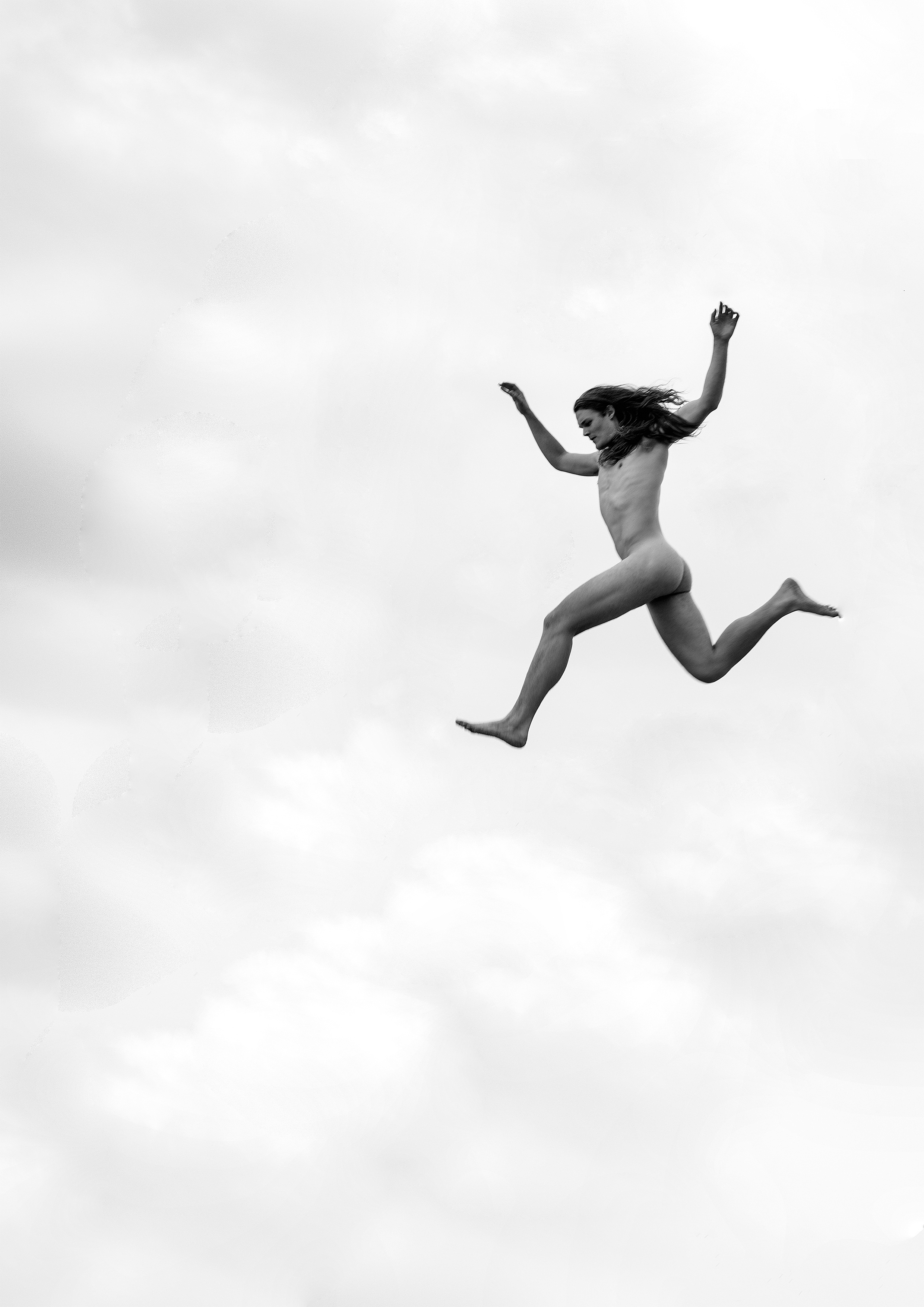
One work is titled Slip - whereas I saw a leap.


Gabrielle Hall-Lomax, Slip

Another titled Bushfires did not speak to me of that phenomenon - but is a lovely image, nonetheless. These are reminders, perhaps, that titles are unimportant to many artists and exhibition visitors. Whatever our views about that, these are fine images.


Gabrielle Hall-Lomax, Bushfires, 2021

Yet another is titled Rituals – it shows four modest-sized, standing stones amongst the mist – an acknowledgement of Stonehenge perhaps?


Gabrielle Hall-Lomax, Rituals

And Touching the sun is a sublime work that deserves lengthy contemplation – for me, the most interesting piece in the suite of three exhibitions.

The exhibition catalogue says the third show, Jamie Hladky’s Reverberation Time, “uses flash to explore places that have been reclaimed by nature after human occupation, illuminating the power of natural forces and our futile attempts to corral them.” Hladky himself has told me that the work is not so much about decay, or nature reclaiming, as he’s seen written. For him, his imagery is about “the irrelevant brevity of our short endeavours and our moments of self-absorbed pride.”

The titles of Hladky’s works reveal only where the images were taken. Around half are of decaying building interiors and half of cave and mining tunnel interiors.


Jamie Hladky, Gilgandra NSW, 2021


Jamie Hladky, Yarrangobilly NSW (1), 2021

One shot of the exterior of a neat and clean motel located in a desert area initially seemed out of place. Asked about it, Hladky told me he sees it as the first image in the series to pull the rest of them indoors - demonstrating that it is always good to have opportunities to discuss works with their authors!

In addition to viewing the three exhibitions, reading the delightful “essays” in their catalogues is a definite must, especially The House by Paddy Julian and A Cloak Stands in a Bore Hole, Arms Extended by Simon Eales.

This review was published in The Canberra Times of 4/4/22 here. It is also on the author's blog here.

Monday, February 14, 2022

VIEW2022

Photomedia Exhibition

VIEW2022 | Annette Fisher, Catherine Feint, Fiona Bowring, Greg Stoodley, Isaac Kairouz, Izaak Bink, Jemima Camper, Tom Campbell, Wendy Dawes, Xueqin Yi

Photo Access | 4 February - 5 March 2022

This show features emerging, or re-emerging, contemporary photographers. Technically, an emerging artist – no matter how old or how long they’ve been at their chosen medium - has not yet been recognised by major critics, galleries and museums. More generally, the term tends to be used when artists have been practising for less than 10 years, haven’t been acquired by a gallery, and have a low profile in the art market. A re-emerging artist is one whose career was interrupted by circumstances and is now resuming. I understand one of these exhibitors is 80. Yes, artists can emerge at any age.

Ten photographers, each producing works in their own distinctive styles, using diverse materials and exploring many subjects. You might appreciate different artists/works than those that stand out for me. I am confident, however, that every gallery visitor will find delight here and enjoy contemplating all exhibits. 

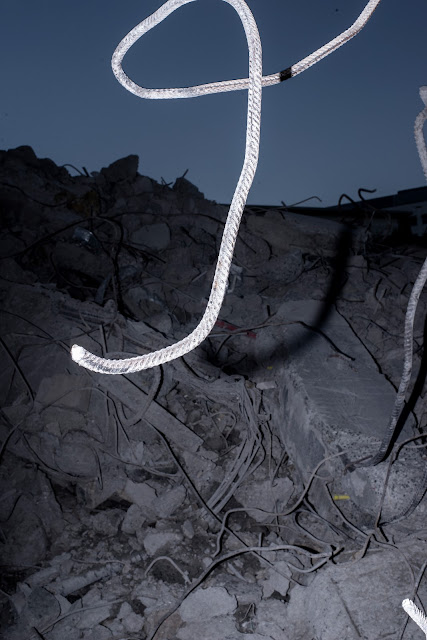
Accompanied by a video showing demolition, Annette Fisher’s powerful Demolition print captures light coming from the rubble, surprisingly revealing beauty in the site.


Demolition, 2021 – Annette Fisher

Greg Stoodley’s two Small Worlds prints delightfully reflect on how animals, in this case a cat, may be real supports during lengthy periods spent at home.


Cat TV, 2021 – Greg Stoodley

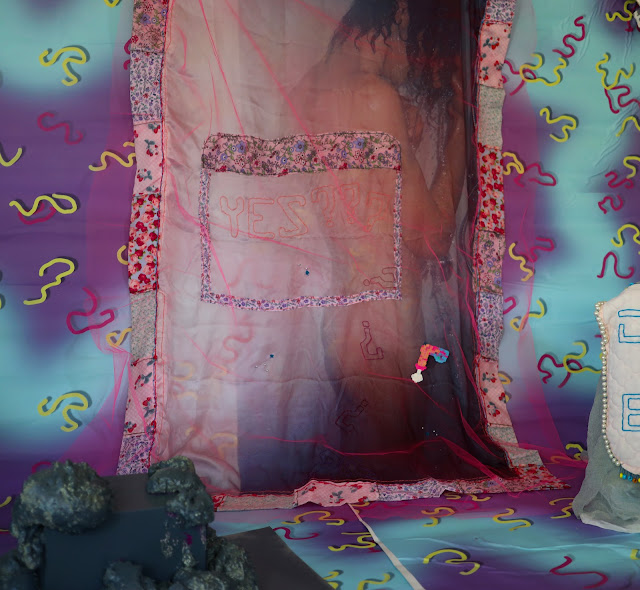
Isaac Kairouz’s Hek! BIDEO installation includes video, collage and painting. Each element needs to be explored individually, whilst the whole wonderful installation also needs to be contemplated in the context of the ways a person’s various social identities come together.


GolDen sHowASs, 2020 – Isaac Kairouz

Catherine Feint’s Childhood Home is a set of monochrome film shots of the house in which she grew up. The twist though is that they are actually photographs of her created cardboard models of the house. The quality of the shots is such that I did not realise that until reading the catalogue.


Figure 4 – Catherine Feint

Suspension, by Wendy Dawes, also took me by surprise. The catalogue refers to the rotoscope technique and drawing on suspension files. I know of rotoscoping, but it did not occur to me that the reference to suspension files meant just that – two artworks have been created on those ugly holders that we suspend in filing cabinets to hold documents. A much more creative use!


Suspension Trampoline, 2021 – Wendy Dawes

Jemima Campey’s two related video works explore the growing use of scripted and performed apologies, designed to minimise damage to the person’s “brand”. We can all quickly bring to mind certain politicians.


Still from digital video Crocodile Tears, 2021 – Jemima Campey

Tom Campbell’s split-screen video work tells two simultaneous stories, investigating the impact of border closures on our connections with places and family. I had to view this a few times to take in all the words on each screen but doing so reinforced the message.


Still from split-screen video – not that hill as a site of dominion 2021, Tom Campbell

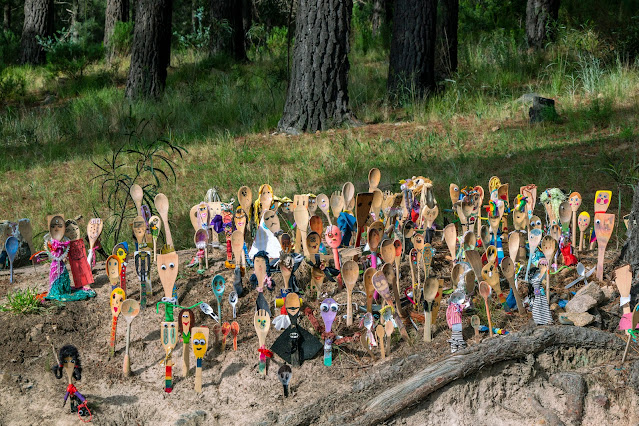
Fiona Bowring’s Spoonville is another quality print of a whimsical feature. Having seen this work previously on social media (as well as other folk’s images of other Spoonville installations) reduced its impact for me.


Spoonville-7719, Fiona Bowring

Xueqin Yi’s Plants Chant images resulted from using her camera to escape boredom and, so, becoming intensely interested in and gaining comfort from observing plants. There is much more than just plants in the images though, as she has included their, sometimes odd, surrounds.


Untitled, 2018 – Xueqin Yi

The catalogue says Izaak Bink’s I want you, because I can’t have you uses found images to draw attention to the exaggerated masculinity gay men can be forced to emulate – and forces us to ask, “whose place is it to decode this work?” Whilst not feeling any need to ask such a question, I nevertheless thoroughly enjoyed the graphic style of these two works.


Ride Em Cowboy – Izaak Bink

Thoughtfully curated by Wouter van de Voorde, this exhibition explores alternative processes and offers fresh perspectives on current issues, from early-career artists.

This review was published in the Canberra Times on 14/2/22 here. It is also available on the author's own blog here.