Showing posts with label Rory Gillen. Show all posts

Thursday, February 8, 2024

VIEW 2024

Photography Exhibition Review | Brian Rope

VIEW 2024 | Caleb Arcifa, Juncture Collective, Rose Hartley, Brittany Hefren, Emma Phillips, George Pople

Photo Access | 25 January - 9 March 2024

PhotoAccess has launched its 2024 Exhibition Program with VIEW2024, its annual showcase of emerging photo-media artists from the ACT and surrounding regions.

Caleb Arcifa shows us one work comprising silver gelatin photos and a mixed media installation. It’s interactive – touch it to create your auditory identity.

Brittany Hefren displays three delightful collages with holes cut in front prints revealing something of childhood’s imagined memories. In one work, wisteria not only creeps over a suburban front fence but spills out of a window on the house behind that fence.

Emma Phillips explores Artificial Intelligence. AI has created quite a storm with many people expressing diverse concerns whilst others see great benefits. There has been considerable discussion of it in the context of photography, with some groups banning it and others embracing it. Many photographers use it, perhaps even unwittingly, whilst post-processing their images with various software packages.

From Phillips we see what happened when the prompt “what is gender” in various languages was put into an image generator. The results perpetuated binary gender roles and the belief that heterosexual is the only normal and natural sexual orientation. And also affirmed the view that representing someone or something in an idealised way or through cultural stereotypes is appropriate. 

Emma Phillips, from Generative Genders, 2024

Rose Hartley shows us five works from Frames, an evolving series. She is looking to reveal the connections between people and the environments and settings in which they exist. These images are all interesting. I was particularly drawn to A Palestinian Wedding which shows a mirror reflection of a woman wearing a headpiece, close by a hairpiece that, presumably, she might wear to the wedding.

Rose Hartley, A Palestinian Wedding, 2018

Photo Access Director Alex Robinson’s catalogue essay tells us “The Juncture Collective brings together the work of several artists working with emerging technology to consider its social, political and economic impacts critically.”  The artists are Sophie Dumaresq, Rory Gillen and Emily April O’Neill. Dumaresq is probably the most well-known not just to Canberra audiences but, through her success – for example, as winner of the 2022 Mullins Conceptual Photography Prize – to a wider audience. She is displaying three artworks – one a digital print & mixed media. Another a digital video. The third an installation comprising a digital video, an expanse of fluffy pink carpet (also on the floor in her digital print), cow pillows and a beanbag.

O’Neill contributes an interactive installation with several parts. Gillen gives us a digital video. Both these artworks also have that fluffy pink on the floor below. Juncture’s works use emerging technologies – AI, DALL-E and ChatGPT - to critically consider their impacts. Whatever else you make of the Juncture artworks you will certainly find them absorbing - and yourself smiling.

Sophie Dumaresq (Juncture Collective), What's In A Postcard? Baby
I just wanted to make you smile, 2023

George People is responding to the dark aspects of this country’s military activities in Afghanistan, in particular the Ben Roberts Smith defamation trial. The artist set up his own “memorial” at the top of Anzac Parade in Canberra. His installation here includes the created video work, a tower of laptops (fortunately not burning as Roberts Smith was found guilty of doing), and one working laptop looping through pages from the 2020 Brereton Report which shed light on concealed war crimes. This is a powerful artwork, challenging viewers to think about the dominant military account.

George Pople, Additional Content, 2023

So, this exhibition emphasises photography's role in mirroring societal phenomena, with the artists delving into various contemporary issues. Analogue and digital photography, alternative processes, videos and installations - VIEW2024 provides a fascinating look at current trends.

This review is also available on the author's blog here.

Tuesday, November 15, 2022

ANOTHER/S/KIN

Post-digital and networked photographic art | Brian Rope

ANOTHER/S/KIN | Maddie Hepner and Rory Gillen

Tributary Projects, Gorman Arts Centre | 20 October – 11 November 2022

Ever wondered what it would be like to inhabit another person’s life or skin? Or a step further, that person lives your life at the same time? It may not quite be that, but within ANOTHER/S/KIN Maddie Hepner and Rory Gillen undertook resided in each other’s internet lives. They exchanged their social media accounts and user data to explore how each other’s curated feeds influenced their online experiences, and how those feeds reacted to being hijacked.

In 2018, Rory Gillen completed a Bachelor of Visual Arts Photomedia Major at the ANU School of Art and Design, then in 2019, added Honours, Photomedia (First Class). In 2021, Maddie Hepner completed a Bachelor of Visual Arts (First Class Honours) Photography and Media Arts at the same ANU School. In 2021, both artists were recipients of PhotoAccess ANU EASS Residency Awards.

Gillen enjoys creativity and learning and figuring out how things work and then how to tinker with them. Hepner loved the overlapping of their collaboration but is not a technology nerd.

The artists describe their process as undertaking “a subjective analysis of a subjective network.” You may or may not know, leave alone understand, how the internet increasingly divides us algorithmically and ideologically. Having both worked within this area previously, these artists so certainly did know. Here, they aimed “to perform a radical act of transparency” – not being afraid to let each other see what they said or viewed on their social media accounts. They sought answers to the question “how does my feed inform what I know?” 

This necessarily empathetic project also explored the nature of data collection and the voyeuristic exercise of witnessing. The coincidental recent hackings and releasing of personal data on the internet means many affected people are dealing with the question of how it feels to have strangers able to look directly at data about them. Does it feel any different having another artist directly looking at your data to having a corporation analysing or revealing your data? Does it make the collection more invasive? Does it make it more real? This show shares the results of the artists’ observations and collaboration.

The highly experimental artform they are practising is “post-digital and networked photographic art.” There are few practitioners of this artform in Canberra, some here and there elsewhere in Australia, but many in Europe and America. It is an extension of photography, videography and digital art. The artists consider the show to have become immediately dated since everything constantly changes on the Internet.

So, what is in the show? There is a joint audio work Persuasive Bargaining, inkjet prints, and “structures.”


Persuasive Bargaining – installation photo by Rory Gillen


Persuasive Bargaining ANOTHER/S/KIN – installation photo by Rory Gillen


GET-I (an experiment in withdrawal) detail – installation photo by Rory Gillen

There are also face casts of the artists, made together (with some friends assisting) in a very intimate experience, plus a broken merged piece. Uncannily alike, the face casts are positioned as silent viewers of Hepner’s video artworks.


ANOTHER/S/KIN 01 - photo by Rory Gillen


Epidermal Impact (imploded)(1) – installation photo by Rory Gillen

Those three video artworks are about topics that popped up repeatedly on Gillen’s social media account. Satisfying Scrapes (dirty carpet) is all about carpet cleaning -  and somewhat hypnotic.


Satisfying scrapes (dirty carpet) – installation photo by Rory Gillen

Divulge and Devour is about the art of cake decorating on Reddit (a  network of communities where people can dive into their interests, hobbies and passions) - with the video accompanied by audio of creepy stories.


Divulge and devour – installation photo by Rory Gillen

All Hustlers go to Hell is about the deeply misogynistic cigar smoking internet persona, Andrew Tate, who has been banned from several social media platforms.


All Hustlers go to Hell – installation photo by Rory Gillen

Weird right? But then what strange video material do you see on your own social media accounts? And do you understand why it is shown to you?

Gillen pulled out images from different things he saw on Hepner’s account and created abstractions from very small selections of pixels. What we see exhibited is Content - a multi-dimensional, ever-changing abstract on a screen re-purposed from his 2021 exhibition Uncalibrated Space.


Content – installation photo by Rory Gillen

This review is also available on the author's blog here.


Saturday, November 27, 2021

Uncalibrated Space

Photomedia | Brian Rope

Rory Gillen | Uncalibrated Space

Tuggeranong Arts Centre | Until 16 December 2021

Rory Gillen is a Canberra-based audio-visual and new media artist and educator. He has worked extensively in documentary and event photography, as well as maintaining an arts practice exploring the cutting edge of post-digital and networked photographic art. Working across photography, audio, video, and electronics, Gillen creates multisensory installations that critically engage. 

Graduating from the ANU School of Art and Design in 2019 with first class honours, Gillen has exhibited in various galleries, including Canberra Contemporary Art Space, Brunswick Street Gallery (Victoria), and the Perth Institute for Contemporary Art.

Gillen is sometimes referred to as the resident tech nerd at Photoaccess where he currently works developing post digital programming and workspaces as well as tutoring and facilitating visiting artists in their practice and technical skills.

Many scholars consider us to be in the era of ‘Post Digital’. What does this mean for photography; its analogue form in some ways already consigned to the dustbin of history by theorists who insist that we live in a post-media era?

In a recently streamed conversation with another multidisciplinary artist Gillen dived deep into the changing face of photographic practice. He suggested, correctly, that whilst digital photography is essentially about capturing data, post digital is about investigating it and exploring concepts that silently exist in the data set. As someone who was amongst the first computer programmers in Australia and who watched the ones and zeros coming together as light dots on a bulky “pre-computer” whilst debugging my programs, I am fascinated now when people speak about manipulating ones and zeros - akin to manipulating negatives in darkrooms.

In his artistic practice, Gillen is fascinated by “the digital paradigm shift toward the fundamental machine readability of objects, exemplified by the digital image”. Here he explores the facets that deep learning carves into images and investigates “the underlying machinations of the algorithms themselves” posing the question “what is real, and how do we know”?

This exhibition comprises twelve inkjet prints plus a mixed media installation showing faces, illustrations, landscapes and objects – and much more. Aluminium, plywood, a desktop computer, wires and miscellaneous electronics are all part of the installation, without them there would be no screen images to see.


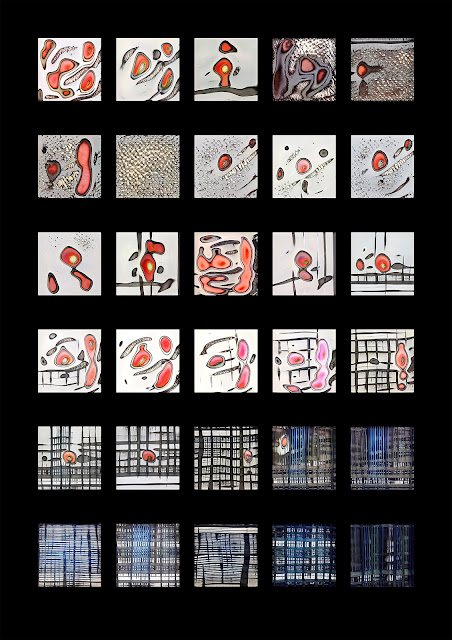
3500 Steps From Illustrations, 2021 © Rory Gillen


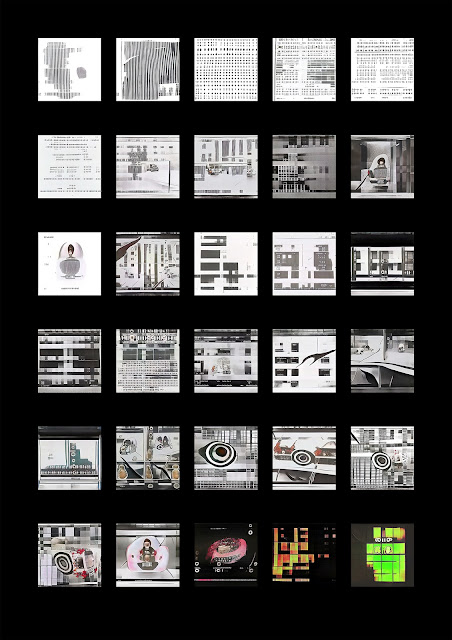
3500 Steps From Objects, 2021 © Rory Gillen

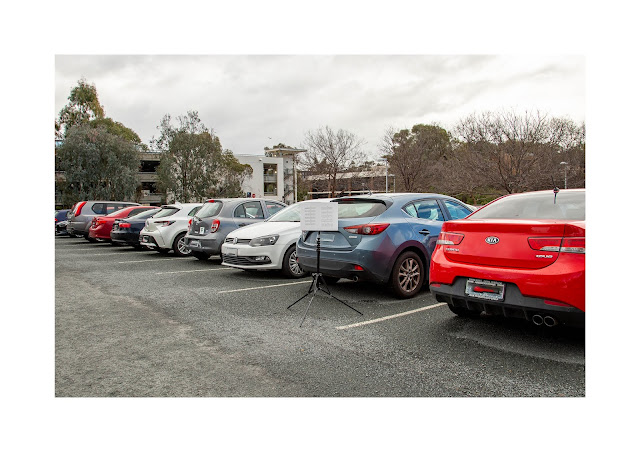
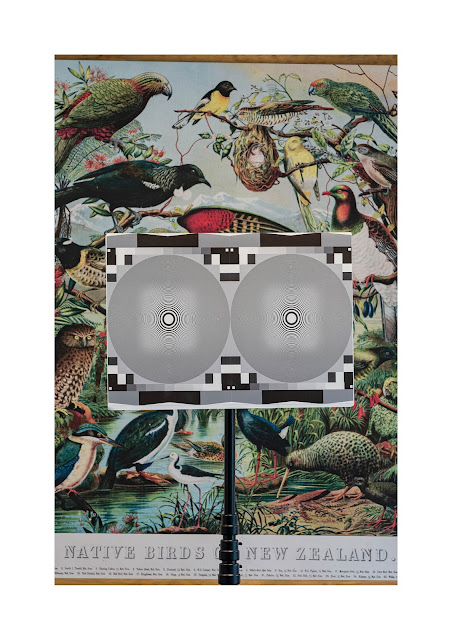
The prints relationships to faces, illustrations, landscapes and objects is not immediately obvious. At first glance I asked myself why one smaller print was of parked cars with a music stand amongst them. Closer inspection revealed that the stand was in fact supporting a copy of one of the larger prints. The same is true for other smaller prints of a landscape, Gillen’s own face, and an illustrative poster – stands in each of them support copies of larger prints in the exhibition. Four large prints titled 3500 Steps from Faces, etc. are curated grids of images resulting from heavy manipulation of ones and zeros.


Untitled Source Image IV, 2021 © Rory Gillen

Untitled Source Image II, 2021 © Rory Gillen

There is so much to look at, so much to wonder about. Images on the computer screen are mesmerising, flashing on and off at a rapid rate. Individual images on a larger LCD screen have a dreamlike quality. I saw cartoon-like faces, old hand made nails, overhead views of building site plans, hieroglyphics and lenses. Whatever you see you will enjoy.


Uncalibrated Space IV, 2021 © Rory Gillen


Uncalibrated Space III, 2021 © Rory Gillen

Grant Scott, the founder/curator of United Nations of Photography, has written “The role of the 21st century photographer has changed and is constantly evolving. It is, therefore, the responsibility of the engaged photographer to understand that reality and to respond to those changes.” Gillen is so engaged. We can expect the future to bring us many more manipulated and appropriated artworks from him and others.

This review was published in the Canberra Times on 27/11/21 here. It is also on the author's own blog here.