Showing posts with label CMAG. Show all posts

Monday, December 15, 2025

LOVING - Photographs of men in Love, 1850s to 1950s & A loving City - Queerberra Revisited

LOVING - Photographs of men in Love, 1850s to 1950s

A loving City - Queerberra Revisited

Canberra Museum and Gallery (CMAG), Gallery 2 | 6 December 2025 to 5 April 2026

Whilst most certainly being complementary, these two exhibitions in adjoining spaces are also very different to each other. LOVING – Photographs of men in Love, 1850s to 1950s is, obviously, only about men. The large number of photographs in the display is essentially monochromatic.

Installation image - LOVING – Photographs of men in Love, 1850s to 1950s © Brian Rope

But, when visitors walk through into the next space to A loving City – Queerberra Revisited they will immediately see colour images hung against a background of vivid rainbow colours.

Installation image - A loving City – Queerberra Revisited © Brian Rope

The content of LOVING was created by collectors and arts professionals Hugh Nini and Neal Treadwell. That married couple discovered an old photograph of two other men in a tender loving embrace at an antique store in Dallas, Texas, 25 years ago. The image sparked a passion which resulted in a global journey searching for other photographs capturing men in love. They searched flea markets, auction houses, family albums and online collections, gradually gathering from all over the world over 4,000 tender images of male couples taken between the 1850s and 1950s - 100 years of social history and the development of photography.

In 2020, they published a book internationally, showing hundreds of the previously unpublished vernacular photographs depicting romantic love between men that powerfully and movingly reasserted both that love is love and that there had always been men who loved each other. It and this exhibition tenderly portray romantic love between men. There are snapshots, portraits, and group photos taken in the most varied places and situations. Often taken when male partnerships were illegal, the collectors identified the men in the images as couples by what they have described as the unmistakable look in the eyes of two people in love, by their body language, and even by coded inscriptions. There is a diversity of image formats - ambrotypes, daguerreotypes, glass negatives, tin types, cabinet cards, photo postcards, and more.

Three years later, the collection was exhibited for the first time at the Musée Rath in Geneva. Now, it is being displayed in Australia, co-presented by CMAG and the Delegation of the European Union to Australia. The photographs on display have been digitised. They tell stories which have a considerable impact when we consider them. They speak to spirit and resilience. LOVING brings to light the lives and stories of male couples from around the world - giving voice to their courage, intimacy and enduring love for their “other halves”.

Unknown subject, Loving: Photographs of Men in Love 1850s-1950s © The Nini-Treadwell collection

Two men hugging each other

AI-generated content may be incorrect.
Unknown subject, Loving: Photographs of Men in Love 1850s-1950s
© The Nini-Treadwell collection


A couple of men in military uniforms

AI-generated content may be incorrect.

Unknown subject, Loving: Photographs of Men in Love 1850s-1950s

© The Nini-Treadwell collection

The second exhibition, A Loving City: Queerberra Revisited, is a return to a 2017 portrait series - Queerberra by photographer Jane Duong and producer Victoria Firth-Smith.

Created between 2015 and 2017, in the lead-up to Australia’s same-sex marriage postal vote, the original project captured over 100 portraits of LGBTQIA+ Canberrans in their homes, workplaces and everyday spaces. Over weekends spent in bedrooms, workplaces, and on the streets, portraits of pride, exhaustion, defiance, love, and hope were captured with grace and honesty. Some subjects were already out. Others came out for the first time. This unique art project set out to portray the beauty of Canberra’s rich array of local identities from LGBTIQ, asexual and cisgender peoples, to drag queens and kings, and beyond. Everyday lives were captured and shared with pride - some had not been ‘out’ publicly, others were very much in the public eye.

On 15 November 2017, Canberra’s voters delivered Australia’s strongest "Yes" vote in support of marriage equality. The Queerberra book was launched the very next day. Eight years later, this revisiting of the book and original exhibition showcases 99 of the original 100 portraits from that book and invites audiences to consider how much things have changed in that time.

Two women standing in front of a tree

AI-generated content may be incorrect.
Caitlin and Jill, Queerberra - photography by Jane Duong and produced by Victoria Firth-Smith
 
A person in a striped shirt

AI-generated content may be incorrect.
James, Queerberra - photography by Jane Duong and produced by Victoria Firth-Smith

These two exhibitions are simultaneously intensely intimate and deeply political. Each one stands alone in its story and tone; together they form a larger narrative about connection across generations, time periods and other things that often divide us.

This review is also available on the author's blog. And a shorter version is on a Canberra City News webpage.

Saturday, July 15, 2023

Capturing Canberra

Brian Rope | Photography

Capturing Canberra | Various Photojournalists

CMAG | 8 JUL 2023 - 28 JAN 2024

Capturing Canberra showcases the recently acquired Press Photography Collection of the Canberra Museum and Gallery (CMAG). On display for the first time - part of it that is - this remarkable collection of 3,560 press photographs captures the essence of Canberra, its people, and events that shaped both the city and the nation. As one would expect, the 150 images on display overall reflect the skills of trained photojournalists, so this review focuses on content rather than quality.

There are historic, thought-provoking, artistic and amusing images that have graced the front pages of Australian newspapers, including The Canberra Times and The Sydney Morning Herald. CMAG has added material from the photojournalists' personal collections and some of their recollections to bring their experiences to life. Visitors can immerse themselves in the visual storytelling and reflect about the people and events they are looking at. They can truly engage with particular stories and images; and be inspired by them.

Images that will captivate the audience in 'Capturing Canberra' at CMAG. Image supplied by CMAG

The exhibition is made even better by displays about wet darkroom magic and the secrets of the development process. Visitors are invited to use a vintage typewriter to write their own breaking news stories. They can watch and listen to first-hand video accounts from photojournalists talking about their careers and experiences working for Fairfax-associated newspapers.

Some of the photojournalists represented in the Press Photography Collection have contributed considerably to make this a great exhibition, especially for those of us who have lived in Canberra during some of the years covered by the displayed imagery (1913 – 1994). Many Canberrans will be familiar with the names Graham Tidy, Rob Little, Mike Bowers, Lorrie Graham and Rick Stevens. Passionate Canberra photographers will remember Rob Little judging their entries in Canberra Photographic Society competitions (as some current day photojournalists also do) or have attended presentations in their city by Mike Bowers.

Biographies of photojournalists within the collection. Image supplied by CMAG.

Having lived in Canberra since early 1959 and photographed many things here myself during the period covered by this collection, I was delighted to see people, places and events that I knew and remembered – and photographed.

People such as the first Chief Minister of the A.C.T., Rosemary Follett, Prime Minister Gough Whitlam and members of his Cabinet, including Tom Uren who I answered to as ACT Commissioner for Housing in the early 1980s when he directed that there were to be no evictions whatever if tenants decided not to pay their rent. Word got around and, as a result, rental arrears skyrocketed.

Prime Minister Gough Whitlam addresses joint sitting of Parliament, 6 August 1974.
Image by unattributed photographer. CMAG's Canberra Press Photography Collection, 2018.

Buildings such as the Academy of Science in 1969 and the Black Mountain Communications Tower in 1973. Events - including moratorium marchers in 1970-71 photographed passing by the Rogers department store that older Canberrans all remember, and floodwaters passing over Googong Dam in 1976.

Moratorium marchers in Canberra, c.1970-71.
Image by unattributed photographer at The Canberra Times.
CMAG's Canberra Press Photography Collection, 2018

There are historic photos from the beginnings of Canberra and copies of front pages of The Canberra Times. There are displays about the “Great Outdoors” – youngsters playing when snow fell, yachts at the lake, and people enjoying places along the Cotter River. There is a photo that includes the first Duntroon Cadets of “Aboriginal descent” on graduation day in 1987.

Bathing in the Molonglo River, c. 1937. Image by William G Buckle.
CMAG's Canberra Press Photography Collection, 2018.

Who amongst Canberra’s long-time residents could forget the Minister for the Capital Territory, Michael Hodgman? There is an image of him in a suit, trousers rolled up and standing in a paddling pool alongside Flipper, a plastic duck, after he had turned the first sod at the site of the $7.8 million indoor swimming and training hall at the National Sports Centre in Bruce. I have other memories of him – one about a “notorious” swastika on a garage door in Charnwood, another about him “requiring” some of his departmental branch heads to drink Tasmanian beer in his old Parliament House office after midnight whilst he changed into suitable clobber for a late appearance at a dressy event.

Many of the photographers have not been identified, as their published images were not attributed. There are photos of unknown people, including one of five young women in Canberra Times uniforms outside that newspaper’s offices. CMAG invites visitors to provide any information they have to assist identify people and places and the unattributed photographers.

My wife, who has lived here only since 1988, accompanied me to the exhibition and was just as interested in all the material. Indeed I would be surprised if any visitor did not find the exhibition fascinating. I look forward to a future opportunity to see many other works from the collection.

This review is also available on the author's blog here.


Monday, December 20, 2021

‘hand/made/held/ground’ & Made in Australia Series II

Photography & Mixed Media Review | Brian Rope

‘hand/made/held/ground’ & Made in Australia Series II | Brenda L. Croft

Canberra Museum & Gallery | Until 22 January 2022

‘hand/made/held/ground’ is a major body of work by a leading contemporary artist, Brenda L. Croft, a proud Gurindji/Malngin/Mudburra woman whose background also includes Australian, Chinese, English, German and Irish heritage.

This mixed media installation explores Croft’s intimate patrilineal relationship, and her return to her father’s, and her own, Country; sharing something of that lineage connection and her journey. It reimagines and honours customary objects - jimpila (spearhead) and kurrwa (stone axe) - created on their Gurindji homelands in the Northern Territory. Contemporary representations on display reflect ancestral journeys - undertaken on traditional homelands, and returning home.

When, and who by, the stone axe was created is unknown. However, it is known that the axe survived over 130 years of pastoral impact prior to being found by Croft when she visited the remote site where it was.

The spear tip was given to Croft under temporary care by a supporter (Lyn Riddett) of the Wave Hill walk-off led by Vincent Lingiari. Riddett received the spear as a gift from an Elder at Daguragu in 1971. In the following years, the tip of the spear was accidentally broken before it was able to be repatriated to the Gurindji community, via Croft.

Whilst caretaker of the spear, Croft repaired it with wax and had a wax mould made of it, along with a mould of the stone axe. With permission from family and community members, she used those moulds to create multiple copies of these significant cultural objects - black and red lead crystal, clear and uranium glass cast stone axes and spear tips.

It is these copies, displayed on a combination of new and aged steel bases echoing steel bore water tanks, that we see in this exhibition. Each is lit individually from within revealing various colours, their configuration representing constellations in a night sky.

Jimpila (spearheads) (detail) from hand-made/held-ground installation at Niagara Galleries, Melbourne, 19 November – 14 December 2019.
Photographer © James Henry. Image courtesy Brenda L Croft and Niagara Galleries.


Jimpila (spearhead – uranium glass) 2017 - 21. Glass components: kiln cast uranium glass. Display case: stainless steel, Sikaflex, electrical wire, 12 volt globe. Dimensions: variable. Photographer © James Henry. Image courtesy Brenda L Croft and Niagara Galleries.

As well as the kurrwa and jimpila pieces, large satellite images displayed on the gallery walls map journeys embarked on by Croft, sometimes alone and other times accompanied by family and Gurindji community members. These maps, together with the axe and spear tip copies, reveal a connection between land and sky. As the lights in the moulds pulse on and off, their beating synchronises with ancient footsteps on the earth and symbolises the beating hearts of the objects’ owners.


Yijarni (Gurindji History Book Project) (detail) and Jimpila (spearheads) (detail) from hand-made/held-ground installation at Niagara Galleries, Melbourne, 19 November – 14 December 2019. Photographer © James Henry. Image courtesy Brenda L Croft and Niagara Galleries.

In an adjacent space to that displaying ‘hand/made/held/ground’, Canberra Museum and Gallery (CMAG) is showing eight works from Croft’s earlier ‘Made in Australia II’ series, held in its own collection. This is an interesting and clever juxtapositioning of two sets of artworks.

Made in Australia II was produced by Croft to honour her mother, who advocated for social equity at a local level, while also ensuring her children were proud of their heritage. A non-Indigenous woman, Dorothy Jean Croft broke from tradition in Sydney - she found love with a Gurindji/Malngin/Mudburra man, Joseph Croft. They married and raised a family together, living in numerous regions of Australia, including Canberra.

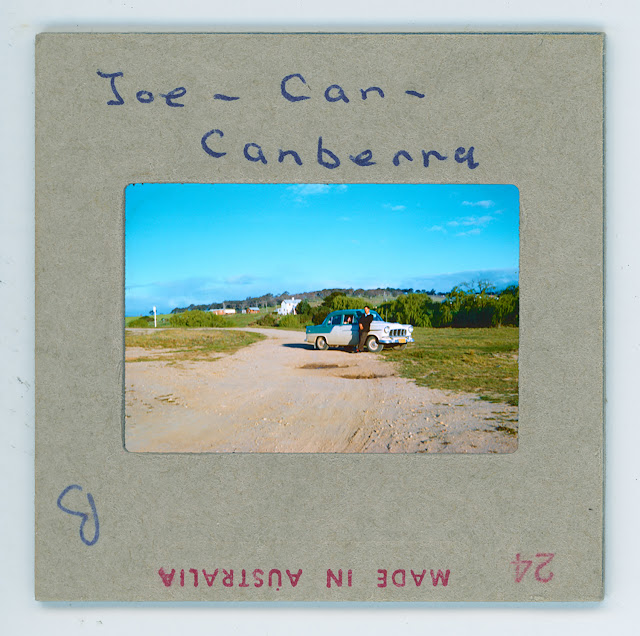
The artist Croft has celebrated her mother’s story by scaling up her (mother’s) original 1950s-60s vividly coloured 35mm Cibachrome slides to giant size photographic prints that speak to the strength and potency of her parent’s relationship - played out quietly in this heart of the nation.


CROFT 21. Civic Centre Canberra 1959 - Made in Australia II Series


CROFT 24. Joe - Car, Canberra - Made in Australia II Series


CROFT 44. Joe & Snow 3 Mile Lake - first snowfall ANZAC - 1960 - Made in Australia II Series

Together, these two bodies of Croft’s work celebrate both the male and female lines of her kinship stories, whilst also shedding light on some of our nation’s tensions: a story of lives impacted by stolen generations, returning to traditional homelands, the assertion of women’s independence and the breaking of class and racial barriers.

Both series wonderfully pay tribute to her mother’s memory.

This review was published in The Canberra Times of 20/12/21 here. It is also on the author's own blog here.