Showing posts with label Family. Show all posts

Thursday, April 4, 2024

Volver (The Return)

Exhibition Review: Photography | Brian Rope

Volver (The Return) | Judith Martinez Estrada

Photo Access | 15 March 2024 – 27 April 2024

Two exhibitions running concurrently at Photo Access explore identity and memory, in quite different ways. Volver (The Return) is one of them. The artist Judith Martinez Estrada has focussed on migration as well. Starting in 2017, she comprehensively explored her paternal family’s apartment in Madrid, which they had rented for more than 100 years. Unearthing photos, documents and other material relating to her family gave her a significant volume of mixed media to which she has applied a variety of techniques.

Three babies had been born at the flat. Two people had died there. A century of family life had been lived there with all its highs and lows. The family’s history and the memories of all who had lived there was powerful and very much overlapped. As the relationship between the apartment and the artist’s grandparents, aunt and parents changed, so the memories altered - as they tend to for many, if not most, of us. As we get older we sometimes forget things long remembered. Sometimes we recall things from our early years which we have not thought of for a long time, if ever. Personally, my earliest knowledge of family history comes not from actual memories of the events but from hearing a story told over and over. Sometimes we are unsure whether an apparent memory is a real one.

So, what is the artist revealing to us here of this significant treasure of her family’s memories? Charu Maithani’s catalogue essay provides considerable background. Her documentation of the apartment became the catalyst in Martinez Estrada’s practice that brings together personal and political histories alongside archival and digital artistic techniques. Working with layers she creates a temporal and spatial juxtaposition of memories and objects. Each layer in the works creates spaces for remembrances to be added, including ones we do not know of yet. Layering allows multiple entry points and numerous recollections and half-rememberings to coexist.

In series of works entitled Family Biographies, photos and a variety of documents are held together using various means, such as rubber bands and paper clips. Has this been done to hide some of the past, the memories, the history? What else is there in the closed book, on the notebook pages not visible to us, in the photos hidden behind the top ones? Or are the assembled objects being presented to us as a symbol, telling us that the apartment which binds family members together will continue to draw back those still living?

Family-Biographies-Biografias-Familiares-XII-2018 - installation image provided by Photo Access

Another series Unknown Portraits uses strips to cover faces, thereby further hiding the already unknown identity of the people photographed at an unknown time in the past.

Unknown-Portraits-Retratos-Desconocidos-II-2018 - installation image provided by Photo Access

Two prints exhibited side by side share the title When God Left. The left side one spoke clearly to me of a god. A hand gesturing towards us is familiar to all who grew up attending Christian schools or churches. Here though we also see a nail hole telling us the artwork partially included is of Christ after his crucifixion – when he had left his earthly life. A video work tells us that Estrada’s grandfather played a role in the relocation and protection of artwork during the Spanish Civil War. Also displayed is a reproduction of an official commendation for that work. His granddaughter is now tracing and recreating the journeys he made transporting artworks from Madrid to Valencia. Did this painting of Christ belong to Grandfather Ramon?

When-God-Left-I-2018 - installation image provided by Photo Access

Old images of grandparent’s Ramon and Emilia are on display, overlaid on new images of things in the apartment. 

Ramon-II-2019 - installation image provided by Photo Access

There is much more to see, explore and consider in this fine exhibition. If you are able to do so, visit the gallery whilst this and its companion exhibition (also about identity and memory) are showing. If you can’t get there, at least take a look at some of her other works here or on her Instagram account

This review is also available on the author's blog here.

Saturday, May 7, 2022

Lifetime Book 1. Coming of age

Photography Book Review | Brian Rope

Lifetime Book 1. Coming of age | Greg Dickins

There have been various photo-books published about Canberra. Heide Smith published five of them about the city and its people between 1983 and 2012. Col Ellis published one in 2014 - providing tips and tricks for aspiring photographers, as well as creating a memento for expatriates and visitors. And I provided all the images for a 1990 book introducing Canberra to thousands of visitors shown around by local tourism company Hire-A-Guide.

However, I doubt that three independent photo-books about the city have previously been launched simultaneously. But now we have three which all examine Canberra as a place of social, cultural and political significance. Each explores the personal relationships of their photographers to the city. Each also looks at the national capital’s wider, public meaning.

One of them, Life-Time Book 1. Coming of age, is the first in a planned series of five photo-books by Greg Dickins. It catalogues his life in Canberra between 1967 and 1973, focussing on his experiences of childhood, school, university student revelry and family intimacy -  against the backdrop of anti-Vietnam War protests and rallies to establish an Aboriginal embassy. His planned later books will cover the years to 1987, after he left Canberra.

Dickins has spent his working life as a journalist and media consultant but has always had a passion for photography. He picked up a 35mm SLR camera as a teenager in the late 1960s - that time of great social, political and cultural change. Since then he has maintained a permanent darkroom, working mostly in black & white.

As a record of Canberra the way it looked and felt fifty years ago, this volume reveals something of the extent to which the city has evolved and changed through time. In his introduction, Dickins identifies his first dilemma as author of a book of photographs – “What do I have to say?” His response was that he needed to narrate a story linking the pictures and explaining their inclusion. So, he shows us what he saw and hopes we will see his take on what his images mean - or meant at the time.

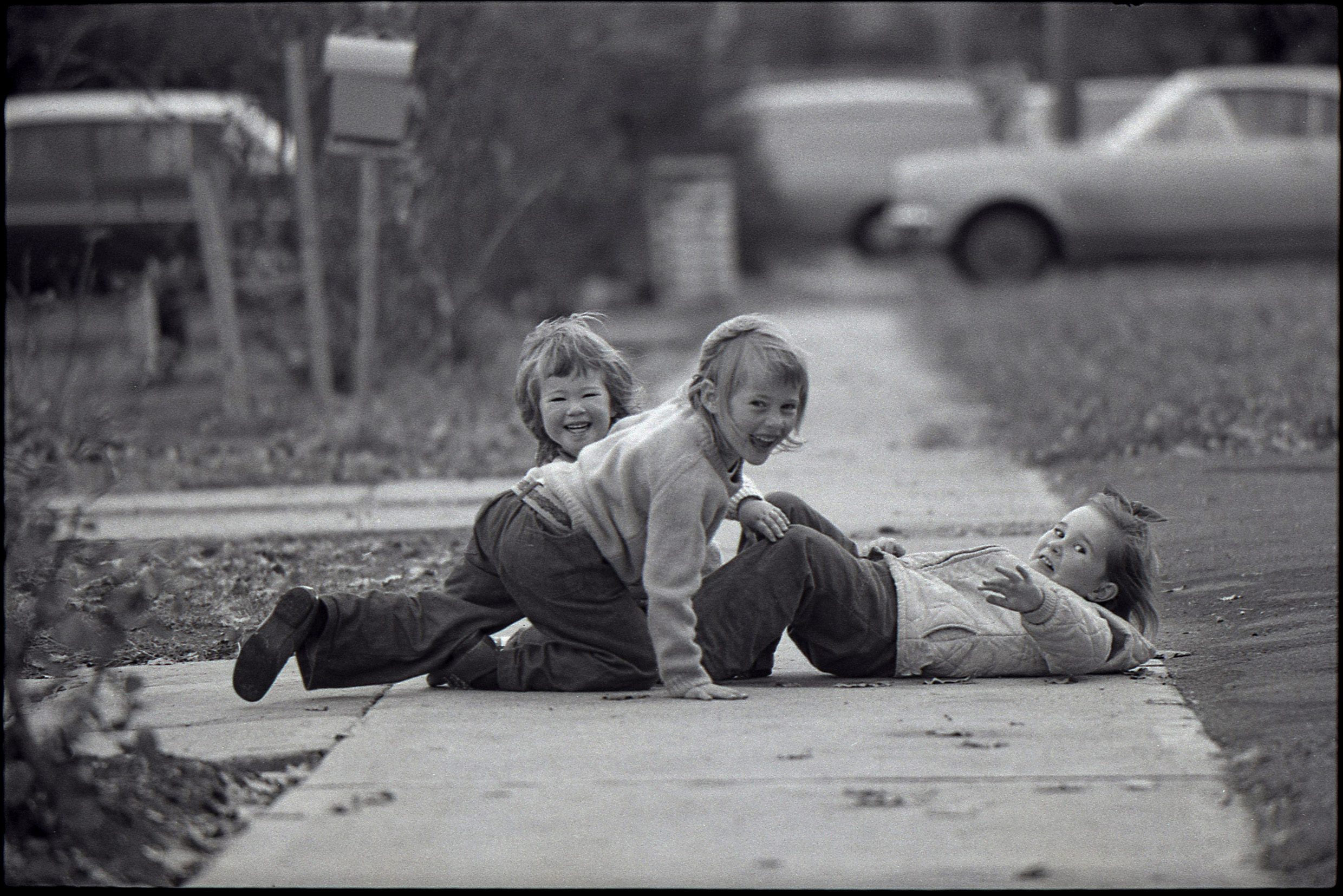
So, how well has the author achieved his purpose? The childhood section includes some delightful images of youngsters doing the types of things all children do – playing with balloons - and something home-made, rolling about together on the ground, and painting at kindergarten.


Jane, Tricia & friend, June 1973 - Greg Dickins

They are also shown gesturing, laughing, and even looking like Winston Churchill. Some adults also make appearances with the children. These photos clearly represent what childhood meant for the majority of kids in Canberra at that period.

Dickins then moves on to school years. He shows us school-age children playing in the Cotter River, waiting for the school bus, in marching girl outfits, together on a sandy beach, and enjoying Canberra Day.


Di, Paul, Kyle & Judy, Casuarina Sands, November 1967 - Greg Dickins

Perhaps of greatest interest are the strong images of schoolchildren participating in an anti-Vietnam War march and rally in September 1970. Are their counterparts protesting today aware their counterparts did the same?

Next the book explores university student years – speakers’ corner (who remembers that?), rugby, drama (including a nude poetess and a production of Marat Sade), the first on-campus condom vending machine, Bush Week activities and conscription notice burning. Plus a 1972 march to establish the Aboriginal Embassy and, again, an anti-Vietnam War march and rally. A number of well-known people appear, including two political leaders. There are some great historical shots here.


March to establish the Aboriginal Embassy, July 1972 - Greg Dickins

The final three images about family neatly close off what Dickins wanted to say. He has successfully narrated his story.

The book can be purchased at Photo Access or online at https://au.blurb.com/b/11093552-life-time-book-1-coming-of-age-large-12x12.

This review is also on the author's blog here. Another version was published in the Canberra Times on 7/5/22 here as part of a combined review of this and the other two book launched at the same time.

Saturday, September 4, 2021

Negotiating the Family Portrait

Photography | Brian Rope

Marzena Wasikowska | Negotiating the Family Portrait

Canberra-based photo artist Marzena Wasikowska has built a name for herself over the years. Since 2000, when she completed her Master of Visual Arts at the ANU, she has had more than a dozen solo exhibitions (as well as being in numerous group exhibitions). Her works are in several public collections, and she also has been publicly commissioned on a number of occasions. Wasikowksa has been successful in various major competitions, including being a finalist in the National Photographic Portrait Prize (NPPP) five times.

Now, Wasikowska has been selected as one of the winners in the 2021 Lens Culture Street Photography Critics’ Choice Awards. Joanna Milter, Director of Photography at The New Yorker selected the series Negotiating the Family Portrait 2011-2021 for an Award. Experts, such as Milter, explored entries from across the globe to select their top three personal favourites. There’s no jurying as a panel; just choices made individually by each of the expert critics.

Images were submitted by photographers from over 150 countries and twenty-one critics chose individual photos and series that captured their hearts. Explaining her choice of Wasikowska’s series, Milter described the images as lively and noted that the artist “purposely captures those instances before everyone is in place. Yet she understands that the presence of a photographer changes everything; even in seemingly offhand moments, her subjects are performing for her camera.”

The ten images in the series have been captured over a decade – indeed it is five of them that have been finalists in the NPPP. Wasikowska says the series title summarises how she thinks about the act and procedure of making family portraits for public viewing. As we all should be, she is keenly aware of the discussions and negotiations of private and public - what to exhibit and what to keep private. She suggests, and I agree with her, that image makers tread a fine line when contributing to the dialogue of family portraiture while revealing something candid but not uncensored.

We have all experienced difficulties taking photos of getting people to smile, not hold fingers above heads, and not hide behind taller folk. Wasikowska has solved those problems. Whilst saying she longs for them to be the actors in her images, she also expresses her hope that each photograph holds the essence of a genuine, personal event, for herself and each of them. These annual portraits of her immediate family are a highlight of her portrait photography, summarising the previous twelve months.

In one image, every family member has brought their year’s story to the table.


Negotiating the Family Portrait 2015-16 - A study of history, myth and identity family
© Marzena Wasikowska

In another, one of two young children appears to be struggling in the arms of the adult holding them, most probably longing to be put down and set free to again explore the camera equipment now being used to capture them.


Negotiating the Family Portrait 2018 – Chaos © Marzena Wasikowska

And then another image is filled with visual symbols for the conflicting extremes associated with this dreadful pandemic affecting each and every one of us in various ways; some the same for us all, others different for particular individuals.


Negotiating the Family Portrait 2020-21-A COVID Kind of Day © Marzena Wasikowska

It is a delight to see these ten images together. They start with a relatively simple, yet exquisite, image of just two of the family.


Negotiating the Family Portrait 2010 - Long Distance Conversation 1 © Marzena Wasikowska

Along the journey we see far more complex groupings of much larger gatherings of family members, in which the theatricality and performance style truly shines through.


Negotiating the Family Portrait 2012 © Marzena Wasikowska

We are members of an audience. Some may wish they were videos rather than just one still image of a moment frozen in time. But these are the precise moments that the artist selected and wants us to see.

This article was first published in the Canberra Times on 4/9/21 here. It is also on the author's own blog here.