Showing posts with label Photobook. Show all posts

Tuesday, December 19, 2023

Nucleo

Photography Book Review | Brian Rope

Title: Nucleo

Author: Wouter Van de Voorde

Publisher: AREA Books (Paris)

Format: 240 pages (all with foldout), 32 x 23.5 cm, softcover (with dustjacket)

ISBN: 978-2-4935-0911-6

Having become aware of Wouter Van de Voorde’s photography, Laure-Anne Kayser of AREA Books (Paris) approached him to do a book. Like his previous sold-out book Death is not here (published by Void, another European company), sales of Nucleo have been excellent since it was first launched on 8 November 2023 in Paris at an Art Book Fair. 

The Foundation Henri Cartier-Bresson named Nucleo as a Book of the Month for December 2023, saying “Like the fantasized nuclear family to which the book’s title refers, the photographer’s family watches the forest burn, plays in the water and stirs up dust. Bureau Kayser’s ingenious layout delicately crystallizes a tale of family self-sufficiency and autarky.”

At the Canberra launch of the book National Gallery of Australia Photography Curator Anne O’Hehir was effusive in her praise for the book, describing it as having a great sense of “isolation being separate” and suggesting that life seems random and chaotic - a series of events only connected by our experiencing them. The word success comes to mind!

C and F at Lightning Ridge, Wouter Van de Voorde, 2019

F throwing sand in the air, Wouter Van de Voorde, 2023

Announcing the book’s publication, Area Books described it as an “emotionally charged photobook, this work encapsulates a decade of artistic evolution, exploration, and the essence of family life set against the backdrop of the Australian landscape.” As I explored the book I found myself very much agreeing with the description. It reveals so much of the artist’s journey and, simultaneously, his family’s life experiences whilst his art has changed and evolved.

Originally a painter in his Belgian homeland, after moving to Australia in 2008 Van de Voorde found his creative sanctuary in photography – which he has suggested provides the advantage of speed over painting. The artist considers his adopted home country through his camera lenses. The photobook is a visual odyssey tracing the life of his family, starting from the birth of his son, Felix, and continuing to their most recent moments captured during a twilight walk on Cooleman Ridge, a nature reserve close to home. It reveals 10 years of the family’s shared experiences, organized chronologically.

C, F and F on Cooleman Ridge at Sunset, Wouter Van de Voorde, 2023

It is certainly not a traditional family photo album though. Members of the family have been photographed exploring parts of the land on which they live or are visiting for some reason. There are images where their faces are not visible, images taken in an ordinary backyard and others where family members might be seen as exploring a nondescript place. There are no photographs of the artist himself. Rather, his presence is evoked through his observations. Exploring the pages I sometimes wondered what I was looking at, or what the children were doing. All of this adds to the intrigue. His wife’s family lives at a considerable distance, his family on the other side of the world. The book reveals his immediate family’s shared moments in Australia.

A Ngunnawal elder explained to Van de Voorde how the land looks after people who live on or even just pass through it. He now has a clear understanding of how the land provides solace, nourishment, and a deep sense of belonging. The artist poetically explores this relationship, drawing parallels between a trig point’s archetypal house shape and the skeletal remnants of a house. He sees this as a metaphor for his family’s life - being inside a house without walls but feeling protected and cared for by the landscape.

C and F on Mount Arawang, Wouter Van de Voorde, 2023

The book’s design utilizes a horizontal layout folded in two. Opening the book at the central fold subverts the typical chronological flow, instead delivering a most Japanese approach to layout. I first saw the latest image, from September 2023, then read in reverse order. This folding technique enables juxtaposition of visual and natural patterns whilst challenging the conventional concept of time. You can get a great feel for the book at https://area-books.com/en/nucleo. As a bonus for purchasers, each copy of the book has a numbered print signed by the artist slipped into the front cover. And just look at this image showing something of the wonderful structure of the book:

At the local launch, O’Hehir suggested Nucleo is, a legacy for the artist’s children. She is right. This artist has assembled and shared a very successful portrait of his art and his family’s life.


This review is also available on the author's blog here.


Tuesday, November 7, 2023

Uninnocent Landscapes


Photography Book Review | Brian Rope

Title: Uninnocent Landscapes

Author: Ian Terry

Publisher: OUTSIDE THE BOX / Earth Arts Rights

ISBN: 978-0-646-88105-8

Just two days before I began writing, this beautifully designed and printed book, Uninnocent Landscapes, was launched at the Sidespace Gallery in Hobart during the opening of Ian Terry’s exhibition of images from the book. Those who pre-ordered copies were fortunate enough to receive them in the post a couple of days earlier.

Terry tells us the book is the result of two years spent combining landscape photography and historical enquiry, seeking answers to questions. What could the landscape tell him about invasion, colonisation and the destruction of First People’s life and culture? What could it tell him about his own life on the island of lutruwita. He acknowledges that his project didn’t fully answer his questions, despite giving him a deeper knowledge of the landscape’s underlying stories. He intends his book to start conversations and, for that reason, commissioned other essays published within it.

The book is described as a photographic conversation. The foreword, by Tasmanian art historian Greg Lehman (descended from the Trawulwuy people), tells us it is “a 21st-century response to a journey undertaken by one of the first Europeans to recognise the humanity of the palawa nations.” That journey was George Augustus Robinson’s Big River Mission undertaken in 1831. So, whilst it certainly is a photographic conversation and contains over 50 sharply observed and carefully crafted black and white tritone images, the book is much more than that. It is telling a most important story. And all proceeds, from the book and accompanying exhibition, will be donated to the Giving Land Back Program of the Aboriginal Land Council of Tasmania - see https://www.givinglandback.org/.

Locked gate ahead © Ian Terry

Terry’s excellent photographs are accompanied by words from Robinson’s journals describing the locations and what he had observed at those places whilst on his Mission. The captions with the photos reproduced here are very much abbreviated selections (by Terry) from the original words. Here is one example of the journal words relevant to the following image.

24 October 1831

This morning proposed to the chief Mannalargenna [Manalakina] to leave some of the dogs behind as they made too much noise. To this he appeared averse, and I observed that I had better tell the Governor that we was not looking for natives but after kangaroo.  He replied that I should tell the Governor I was stopping in the sun.  He is a shrewd man … Came to some large lagoons and encamped for the night … The country round these lagoons is a place of great resort for the natives. There are abundance of eels in these lagoons, so the natives inform me.”

A place of great resort © Ian Terry

Robinson is a controversial figure in colonial history.  He was given a remit by Lieutenant-Governor Arthur to protect and “civilise” the Nunani people living on lunawuni and teach them Christian values. The Big River Mission is often recognised as ending lutruwita First People’s resistance to invasion of their land. Terry’s introductory essay in the book provides considerable information about this part of our unfortunate history. It also explains how the landscapes of lutruwita are, for him, a place of enormous solace.

Melancholy © Ian Terry
 
Clear of wood © Ian Terry

The book also includes text contributions by Rebecca Digney (a proud pakana woman), Nunami Sculthorpe-Green (a proud palawa and Warlpiri woman) and Roderic O’Connor (a sixth-generation farmer committed to a sustainable farming future and returning part of his land to its pre-colonial state). Terry’s photographs helped Digney contextualise Robinson’s recorded events as real, inflicted on real people in real places. They caused Sculthorpe-Green to feel the loss of the landscape. O’Connor acknowledges that he still has much to learn.

Terry himself grew up in Queensland and Sydney. He relocated to lutruwita in 1984, immediately feeling at home on what most of us would agree is a “beautiful island”. He has worked as a national park ranger, freelance historian and heritage consultant. Most recently he has been curator of history at the Tasmanian Museum and Art Gallery.

So, this well-informed book tells a most important story and, in doing so, provides readers with considerable amounts of quality written and photographic material to assist educate us - even those previously lacking knowledge of any or all of the multiple matters covered.

Indignation © Ian Terry
 
Middle deep © Ian Terry

milaythina © Ian Terry

There are numerous footnotes throughout the book telling us the meanings of Aboriginal words such as palawa. They have been used out of respect. I have also used the same words here for the same reason. I encourage you to purchase and read the book to learn the meanings (and much more) – and to support the cause its proceeds benefit. Move quickly as it is a short-run, boutique publication expected to sell out.

This is a quality book, an important book, one which First Peoples and every other Australian would benefit from reading.


This review is also available on the author's blog here.


Saturday, February 4, 2023

Death is not here

Photography Book Review | Brian Rope

Title: Death is not here

Author: Wouter Van de Voorde

Publisher: Void | Australian Distributor: Perimeter Books

Price: AUD$105

Format: Softcover with dustjacket

ISBN: 978-618-5479-25-1

Students of theology, medical practitioners, poets. All have reflected for centuries on the nature of death. Is it “good” or “bad”? A famous death poem often spoken at funerals, Death is nothing at all (Henry Scott-Holland), includes these words “It does not count. I have only slipped away into the next room. Nothing has happened”.

Death is not here, a new photobook by Canberra’s Wouter Van de Voorde, is a photographic reflection on the topic. Published by Void, an Athens-based independent photobooks publisher, last November, it has been reviewed and commented on by others on websites and in publications from various countries. Australian distribution commenced in January 2023.

It is, as other commentators have suggested, a mysterious book. It contains no words (in the traditional sense) other than a page of credits and minimal background – itself slightly intriguingly referring to the book as “This is not death”.

The book’s 160 pages are primarily filled with photographs, but also some delightful sketches of fossils. All images and drawings are by the author. Readers – yes, we are reading when we look at photos – are challenged to understand the author’s story for themselves. Or, perhaps, create their own stories about life and death from those images. Van de Voorde himself has written “A peculiar convergence of death/life and permanence/impermanence occurred during the period I made these images. 'Death is not here' is a personal time capsule capturing and preserving this time in my life.”

The subjects include ravens, dug holes, lumps of clay, rings of fire, curtains, a mother and newborn, sculpted pieces, an egg, plus dead or dying animals and plants.


© Wouter Van de Voorde -32 (raven on pole with fixer stain, 2021)

© Wouter Van de Voorde -30 (Round fire hole, 2021)

© Wouter Van de Voorde -33 (cracked egg on fossils sculpture)

But the subjects, per se, are not the story. Readers need to take up the challenge to explore and interpret what the images reveal.

In some ways, many photographs are so unlike it is difficult to see how they belong together. Every so often there is a blank page. For me, these said stop awhile, think about what you have read, review the material already seen before moving on. Some images may generate feelings of anxiety or be difficult to appreciate in the context of the whole story. Or you may simply not like them.

At the time of taking the photos, the author was about to become a father for the second time. He had been making still lifes with fossils.


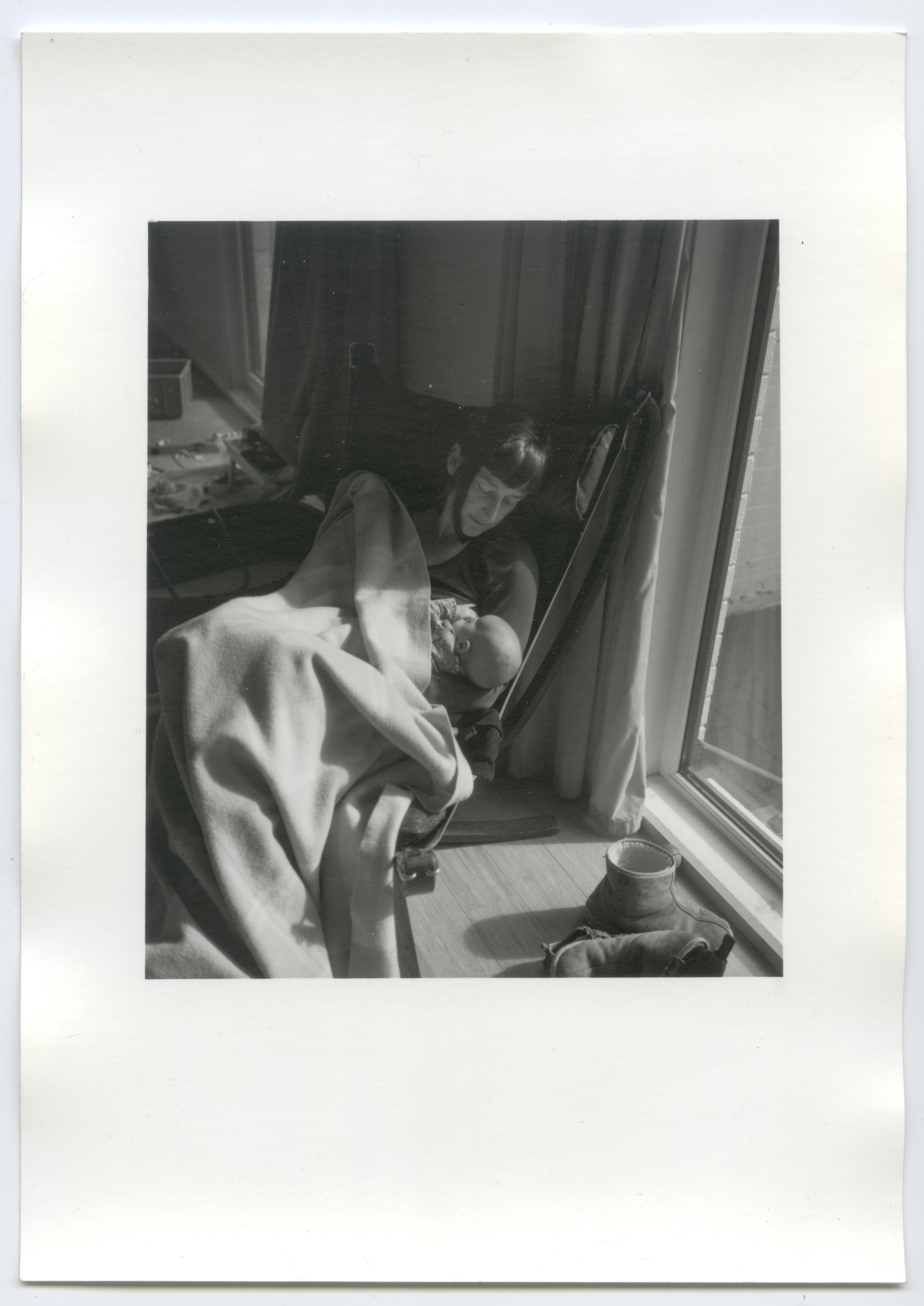
© Wouter Van de Voorde -31 (mother and newborn)

When his son wanted to play a real-life version of video game Minecraft, they began digging in their backyard. The hole grew deeper and wider.


© Wouter Van de Voorde -29 (Felix and Leo playing with mud in the garden, 2021)

Van de Voorde began experimenting - drawing the outlines of holes with flames. Unearthing the grave of a chicken, bones visible, they harvested clay and used it to fire small objects, including a skull. Images of empty backyard spaces are interspersed with others of the artist's son in an eroded gorge. Were the father and son together exploring what lies beneath. Remember the supernatural horror thriller film of that name?


© Wouter Van de Voorde -34

The philosopher Epicurus famously asserted that death should not be feared. His argument has been summarised. When we die, we no longer exist and can feel neither pain nor pleasure. Therefore, there is nothing to fear in death, as death literally is nothing. Or, if you prefer - Don’t worry, as long as we’re alive, Death is not here!

But isn’t death everywhere? In Ukraine and other battlefields, in various Californian shootings recently, on our roads regularly when vehicles crash, sometimes in hospital operating theatres, in the funeral notices pages. The nature of death is highly variable. Despite Epicurus, many do fear it.

How do you perceive life and death?

This review was first published by the Canberra Times - online here and on page 5 of Panorama in the print edition of 4/2/23. It is also available on the author's blog here.

Friday, December 9, 2022

On the Western Edge: Witnessing Bluett's

Photography | Brian Rope

On the Western Edge: Witnessing Bluett's | Various artists

Manuka Arts Centre Gardens | 1 - 17 Dec 2022

The exhibition On the Western Edge: Witnessing Bluetts opened as a pop-up at Bluett’s Block on the evening of 1 December and I’m delighted that I managed to get there as it was well worth seeing. It is a group show (with an accompanying book) revolving around the eucalypt ecosystem of Bluett’s Block. A substantial number of other people also enjoyed walking around the exhibition looking at the prints mounted atop metal stakes pushed into the ground amongst the native grasses and colourful yellow flowers.

All Canberrans know that the Western side of the city has seen much, almost relentless, urban development over the past decade. As a result, habitats and ecosystems have been replaced by numerous newly developed roads, houses and other buildings. Bluetts Block is a natural area on the edge of this rapidly growing urban footprint. The site has been subject to various land uses over the years. Potential threats to it have prompted many Canberrans' to push for the site's protection.

Over ten months, seventeen photographers led by 2022 Dahl Fellow Dr David Wong, regularly visited the site to photograph the resident animals, plants, non-living things, and the ecological processes that shape the place. Each time they undertook their photo walks, another specialist also joined them to highlight their personal practice or background relating to the site. The purpose of the project was, and is, to raise awareness about the importance of Bluetts as a thriving eco-system worthy of protection, rather than urban development.

Folk at the opening, heard about the importance of Bluetts to local Indigenous people and of plans to seek the granting of Native Title over the A.C.T. to them. They heard impassioned words spoken by Jean Casburn, the originator of the Friends of Bluett’s Block. They heard about the importance of reconciliation.

Following the opening, the exhibition was moved to the gardens at the Manuka Arts Centre. Whilst that is different from viewing it at the location where the photographs were all taken, it is nevertheless an exhibition to be seen. The book, available for sale inside from Photo Access, includes numerous photos – some accompanied by text such as this haiku: “Capture and burn, Stop waging war on the forests, making the oxygen we breathe.”

There are photos of landscapes, kookaburra, orchids, sunsets, termite mounds, scribbly moth tracings, birds, fungi, grasses, canopies, native flowers, clouds, a red-headed mouse spider, and more. Jean Savigny has written about the perspectives of the project participants. About first impressions being visceral. About seasons and revelations. About personal learning and discovery. About field studies for a doctorate. About the 2,618 species that, so far, have been identified at Bluetts.

The Edge (Savigny), The Scars (Yasmin Idriss) and The Future (Scott Ferguson) include land clearing, roadworks and houses not far away – clearly revealing the sad future that could befall this piece of eucalyptus ecosystem.


Scott Ferguson - The future

Other images in both the exhibition and the book reveal the natural beauty and precious things that inhabit the area.

I particularly enjoyed Moving (Allen Bills), Exploring (Kristiane Herrmann) showing project participants doing just that, Scribbly Moth Tracing (Fiona Hooton), At Night (Mandi Bennett), Native Yellow Flower (Miriam Blackburn), and Lichens like rocks (Sarah Ryan).


Exploring  by Kristiane Herrmann - installation shot at Bluett's Block - Brian Rope


Allen Bills – Moving


Mandi Bennett - At Night

But every image makes a valuable contribution to the documenting of the many, and different, facets of this eco-system. Every participant and every other person involved in this project is to be congratulated.

If you wish to visit this beautiful place, the entrance to Bluett’s Block is just past Denman Prospect, off Uriarra Rd and right next to the Stromlo Forest West Carpark. The co-ordinates are: 35º17’57.3”S 149º00’35.2”E.

This review was first published online on 4/12/22 by The Canberra Times here. It is also available on the author's blog here.

Saturday, May 7, 2022

Lifetime Book 1. Coming of age

Photography Book Review | Brian Rope

Lifetime Book 1. Coming of age | Greg Dickins

There have been various photo-books published about Canberra. Heide Smith published five of them about the city and its people between 1983 and 2012. Col Ellis published one in 2014 - providing tips and tricks for aspiring photographers, as well as creating a memento for expatriates and visitors. And I provided all the images for a 1990 book introducing Canberra to thousands of visitors shown around by local tourism company Hire-A-Guide.

However, I doubt that three independent photo-books about the city have previously been launched simultaneously. But now we have three which all examine Canberra as a place of social, cultural and political significance. Each explores the personal relationships of their photographers to the city. Each also looks at the national capital’s wider, public meaning.

One of them, Life-Time Book 1. Coming of age, is the first in a planned series of five photo-books by Greg Dickins. It catalogues his life in Canberra between 1967 and 1973, focussing on his experiences of childhood, school, university student revelry and family intimacy -  against the backdrop of anti-Vietnam War protests and rallies to establish an Aboriginal embassy. His planned later books will cover the years to 1987, after he left Canberra.

Dickins has spent his working life as a journalist and media consultant but has always had a passion for photography. He picked up a 35mm SLR camera as a teenager in the late 1960s - that time of great social, political and cultural change. Since then he has maintained a permanent darkroom, working mostly in black & white.

As a record of Canberra the way it looked and felt fifty years ago, this volume reveals something of the extent to which the city has evolved and changed through time. In his introduction, Dickins identifies his first dilemma as author of a book of photographs – “What do I have to say?” His response was that he needed to narrate a story linking the pictures and explaining their inclusion. So, he shows us what he saw and hopes we will see his take on what his images mean - or meant at the time.

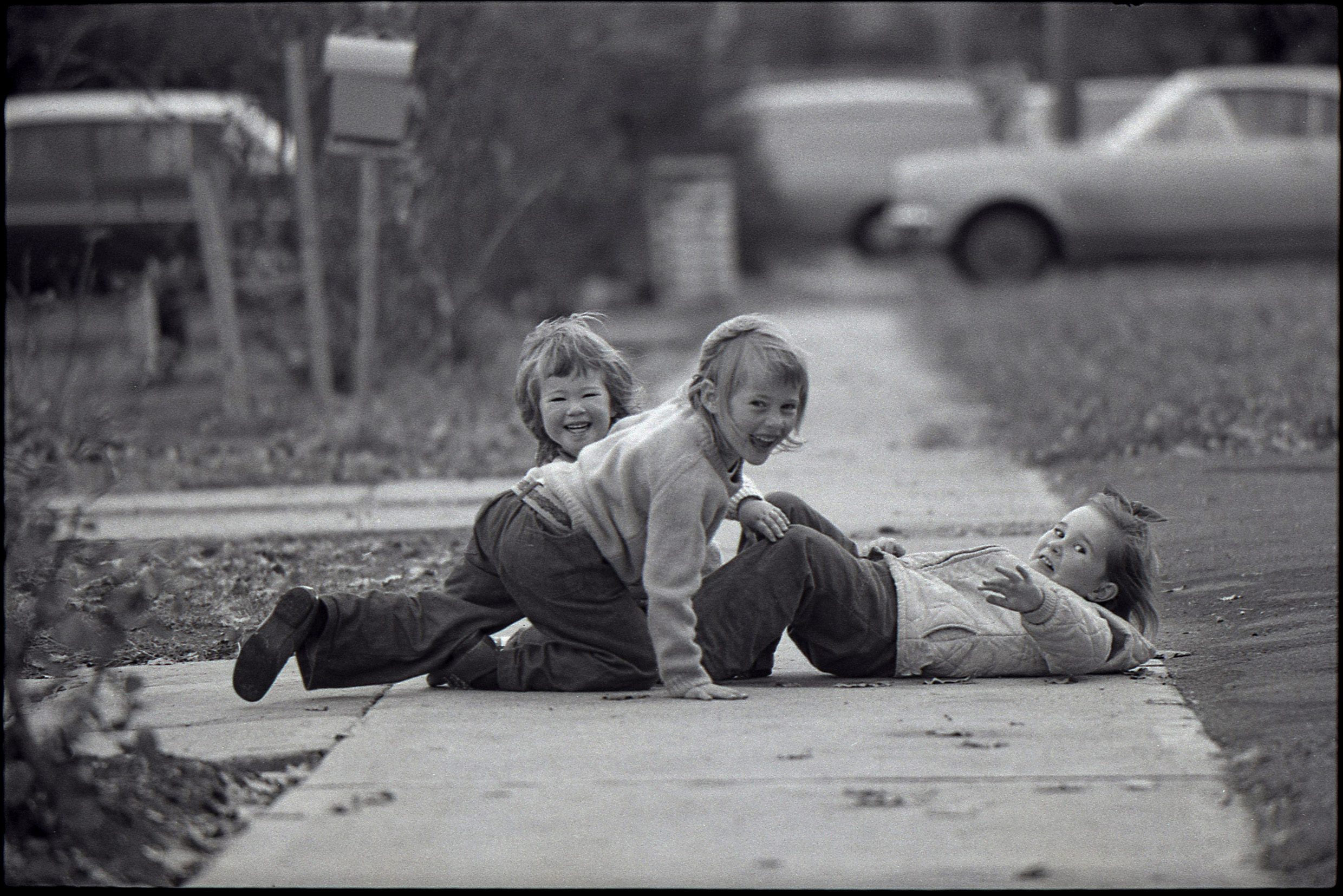
So, how well has the author achieved his purpose? The childhood section includes some delightful images of youngsters doing the types of things all children do – playing with balloons - and something home-made, rolling about together on the ground, and painting at kindergarten.


Jane, Tricia & friend, June 1973 - Greg Dickins

They are also shown gesturing, laughing, and even looking like Winston Churchill. Some adults also make appearances with the children. These photos clearly represent what childhood meant for the majority of kids in Canberra at that period.

Dickins then moves on to school years. He shows us school-age children playing in the Cotter River, waiting for the school bus, in marching girl outfits, together on a sandy beach, and enjoying Canberra Day.


Di, Paul, Kyle & Judy, Casuarina Sands, November 1967 - Greg Dickins

Perhaps of greatest interest are the strong images of schoolchildren participating in an anti-Vietnam War march and rally in September 1970. Are their counterparts protesting today aware their counterparts did the same?

Next the book explores university student years – speakers’ corner (who remembers that?), rugby, drama (including a nude poetess and a production of Marat Sade), the first on-campus condom vending machine, Bush Week activities and conscription notice burning. Plus a 1972 march to establish the Aboriginal Embassy and, again, an anti-Vietnam War march and rally. A number of well-known people appear, including two political leaders. There are some great historical shots here.


March to establish the Aboriginal Embassy, July 1972 - Greg Dickins

The final three images about family neatly close off what Dickins wanted to say. He has successfully narrated his story.

The book can be purchased at Photo Access or online at https://au.blurb.com/b/11093552-life-time-book-1-coming-of-age-large-12x12.

This review is also on the author's blog here. Another version was published in the Canberra Times on 7/5/22 here as part of a combined review of this and the other two book launched at the same time.

Monday, May 31, 2021

Capital Country

Photography Book | Brian Rope

Capital Country | Kate Matthews

Many of us make books of our photographs. They range from very simple homemade books, through print-on-demand photobooks containing heaps of travel shots crammed in, to substantial printed books of quality portfolios in whatever quantities we can afford and think we might be able to market.

This photo book by Canberra artist Kate Matthews is, in effect, an exhibition in a book rather than in a gallery. Matthews graduated Bachelor of Visual Arts, Bachelor of Arts, from the ANU in 2020. She was the recipient of a PhotoAccess ANU EASS Residency for her Graduating Exhibition work. She describes herself as an artist and educator, and says her practice frequently involves a collaborative model of engagement with public audiences and spaces. Her teaching philosophy is to use her skills to make people’s ideas come to life, where no idea is too big or small to be realised.

In 2020, Matthews received an ACT Government Creative Endeavour Grant to fund the publication of this book. Continuing her observational documentary practice investigating public spaces, Capital Country presents darkroom produced photomontages analysing the successes and failures of our shared spaces in regional and urban townships. She has sought to document why some places invite people to pause, stay a while and say hello, while others seem to encourage at least some visitors to hurry elsewhere. The question posed is “what dictates where and how public life unfolds in our regional urban spaces?”

To gather material, Matthews toured the Capital region, walking and photographing shared spaces, investigating how sets of buildings and street furniture, roads and trees, signs and shops created stages for everyday routines, chance encounters and community connection.

The artist comments that city ‘activations’ take place in metropolises, including Canberra. Parks, playgrounds and public amenities are meant to increase community benefit. Braddon and Civic are bursting with colour and life, yet suburbs on the fringes of Canberra are left alone. In nearby sprawling towns, the wide-open scale of them challenges effective and engaged public life. Urban planning favours cars and drive-in, drive-out town centres.

Capital Country reveals Matthews’s observations in photomontages, each pulling apart a scene, breaking apart our sense of space and drawing attention to the varied ways of experiencing places. She has sought to underscore the importance of how different people might interact with any particular public space – noting that our built environment must not only accommodate but be inviting to all.

Capital Country 05 © Kate Matthews

 
Capital Country 13 © Kate Matthews

For me, the best and strongest images to enjoy are those about Yass. A children’s crossing is poignant with no child in sight. There is a lyricism in an image showing material blown by wind.

Capital Country 12 © Kate Matthews


Capital Country 01 © Kate Matthews

A space containing earth moving machinery would be a familiar place to anyone who’s walked along the Belconnen’s Emu Bank lakeside footpath in recent times. A space in Cowra with two damaged cars is also somehow poignant.

Capital Country 11 © Kate Matthews


A simple view through a car windscreen reveals a classic Canberra suburbia place. Regulars who walk through the Valley Tavern door in Wanniassa may never have seen that space in quite the same way.

Capital Country 14 © Kate Matthews

Capital Country 03 © Kate Matthews


There is a lovely touch of humour about an image of a road closed sign in Erindale, whilst a closed skate park in Goulburn is a sad sight. The final image portraying a Gungahlin space with an Exit sign is a perfect choice to end the book.

Copies of Capital Country can be purchased from the Photo Access gallery shop, or online from the artist’s website www.katematthewsphoto.com.

This review was first published in the Canberra Times of 31/5/21 here. It is also published on the author's personal blog here.