Showing posts with label Photography book. Show all posts

Wednesday, July 9, 2025

Fotoheide - A Photographers Tale

Photography Book Review: Brian Rope

Fotoheide - A Photographers Tale - The remarkable career of Heide Smith I Brian O Smith

Cover design by Nector Graphic Designs

Printed in Australia by Clark Mackay

ISBN: 978-0-646-71168-3

Cover of Fotoheide - A Photographers Tale featuring Heide Smith’s 1991 portrait of Josef Gross, an English journalist and photographer

Fotoheide - A Photographers Tale is a book which all Australian and German photo enthusiasts should have in their collections. It is about the career of Heide Smith Photographer, known in her birthplace, Germany, as Fotoheide. The book’s introduction uses various words to describe that career – remarkable, extraordinary, fascinating. Whilst the book’s author is the photographer’s husband Brian Smith, each of those words definitely are fitting.

How do you present a photographer’s career which began in 1959 and has continued ever since? A career during which she has published eleven books, given workshops and seminars to professional and amateur photographers all over Australia and in six other countries, and judged regularly for various groups, including the Canberra Photographic Society. This book attempts to show that career in a little over 200 pages. There is a 2 pages introduction followed by 32 chapters, each of which comprise just one page of words followed by a relevant set of black and white images. We do not see any of the photographer’s colour images in this publication.

The first chapter shows us just three family images, including the photographer’s first portrait of Uncle Albert – taken in 1951 when she was just thirteen and her career had not commenced in the true sense. Then there are chapters about learning to be a photographer, and marriage, motherhood and migration, which set the scene for the diverse career that was to follow.

Uncle Albert 1951 © Heide Smith

Along the way, the book looks at Australia and Germany (revisited). At industry, government, tradesmen, churches and churchmen, Black Australians, the Canberra Raiders rugby league players, timeless beauty, Cambodia, oyster farmers and much more. The subject matter is diverse. The quality of all the included images is top class.

The words provide key facts about the numerous elements of the fascinating career. So many portraits of famous people, but also many of ordinary folk at favourite outdoor locations or in their own homes. The story of the Pegasus Riding School for the Disabled in Canberra. Two trips to Cambodia when roadsides were booby trapped, the countryside was littered with thousands of landmines, and trigger-happy guards manned roadblocks. 

Hidden burial ground, 1993 © Heide Smith

The Smiths had a difficult task selecting the images used in the book from the many thousands available to them. Choosing just a few from those they selected to illustrate this review was also challenging.

A chapter about the Tiwi people contains just seven of the thousands of images made during Heide’s adventures with those islanders. All seven feature people – young and old. The photographer herself is in two of them; one with her two Tiwi sisters. One is a most delightful casual study of four little children.

Four Little Tiwi 1988 © Heide Smith

Another great shot in the same chapter provides just a glimpse of the island lifestyle.

Barney’s Homeland, 1988 © Heide Smith

A chapter about Canberra includes a variety of excellent images – amongst them the jetty at Acton where the old hospital was, scenes of Lake Burley Griffin, and the old and new Parliament Houses. That is followed by a chapter titled Canberra Studios. It tells readers about Heide’s first Canberra book I Love Canberra, a copy of which is on my bookshelves. And about some of her major exhibitions, such as Portrait of an Industry – Australian Photographers. The photos illustrating this chapter include events, wedding portraits and some great fun shots.
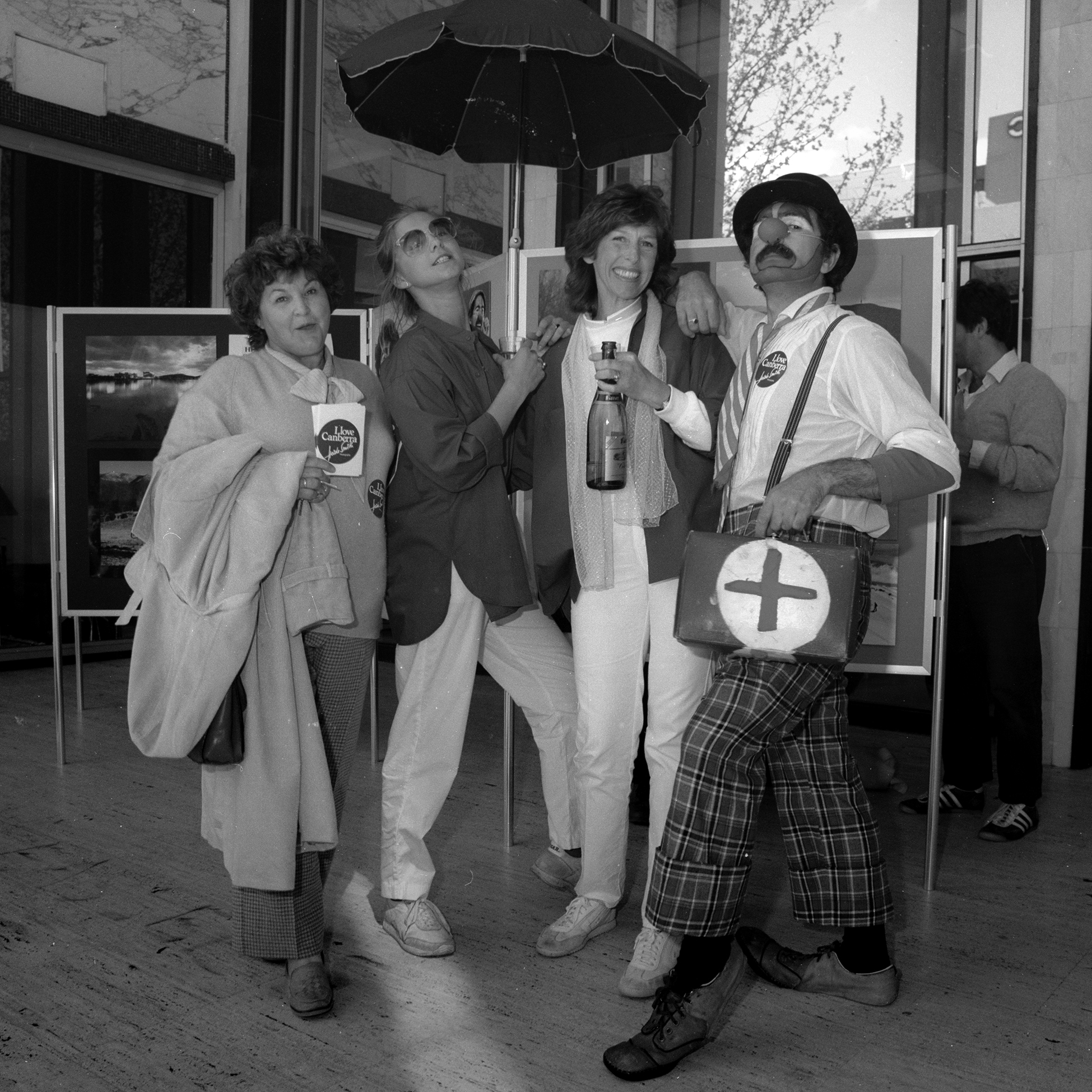
Ingrid, Irene, Lyn and clown, 1983 © Heide Smith

Other wonderful images in the book include a fun selfie shot with Heide’s team at a seminar or workshop in Hong Kong, and one of a cow in a shop in Varanasi (a scene I’ve experienced myself in India).

Heide and her team in Hong Kong © Heide Smith

A shop in Varanasi in 2009, Holy Cow! © Heide Smith

Finally, I must mention the last of the artist’s images in the book. It is one of her excellent coastal landscapes that she continues to capture where she and the book’s author now live.

Stormy Weather Tuross Head 2021 © Heide Smith

Following that, the penultimate chapter, Hidden Treasures, is about various vintage prints discovered long after they were made. And the final chapter has no photographs. Rather it is words from a few of many reviews of Heide’s photographs and books over the years of her career. They wonderfully illustrate the way individual people, newspapers and magazines, and industry groups have responded to this artist’s remarkable career. Professor Manning Clark, an Australian historian and the author of the best-known general history of Australia wrote “this book is a delight to the eye.” So is this book.


A shorter version of this review has been published in Canberra City News here. The version published here is also available on the author's blog here.


Monday, April 21, 2025

THE BASEMENT – Photography from Prahran College (1968-1981)

Photography Book Review: Brian Rope

THE BASEMENT – Photography from Prahran College (1968-1981)

Published by Museum of Australian Photography (MAPh) (2025)

Print production Wilco Art Books, Amersfoort (NL) ISBN: 978-1-876764-88-3

277×208mm, 232 pages, 261 images


This significant publication celebrates a key period in the history of the Photography Department at Prahran College, during the years 1968-81. First-hand accounts from people illuminate the related gallery scene and the cultural impact of the College.

It starts with a foreword by the Director of MAPh, an introduction by that gallery’s accompanying exhibition curators, and photos of the Basement’s teachers. There are six chapters covering different aspects – early years and exhibitions, new 1970s photography, street photography, making film, performative portraiture, and student life. Chapters are filled with images, as well as words.

There are illustrated insights into the memories and outputs of three students from the time. And there is an index, lists of students and illustrations, acknowledgments and a colophon. It is a most important new contribution to the published history of photography in Australia.

Contributors include Helen Ennis (who has delivered a number of other significant books about Australian photography – most recently Max Dupain: a portrait – reviewed on this blog), Daniel Palmer (who, with Martin Jolly, produced the excellent Installation view: photography exhibitions in Australia 1848-2020 – also reviewed on this blog), and Gael Newton (who researched and curated the Australian Bicentenary exhibition on the history of photography in Australia).

Ennis writes about the early years, Palmer about exhibitions in Melbourne 1960s-1980s, and Newton provides a visitor’s view. Each essay provides excellent context for the images that follow and the chapters to come.
 
 Quirk_Students Peter Johnson, Peter Burgess, Paul Cox & Unknown Potter Prahran _1972
          

Paul COX Age of Aquarius (Carol Jerrems, Jan Hurrell) 1970 gelatin silver print

Monash Gallery of Art, City of Monash Collection 2000.85

donated by the artist through the Australian Government's Cultural Gifts Program 2000

reproduction courtesy of the artist

There are chapters by Stella Loftus-Hills (MAPh Curator), Adrian Danks (Associate Professor of Cinema Studies and Media, RMIT University), Angela Connor (MAPh Senior Curator), Bill Henson (a notable leading contemporary photographer) and Susan Van Wyk (NGV Senior Curator), Nanette Carter (photographer turned design historian), Nicholas Nedelkopoulos (contemporary artist), and James McArdle (retired Assoc. Professor, Deakin University). The talent involved with this publication is rather special.

Loftus-Hills’ chapter Down on the Street is about how the conventional art school began to move towards a more progressive teaching approach. A cross-disciplinary approach saw the introduction of a photography department. Teachers fostered creativity and student artists inspired by their desire for personal expression took their cameras to the streets finding and documenting everyday life.
 
Graham HOWE Protester, moratorium to end the war in Vietnam, September 1970

courtesy of the artist
Andrew CHAPMAN Lest we forget 1980

courtesy of the artist

The Danks chapter is about Paul Cox Making Film, frequently casting students as actors and using them as stills photographers and cinematographers, developing their skills and fostering community.

The Performative Portrait chapter has two parts. Connor discovered “many photographic gems” including Polly Borland’s “wonderful student folio from the early 1980s”. And A conversation between Bill Henson and Susan van Wyk is precisely that, with the former responding to questions from the latter.
 
Christopher KOLLER Bauhausler 1980 silver gelatin print

courtesy of the artist
Polly BORLAND Nick 1983 pigment inkjet print

courtesy of the artist and Sullivan+Strumpf (Melbourne)

Stella SALLMAN Sue on the bed, Bondi 1978

courtesy of the artist
Robert ASHTON

Carol Davies, Peter Crowe, Carol Jerrems, Richard Muggleton 1970

courtesy of the artist

Student Life has three parts. Carter - only at Prahran College in 1974 - writes of “a vibrant and dynamic environment that nurtured creativity, experimentation and community.” Her words immediately reminded me of some social media photography groups I am part of, which very much do the same albeit as online communities. The world has changed, but the immense value of such environments continues.

Nedelkopoulos looks back on his Prahran days with fondness because of their value to the rest of his creative life. And McArdle shares many personal memories; Athol Shmith ordering his students to freeze as they were and look around at the various poses of everyone else as doing that with any person would tell them how to photograph anyone. Cox’s challenge ‘Is it possible to photograph God?’ later inspired him to set the assignment ‘Photograph God’ for his own students.

Most readers will know at least some of the contributors mentioned earlier. I recall the first time I saw an exhibition of Henson’s work - Big Pictures (at the Australian National University’s Drill Hall Gallery). I very much value James McArdle’s major contribution to photography through his blog https://onthisdateinphotography.com/. There are a number of pieces on it about this book and accompanying exhibition.

There are, unsurprisingly, various other very well-known Australian photographers who were part of The Basement. They include the teachers Shmith (one of his books was the first acquired for my personal collection), John Cato and Cox. Then there is Carol Jerrems (recently the subject of a major retrospective at Australia’s National Portrait Gallery – also reviewed on this blog).


This review is also available on the author's blog here.

Thursday, February 20, 2025

Until Justice Comes

Photography Book Review: Brian Rope

Until Justice Comes (Fifty Years of The Movement for Indigenous Rights. PHOTOGRAPHS 1970 – 2024) I Juno Gemes | First Nation's Resistance Photography | Large format flexibound, 284×234mm, 348 pp

I acknowledge Aboriginal and Torres Islander People as The Traditional Owners and Custodians of Country throughout our Nation.

Cover of Until Justice Comes

Until Justice Comes is a most significant and important book which, undoubtedly, will become a valuable resource for teachers and leave a significant legacy. It is a landmark publication based on collaboration, and reveals the true history of Australia.

The author Juno Gemes was born in Hungary in 1944 and emigrated to Australia with her parents in 1949. A performer, theatre director, writer, publisher, photographer and activist, she was one of the founders of Australia's first experimental theatre groups, The Human Body. As an Australian activist and photographer, she is best known for her photography of Aboriginal Australians.

Gemes is one of Australia’s most celebrated contemporary photographers with many achievements. In 1982 she exhibited photographs in the group shows After the Tent Embassy and Apmira: Artists for Aboriginal Land Rights. She created a unique visual document of the historic Uluru Handback Ceremony 26 October 1985. In 2003 the National Portrait Gallery (Australia) exhibited her portraits of Aboriginal and Torres Strait Islander reconciliation activists and personalities, Proof: Portraits from the Movement 1978–2003, and has since acquired many of her photographs.

Using both words and images she has spent over fifty years documenting the changing social landscape of Australia, and in particular the lives and struggles of Aboriginal Australians, a process that culminated in her being one of just ten photographers invited to photographically document the National Apology to the Stolen Generations in the Parliament of Australia on 13 February 2008.

This book’s photographs cover crucial moments in Australia’s history including the Redfern Revolution, land rights campaigns, the aforementioned National Apology, the election of eleven Indigenous Members to the 47th Federal Parliament, and the preparations for the 2023 Referendum on the Voice to Parliament. The powerful collection of over 220 photographs brings Gemes’ current and continuing work together with her unique living archive. It portrays her career witnessing and advocating for change.

Elders from Aurukun - Denny Bowenda and Countryman Laurie Pantoomba have a meeting beside the flag on the bora ground, Mornington Island, QLD, 1978 ©JUNO GEMES

Terribly civilized, Aren't you? Photomontage published in Photo-Discourse, Sydney, NSW, 1981
©JUNO GEMES

At the 50th anniversary of the Aboriginal Tent Embassy. Matriarch activist Jenny Munro was first at the Tent Embassy in 1972: now her children and those of her sister Isabel Coe and founders Billy Craigie and Paul Coe take responsibility for running the Aboriginal Tent Embassy into the future, 26 January 2022
© JUNO GEMES

Sammy Wilson, Mutitjulu Community Leader, welcomes members of the Referendum Working Group to sacred sites at Uluru, 2023 © JUNO GEMES

This visual uncovering of an often-invisible history has been at the heart of Gemes’ engagement with the First Nations people she has known and worked with throughout all these years. The book shows us both well-known and lesser leaders, intimate community events, and activism. It includes new writings and poems by various contributors.

Gael Newton, a former Senior Curator of Australian and International Photography at the National Gallery of Australia, has said Until Justice Comes is the first fully retrospective testament to a woman universally revered for her artistry, activism, engagement and collaboration. It also shines with the warmth, wry side glances, acuity and determined end game that fill her images with life and hope.

Why did I say true history at the end of my opening paragraph? Because we are one nation. We are all Australians - Indigenous first people, descendants of those who established a British colony here in 1788, or those (including me as a young migrant child) who arrived later from numerous parts of the world to make Australia their home are part of our nation. My parents were. My children are. Juno Gemes is. Most people reading this will be citizens of Australia. Together we comprise our one nation and are all part of the true history of our nation. That was acknowledged by a banner displayed at the Tent Embassy on its 50th anniversary in 2022.

We have all contributed to the making of our one nation. All Indigenous first people from the very beginning until right now have contributed in many ways. The convicts, marines, sailors, colonial officials and free settler who arrived in 1788 and all their descendants added more. The migrants from many different cultures who have come over the years since have also brought different skills. Together everyone has played a part in making Australia what it is today.

This review is also available on the author's blog here.

An abbreviated version has been published by Canberra City News here.