Showing posts with label Australia. Show all posts

Wednesday, July 9, 2025

Fotoheide - A Photographers Tale

Photography Book Review: Brian Rope

Fotoheide - A Photographers Tale - The remarkable career of Heide Smith I Brian O Smith

Cover design by Nector Graphic Designs

Printed in Australia by Clark Mackay

ISBN: 978-0-646-71168-3

Cover of Fotoheide - A Photographers Tale featuring Heide Smith’s 1991 portrait of Josef Gross, an English journalist and photographer

Fotoheide - A Photographers Tale is a book which all Australian and German photo enthusiasts should have in their collections. It is about the career of Heide Smith Photographer, known in her birthplace, Germany, as Fotoheide. The book’s introduction uses various words to describe that career – remarkable, extraordinary, fascinating. Whilst the book’s author is the photographer’s husband Brian Smith, each of those words definitely are fitting.

How do you present a photographer’s career which began in 1959 and has continued ever since? A career during which she has published eleven books, given workshops and seminars to professional and amateur photographers all over Australia and in six other countries, and judged regularly for various groups, including the Canberra Photographic Society. This book attempts to show that career in a little over 200 pages. There is a 2 pages introduction followed by 32 chapters, each of which comprise just one page of words followed by a relevant set of black and white images. We do not see any of the photographer’s colour images in this publication.

The first chapter shows us just three family images, including the photographer’s first portrait of Uncle Albert – taken in 1951 when she was just thirteen and her career had not commenced in the true sense. Then there are chapters about learning to be a photographer, and marriage, motherhood and migration, which set the scene for the diverse career that was to follow.

Uncle Albert 1951 © Heide Smith

Along the way, the book looks at Australia and Germany (revisited). At industry, government, tradesmen, churches and churchmen, Black Australians, the Canberra Raiders rugby league players, timeless beauty, Cambodia, oyster farmers and much more. The subject matter is diverse. The quality of all the included images is top class.

The words provide key facts about the numerous elements of the fascinating career. So many portraits of famous people, but also many of ordinary folk at favourite outdoor locations or in their own homes. The story of the Pegasus Riding School for the Disabled in Canberra. Two trips to Cambodia when roadsides were booby trapped, the countryside was littered with thousands of landmines, and trigger-happy guards manned roadblocks. 

Hidden burial ground, 1993 © Heide Smith

The Smiths had a difficult task selecting the images used in the book from the many thousands available to them. Choosing just a few from those they selected to illustrate this review was also challenging.

A chapter about the Tiwi people contains just seven of the thousands of images made during Heide’s adventures with those islanders. All seven feature people – young and old. The photographer herself is in two of them; one with her two Tiwi sisters. One is a most delightful casual study of four little children.

Four Little Tiwi 1988 © Heide Smith

Another great shot in the same chapter provides just a glimpse of the island lifestyle.

Barney’s Homeland, 1988 © Heide Smith

A chapter about Canberra includes a variety of excellent images – amongst them the jetty at Acton where the old hospital was, scenes of Lake Burley Griffin, and the old and new Parliament Houses. That is followed by a chapter titled Canberra Studios. It tells readers about Heide’s first Canberra book I Love Canberra, a copy of which is on my bookshelves. And about some of her major exhibitions, such as Portrait of an Industry – Australian Photographers. The photos illustrating this chapter include events, wedding portraits and some great fun shots.
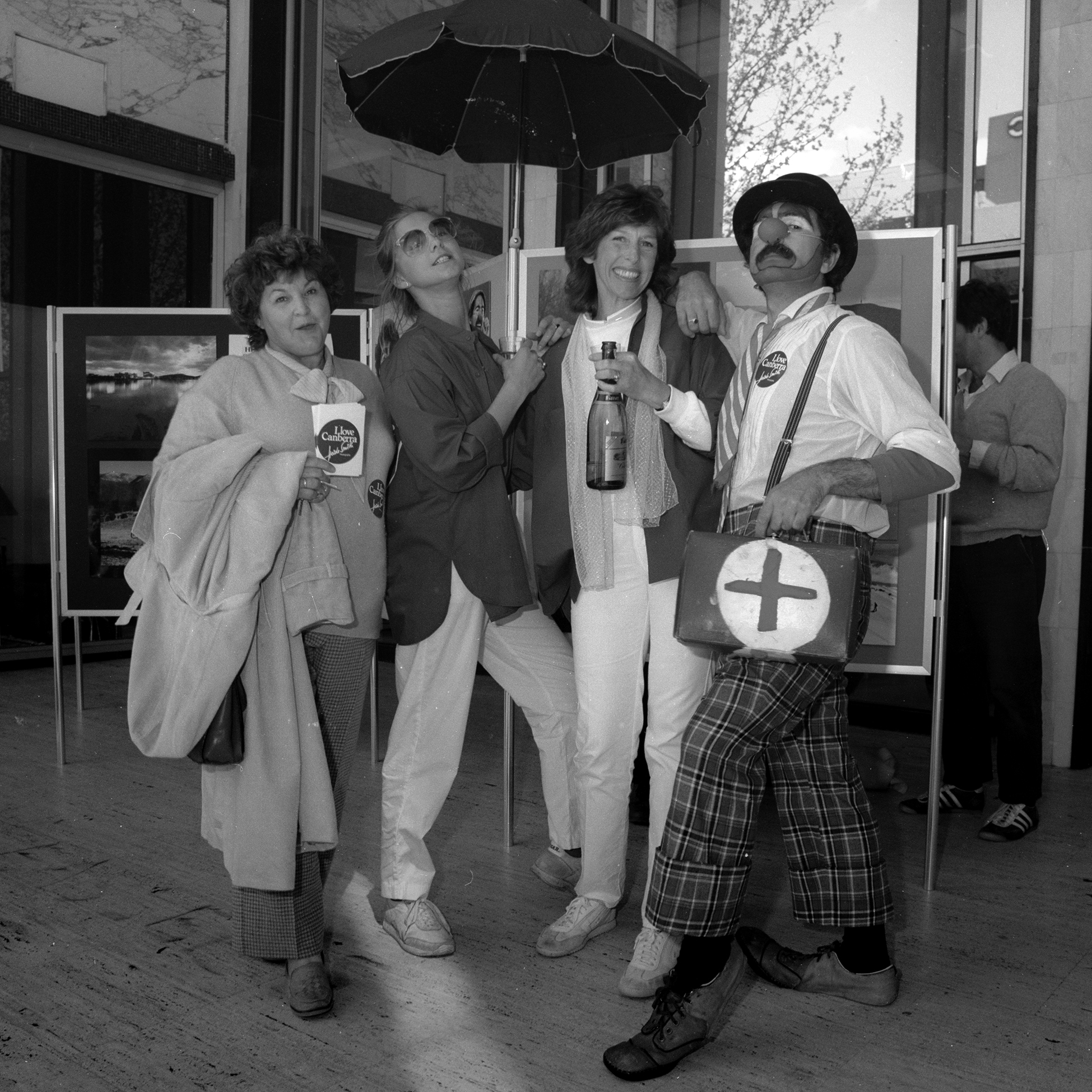
Ingrid, Irene, Lyn and clown, 1983 © Heide Smith

Other wonderful images in the book include a fun selfie shot with Heide’s team at a seminar or workshop in Hong Kong, and one of a cow in a shop in Varanasi (a scene I’ve experienced myself in India).

Heide and her team in Hong Kong © Heide Smith

A shop in Varanasi in 2009, Holy Cow! © Heide Smith

Finally, I must mention the last of the artist’s images in the book. It is one of her excellent coastal landscapes that she continues to capture where she and the book’s author now live.

Stormy Weather Tuross Head 2021 © Heide Smith

Following that, the penultimate chapter, Hidden Treasures, is about various vintage prints discovered long after they were made. And the final chapter has no photographs. Rather it is words from a few of many reviews of Heide’s photographs and books over the years of her career. They wonderfully illustrate the way individual people, newspapers and magazines, and industry groups have responded to this artist’s remarkable career. Professor Manning Clark, an Australian historian and the author of the best-known general history of Australia wrote “this book is a delight to the eye.” So is this book.


A shorter version of this review has been published in Canberra City News here. The version published here is also available on the author's blog here.


Thursday, December 8, 2022

Viewfinder: Photography from the 1970s to Now

 Photography | Brian Rope

Viewfinder: Photography from the 1970s to Now | Various artists

National Library of Australia Exhibition Gallery | 16 Sep 2022-13 Mar 2023

Viewfinder: Photography from the 1970s to Now explores fifty years in the life of Australia. 125 images from the National Library of Australia's collections reveal a changing Australia and the evolving nature of photography. It looks at powerful Australian documentary photography, from 1970s black and white images to recent vibrant high-definition images.


Quintessential Aussies feature, including shearers, dancers, infantry diggers, knitters, sporting heroes and bronzed bodies on the beach. However, there is a much bigger, far more inclusive story, including William Yang’s winged angels at Mardi Gras in 2003, migrant lives, Australian First Nations people, and the joys of family life.


William Yang, Rainbow Angel Wings, New Mardi Gras, 2003,
nla.gov.au/nla.obj-136950531, courtesy William Yang


A 1973 Jon Rhodes image of a ticket booth employee at a railway station would have meaning and memories for his family and all who remember those booths. Others, too young to remember, should also be interested in this snippet of history.


Jon Rhodes, Paul Jackson, Dubbo, News South Wales, 1973,
nla.gov.au/nla.obj-2147881601, courtesy Jon Rhodes


There’s a cyclist towing an older woman in a wheeled cart, itself towing a caged dog. Bruce Howard’s delightful 1985 image shows that such modes of transport are not new.


Bruce Howard and Herald and Weekly Times, On a bicycle built for ?, 1981,
nla.gov.au/nla.obj-148147368, courtesy Bruce Howard


Bill Bachman’s image of three Aussie blokes having a beer in 1995 is simply classic.


Bill Bachman, Council mechanics, Jack Western, Bob Mackenzie and Bryan Steele
having a drink of beer, Gascoyne Junction, Western Australia, ca. 1995,
nla.gov.au/nla.obj-138088597, courtesy Bill Bachman


Anne Zahalka’s colourful 1998 image of Star City Casino is of particular interest right now because it, and other casinos, have been in the news.


Anne Zahalka, Star City Casino (after Breughel), 1998,
nla.gov.au/nla.obj-150880157, courtesy Anne Zahalka


Matthew Sleeth shows us senior citizens on the footpath to see their much-loved Queen pass by in 2000.


Matthew Sleeth, Residents of a Retirement Home are Wheeled onto the Footpath to Watch the Queen, Western Freeway, Friday 24 March 2000,
nla.gov.au/nla.obj-145875044, copyright courtesy Matthew Sleeth and Josef Lebovic Gallery, Sydney


And, from 2007, Martin Mischkulnig shows us a very dusty Pilbara Aussie rules venue.


Martin Mischkulnig, Warralong, Western Australia, 2007,
nla.gov.au/nla.obj-691608047, courtesy Martin Mischkulnig


These are just examples of works from this wonderful collection which is never fully on view at any one time.


The exhibition also focusses on the evolving nature of photography as a way of recording our lives and highlights the significant technological advances and increasing diversity of styles, approaches and techniques utilised by photographers over the past five decades.


Walking through and taking time to look, study and absorb each work and the accompanying information, I was struck by a message for children under a self-portrait of Tracey Moffatt. It included this definition “A portrait is a painting, drawing or a photograph of a person”. Just 700m away at the National Portrait Gallery, another current exhibition is boldly proclaiming about the show being designed to make visitors think about “the ever-evolving and ever-expanding idea of portraiture”.


Does that mean the NLA is out of touch? No, because the images it is showing from its collection are primarily from the past, whereas the diverse artworks on display at the other institution are from collections that have a different focus. Any and all collections in national institutions have an important place and opportunities to view pieces from those collections are most welcome and, indeed, important. Being able to view both exhibitions at the same time is an especially valuable opportunity for us all.


So, back to the NLA exhibition. What does it tell us about Australia? The diverse works include well-known pieces that anyone with a modest knowledge of Australian photography will recognise. There are images most of us will not be familiar with, by photographers whose names we may not recollect having heard. Pleasingly, the indigenous country location is identified for each image.


The NLA describes its image collections as the photo albums of Australia. They certainly are an invaluable archive that can assist us to understand the story of this country. They reveal the communities we live in, the landscapes we inhabit, our history and moments both significant and ephemeral.


Documentary photographers – including you - capture images that assist us understand both place and people, and to plot our way forward in this uncertain world.

This review was first published online by The Canberra Times here. It is also available on the author's own blog here.

Saturday, September 18, 2021

Are We Dead Yet?

Photography Exhibition Review | Brian Rope

Stephen Dupont | amBUSH Gallery, Kambri (ANU) | Until 24 October 2021

This exhibition comprises 21 large photographic prints detailing various devastating ecological events around Australia, that have made award-winning Australian photographer Stephen Dupont realise the inevitability of the shift in conversation from ‘Is climate change happening?’ to ‘Is it too late?’

Inspired by his young daughter Ava – a climate activist – Dupont’s discussions about environmental issues ask the big question: is it possible to save the planet, or have we pushed Mother Nature to the brink of extinction? Are We Dead Yet? is part of a long-term artistic documentation of the effects of climate change on our nation.

In a review published 18 months ago, I confessed having struggled somewhat for several months seeing so many images of the bushfire crisis. On social media I had found it very difficult to ‘Like’ excellent images that revealed the anxieties all of us felt. Now here we are still seeing images of the aftermath of drought, bushfires and the pandemic – not only in this exhibition but numerous others.

Given Dupont’s experience and expertise, it was not surprising to see very high-quality images on display. Shot over the course of the past few years, in locations across several States, Dupont’s photographic journey tells striking visual stories, and conveys a sense of urgency. He wants to motivate us, his audience, to question our roles and responsibilities in these real-time catastrophes.

Using a solitary figure swimming in the ocean during a dust storm, a flooded football ground, the remains of a caravan, charred bushland, the parched ground of drought-stricken regions, and the rich colours of smoke and dust-filled skies, Dupont socks it to us. If we were previously immune to its impacts, or unchallenged by climate change, he wants to infect us with concern right now.

Some of the images reveal the impacts of climate change less obviously than do others. The remnants of a tree, used on the exhibition poster and in the catalogue, is probably the most graphic despite its simplicity; but another more effectively reveals the widespread and devastating destruction in the Tarkine region.


Tarkine, 2018 © Stephen Dupont

An image of a dust storm is very dramatic and powerful, showing the dust towering over a lone bather in the sea. Other images of dust storms remind us that they are widespread and commonly occur.


Scarborough Beach Dust Storm, 2020 © Stephen Dupont

Floating burnt embers during a bushfire are the real story element in a quite strangely beautiful story of sunlight streaming through the fire’s smoke. Once again, whether we need it or not, we are reminded by this and half a dozen other images that these types of fires were widespread in 2019 and 2020.


Hillville Fires 02, 2019 © Stephen Dupont

Another bushfire image clearly shows the human impact. The face of the man in it needs no words to tell of his emotions. And another equally, and poignantly, tells of the impact through a rather sad looking Christ figure.


Bodalla Fires, 2020 © Stephen Dupont

And an image of the skeletal remains of a caravan owned by Dupont’s friend, completely destroyed by fire in the devastating 2020 black summer bushfires has just been named as a finalist in the Australian Life competition (albeit with a different title). This powerful photograph clearly conveys just what such a fire can do and will, I suspect, be a strong contender in that competition.

A view from above of whites and blacks of trees impacted by dieback and fire is visually arresting. For me, the patterns make it the strongest artwork in the exhibition.


Snowy Mountains, 2020 © Stephen Dupont

Whilst the exhibition is technically open, the gallery is closed during the ACT COVID lockdown expected to run until 17 October. In the meantime there is a walk through of the exhibition here. All the images may also be seen on the artist's website here.

This review was published in the Canberra Times on 18/9/21 here and is also on the author's own blog here.

Saturday, March 20, 2021

Mervyn Bishop, the exhibition


Photography | Brian Rope

Mervyn Bishop | Mervyn Bishop, the exhibition

National Film and Sound Archives | Until 1 August 2021

This exhibition is drawn from the Art Gallery of New South Wales (AGNSW) collection and Mervyn Bishop’s private archive; and enriched by sound and moving images from the NFSA. It features iconic photographs that derive from his career as a photojournalist, alongside personal images of family and friends and intimate portraits of members of the Aboriginal community.


H. Thomas, C. Dixon, K. Smith ACT from the Mervyn Bishop archive 1976 35mm colour slide 2.5 x 3.5 cm National Art Archive|Art Gallery of New South Wales © Mervyn Bishop Photo: AGNSW

There are also images of Bishop by other photographers, cameras from his personal collection, sound and moving image about him, and other videos providing context. So, it is not simply an exhibition of the artist’s imagery. It is an exhibition about the artist, one of Australia's most prolific and influential photographers, who has significantly influenced our collective understanding of Australia’s history.

Bishop himself has said: ‘Photography has been my life, my passion for 60 years: the art and technique, the stories I’ve witnessed and captured. I’m glad to be able to share my life’s work with the public’.

Born and raised in Brewarrina, Bishop was encouraged by his mother to take his first photograph. After witnessing the ‘magic’ of the developing process, he became passionate about photography. In 1963 he successfully applied for a four-year cadetship at The Sydney Morning Herald and became Australia’s first Aboriginal press photographer. In 1971 he won the News Photographer of the Year Award with his front-page photograph, Life and Death Dash, 1971.

There is no need for me to assess the quality of Bishop’s images; others have recognised his skills many times over many years. I will simply say that his body of work is amongst the most significant by any Australian photographer.

Inevitably displayed is the iconic image from 1975 when the (then) Prime Minister, Gough Whitlam, poured a handful of earth back into the hand of Vincent Lingiari, Gurindji elder and traditional landowner. This image became an icon of the land rights movement and Australian photography.


Prime Minister Gough Whitlam pours soil into the hands of traditional land owner Vincent Lingiari, Northern Territory 1975, printed 1999 type R3 photograph 30.5 x 30.5 cm image; 33.9 x 33.9 cm sheet Art Gallery of New South Wales Hallmark Cards Australian Photography Collection Fund 1991 © Mervyn Bishop/ Department of the Prime Minister and Cabinet Photo: AGNSW

But there is so much more. A wonderful shot of womenfolk at Bowraville includes Aunty Elaine Kelly wearing a cloth nappy around her face to ease toothache pain. Women attending a home management course at Yuendumu are portrayed sensitively in a fine moody image. Another of a woman balancing precariously on a wooden plank, holding a pot of water over a submerged cord supplying electricity to neighbours is a moving portrayal of living conditions for Aboriginal people in 1988.

There are important documentary images of well-known and important people, including Lois O’Donoghue and Oodgeroo Noonuccal. Other featured people include Roslyn Watson, one of the first Aboriginal ballerinas, and June Barker, an Aboriginal educator and story keeper.


Lois O’Donoghue CBA, AM, and Oodgeroo Noonuccal 1974, printed 2008 gelatin silver photograph 30 x 30.4 cm image; 40.4 x 50.6 cm sheet Art Gallery of New South Wales Purchased under the terms of the Florence Turner Blake Bequest 2008 © Mervyn Bishop Photo: AGNSW


Roslyn Watson 1973, printed 2008 gelatin silver photograph 40 x 30 cm sheet Art Gallery of New South Wales Purchased under the terms of the Florence Turner Blake Bequest 2008 © Mervyn Bishop Photo: AGNSW

And there are other more simple or gentle portrayals, such as Bob with his tiny catch at Shoalhaven Heads. An early work from 1966 portrays two of the photographer’s cousins when he visited Gundawera, a property near Brewarrina, where his grandfather, father and uncle once worked. It tenderly portrays a special and fun moment on a boat. It is a precious memory for Bishop, just as our old family photos are precious for each of us.


Cousins, Ralph and Jim, Brewarrina 1966, printed 2008 gelatin silver photograph 30 x 40 cm sheet Art Gallery of New South Wales Purchased under the terms of the Florence Turner Blake Bequest 2008 © Mervyn Bishop Photo: AGNSW

We are shown an excellent film about Bishop, directed by Warwick Thornton. And a home movie dating from c1957-8 of Bishop with fellow altar boys and Brothers at Brewarrina’s Christchurch, Church of England.

And when you have explored and taken in all of that, you can sit down and watch a curated slideshow of images from Bishop’s personal archive of over 8000 photos, taken during his 60 years of taking them. Like most photographers of his generation, he liked to host ‘slide nights’ for family, friends and neighbours. They were most fortunate people.

This review was first published by the Canberra Times here. It is also published on the author's own blog here.