Sunday, August 5, 2018

Social ethos in wellspring of art


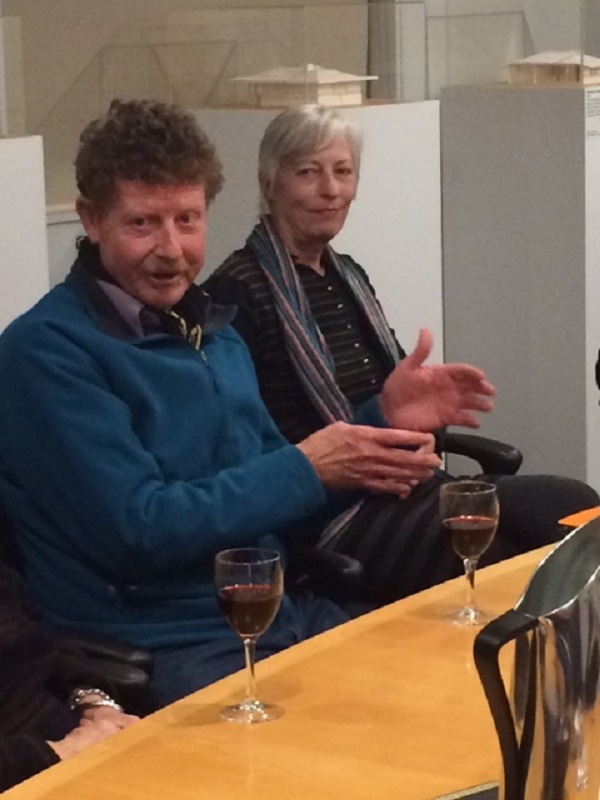
L. Phil Nizette and R. Jennifer  Jones


Canberra Critics Circle in Conversation with Wellspring Environmental Arts and Design - 30 July, report by Simone Penkethman.
JENNIFER Jones and Phil Nizette joined the Canberra Critic's Circle in conversation on 30 July 2018. 
Jennifer and Phil have worked together, making placed-based public and community art, since the early 1990s.
Their business, Wellspring Environmental Arts and Design, draws on their combined expertise in ceramics, sculpture and landscape architecture. They work locally in Canberra, nationally and internationally. There is a strong social ethos running through their art and their business; they say that their work is all about wellbeing and how the arts can improve quality of life.  Being a business from which they both make a living  means that they are always hunting work; but when they do secure a tender or contract, they make the project fit within the Wellspring philosophy. 
Wellspring works with communities and places. Whether in a dementia ward, the outback or Southeast Asia, Phil and Jennifer say they  feel a responsibility to foster creativity in everyone.
 Gubur Dhaura Heritage Reserve in Franklin ACT is one example of their local work. The reserve is on a partial hill which is ancient ocre collection site. Jennifer and Phil worked with local Ngunnalwal people in the design and installation of sculptural entry walls, 'Ground Maps', pedestrian barriers made from re-purposed farm equipment from the site. Seating and interpretive nodes occur throughout the reserve, relating aspects of its Aboriginal and rural past. They also used clay from the site to make bricks and engaged local Ngunnawal people to make decorative ceramic tiles for the work. It was interesting to hear Phil muse that sometimes local residents visit the place and don't necessarily recognise it as art. 
There is an inclusiveness and lack of ego about the art of Wellspring.
Phil and Jennifer often work in temporary of ephemeral art installations. Discussing their experiences in this space, brings new energy to their conversation. Jennifer said that there is pleasure, fun and freedom to be had in creating temporary works because they don't have to be durable and relevant for decades. They recently completed a six week installation of three temporary spaces in Canberra's city centre. 
In both their temporary and permanent work, Phil and Jennifer make use of recycled and repurposed materials. Whether the work is temporary or permanent, Phil is always looking to find ways that artists can work with larger teams to shape public spaces.  He says that artists need to be working with the planners and designers of buildings, towns and cities.

THE TRAGEDY OF HAMLET PRINCE OF SKIDMARK


The Tragedy OF Hamlet Prince of Skidmark. The Listies.
Conceived by Richard Higgins, Matt Kelly and DeclanGreene. Directed by Declan Greene. Lighting designer. Verity Hampson. Composer and sound engineer. Jed Palmer. Costume designer. Renee Mulder. Produced by Sydney Theatre Company. The Playhouse. Canberra Theatre Centre. August 3 amd 4 2018.
Reviewed by Peter Wilkins
Matt Kelly and Richard Higgins are The Listies
Hamlet for five year olds? Shakespeare’s  classic tragedy for children? With murder, revenge and dead bodies littered across the stage?  And performed by only three actors, none other than the crazy, zany, madcap Listies with the help of Courtney Stewart as stage manager and the fair Ophelia. This has to be seen to be believed. So, with my seven year old grandson in tow, off I went to see how The Listies could tell the tale of the melancholy Dane to an audience of children, upwards of five years.

Within seconds of finding his seat, my grandson let out peals of laughter as bellboy costumed ushers  clambered from the auditorium onto the stage , only to discover that the company of actors whp were to play the tragedy had all come down with the Brown Plague, a terrible affliction caused by something they ate and rendering them the victims of shakes, sweat explosive farts and ensuing results from behind and out of the mouth. That’s right, it was going to be one of those kind of children’s shows and my grandson joined an audience of giggling, squirming wrigglers with delight.
Richard Higgins as Hamlet, Prince of Skidmark
What followed was The Listies’ irreverent, hilarious badaptation of the Bard. Richard Higgins plays the straight man with lapses into absurdity while Matt Kelly plays his fall guy, the buffoon to Higgins’s character. Think Bud Abbot and Lou Costello, Dean Martin and Jerry Lewis, Stan laurel and Oliver Hardy, Colin Lane and Frank Woodley. Higgins is the serious clown, carefully controlled until events send him into an uncoiled spin. Kelly is a turbo charged clown, irrepressible, infectiously funny and the perfect foil. Stewart completes the cast, taking on Ophelia and Princess Nun-Ninja.
The action rockets through one turbo charged hour of lighting speed costume changes, snippets of the Hamlet story for the young child with twisted versions of the four hundred year old plot, sword fights, audience interaction and some scene stealing by an adorable five year old , shadow puppetry of pirate ships upon the high seas, Ninjas, ghosts, zombies and dragons. There are even quotes from the play as Hamlet (Higgins) holds aloft Yorrick’s skull or Hamlet despatches Ophelia to a nunnery before he finds he has to make a fast exit to the dunnery, possibly brought on by feeble puns and misspelt lists. It’s all in good fun.

The audience, enchanted, engrossed and rocking with laughter lapped up every moment, giggling at Kelly’s cross-eyed Claudius, doubling up at the sight of the versatile Kelly’s floss and screaming out instructions during the old “Where is he?” panto routine.
For the accompanying adults, it might all be a bit familiar – the knockabout physical comedy, the lavatory humour, the audience participation and the sheer butane energy of performers who have found their niche, discovered their target audience’s funny bone and come up with a clever idea to bastardize the bard, or maybe do him some service by introducing him to a completely new audience. I just hope they won’t all burst into laughter when they see the real thing.
One thing is certain. They will remember the story and the time they saw The Listies and couldn’t stop laughing from start to finish. That’s an unforgettable lesson in how to love their visit to the theatre. There’s nothing tragic about that!

Friday, August 3, 2018

Review: Two new theatrical enterprises


Accidental Death of an Anarchist by Dario Fo and Franca Rama, directed by Clare Moss for Limbo Theatre Co in collaboration with Honest Puck, 1-4 August.
The Judas Kiss by David Hare, Directed by Karina Hudson for Mockingbird Theatre.
Reviewed by PHILLIP MACKENZIE
IN the past fortnight two new theatrical enterprises have strutted their stuff on Canberra's stages, each winning a warm round of applause – the fledgling Mockingbird Theatre with The Judas Kiss and Limbo Theatre Co (in a co-production with Honest Puck) with Accidental Death of an Anarchist, adding their weight to the plethora of existing companies.
Some of the latter will have to look to their standards if they are to survive in this maelstrom of initiative and talent.
L. Damon Baudin, R. Hayden Splitt
The Dario Fo/Franca Rame modern classic Accidental Death of an Anarchist, skilfully directed by Clare Moss, is the perfect launching pad for the Limbo/Honest Puck collaboration,  wildly comedic and searingly satirical.
The talented cast work as an ensemble to pull off some of the most difficult slapstick stunts while presenting creditable, if venial, characters and lampooning the corruptibility of organs of state. One might make the comparison with the classic Charlie Chaplin/Buster Keaton/ Monty Python styles, but this should not obscure the originality of the Fo/Rame product.
The play is the authors' response to an real-life incident in which an innocent demonstrator falls victim to the machinations of the flawed forces of the law, impersonated by Hayden Splitt in the multiple roles of the Maniac, persecuted by the inept Bertozzo, Pissano, and Superintendent (Nick Steain, Izaac Beach and Damon Baudin with the support of the gullible constable(s), Anna Van der Velde).
So athletic and acrobatic are these actors in their endlessly energetic encounters with vengeful filing cabinets and other furniture that one fears for the longevity of the set – particularly the hard-working door, whose trembling frame only adds to the theatrical silliness of the show.
The original script is not entirely flawless as it tends to run out of steam in the second act and clunks a little with faux Fo material referencing later political targets, as well as committing the crime of introducing a new character in the last 15 minutes – the reporter Feletti, played by Imogene Irvine, who has a tough time catching up with and matching the madness of the rest of the ensemble.
Liam Jackson as Lord Alfred 'Bosie' Douglas and Chris Baldock as Oscar Wilde
DAVID Hare’s play, The  Judas Kiss, opens in Oscar Wilde's rooms at the Cadogan Hotel, London, on the day that Oscar needs to decide whether to flee to Europe or to stay and go to jail.
Before the debate begins, however, we are treated to a gratuitous display of Sex-in-the-Victorian-city, as performed by the downstairs maid (Meaghan Stewart) and the apprentice butler (Cole Hinder). Their little uninhibited gambol, it turns out, has nothing to do with the rest of the play, which proceeds after Arthur's boss Sandy Moffatt (Arran McKenna) puts an end to their fun and games.
Enter the noble Robbie Ross, (reliably acted by Patrick Galen-Mules) one-time lover of the Great Man, and his successful rival, the rather less noble Lord Alfred 'Bosie' Douglas, played  less successfully by Liam Jackson; and Chris Baldock, playing Oscar Wilde.
Under the direction of Karina Hudson in her debut directorial role, the three men engage in a complex and wordy debate-cum-contest for the role of advisor to Wilde, in which the central figure vacillates and philosophises across a range of themes.
It is a debate that cries out for at least an occasional display of the Wildean flamboyance amid the tendentiousness of the Wildean intellectual philosophising. But Baldock sets himself on the latter path, while morosely sipping his red wine, masquerading as ‘hock.’
BY Act II, Wilde has served his 18-month sentence for gross indecency and, after interval, we join Wilde and the nasty Bosie in Naples where we find ourselves in another nude scene involving Bosie, modestly wrapped in the bed-linen and the sexy Galileo Masconi (played by Benjamin Balte Russell) who, declining modest coverage, converses in fluent Italian with the equally fluent but now down-fallen yet still verbose Wilde who is now destitute-on-principle and suffering from an apparently terminal bout of writer's block.
The script skips the prison period, during which Wilde wrote his last major piece, De Profundis, and thus gives inadequate background to Wilde's state of mind as an exile.
Baldock provides a sound representation of the central character's physical properties, intellectual arrogance and moroseness without getting waylaid by any suggestion of emotional stimulus.
Bosie, having been lured by the promise of Mummy's money back into the family circle from which he had strayed, makes a feeble effort to encourage the lover whom he had betrayed to mend his ways and take the proffered 30 pieces of redemption. After a final assignation with the compliant Galileo, Bosie leaves Wilde bereft and heading towards death.
While Bosie and Galileo are off on a final fling downtown, the faithful Robbie arrives with news of Oscar's wife and children, but not much else to help Oscar to get back in the saddle.


Thursday, August 2, 2018

COSI FAN TUTTE


Libretto by Lorenzo da Ponte
Music by W.A. Mozart
Directed by Elisha Holley
Canberra Opera
Belconnen Theatre to 5 August.
Reviewed by Len Power 28 July

It’s quite a major undertaking for a local non-professional company to stage a full Mozart opera on a limited budget.  Canberra Opera’s production of Mozart’s ‘Cosi Fan Tutte’ works quite nicely, due to some fine singing and imaginative staging.

Originally performed in Vienna in 1790, ‘Cosi Fan Tutte’, usually translated in English as ‘Women Are Like That’, is a silly romp involving young lovers, disguises and a now inappropriate test of woman’s fidelity.  This modern day production is set in a popular café called ‘The Hamlet’ in Canberra’s Braddon and it plays surprisingly well on a simple but atmospheric set by Mel Davies.

Spoiled sisters Fiordiligi (Keren Dalzell) and Dorabella (Clare Hedley) run their own café.  Cynical Don Alfonso (Peter Smith) aims to prove to their fiancés, Duntroon graduates Guglielmo (Nathanael Patterson) and Ferrando (Andrew Barrow), that all women are the same and, when put to the test, will not remain faithful to their partners.  The young men pretend to be deployed overseas and then transform themselves into unrecognisable suitors that try to tempt the young ladies with their affections.

Left to Right: Nathanael Patterson, Keren Dalzell, Andrew Barrow, Clare Hedley, Katrina Wiseman and Peter Smith with the Chorus and Orchestra

The sisters and their fiancés, Keren Dalzell and Clare Hedley, Andrew Barrow and Nathanael Patterson, sang well and performed their large roles with confidence.  Peter Smith was in fine voice as the oily Don Alfonso and Katrina Wiseman displayed notable comic timing and nicely sang the role of the waitress, Despina.  The chorus of singers provided good vocal support as well.

Musical director, Kathleen Loh, has done an excellent job with the singers.  Their singing was technically accurate and their diction was clear.  Conductor, Lizzy Collier, and her small orchestra played the lengthy score very capably.

Director, Elisha Holley, has done well with her Braddon café concept and the production flows nicely.  More work needed to be done with the chorus who were a bit under-directed and there were some melodramatic moments here and there that seemed more 18th century Italy than modern day Braddon.

Canberra Opera’s ‘Cosi Fan Tutte’ shows what can be done by an enthusiastic company with limited resources.  I’ve seen lavish professional presentations of this opera that were not as enjoyable as this production.

Photo by E.S. Fotographi

This review was first published in the Canberra City News digital edition of Monday 30 July.

Len Power’s reviews are also broadcast in his ‘On Stage’ performing arts radio program on Mondays and Wednesdays from 3.30pm on Artsound FM 92.7.