Wednesday, December 6, 2023

A reflection on “Lear” by Helen Musa


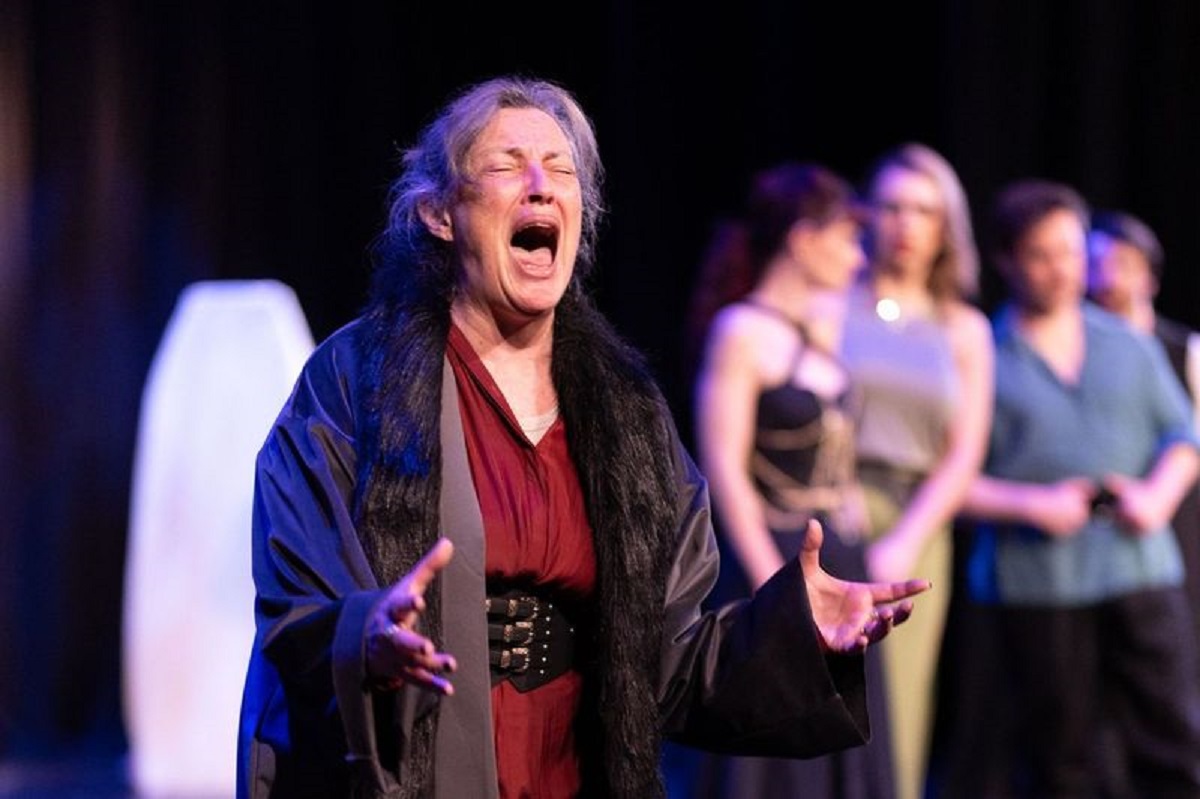
Vickery as Lear. Photo Josh McTackett

“King Lear”, directed by Joel Horwood for Echo Theatre, at The Q, Queanbeyan, closed December 3.

JOEL Horwood’s recently closed production of “King Lear” at The Q was the eighth staged version of Shakespeare's tragedy that I have witnessed.

I have seen actors Ron Graham and Garry McDonald playing their roles in prehistoric bearskins, Judy Davis in the traditional doubling of The Fool and Cordelia, and the much-excoriated 1998 post-modern Barrie Kosky production where John Bell as Lear was seen dementing in the waiting room of a bus station.

Horwood’s production is easily the most convincing of these, and viewed on the same weekend as a concert of Bach’s Advent cantatas, it had me reflecting on why the classics are so important, not just for the brilliance of the creations, but for their sheer humanity.

So thrilling was Horwood’s production to me that it pretty well converted me from being a lifelong “Hamlet” fan to believing that “Lear” is indeed the Bard’s master work – it's also his maddest.

Shakespeare's King Lear is notoriously, difficult to stage, so much so that Samuel Taylor Coleridge was of the opinion that some parts of it couldn’t be done.

Horwood seemingly met all the challenges inherent in this dark tragedy, yet he exposed the raw edges of the drama in such a comprehensive way so that the long evening went by in the blink of an eye.

Of course, the painful parts to which Coleridge alluded were there, and much more.

The machinations of the hypocritical daughters Goneril and Regan, savagely indifferent when they cast Lear out into the wilderness, was articulated loud and clear by Lainie Hart and Natasha Vickery respectively.

The Iago-like self-justifications of Edmund the bastard as he plans the downfall of his legitimate brother, Edgar (Josh Wiseman), is given a nasty comic edge by Lewis McDonald.

The revolting blinding of Gloucester (Michael Sparks) as a punishment for perceived treachery drew gasps from the audience.

And the bit Coleridge couldn't stand where Lear holds the dead Cordelia in his arms is indeed almost too painful to view.

Balanced against this in the play is evidence of light and nobility. There is Edgar for Edmund, Cordelia for Goneril and Regan, Kent for Oswald, Albany for Cornwall.

At the centre of this almost insane play, unlike anything else Shakespeare ever wrote, is the towering presence of Karen Vickery as  Lear, a powerful, vulnerable performance as the arrogant, emotionally blind king who begins, too late, to see the origins of his fate. Vickery takes on Lear’s silly regal posturing, insane ravings and insightful judgements with equal fearlessness.

Supporting him tenderly in his most insane moments, is Petronella van Tienen’s Fool, doubling as Cordelia, a theatrical convention started by Shakespeare himself when he gave Lear the plaintive Act V lines, “And my poor fool is hanged.”

Director Joel Horwood has pursued the text with fine detail through the smaller roles, like the servant who stands up against Cornwall when he has gouged the eyes out of Gloucester. The detail of these parts was very fine.

This production looked good with regal black drapes transformed into billowing winds and the upstage cyclorama revealed in Act V to be the White Cliffs of Dover, where the play concludes.

Horwood and Vickery have, in what to me was a complete breath of fresh air, given me a new understanding of what the word tragedy can mean.


Sunday, December 3, 2023

Theatre / “King Lear”, directed by Joel Horwood. At The Q, until December 3. Reviewed by JOE WOODWARD.


Karen Vickery as Lear. Photo: Jenny Wu

OFTEN mooted as Shakespeare’s greatest tragedy, Echo Theatre’s production of “King Lear” proved to be less a tragedy and more of a deeply psychological drama.

Karen Vickery’s performance plunged into a varied psychological plane I hadn’t seen in any previous production, including Warren Mitchell’s magnificent stage performance in the 1970s and the filmed performances of Paul Scofield in the Peter Brook 1971 film.

The bare stage provided the perfect space for complexity and a breadth of relationships that melded human vanities into threads of uncompromising action.

Vickery’s Lear was the spine that took her audience on a compelling journey from the illusory trappings of power to the discovery of human significance through a startling relationship discovered with another human being.

This was most evident in a beautifully constructed and played scene when Lear met up with her daughter Cordelia for the first time since banishing her in the opening scenes. Now in a wheelchair, Lear’s mind is shot. She has been through the depths of psychological pain and physical breakdown.

Both mother and daughter have survived the consequences of their respective arrogance and now have let go of all that restricted them. Petronella van Tienen’s Cordelia creates a soulful avenue for Lear to enter into a more fundamental humanity; their highly emotional connection evoked on stage was as pure and as heart wrenching as one could ever see in theatre.

Vickery’s vocal and physical dexterity on stage gave Lear a versatile and highly energetic vitality that denied the more usual “infirmity of his age”. The physical hysteria she created then gave way to near total exhaustion, only to be revived for a few minutes towards the very end of the play.

The other older character of Gloucester, played by Michael Sparks, is savagely and physically broken down to an ironically saved person. His journey plunges him to the depths of a dark world through which he finally sees the reality of his life and of those around him.

Sparks never overplays the melodramatic circumstances of Gloucester’s situation. His imposed and then guided journey provides a stark contrast to Lear’s self-imposed journey of discovery.

Lewis McDonald’s Edmund has fun with the devilish plans he reveals to avenge his sense of abandonment by his father. He extracts maximum value from his sharing of plans with the audience.

Josh Wiseman’s Edgar provides the linking of the main plot with the subplot of the play. He manages this with controlled theatricality throughout a most intriguing arc.

Lainie Hart’s Goneral and Natasha Vickery’s Regan merge into villains. They play very contrasting sisters who both want the same things. Both are ruled by lust and self-interested power. Yet Hart and Vickery found nuances in performance that gradually made their decline feasible and real.

All performances supported the construction of a genuinely significant production of “King Lear”.

Christina Falsone, Jim Adamik, Tom Cullen, Glenn Brighenti and Holly Ross sculpted the stage and echoed the central themes of the play efficiently and without any clutter. The professionalism of the whole cast made for a compelling presentation of a very difficult play.

On opening night perhaps there were some losses of momentum in the long first half before interval; though it recovered quickly. Considering the power of the performances, the use of toy knives seemed incongruent with the violence portrayed. Something more threatening or even more symbolic might have been used instead to give vent to the shocking events. However, this is a minor point in relation to the whole play.

Vickery’s Lear is a triumphant revelation of deeply psychological motivations, feelings and responses that are embedded in the text but which have rarely been extracted.

Echo Theatre’s “King Lear” cuts through to the psychological essence within a story. It avoided over-simplifying the actions into a linear narrative that neglected the vertical dimensions of human behaviour. This required exquisite performance skills from the cast and director making this production a high point for Echo Theatre.

This review was first published in Canberra CityNews on December 1, 2023.

Saturday, December 2, 2023

KING LEAR - Echo Theatre


Karen Vickery as King Lear in Echo Theatre's "King Lear". 

Written by William Shakespeare - Directed by Joel Horwood

Set and Costume Design by Kathleen Kershaw – Lighting Design by Zac Harvey

Sound Design by Neville Pye and Sophia Carlton.

The Q, Queanbeyan Performing Arts Centre – Nov. 30 – December 4, 2023.

Opening Night Performance reviewed by BILL STEPHENS.

Having compulsorily studied only three Shakespearean plays at school, but sat through many more since, my yardstick for judging the success of a Shakespearean production is whether or not I can follow the story.

In recent years the fashion for inclusiveness and gender-blind casting has made this simple guideline increasingly more difficult. So much so that I sometimes feel my enthusiasm for self-education with regards to Shakespeare waning.

However, the titillating prospect of experiencing Karen Vickery, surely Canberra’s most accomplished actor, take on the challenge of interpreting what is often to referred to as the Mount Everest of Shakespearean roles, made Echo Theatre’s production of “King Lear” a ‘must see’.

The evening commenced promisingly on entering the theatre to be met with a dramatically lit stage on which the lone figure, King Lear, was seated on a rough throne musing over a map.

This was the first of several impressive visual images which would occur throughout Echo Theatre’s arresting production of “King Lear”.

Karen Vickery (Lear) - Lainie Hart (Goneril) in Echo Theatre's "King Lear"

As played by Karen Vickery, Lear wears trousers throughout, even though her three daughters wear dresses. She is addressed as ‘my lady’ and referred to as the Queen, leaving no doubt that in this production, the play is about a mother’s response to the terrible events which engulf her three daughters, rather than a fathers.

While the possibilities of this premise are interestingly explored by Joel Horwood with his intelligent direction and Karen Vickery’s astonishing performance in the central role, there is something about the psychology of this premise that doesn’t sit quite right. So while fascinated with Vickery’s extraordinary display of histrionics and technique, it was difficult to feel empathy for her character until the climactic scene in which she briefly recognises her daughter, Cordelia.


Karen Vickery (Lear) - Petronella van Tienen (Cordelia) in "King Lear"


Though the storyline regarding Lear’s relationship with her daughters was relatively clear, double casting made it difficult for anyone not familiar with the play to make much sense of the many sub-plots.

For instance casting Petronella van Tienen, a fine, but easily recognisable young actress, as Lear’s youngest daughter, Cordelia, then have her play Lear’s fool, before returning at the end of the play as Cordelia, was confusing and just one example.  Where it was necessary for double casting, more attention with costuming and deportment was necessary to distinguish between the characters.

In fact, in this regard, the set and costume design by Kathleen Kershaw was a bit Curate’s egg. The use of artfully lit, dark drapes in the first act was inspired, particularly as utilised later with additional lighting and sound effects to create the spectacular storm scene. Thoughtfully staged scene-changes were also impressive.  

However the stark white screen across the back of the stage for the second act left the stage without atmosphere or context, and the actors exposed. And while there were some excellent individual costumes, Lear’s opening costume, the costume for Goneril, and the kilts for the men being outstanding, there appeared a lack of an overall concept, with other costumes looking haphazard and lacking of clues as to status or purpose.

Despite this there were many fine performances among the excellent cast, with obvious attention having been paid to clarity of line delivery. Particularly impressive in this regard, in addition to Vickery, were Lewis McDonald (Edmund), Josh Wiseman (Edgar), Michael Sparks (Gloucester), Jim Adamic (Albany), Laine Hart (Goneril), Natasha Vickery (Regan) and Petronella van Tienen (Cordelia).

So while your response to this production may be dependent on how familiar you are with the play, I would certainly rate it as the most interesting Shakespearean production I have experienced this year.


                               Images by Photox Canberra Photography Services.


  This review is also published in AUSTRALIAN ARTS REVIEW. www.artsreview.com.au


O MAGNUM MYSTERIUM


Oriana Chorale

Directed by Dan Walker

Wesley Uniting Church, Forrest 1 December


Reviewed by Len Power

Oriana Chorale’s final concert of 2023 delivered masterworks from two of the 20th century’s greatest composers, Francis Poulenc and Frank Martin, as well as works by the 16th century Italian composer Madalena Casulana and Sydneysider Brooke Shelley.

Beginning with “Nativity”, a setting of a poem by James McAuley, Brooke Shelley’s work opened quietly and built to an emotional sense of wonder at the beauty of small natural things in this world. The choir sang it with great accuracy and sensitivity, achieving an appealing depth of feeling.

After this exquisite opening, Frank Martin’s “Mass for Double Choir” followed. This work, composed between 1922 and 1926, did not receive a premiere until 1963 in Hamburg, Germany. It is now considered one of the great choral works and it was given a fine presentation by the choir. The highlights of their performance included the dramatic and complex combined Sanctus and Benedictus and the very movingly sung Agnus Dei.

Oriana Chorale

The 16th century composer, Madalena Casulana’s “O Notte O Cielo O Mar” (oh night, oh sky, oh sea) comes from her second book of madrigals. This work is notable for its emotional restraint and the choir gave it a sense of great beauty and reflection.

The final work of the program, Francis Poulenc’s “Quatre motets pour le temps de NoÑ‘l”, paints four colourful scenes from the nativity story. The first part takes us immediately into the wonder and mystery of the nativity, leads into the witness by the shepherds, the sighting of the star and, ultimately, celebrates the birth of Christ.

Dan Walker, conductor

There was strength in the choir’s singing of the profound opening and their delivery of the description of the wise men sighting the star was hauntingly beautiful. The singing of the finale was dramatic and joyful, making this a perfect end to a concert that left us in no doubt that the Christmas season has begun.


Photos by Peter Hislop

This review was first published by Canberra CityNews digital edition on 2 December 2023.

Len Power's reviews are also broadcast on Artsound FM 92.7 in the ‘Arts Cafe’ and ‘Arts About’ programs and published in his blog 'Just Power Writing' at https://justpowerwriting.blogspot.com/.


Friday, December 1, 2023

King Lear


 King Lear by William Shakespeare.  Echo Theatre at Queanbeyan Performing Arts Centre, The Q.  

Reviewed by Frank McKone
Opening Night November 30, 2023


Creative Team:
Playwright: William Shakespeare    Director: Joel Horwood
Producer/Props Assistant: Jordan Best    
Stage Manager: Maggie Hawkins; Assistant Stage Manager: Ann-Maree Hatch
Set and Costume Design: Kathleen Kershaw; Set Builder: John Nicholls
Costumier: Helen Wojtas; Sound Design/Operator: Neville Pye, Sophia Carlton
Lighting Design/Operator: Zac Harvey; Voice Coach: Sarah Chalmers
Promotional Photography: Jenny Wu, Shelly Higgs
Promotional Videography: Craig Alexander
Production Photography: Photox - Canberra PhotographyServices

Cast (in order of appearance)
Karen Vickery - Lear
Lewis McDonald - Edmund/Others
Christina Falsone - Kent
Michael Sparks - Gloucester/Others
Lainie Hart - Goneril
Jim Adamik - Albany/Others
Natasha Vickery - Regan
Tom Cullen - Cornwall/Others
Petronella van Tienen - Cordelia/Fool
Glenn Brighenti - Oswald/Burgundy/Others
Holly Ross - France/Doctor/Others
Josh Wiseman - Edgar
Ensemble - Sienna Curnow, George Hatch, Liam Prichard, Nathan Wilson

_________________________________________________________________________________

You might wonder if a small-town theatre company, Echo Theatre in Queanbeyan, could have the resources to mount a great Shakespeare play, but, as Hamlet said, “The play's the thing/ Wherein I'll catch the conscience of the king.”  

Joel Horwood shows us, as Peter Brook famously explained last century, all a play needs is The Empty Space and some people to watch some other people acting.  Around the same period, Jerzy Grotowsky called this Poor Theatre.  But there was nothing poor about Karen Vickery’s performance last night.

Petronella van Tienen and Karen Vickery
as The Fool and Lear
Echo Theatre 2023

Her Queen Lear, for the first time in my experience watching a number of productions of this play, made me feel deeply sorry for this royal parent whose political opponent, the horribly manipulative sexually and socially-controlling Edmund, had ordered the hanging of her youngest daughter – whom she now realised was the only one who genuinely loved her.  As she remembered Cordelia’s “voice was ever soft, / Gentle and low, an excellent thing in woman”, we remembered how harsh her mother’s voice had been in Scene 1 when Cordelia had spoken truthfully about her love for her mother as Queen, and the hypocrisy of her elder sisters – which we saw play out in their treatment of their mother throughout the play.  

Reaching this impossibly low point after the madness engendered by Goneril and Regan, and their ‘noble’ husbands, and by Edmund’s perfidy against his brother Edgar, the sons of her only honest noble supporter, Earl of Gloucestor, it is no wonder Lear dies exhausted by the utter collapse of her world.  The bravura performances of Karen Vickery and Michael Sparks were exhausting to watch, against the cruelty of Lainie Hart’s and Natasha Vickery’s Goneril and Regan.

Horwood has captured the human disaster of government by monarchy, or any other form of dictatorship, and made it real at a personal level.  I could not help recognising what we saw on ABC TV recently: Queen Victoria’s Royal Mob.  This UK Sky History TV production showed how the family relationships of Queen Victoria’s grandaughters led to the disastrous World War I.  What on earth could we expect to happen next in Lear’s Britain?  

Anthony Burgess in his Shakespeare points out that King Lear was written after the Gunpowder Plot of November 1605: the “[Robert] Catesby plot [when] the people nearly came face to face with the ultimate apocalyptic vision of horror – their king [James VI of Scotland, now James I of Britain], whom only holy oil had laved, blown skyhigh.  His father [Henry Stuart] had been blown skyhigh too, at Kirk-o’-Fields when his mother had gone to a ball….   At Christmas, 1606, The Court was regaled with King Lear….   The theme of deference to a ruler by divine right is sounded loudly enough in the very first scene, but Lear is all too James-like in wanting fulsome flattery more than plain truth; his tragedy springs from a rejection of honesty.”

In fact, it was Tuesday, 30 January 1649 when “the anonymous executioner beheaded [James’ son] Charles with a single blow and held Charles' head up to the crowd silently, dropping it into the swarm of soldiers soon after.”
https://en.wikipedia.org/wiki/Execution_of_Charles_I
Shakespeare was some 33 years dead by then, but did he wonder about the possibility of Parliament forming a “Commonwealth” without a king or queen?  And later reinstating monarchy, but limited, as we see today in King Charles III?

I think he might have – and it is Echo Theatre’s showing the visciousness of the social destruction caused by divine right that makes William Shakespeare live again.

Christina Falsone, Petronella van Tienen, Karen Vickery
as Kent, Cordelia and Lear
Echo Theatre, 2023


KING LEAR


Petronella van Tienen as Fool and Karen Vickery as Lear

King Lear by William Shakespeare. 

Directed by Joel Horwood. Echo Theatre. The Q Theatre. Queanbeyan Performing  Arts Centre. November 30- December  2023. Bookings 62856290

Reviewed by Peter Wilkins


IKaren Vickery as Queen Lear. Lainie Hart as Goneril

It is often customary for great actors at the height of their art to take on the challenge of performing the role of Shakespeare’s King Lear.  Legendary British actors like Laurence Olivier, Paul Scofield, John Gielgud and Glenda Jackson have accepted the challenge under the direction of such esteemed directors as Peter Brook, Peter Hall and Tyrone Guthrie.In Australia John Bell towered as the tortured foolish old man in Barrie Kosky’s idiosyncratic production. It is not surprising then that Canberra’s leading actor, Karen Vickery should attempt to scale the heights of this daunting and challenging role. It could be considered even more challenging that the role of the foolish, old king who divides his kingdom amongst his daughters depending on which of them can profess the greater love should be played by a female. More than that, the production is being staged by fledgling director Joel Horwood (Hayfever). It is imperative that they have an actor of the calibre of Vickery to rake on the eponymous role. Horwood is an alumni of the highly regarded West Australian Academy of Performing Arts (WAAPA) and one of Canberra’s finest actors. However, directing Shakespeare’s arguably most unwieldy tragedy is another matter and it is the inherent dichotomy in this Echo Theatre’s production that causes  concern.

Lewis McDonald as Edmund. Josh Wiseman as Edgar

There is no doubt that Horwood has assembled an excellent cast and none more so than Vickery in the role of a queen whose ego and vanity embody the fatal flaw that sets her on the path to irrational judgement and madness.  Vickery gives an amazing performance of depth and complexity. From the moment that she rejects the loyal Cordelia with vitriolic irrationality to her railing against the elements upon the torrential heath to her subjection to a demented mind, Vickery charts the descent into madness and the consequences of her hubris. Vickery’s performance is a catalogue of conflicting Elizabethan humours. The audience is invited to witness a queen in the throes of menopausal turmoil which should and does evoke pity for her condition. We watch in horror a woman who through a foolish act becomes a mother “more sinned against than sinning” It is a cause pity that could well be overlooked if a man were playing Lear.

Michael Sparks as Gloucester

Faced with an actor of the stature of Vickery, Horwood could well leave her to her own creative process, but even so, Horwood’s inexperience becomes apparent in the lack of cohesion in the motivations and actions of the principal characters. This is also not helped by the vastness of the space and the overly dark lighting design. It may cast a bleakness across the stage and depict a wasteland in which Nature holds full sway over the inner and outer psyche of the human condition but too often excellent actors were left to contend with a poor use of the space. Actors of the proven excellence of Natasha Vickery (Regan) and Lainie Hart (Goneril) were too often left to define their action upon the stage. Lewis McDonald looked and played the part of the evil Edmund but needed guidance to sway an audience to accept his justification for his resentment. There is the subtlety of complexity of the human motive that appeared lacking in staging and performance at times. It is confounded by a space that might have been avoided in a more intimate setting under more intentionally designed lighting design..

Only Josh Wiseman’s Edgar and Mad Tom surmounted the obstacles of the space and limited exploration of character that seemed to limit the full power of some other performances. From his appearance as a drunken youth to his feigned madness upon the heath, Wiseman’s performance stood out as a highlight in this production.

Josh Wiseman as Mad Tom

Paradoxically, it is the moments of intimacy that evoked pathos and empathy. Lear hugs the blinded Gloucester (Michael Sparks) in a tender moment of recognition and admission of their failing. We are moved and forgiving as Lear the mother cradles her dead child Cordelia (Petronella van Tienen). Vickery’s gut-wrenching howl of despair rents the air with Lear’s grief.

There is much to commend in Echo Theatre’s production, not the least Vickery’s interpretation and performance of a queen and a mother.  The themes of loyalty and betrayal,sibling rivalry,  love and hate and justice and injustice are clearly shown.  As Laurence Olivier writes in his autobiography  On Acting. “Shakespeare makes his actors work for their bread and butter” It is an observation that applies to cast and creatives on King Lear. I encourage all audiences to visit this bold and challenging production during its short season. It is not without its flaws but it is played with passion and intelligence and is certain to overcome the tentativeness of an opening night.

Photography - Photox - Canberra Photography Services


KING LEAR

Written by William Shakespeare

Directed by Joel Horwood

An Echo Theatre Production

Q Theatre, Queanbeyan to 3 December


Reviewed by Len Power 30 November 2023


Shakespeare’s tragedy, “King Lear”, based on a legend, is a story of power, ambition and death in a regal family that begins with Lear, aware of approaching old age, planning to divide the kingdom between her three daughters.

The formidable role of King Lear has been a demanding challenge for many fine actors over the years.  These days gender changes for roles have become more acceptable, giving women the opportunity to play roles traditionally denied to them.  It’s one thing to take on the challenge of the role of the ageing ruler who suffers family betrayal and descends into madness, but it takes a very skilful actor to make a success of it.

From the moment she appears onstage, Canberra’s Karen Vickery as Lear plays a queen with a commanding and convincing strength. The warmth of affection towards her family at the start of the play makes her someone we can identify with and her subsequent descent into madness is more moving because of it.  Vickery’s journey in the role is regal, passionate and frightening in her rage and madness but is ultimately touching.  It’s a memorable performance that must be judged a success.

Karen Vickery and Petronella van Tienen

Director, Joel Horwood, has assembled a fine company of actors who all bring confidence and skill to their roles.

Lear’s three daughters, played by Lainie Hart as Goneril, Natasha Vickery as Regan and Petronella van Tienen as Cordelia, give strong performances as three distinct personalities whose motivations are clear to us, if not to Lear.

Karen Vickery and Lainie Hart

Gloucester is given a sensitive portrayal by Michael Sparks, a man who strives for good but suffers hideously in the process. As his illegitimate son, Edmund, Lewis McDonald achieves a multi-faceted character who is charming but evil and motivated by bitterness. Josh Wiseman as Gloucester’s first-born son, Edgar, is particularly fine in his disguise as the mad Tom o’Bedlam.

Josh Wiseman

There are notable performances by Petronella van Tienen, in the dual role of the Fool, Christina Falsome as Kent, Jim Adamik as Albany and Tom Cullen as Cornwall. The rest of the cast in smaller roles all give fine support.

The production design by Kathleen Kershaw utilizes the full width of the stage. The first half of the show uses curtaining to great effect, especially in the storm sequence and then the plain backdrop for the second half evokes an open country setting. With a sensitive lighting design by Zac Harvey it all comes alive.

Joel Horwood has given us a fine production with in-depth performances of a challenging and demanding play that deserves to be seen.


Photos supplied by the company.

Len Power's reviews are also broadcast on Artsound FM 92.7 in the ‘Arts Cafe’ and ‘Arts About’ programs and published in his blog 'Just Power Writing' at https://justpowerwriting.blogspot.com/.