Wednesday, March 5, 2025

HEWA RWANDA - LETTER TO THE ABSENT ADELAIDE FESTIVAL 25


Hewa Rwanda  Letter to the absent

Author Dorcy Rugamba, Performers Dorcy Rugamba and Majnun, Musical creation: Majnun and Akasha. Stage manager,Jules Nionkuru. Dialogue director Judy Dennis. Production Rwanda Arts Initiative (Rwanda)/The Charge of the Rhinoceros (Belgium). Producer Ellen Dennis USA. Tour manager The Charge of the Rhinoceros (chargedurhinoceros.be) Presented by Arts Projects Australia and Adelaide Festival. Supported by Wallonie Bruxelles Internationale (WBI) and Commission Communautaire Francaise (COCOF) Belgium. Elder Hall. March 3-6 2025

Reviewed by Peter Wilkins


It is impossible not to be profoundly moved at the sight of the family photo upon the large screen behind Dorcy Rugamba. It haunts me still as I sit to write this review of Hewa Rwanda --Letter to the absent. The camera captures a loving Rwandan family, neatly dressed one suspects for a special occasion. There is no premonition of the horror that is about to befall. On April 7th 1994, during the Rwandan civil war, members of the presidential guard invaded the family’s home and slaughtered ten members of the Tutsi family. Not one person was spared. Not Rugamba’s 59 year old father, his 50 year opld mother, his brothers, his sisters or the children ranging in age from 6 years to 16. Only Dorcy Rugamba, who was away at the time escaped the violent fate of the ten members of the family. 

Dorcy Rugamba presents Hewa Rwanda. Letter to the absent
Rugamba, simply dressed in trousers and an orange shirt enters to the lectern at the front of the stage. He is accompanied by musician Majnun with his Senegalian  string instrument. What follows is a reading of a memoir so vivid and so powerfully moving that it is impossible not to be transfixed by Rugamba’s narration and Majnun’s lyrical accompaniment. Music, poetry and anecdote coalesce in what Rugamba describes as a hymn to life. This is not an account of atrocity. That is implicit in the memoir and the photo on the screen. It is thirty years since his family was stolen from him. The mourning and the heart-breaking grief remain a memory of the time. Rugamba writes his heartfelt hymn to life, a love letter to  family that lived, loved, had dreams and achievements and were more than a statistic, a number or maybe a name scratched on a wall. They were Rugamba’s family, a father he adored, a loving mother who was the bedrock of the family, a sister whose embrace he recalls so fondly. Herwa – Letter to the absent is more than a eulogistic acknowledgement of the dead. It is a celebration of the living. It is a life affirming memoir – a hymn to the living and a gift to an audience who listen to the pain of his experience, the love in his song, and the memory in the music. There is theatre in his performance and drama in his and his father’s poetry.

The photo portrays a family frozen in time. Each year Rugamba returns to the house in Kingali in Rwanda. The ivy still clings to the wall. The guava falls from the tree. He remembers the open air theatre with its dirt floor that his father created for the community. He recalls with regret the fact that he never had the opportunity to explain to his dismayed mother why he embraced the Muslim faith and the teachings of the Quran and reconcile them to his decision.

There are regrets and there are lessons to be learned. He understands why the big will lay blows on the little and the little will lay blows on the weak when they become the big. The vicious cycle of violence does not end. He understands that if you abolish hate, the pain remains to be dealt with. And finally, the only absolute is love.

The performance of Hewa Rwanda – Letter to the absent does not leave you. It remains in the intensity of Rugamba’s vocal and musical delivery. The imagery of the language envelops you. Rugamba and Majnun have created a work of profound integrity that is much more than a personal memoir. It is a lesson for the living and a resurrenction of the dead. It is, in short, brilliant theatre.   


Tuesday, March 4, 2025

CAIDI DEL CIELO (Fallen From Heaven) ADELAIDE FESTIVAL 2025


Caida del Cielo (Fallen From Heaven)

Artistic co-direction, choreography, musical direction Rocio Molina. Artistic co-direction, dramatic art, stage space and lighting Carlos Marquerie. Composition of original music Eduardo Trassierra. Participation in the musical composition Jose Angel Carmona, Jose Manuel Ramos “oruco” and Pablo Martin Jones. Collaborator for Dance Elena Cordoba. Costume design Cecilia Molano. Costumes creation Lopez de Santos, Maty and Rafael Solis. Photography Pablo Guidali and Simone Fratini.

CAST: Dancing Rocio Molina, Guitars Oscar Lago, Singing/ electric bass Kiko Pena. Handclapping and beat, percussion Jose Manuel Ramos “Oruco” Percussion and electronics Pablo artin Jones. Technical direction Carmen Mori. Lighting Valentin Donaire. Sound Javier Alvarez. Stage management Maria Agar Martinez. Executive direction El Mandaito Producciones S.L. Her Majsty’s Theatre. Adelaide Festival. February 28 – March 3 2025

Rocio Molina  Photo Simone Fratini


Reviewed by Peter Wilkins

A great dancer can transform her art and transport us to new ways of experiencing and understanding our humanity. Roci Molina is such a dancer. In her Adelaide Festival performance Caida del Cielo (Fallen from Heaven) Molina, accompanied by four musicians including a singer. infuses her art as a flamenco dancer with the passion and the pain, the darkness and the light and the vulnerability and the power of being a woman. We see her first in a single spot motionless in the centre of the stage. She is dressed in a  white flamenco dress  with a train that splays out across the floor. Slowly the arms move into the classic position of the flamenco dancer before she sinks to the floor. Reptilian like she communes with the earth, a fallen angel in search of her roots. It is the overture to her discovery of self and a celebration of her womanhood empowered by the fiery spirit of the flamenco and the enduring power of the spirit of duende.

 The dress is removed and she changes into the clothes of the matador, sleek, tight and stylish. It is here that she gives sway to possession by the traditional dance of the Spanish folk. It is the flamenco of the caves of Granada. Arms reach towards Heaven and the feet pound the earth with percussive rhythm. It is the dance of the people, assertive and confident, rebellious and defiant. Castanets click and Kiko Pena lets out the song of the dance like a wind sweeping across the Andalucian plains while the musicians lend fire to the pulsating rhythm of the dance. 

 Caida del Cielo is performed in four separate movements, marked by the phases of the moon and a costume change, This and a comic interlude when the members of the company come to the front of the stage to eat from their crisps packet allow Molina a pause from her powering dance and a natural transition to a new stage in a woman’s experience. At one stage, Molina responding to the harsh music of German metal band Einstuerzende Neubauten crawls across stage leaving a trail of mud behind her as she struggles to regain a sense of self. A musician kneels at her feet in symbolic gesture to remove the dirt before a final celebration of her womanhood, bedecked with flowers that she casts through the audience in triumph and joy. The journey is complete, the descent substantive in its goal of discovery of self as woman. The flamenco offers affirmation.

For more than ninety minutes Molina and her musicians transport us to a new understanding of what it means to be a woman and the nature of struggle and survival. Molina’s athleticism and artistry is extraordinary, at times heart pumping, at times awe inspiring. Molina is the doyenne of flamenco. More than that she is an inspiration to all. It is little wonder that the audience leapt to their feet in a standing ovation.


Monday, March 3, 2025

INNOCENCE ADELAIDE FESTIVAL 2025


Innocence by Kaija Saariaho. Original Finnish Libretto by Sofi Oksanen and Multilingual Libretto by Aleksi Barriere.

Conducted by Clement Mao Takacs. Directed by Simon Stone. Set design Chloe Lamford. Costume designer Mel Page. Lighting designer James Farncombe. Sound designer Timo Kurkikangas. Assistant director Sybille Wilson. Choreographer Arco Renz. Adelaide Chamber singers and State Opera Chorus. Chorus Master Christie Anderson.Presented by Adelaide Festival in association with State Opera South Australia. A co-commission and a co-production of Festival Aix-en-Provence, San Francisco Opera, Dutch National Opera Amsterdam, Royal Opera House Covent Garden London, Finnish National Opera and Ballet Helsinki. In partnership with the Metropolitan Opera. Festival Theatre Adelaide Festival Centre. February 28 – March 5 2025.

Reviewed by Peter Wilkins


Innocence is a work of extraordinary stature. Composer Kaija Saariaho and librettists Sofi Oksaanen and Aleksi Barriere have created a contemporary opera of enormous resonance and relevance to our time. From the foreboding sounds of the overture the audience is drawn into the tragic account of the consequences of a shooting at an international school.. Ten years earlier a student entered the school and shot dead ten of his classmates in an act that shocked the community and changed lives forever. Innocence opens on the occasion of a wedding of the shooter’s brother Tuomas (Sean Panikaar) to Stela (Faustine de Mones). Present at the wedding are the parents of the groom , the mother Patricia (Claire de Sevinge) and the father Henrik (Tuamos Pursio) and the family priest (Teddy Tahu Rhodes. A waitress has fallen ill and her replacement Tereza (Jenny Carlstedt) has been called in, unaware until she arrives that she will be waiting on the family of the boy who murdered her daughter Marketa (Erika Hammarberg). Tereza’s appearance becomes the catalyst for the emergence of painful memories, guilty secrets and a heart-wrenching grief.

The teacher and students in Innocence

Saariaho’s work is a reminder that society is morally and socially culpable and responsible for such horrific acts of terror. Her composition realized so magnificently by the Adelaide Symphony Orchestra under the baton of conductor Clement Mao-Takacs conjures an atmosphere of tension, exploding into a sudden and surprising climax and eventually arriving at a catharsis to the tragedy. All the characters grapple with their guilt. Did the parents raise their son to be a murderer? Could Tuomas have prevented the shooting in which he was implicated by revealing the plot to his parents? Could the teacher Cecilia (Lucy Shelton) have stopped the murder by revealing the clues in his essays? Could Alexia (Marina Dumont) have opened the closet door to let a classmate in, rather than lock them out? Could Marketa have realized the effect of her goading on the bullying? Society’s collective absence of innocence is a central theme in Saariaho’s  opera. It is also highlighted by the use of different languages with English surtitles to accentuate international responsibility to address the proliferation of school shootings around the world.

Director Simon Stone uses Chloe Lamford’s astounding revolving two-storeyed set design to stunning effect. The action moves from room to room becoming revealed within the glass exterior as the set revolves from one area of the school to the next. The multiple use of the rooms is used to brilliant effect to reveal a classroom on the upper level before the attack and the kitchen where the wedding feast is being prepared on a lower level. Actors play out the roles of additional characters during the shooting or at the time of the wedding. Time shifts allow a simultaneous viewing of the horrific events with the interaction of character in the present time. The contrast is electric. Stone and choreographer Arco Renz contrast the frantic attempt to escape in parts of the school with Stela and Tuomas’s slow waltz in the shadows below or the slow and threatening movement of the killer’s accomplice Iris (Julie Hega) The impact is riveting.  The orchestra under Mao-Takac’s baton are perfectly attuned to the action, providing the emotional response to the unfolding of two tragedies, the shooting ten years earlier and the revelation of the groom’s complicity and breakdown of his marriage and relationship with his bride.

In a production as brilliantly composed, written and staged as Innocence there is only adulatory praise. Drama and opera come together in which every player plays a part and that brilliantly. There is again the outstanding contribution of a world class Adelaide Symphony Orchestra, Adelaide Chamber Singers and State Opera South Australia Chorus under Chorus Master Christie Anderson In the tradition of Operatic triumphs at previous Adelaide Festivals, Innocence stands tall as a beacon of excellence. This is an opera that forges new ground, takes risks, challenges audiences and speaks with a universal voice about one of the most important issues facing a society, keeping its people safe, addressing the issue of mental health, speaking out on gun control and enabling redemption. This production in Australia of Innocence is exclusive to the Adelaide Festival but it is an opera with universal relevance. The priest pleas for mercy and love to absolve the wrong, pain and the grief. Marketa asks her mother to let her go. In Innocence Saariaho’s creative spirit offers hope that the entire world needs to see.

Photos by Andrew Beveridge


Saturday, March 1, 2025

A QUIET LANGUAGE AUSTRALIAN DANCE THEATRE AND ADELAIDE FESTIVAL


Tayla Lee Hoadley in A Quiet Language Photo Zoe Wozniak


 A QUIET LANGUAGE

Director/concept Daniel Riley. Co-director  Brianna Kell. Choreography. Daniel Riley, Brianna Kell and ADT Company Artists: Sebastian Geilings, Yilin Kong, Zachary Lopez, Karra Nam, Patrick O’Luanaigh and Zoe Wozniak. Guest artist Tayla Lee Hoadley. Dramaturg Alexis West.Composer and Musician Adam Page. Production Design. Matthew Adey. Costume Designer Ailsa Paterson Lighting Associate Mark Oakley. Production manager Ninian Donald. Company and Stage Manager Katya Shevtsov. Technical Manager Ellen Demaagd.Sound technician Sascha Budimski.Venue Technician Ben Johnston. Operator Reece Vilder. Australian Dance Theatre in association with the Adelaide Festival. The Odeon. February 26th – March 7th. 2025

Reviewed by Peter Wilkins


A Quiet Language. Photo: Jonathan van der Knapp

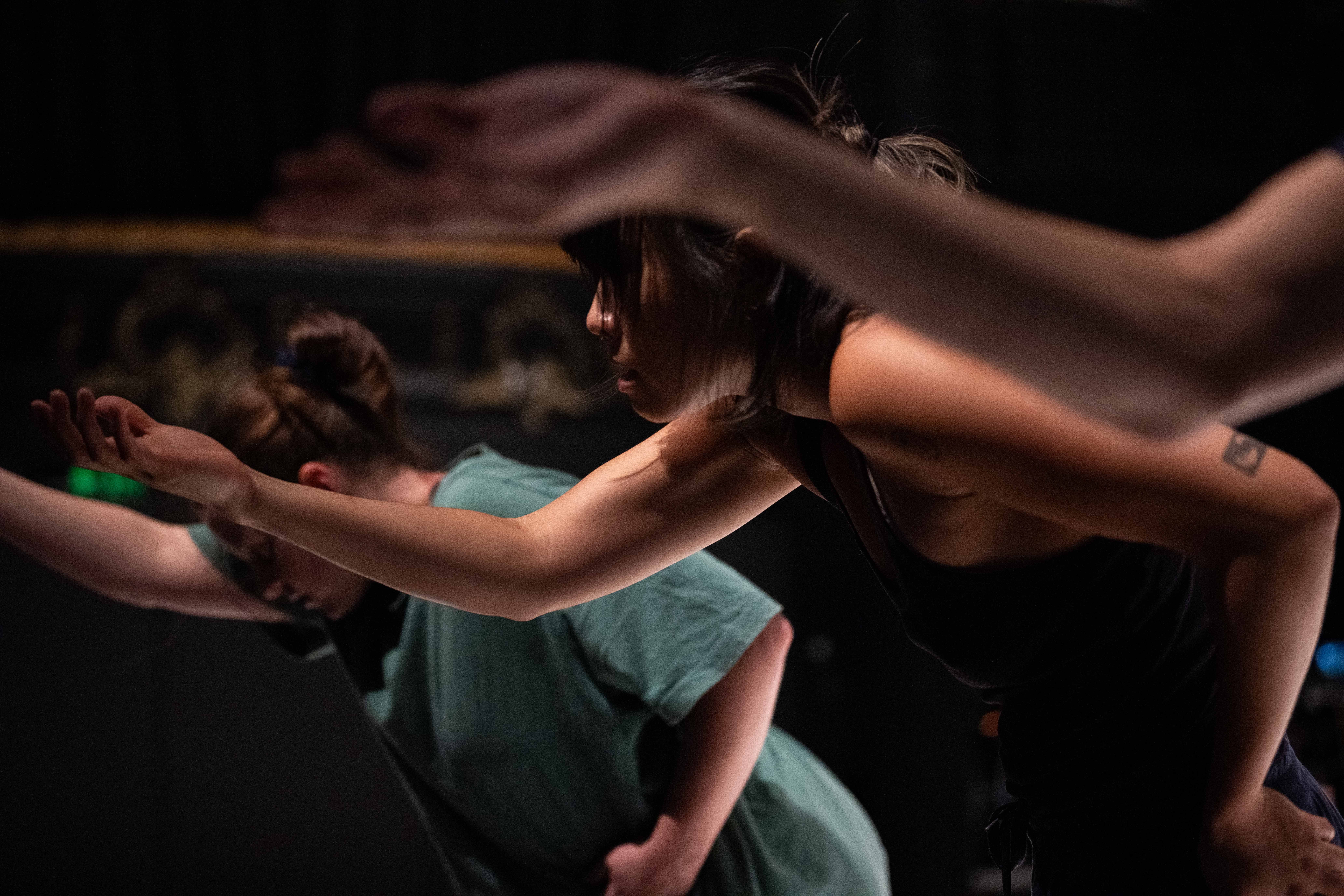
Australian Dance Theatre’s A Quiet Language is a triumphant and glorious celebration of the company’s 60th anniversary. Australia’s contemporary dance legend and creative collaborator on A Quiet Language, Elizabeth Cameron Dalman OAM established ADT in Adelaide in 1965 to introduce an exciting new style of contemporary dance to Australian audiences. Having just returned from dancing with the Nederlands Dance Theatre Cameron Dalman was inspired to establish the first fully professional contemporary dance theatre in Australia. For 60 years different artistic directors with different artists have maintained an enviable legacy which remains vibrant and innovative to this day.  A Quiet Language, the language of dance, illuminates a new phase in the artistic work of ADT, which began with the appointment of Daniel Riley as Artistic Director. Previously a dancer with Bangarra Dance Theatre, Riley brings to the dance a force and vitality of a  new era. 

A Quiet Language gives a powerful voice through its dance to today’s society, while recognizing its significance through the decades. The dance is visceral -the dancers luminescent in their technique. A Quiet Language traces the company’s different journeys from the age of protest, rock and roll, Vietnam, women’s liberation and the referendum of 1967 that finally gave aborigines the vote to the current age of reconciliation, the failed Voice, new protests, COVID  and the euphoric celebration of the  survival and success of the iconic Australian Dance Theatre A Quiet Language chronicles the key events and experiences of the nation and its people. The ADT Company of Artists through their artistry and imagination find a synthesis of spirit and body through their dance. Their talent and athleticism are electrifying  as they weave their bodily patterns of interconnection. Their dance becomes the language of rebellion, of collaboration and of unity against the forces of oppression. Audiences on two sides experience inclusion that turns to exclusion on one side as dancers move to the other side to turn exclusion to inclusion in a moving cycle of total engagement.

Through the expressive power and interpretive physicality of contemporary dance, A Quiet Language breaks down the barriers to social change and care for the environment. It is the dance of a nation, the expressive acknowledgement of struggle and oppression, of survival and community. The dance closes on a celebration of togetherness and the celebration of love and joy. A sole dancer counts down from 60 to remind us of the years, the conflicts and the triumphs, the changing nature of the dance bonded over the decades by Caneron Dalman’s Legacy and fired for today’s audiences by the amazing artistry of Riley’s present company.

A Quiet Language.  Photo: Zoe Wozniak
I watch in amazement at the sheer dynamism, physical flexibility and emotive power of the dance company of five dancers from different backgrounds, dancing in unison and while celebrating the times and events past pointing to a future of promise and fulfillment. Throughout a saxophonist (composer and musician  Adam Page) accompanies the dance with the magical spirit of the instrument that touches the soul. Alternating between vocal and musical accompaniment he transports us through time and experience .

The overarching themes of People, Place, Politics, Voice and Body inform the power of their storytelling as they present the evolving experiences of a nation through social change, Nature’s fury, political upheaval and world conflict and pandemic. In the realm of dance A Quiet Language, is a testament to the survival of the artist in society. It is the lesson taught by Cameron Dalman in the creation of ADT and carried through from one period to the next. The audience sits spellbound, releasing their imagination and interpreting their response to the story of the dance. If this is a salute to the enduring power of contemporary dance in society, then ADT can look forward to another 60 years. Be sure not to miss this celebration if you are in Adelaide before the season ends.  A Quiet Language raises a cry of celebration and joyful commemoration of the artist and the dance


KRAPP'S LAST TAPE ADELAIDE FESTIVAL 2025


KRAPP’S LAST TAPE by Samuel Beckett.

Directed by Vicky Featherstone. Performed by Stephen Rea. Landmark Productions. Dunstan Playhouse. Adelaide Festival Centre. Adelaide Festival 2025. February 27 – March 8 2025.

Reviewed by Peter Wilkins

Stephen Rea is Krapp in Krapp's Last Tape. Photo: Pato Cassinoni 


Darkness enfolds the space. Gradually a glimmer of light intrudes through the darkness. As it emerges, Krapp can be seen seated at a table, a solitary figure on the occasion of his 69th birthday. With the slow deliberate movement of an old man he removes a key from his pocket. He moves to the drawer of the table, pulls it out and reaching deep into the furtherest recess he removes a banana. He peels it slowly and deliberately and drops the skin to the floor. In just those few brief moments, actor Stephen Rea and director Vicky Featherstone faithfully create Beckett’s archetypal lone clown. Like the old silent movie stars that Beckett so admired, Rea personifies the hapless victim of his own circumstance, trapped in the private solitude of his mind, his memory and his past. 

Director Featherstone and actor Rea in this Adelaide Festival exclusive of Krapp’s Last Tape have observed Beckett’s detailed stage directions, like the lazzi with the bananas and the sweeping of the tapes from the table or the drawn out utterance of the word ‘spool.’  Long pauses echo the silence of Krapp’s unspoken thought before he returns  to continue playing the recording of his younger self at the age of 39. The tape is interrupted as he disappears to his den at the rear of the stage, presumably for a slug of whisky. He returns to resume remembrance of things past, such as his love affair with a girl upon a punt “where he laid his head upon her breast and his hand on her”

Rea is the consummate Beckett actor. His appearance in his confinement reflects neglect. Aspiration is disbanded by disappointment.  In the relationship between the old man listening to himself on tape and the mechanical voice of a younger self there is a certain pathos that is the essence of the sad clown. The optimistic creation of an opus magnum thirty years earlier is pitifully contrasted by his admission that only 17 copies of his latest publication were distributed and eleven of those to trade buyers such as libraries. The sexual passion of a young man in lust is the antithesis of the time with Fanny, the bony old whore .

Crucial to the production is the actor’s relationship to the recorder. Rea makes it a second character in the  drama. He bends over it, clicking it on and off at key moments to heighten the tension or to keep an audience in a state of anticipation before he returns from the den to the play button, relieving the tension or completing the anecdote. The recorder reveals his spool of memories, his judgement and the admonition of his younger self. The tape is a reminder of “his critical age and profound gloom and indigence”

And yet, Beckett allows no self pity.  Loneliness is an accepted state of affairs for the aging writer. He is not attempting to recapture the past. There is still fire in him. He longs for the “burning to be gone” in the full knowledge of who he was and who he has become.  Rea is totally credible. His Krapp is bitter, gloomy and lonely in the familiarity of his den while on tape we are reminded of a lyrical tenderness as a younger man infatuated with the girl on the punt. There is humour and pathos in Beckett’s lyricism and melancholy. Krapp is no Everyman but we identify with the loss of dreams and desire. This is the magnificence of Krapp’s Last Tape. Beckett spans life’s trajectory and teaches us the lessons of experience. Rea embodies the straddled worlds of his character with pin sharp attention to detail.

Featherstone and Rea have created a Krapp who is true to Beckett’s vision. They have observed the details that Beckett has so meticulously and punctiliously described in his stage directions. The timing is perfect, the musicality of the text evocative and highly expressive and the interaction between actor, tape recorder and the recorded voice carefully interpreted and orchestrated.

 Beckett’s characters, isolated from the external world and trapped within a world of their own imagining or recollection require an intimate relationship between performer and audience. I couldn’t help but feel that however true to Beckett’s vision performance and production were the impact of this acclaimed masterpiece was diminished to some extent by being performed  in the Dunstan Playhouse of the Adelaide Festival Centre. It mitigated against the intimacy that Krapp’s Last Tape requires.

Nonetheless, the opportunity to see a brilliant exponent of the role of Krapp in a production that faithfully observes Beckett’s vision and motifs is an opportunity not to be missed.


Credits: Krapp Stephen Rea Director Vicky Featherstone Set Designer Jamie Vartan Costume Designer Katie Davenport Lighting Designer Paul Keogan Sound Designer Kevin Gleeson Audio Director Stephen Wright Production Manager Eamonn Fox Stage Manager Ciara Gallagher Assistant Stage Manager Ross Smith Costume Supervisor James Seaver McGlynn Associate Lighting Designer Eoin McNinch Sound Engineer | Original Tapes Bill Maul Set Construction TPS Photographer Patricio Cassinoni Videographer Aileen Power Graphic Design Gareth Jones FOR LANDMARK PRODUCTIONS Producer Anne Clarke Associate Producer Jack Farrell Marketing Manager Sinead McPhillips Marketing Assistant Hannah Morris Publicity Sinead O’Doherty | O’Doherty Communications

CHAMBER PHILHARMONIA COLOGNE


Sergey Didorenko, solo violin

Dimitrij Gornowskij, solo cello

St. Christopher’s Cathedral, February 28


Reviewed by Len Power


With their motto, Classical Music Around the World, Chamber Philharmonia Cologne presented a charming program of works by the much-loved composers, Antonio Vivaldi, Wolfgang Amadeus Mozart, Peter Tchaikovsky, Johannes Brahms and Niccoló Paganini.

Solos in the works were played by the German virtuosos, Sergey Didorenko, violin and Dmitrij Gornowskij, cello.

Didorenko was born in Ukraine and after training in Moscow, he moved to Germany where he is now a German citizen and permanent soloist with the Chamber Philharmonia Cologne. He has also published two books on philosophy.

Sergey Didorenko, violin

Gornowskij was born and trained in Kazakhstan, winning many prizes for his playing. He has lived in Germany since 1997 and is now a German citizen. He performs as a soloist and in orchestras and chamber ensembles. He is one of the founding members of Chamber Philharmonia Cologne.


Dmitrij Gornowskij, cello

The group commenced with Vivaldi’s well-known Winter from his Four Seasons concerto.  Sergey Didorenko played the solo violin part. It was a vibrant, highly atmospheric performance that evoked strong, clear images of that most dramatic of seasons.

This was followed by a second Vivaldi work, Concerto in A minor for violoncello and strings. In three movements, the solo parts were played by Dmitrij Gornowskij, cello.

The bright, melodic Allegro was followed by a deeply reflective Largo with the sensitive solo playing of Gornowskij. The final Allegro movement was given a busy and exciting performance.

Mozart’s well-known and much-loved A Little Night Music (Serenade in G major for string orchestra), was then played in a colourful performance of great clarity.

Chamber Philharmonia Cologne

After interval, cello soloist, Gornowskij, led the group with a fine performance of Tchaikovsky’s Pezzo Capriccioso. Their playing brought out all of the expressiveness and varying moods of this work. They followed it with a scherzo from Brahms’ F-A-E Sonata. The F-A-E stands for Frei Aber Einsam (free but lonely) and their atmospheric playing of this piece was very enjoyable.

The final work on the program was Paganini’s Capriccio in an arrangement for violin and string orchestra. Paganini, of course, was well-known for his virtuoso playing of the violin and Didorenko showed his ability with the instrument in fiery solos that were breathlessly exciting.

With an encore performance of Edward Elgar’s Salut D’Amour, this dreamy work brought the concert by these excellent musicians to a close.


Photos by Dalice Trost

This review was first published by Canberra CityNews digital edition on 1 March 2025.

Len Power's reviews are also broadcast on Artsound FM 92.7 in the ‘Arts Cafe’ and ‘Arts About’ programs and published in his blog 'Just Power Writing' at https://justpowerwriting.blogspot.com/.


JOSEPH AND THE AMAZING TECHNICOLOR DREAMCOAT - Canberra Philharmonic Society

Tim Dal Cortivo as Joseph and dancers in The Canberra Philharmonic Society's production of 
"Joseph and the Amazing Technicolor Dreamcoat"


Music by Andrew Lloyd Webber – Lyrics by Tim Rice

Directed by Kelda McManus – Choreographed by Caitlin Schilg

Musical Direction by Jenna Hinton – Conducted by Craig Johnson

Set Design by Ian Croker and Kelda McManus -Costume Design by Jennie Norberry.

Sound Desing by Eclipse Lighting and Sound – Lighting design by Alexander Clifford

Presented by Canberra Philharmonic Society - Erindale Theatre Feb.27 - March 15.

Opening night Performance on Feb.27 reviewed by BILL STEPHENS.


There can be few people left standing who have not seen or taken part in at least one production of Joseph and the Amazing Technicolor Dreamcoat in any of its countless iterations.

Conceived and written in 1965, as a 15-minute “pop cantata” by 17-year-old Andrew Lloyd Webber and 20-year-old Tim Rice, responding to a commission to write a piece for their school choir.

The commercial potential of Joseph and the Amazing Technicolor Dreamcoat was spotted by a canny producer in the audience who had it expanded into a full-length musical to take advantage of the international success of Lloyd Webber and Rice’s break-out musical, Jesus Christ Superstar.

Their light-hearted reworking of the story lifted from The Book of Genesis, describing how Joseph became alienated from his eleven brothers after their father gifted him an incredibly special coat, became a world-wide hit after its premiere on the West End in 1973.

50 years on, the Canberra Philharmonic Society provides an excellent example of why this musical has retained its popularity over the years with a lavish new production in the Erindale Theatre.

Director Kelda McManus has adroitly harnessed the talents of many of the region’s most accomplished musical theatre creatives and performers, and anchored her production with a charming, confident performance by Taylor Paliaga as the narrator, with the experience of Tim Dal Cortivo as Joseph, to produce a warm-hearted, family friendly sung-through production, awash with visual and aural surprises.

Taylor Paliaga as Narrator with ensemble in "Joseph and the Amazing Technicolor Dreamcoat"

Following an arresting overture from the off-stage 15-piece band conducted by Craig Johnson, the unexpectedly dull setting and costumes chosen to set up the story soon gives way to a riot of colour and movement for a succession of spectacular production numbers devised by choreographer, Caitlin Schilg.

Schilg cleverly draws on the dance styles of influential Broadway choreographers to give each scene individuality as well as highlight the individual talents of each of her fifty-one cast members. While not all those cast members can match her choreographic ambitions, what they lack in finesse, they certainly make up in enthusiasm, with spectacular results.

Similarly, Ian Croker’s set designs are a gift that keeps giving as they cleverly morph through surprising combinations to accommodate Jennie Norberry’s lavish costumes which by the finale threaten to challenge the spectacle of a Disney production.

Then there are the wonderful puppet creations of Sarea Coates, particularly her adorable sheep and goat creations along with the scene-stealing camel, which are worth the price of admission alone.

Joseph and the Amazing Technicolor Dreamcoat is very much an ensemble show which offers endless opportunities to display individual performers and performances.

Director McManus has taken full advantage of these opportunities by making sure each member of her large cast has a moment in the spotlight.

Joe Dinn as Pharaoh in "Joseph and the Amazing Technicolor Dreamcoat"

Among many highlights, are the outrageous, show-stopping turn by Joe Dinn as the Pharaoh, channelling Donald Trump doing an Elvis Presley impersonation; and the attention paid by Musical Director Jenna Hinton to the harmonies and diction clarity of all the songs, especially evident in the "Those Canaan Days" number, therefore allowing cheeky exuberance of the youthful Tim Rice’s lyrics to be savoured.


Bradley McDowell as Reuben and company in "Joseph and the Amazing Technicolor Dreamcoat"


With this production, Philo has devised an imaginative and entertaining show which besides showcasing the strength of musical theatre talent in the region, is also an outstanding example of what can be achieved with enthusiastic community participation.

No matter how many productions of Joseph and the Amazing Technicolor Dreamcoat you may have seen before, this is one you can’t afford to miss.


                                             Photos by Ben Appleton - Photox


       This review first published in the digital edition of CITY NEWS on 28.02.25