Saturday, July 11, 2020

2020 Mullins Australian Conceptual Photography Prize

Photography Review by Brian Rope

Various artists | 2020 Mullins Australian Conceptual Photography Prize

Magnet Galleries, Docklands, Melbourne | Until 1 August 2020

The annual Mullins Australian Conceptual Photography Prize (MACPP) is conducted by the Australian Photographic Society. The 2020 winners were announced on 9 July during an onsite exhibition opening in the Magnet Galleries, simultaneously livestreamed to a broader audience nationwide via Zoom. Sadly, the physical exhibition is closed to visitors because of the Melbourne lockdown. However, the gallery has created a wonderful virtual gallery which allows us to explore all the images. There is a link on their Website http://magnet.org.au/

Of 34 finalist images selected by the judges, an extraordinary 9 of them are by Canberra artists – Sophie Dumaresq, Ian Skinner, Lyndall Gerlach, Mark Van Veen, Judy Parker, Jim McKenna, and me. So, it was not altogether surprising when one of them, Judy Parker, was announced as the winner of the major prize of $10,000 cash for one of her two finalist images.


Dumpster Sketchbook: Waterside © Judy Parker

Parker’s concept statement for the image read: Recently I took a series of photographs of the side panels of a large open container at a local recycling centre. The markings had a wonderfully strong graphic quality, red rust-lines on a silver-painted surface: a calligraphy of wear and tear. When I processed my images, I was intrigued by the way sections of the random patterns suggested a series of semi-abstract coastal landscapes, each quite different. I modified three of these to reinforce the reference and combined them as a triptych. Our minds are not limited to the literal. They can equally re-identify and re-imagine.

Parker’s second finalist image quickly brought a smile to my face for its creation of a human emotion in an inanimate object.


Delighted Vertebrae © Judy Parker

Other prize winners were Louise Alexander from Western Australia and Anne O’Connor from Launceston, both of whom entered excellent works. Alexander’s image about wanting to hide and not be seen was a standout for me. O’Connor’s work features red hand stitching representing the blood of humanity and the land in their struggle for survival.


Beige Chair © Louise Alexander


The Price of Water © Anne O’Connor

Amongst the other Canberran finalists, one of the works that I most enjoyed was The Hairy Panic, Untitled 15 by another Canberran, Sophie Dumaresq.


The Hairy Panic, Untitled 15 © Sophie Dumaresq

It is part of Dumaresq’s series of photographs of a Land Art Installation that took place out in the windswept grasslands surrounding Lake George. That full series was exhibited in Canberra’s Nishi Gallery in March/April 2020. Another image from the series was a finalist in the 2020 Goulburn Art Prize.

Ian Skinner’s two finalist images wonderfully tell their sad stories of loss by his friends because of the New Year’s Eve bushfires at Cadgee.


Aftermath Cadgee 2020 No.1 © Ian Skinner


Aftermath Cadgee 2020 No.3 © Ian Skinner

Lyndall Gerlach features with an evocative creation titled Skinbark, from her “Textures of Life” series exploring age and ageing both emotionally and visually.
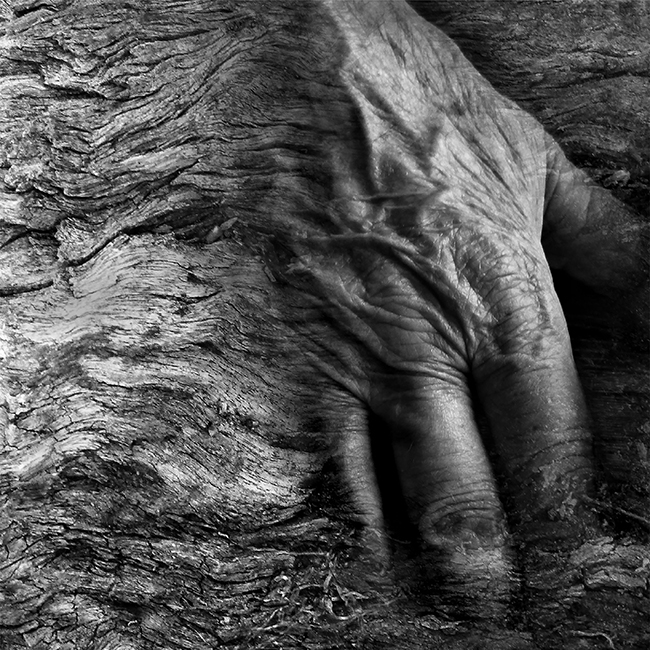

Skinbark ©Lyndall Gerlach

Mark Van Veen also brought us an image from an ongoing series, “Point of Return”, exploring reflections in our urban environment and how they alter our view of the world.


Blue Kimono Takamatsu 2019 7626 © Mark Van Veen

Jim McKenna (technically no longer a Canberran as he has moved to the Bega Valley, but still a participating member of the Canberra Photographic Society) tells a powerful story about life’s journey.


Life’s Journey © James McKenna

And the final featured Canberran is me with an image seeking to show that there is nothing to fear.


The Black Crow © Brian Rope

I could discuss every other image in this fine exhibition, but I’ll leave that to you to explore them for yourself via the virtual gallery mentioned in the opening paragraph of this. After exploring them you can vote for the People’s Choice Award. I haven’t decided yet but am leaning towards giving my personal vote to an image about the need for good to triumph over despair.


Helena and Florek © Sue Joy


TWO OF US (DEUX)

Written by Malysone Bovorasmy, Filippo Meneghetti

Directed by Filippo Meneghetti

Alliance French Film Festival 2020

Palace Cinemas from 14 July to 4 August


Previewed by Len Power 10 July 2020

Two elderly women, Nina and Madeleine, have had a secret relationship for many years.  To maintain their relationship after Madeleine suffers a debilitating stroke, Nina negotiates a perilous path between Madeleine’s unsuspecting grownup children and an increasingly suspicious employed carer.

This moving film, directed by Filippo Meneghetti, shows the difficulties than can arise when participants in a same-sex relationship feel the need to keep it hidden from the world.  Suddenly losing access to a loved one would be unbearable enough, but having to keep quiet about your feelings as well would be isolating and intolerably painful.

Nina and Madeleine have lived for years on the same floor of an apartment block and, to Madeleine’s family, Nina appears to be just a concerned neighbour.  After the stroke, Nina’s offer to help with her partner’s care is rebuffed, leading her to make secret nocturnal visits into Madeleine’s apartment while her 24 hour carer is sleeping there.

These stealthy apartment visits add a high level of suspense to the film as we hold our breath waiting to see if Nina will be caught.  Nina’s love for Madeleine forces her go to extraordinary lengths to maintain access to her.  As Madeleine slowly recovers, it’s clear that Nina’s secret contact with her is aiding her recovery.  When a family member discovers the truth about their relationship, their negative reaction threatens to undo the fragile recovery process.

Martine Chevallier

At the heart of this film are two very fine performances by Martine Chevallier as Madeleine and Barbara Sukowa as Nina.  In the early part of the film, Chevallier is very convincing in her anxiety to hide her secret relationship from her family and, later, as a stroke victim slowly recovering some of her faculties, she gives a subtle and carefully measured performance of great realism.

Barbara Sukowa

Nina is the more outgoing of the two women and, in her performance, Barbara Sukowa gives her an obsessive dynamism that we fully understand.  The luminous portrayal of her love for Madeleine is stunningly real.

There is fine support from Léa Drucker as Madeleine’s daughter, Anne, and Muriel Bénazéraf as the increasingly aware care-giver.

This a fine first feature film from director, Filippo Meneghetti.  It’s gripping and suspenseful as well as moving and insightful into the impact that people’s attitudes towards relationships can have on everyone concerned.

 ‘Two Of Us’ is one of the films that will be showing in the 2020 Alliance French Film Festival in Canberra at the Palace Cinemas from 14 July to 4 August.

 Len Power’s reviews are also broadcast on the Artsound FM 92.7 ‘In the Foyer’ program on Mondays and Wednesdays at 3.30pm.

 ‘Theatre of Power’, a regular podcast on Canberra’s performing arts scene with Len Power, can be heard on Spotify, ITunes and other selected platforms or at https://player.whooshkaa.com/shows/theatre-of-power.

HAMILTON


Book, Music and Lyrics by Lin-Manuel Miranda

Directed by Thomas Kail

Streaming via Disney+

Reviewed by Len Power 4 July 2020


‘Hamilton’, the musical with book, music and lyrics by Lin-Manuel Miranda was inspired by the 2004 biography ‘Alexander Hamilton’ by Ron Chernow. It opened on Broadway in 2015 to great critical and audience acclaim, winning 11 Tony Awards and the Pulitzer Prize for drama. Since then it’s become a ‘must-see’ phenomenon and is due to be staged here in Australia in 2021.

The Broadway production with its original cast was filmed live on stage in 2016 for an expected theatrical release in 2021. However, the Disney + streaming platform reportedly paid $75 million dollars for the rights to show it world-wide from the 4th of July this year.

It tells the story of American Founding Father, Alexander Hamilton. He’s pushy and abrasive which is OK because he’s just following the American Dream and, when he gets shot dead at the end of the show, we’re meant to feel sorry that his dream was shattered.

The music of the show draws heavily from hip hop, as well as R&B, pop, soul, and traditional-style show tunes. It also casts non-white actors as the Founding Fathers and other historical figures. This gives the show an added interest but it’s hardly revolutionary. Anachronistic music scores are not new and colour-blind casting has rightly been around for a while now.

It’s superbly performed by the large cast, all of whom sing the very tricky score extremely well. The direction by Thomas Kail keeps it all fast moving and it looks terrific – colourful and full of life. The lighting plot is extraordinary, creating fast changes in atmosphere and mood. There is constant choreography in the background by accomplished dancers that adds to the energetic feel and excitement of the show.

The lyrics are especially smart and incisive. Not a big fan of hip-hop, I found that aspect of the music repetitive and wearying, especially in the second act. Occasional flashes of harmony and various changes in music styles were a welcome relief.

If you are not familiar with this period of American history, it can be confusing to keep track of many of the characters being played by non-white actors. I can understand Americans finding the subject matter enthralling as it celebrates their own history but I wonder how interesting it will really be for Australians and others around the world.

There has been a vast improvement over recent years filming live shows for broadcast on television. The filming and editing of ‘Hamilton’ is excellent.

I was satisfied to see the show via streaming. It’s a fine show but not emotionally involving and I can’t see why it’s considered such an outstanding event when compared to other successful Broadway shows of the past few years.

Len Power’s reviews are also broadcast on the Artsound FM 92.7 ‘In the Foyer’ program on Mondays and Wednesdays at 3.30pm.

‘Theatre of Power’, a regular podcast on Canberra’s performing arts scene with Len Power, can be heard on Spotify, ITunes and other selected platforms or at https://player.whooshkaa.com/shows/theatre-of-power.


THE NANCE


Written by Douglas Carter Beane
Directed by Jack O’Brien
A 2013 Lincoln Centre Theatre, New York production
PBS Series Live recording currently available on YouTube
Reviewed by Len Power 30 June 2020

Written by Douglas Carter Beane, ‘The Nance’ focusses on the lives of a group of burlesque performers in a New York theatre during the 1930s.

Burlesque was an entertainment that was popular in the USA from the 1860s to the 1940s in cabarets and clubs as well as theatre.  Presented in a variety show format, it featured bawdy comedy and female striptease.  Many famous comedians such as W.C. Fields, Eddie Cantor and Phil Silvers honed their skills in burlesque before going on to fame in legitimate theatre and movies.

A ‘nance’ was an exaggerated effeminate homosexual comic character in burlesque.  The character had to tread a dangerously fine line between suggestive humour and the law at the time.  Police raids on burlesque in the late 1930s, when the play is set, were becoming increasingly common at that time.

Nathan Lane plays Chauncy Miles, the nance at a New York burlesque theatre.  Gay in real life, Chauncy meets Ned, a young man recently arrived in New York and commences a relationship with him.  After years of furtive meetings with random men, Chauncy finds it hard to commit to a relationship with Ned who clearly loves him.

The story of this couple is punctuated with classic burlesque performance on the stage of the theatre where Chauncy works.  Nathan Lane is superb in the nance comedy sketches.  His energy, rapid fire line deliveries and sense of timing are breath-taking.  His performance is reminiscent of Lou Costello of the comedy duo Abbott and Costello, who also started in burlesque.

Lane is equally adept at the dramatic side of the story, showing every facet of a bitter, unhappy man unable to accept or return affection and using sarcastic humour to push people away from him.

This is a star vehicle for Nathan Lane and he is given excellent support by Jonny Orsini as Ned and Cady Huffman, Andréa Burns, Jenni Barber, Lewis J. Stadlen, and Geoffrey Allen Murphy as other burlesque performers.

Director, Jack O’Brien, incisively points up the contrast between the onstage and offstage lives of these characters, obtaining performances of great depth by his cast.

A detailed revolving set designed by John Lee Beatty shows the stage of a burlesque house, its backstage area, and Chauncey's apartment and Ann Roth has provided great period on and off stage costumes.

The opportunity to see Nathan Lane’s powerful, award-winning performance at the heart of this fascinating play about the burlesque era is not to be missed.  It’s currently available for viewing on YouTube.

Len Power’s reviews are also broadcast on the Artsound FM 92.7 ‘In the Foyer’ program on Mondays and Wednesdays at 3.30pm.

‘Theatre of Power’, a regular podcast on Canberra’s performing arts scene with Len Power, can be heard on Spotify, ITunes and other selected platforms or at https://player.whooshkaa.com/shows/theatre-of-power.


Shadows and Consequences

Photography Review by Brian Rope

Vic McEwan: Shadows and Consequences

PhotoAccess

Until 25 July 2020


This exhibition focuses on the impact of human activity, and the role of the arts and photographic media, exploring the period during which scientists say we have significantly altered the Earth. The changes include global warming, habitat loss, altered chemical composition of the atmosphere, oceans and soil, and animal extinctions. Addressing all of that is a huge challenge, but one that the artist has tackled imaginatively.

 What do embryos, intestines, bogongs and a koala paw have in common? They’re all animal specimens, mostly from the National Museum of Australia’s collection that some of us will remember seeing in jars at the old Institute of Anatomy. Vic McEwan has photographed the specimens and then projected his images onto diverse surfaces to create new still and video images.

Selection of projection sites was important in telling the story. Sections of old walls along the River Thames during periods of low tides. Plymouth walls dating from the time of Cook’s voyages of discovery. An ancient fort in Portsmouth, from where the First Fleet departed.


Vic McEwan, Koala Paw - River Thames, 2020, photographic archival pigment print, 84.1cm x 59.4cm


Vic McEwan, Specimen Foliage - Plymouth, 2020, photographic archival pigment print, 84.1cm x 59.4cm


Vic McEwan, Embryo - Portsmouth, 2020, photographic archival pigment print, 59.4cm x 42cm

The Arthur Phillip monument in the centre of London displays a wonderful image of lizard intestines. McEwan rightly suggests they look like a big bunch of balloons. This is intimate, being only a 40 or 50 cm wide projection, quite different from the other images.

One specimen is a monkey’s head – a curious collection item as monkeys are not native to Australia. Foliage in the form of ivy appears on one projection wall. Two animals in one jar – a love story? Each element of every image contributes to the complex story that is shared with us.

The projections in England were done using a small handheld projector with its batteries charged in Australia using solar power. More connections! Back in Australia at Narrandera, on the Murrumbidgee, and close to McEwan’s own house, he used a much more powerful projector – takes 4 people to carry it – because of the projection distance.

In the second gallery, images show the same body of specimens projected onto smoke during the recent Summer of bushfires. Again, this is about the consequences of the way European colonisation has impacted on Australia – millions of animals have died because of fires and smoke. The specimens are not recognisable in these – to viewers who do not have the artist’s knowledge of them. He accurately describes the result as “paintings” in projected light. They would stand alone as images if we knew nothing of their purpose here. A much bigger catastrophe is represented in these strong works.

Then there are three images of bogongs from a CSIRO collection – taken at Mt McKay in Falls Creek. Scientists are trying to find out why bogongs have disappeared from there in recent years. So, the artist used projections to return moths into that landscape.

In the third gallery space I thoroughly enjoyed a three-act video work made from materials gathered during the project. Almost hosted by lizard and kangaroo specimens, it steps through the chronology from departure of the First Fleet through to the current day’s consequences. The video soundtrack also was made on the sites of the projections. We hear the artist playing the Arthur Phillip monument with a bow and extracting bell sounds from the bars in windows of the old Plymouth fort. Sonically mined from the time when they were built.

McEwan speaks about his work in a 37 minutes recording. This “photo-story” is available on the Photo Access online gallery and is an excellent audio guide if used when walking through the exhibition.

This review was also published in The Canberra Times and in Brian Rope Photography’s blog at https://brianropephotography.wordpress.com/, both on 11 July 2020.


Monday, July 6, 2020

HAMILTON - Original Broadway cast, 2016 film livestream


Book Music and Lyrics by Lin-Manuel Miranda

Directed by Thomas Kail – choreographed by Andy Blankenbuehler

Scenic Design by – David Konins – Costumes by Paul Tazewell

Lighting by Howell Binkley – Sound by Nevin Steinberg

Streamed by Disney Plus from 3rd July 2021.

Reviewed by Bill Stephens.

Since Hamilton premiered on Broadway in 2015 It’s been showered with awards, including 11 Tonys,  and has quickly become a world-wide phenomenon. Though the Broadway production is currently closed because of the Covid-19 restrictions, the Australian production of Hamilton is, at last reports, still scheduled to open in Australia in 2021.

As part of the American 4th July Celebrations, Disney Plus has released a film of Hamilton,  made in 2016, which features the original Broadway Cast, which it is streaming in Australia from 3rd to 7th July, and  which, thanks to the American Embassy in Canberra, I was invited to view.

Deliberately ambiguous, with a cast of non-white actors portraying America’s founding fathers and other historical figures, brilliantly designed costumes that suggest historical accuracy without actually being so, and scenery on revolving stages constantly materialising on the brilliantly lit stage,  Hamilton tells the story of founding father, Alexander Hamilton, by detailing major events in his life through a fusion hip-hop, soul, R & B, and conventional show tunes.

The concept and execution of the show is breathtaking.  Its sheer pace and complexity is both exhausting and exhilarating. Your eyes are continually tantalised by swirling figures, magnificent costumes and striking lighting effects, while your ears strain to capture every syllable of the brilliant dialogue, delivered at break-neck speed, by the ever-changing milieu of characters, appearing, and then disappearing as seamlessly as they arrived.

While you don’t have to be student of American history to follow the plot, it would certainly be an advantage. Otherwise it’s unlikely that many non-Americans will fully appreciate the historical nuances which abound, or recognise many of the historical characters being portrayed. The colour-blind casting offers little assistance in this regard, and no doubt, watching it in a theatre, the significance of many of the plot details are likely to escape.

Despite this, the brilliant staging, the intensity of the performances and the choreographic spectacle, are more than sufficient to stamp Hamilton as a “must see” musical experience.

 All these elements were revealed at very first viewing, and among the advantages of viewing a film of the production, is the opportunity to experience subtleties of the actor’s performances in close-up. Another is the opportunity to watch it a second time……with surtitles.

Being familiar with most of the lyrics from my CD of the show, I thought I had heard everything significant, first time through. But the surtitles were a revelation. Miranda’s extraordinary facility to manipulate words, and rhymes, to match, exactly, the complex personalities of each of his characters, is captivating, and part of the appeal of the show.

But, as anyone who’s been to an opera quickly realises,  there is so much more to be discovered with the assistance of surtitles. In the case of Miranda’s marvellously complex lyrics, it’s tantamount to rediscovering the brilliance of the show for the first time.

Another advantage of this excellent film is that it captures for posterity the performances of the original Broadway cast. These performances will become the templates for the actors who succeed them in the many productions this show will inevitably spawn around the world.

Included among these performances is that of the creator of Hamilton, Lin-Manuel Miranda, who, besides being one of the producers, and providing the book, music and lyrics, also plays the title role of Alexander Hamilton in this production. His is an impressive performance, but it will be interesting to see other actors interpret this role.

There are many other strong performances, including that of Leslie Odom Jr., who plays Aaron Burr, Hamilton’s rival, and ultimately, his assassin.  Daveed Diggs as Thomas Jefferson, and Renee Elise Goldsberry as Angelica Schyler, Hamilton’s sister-in-law, both give commanding performances, while Phillipa Soo brings a captivating mixture of fragility and strength to the role of Hamilton’s long-suffering wife, Eliza.  Christopher Jackson also impresses with the dignity and warmth of his characterisation of George Washington.

But for this reviewer, the element of this production that burns itself into the memory is the  precision and recklessness of the superb ensemble which stunningly executes  Andy Blankenbuehler’s mesmerising choreography to provide a constantly moving frame for the central performances. I can’t wait to see Hamilton in a theatre.


This review also appears in Australian Arts Review. www.artsreview.com.au