Friday, September 16, 2022

The Barber of Seville


The Barber of Seville by Rossini.  Opera Australia on tour at Canberra Theatre Centre, September 15-17 2022.

Reviewed by Frank McKone
September 15

Composer – Gioachino Rossini; Libretto – Cesare Sterbini
Conductor – Luke Spicer; Director – Priscilla Jackman
Set Designer – Michael Scott-Mitchell; Lighting Designer – Morgan Moroney
Costume Designer – Sabina Myers

Characters:
Rosina – Esther Song; Count Almaviva – Nicholas Jones
Figaro – Haotian Qi; Dr Bartolo – Andrew Moran; Don Basilio – Shane Lowrencev
Fiorello & Coro – David King; Berta – Jennifer Black
Officer – Michael Lampard; Notary & Coro – Cathy-Di Zhang
Coro – John Longmuir; Coro – Andrew Williams; Coro – Dominica Matthews

Orchestra:
Leader/Violin 1 – Matthew Rigby; Violin 2 – Phoebe Masel
Viola – Mariette Reefman; Cello – Stephanie Arnold
Double Bass – Hamish Gullick; Flute – Eliza Shephard
Oboe – An Nguyen; Clarinet 1 – Amy Whyte
Clarinet 2 – Jarrad Linke; Bassoon – Chris Martin
Keyboard – Jane Matheson
Orchestra Reduction – Simon Bruckard

Children’s Chorus: Woden Valley Youth Choir
Children’s Chorus Master – Kate Joy Stuart

_____________________________________________________________________

This is how I might have imagined the style for The Barber of Seville in Rossini’s day:

[ https://www.pinterest.com.au/pin/98023729377420159/ ]
cerovic_designs • Accademia Costume & Moda

 ________________________________________________________________________________

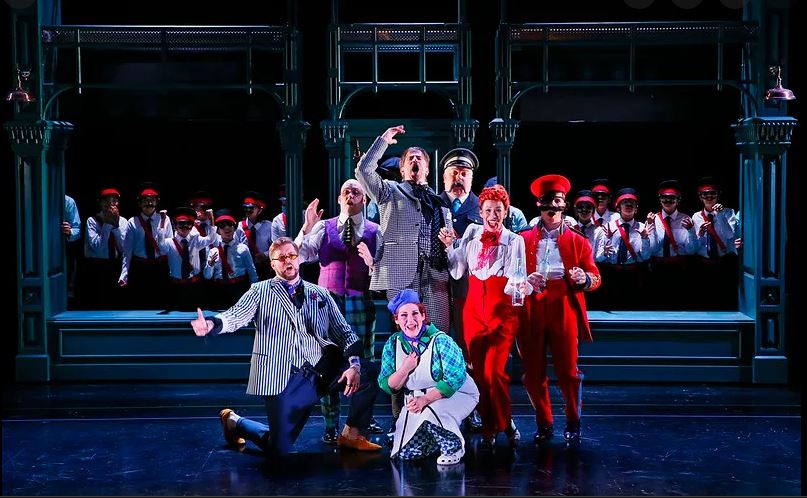
This is Opera Australia’s program centrefold picture of Rossini’s characters (the cast in this image are in their alternate roles which change from performance to performance):
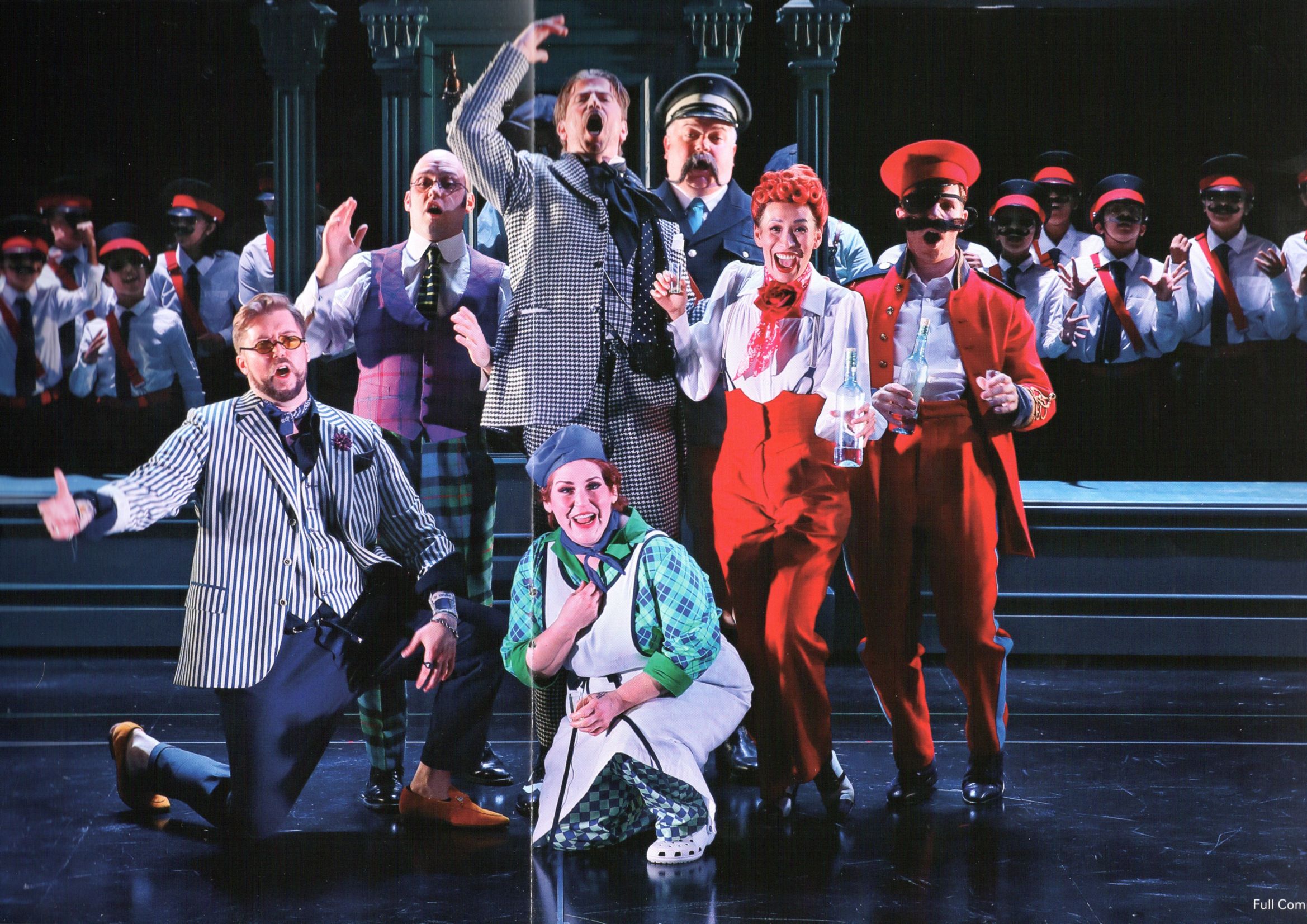
 

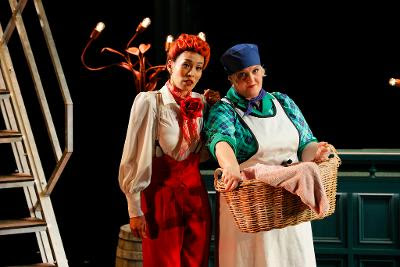
Here we see a quite different style of costuming and characterisation.  Instead of a sophisticated version of Italian street theatre – commedia dell'arte – director Priscilla Jackson has shifted us from “Rossini’s Seville [as] a place of great fun, romance and the frolicking pleasures of life” and his “incredibly infectious and frothy music” to an absurdist modern comedy: “a world of ever moving delights, of intrigue, disguises, games, near catastrophes, amusing diversions, large moustaches, romps and romance”.  

Yet we must not forget the warning in Figaro the Barber’s final words:

FIGARO
Here is really the "Futile...

ALL
...Precaution"!

FIGARO
So happy a reunion
let us remember for ever.
I put out my lantern,
I am no longer needed.


while everyone sings again and again:

May love and faith eternal
reign in both your hearts.


not only to Rosina and Count Almaviva, but as an invocation to us all.  As Jackman writes, “In coming together as a community (moustaches and all), we are delighted to celebrate the whimsical games of love and connection with you through Rossini’s timeless, The Barber of Seville.”

The acting and choreography in this production are as excellent as the singing and the delightful small orchestra, but the extra level of absurdity which begins with everyone on stage wearing huge moustaches, and ends with an injunction to us – not in the original script, of course – to keep wearing our moustaches as we applaud, is a reminder.  Can we remain true to love and faith eternal, or will we need this Figaro again to light up his lantern?

Jackson notes that “it was interesting for us to reframe Rosina away from the damsel in distress needing to be rescued from the clutches of her controlling guardian, and create an environment for a more autonomous Rosina” who, in setting up her own business, is equal in status to the wealthy Count she loves, as he does her.  

The froth in the music becomes more substantial as the significance of the role of Figaro becomes clear.  There are four men with an interest in the woman, Rosina.  Her guardian, Bartolo, is a coercive controller.  His intention is to force Rosina to marry Don Basilio, an equally coercive controller.  The marriage would be a social status and maybe financial asset for Bartolo.  

Figaro, the barber who cuts every man’s hair, and thus knows the ways of all men, recognises the injustice of Rosina’s position and sees the genuine sincerity of Count Almaviva’s attraction to her, and of her response to him.  Though Almaviva is essentially naïve, Figaro takes a thoughtful, objective stand.  

He knows that, even if romance may not last forever, he has a duty to find a way to bring these two together because they are right for each other.

This, the good man behind the froth and often frantic comedy, is the achievement of Cesare Sterbini and Gioachino Rossini which makes The Barber of Seville timeless.  In our terms today, love is a human right; coercive control is at last a crime.  Figaro lives on.

Opera Australia offers us great entertainment, and more, in this engaging interpretation of The Barber of Seville.


THE BARBER OF SEVILLE


ROSSINI

THE BAR u The Barber of Seville.  

THE BARBER OF 


The Barber of Seville. 

Composer Giochino Rossini. Librettist Cesare Sterbini. Directed by Priscilla Jackman. Set design by Michael Scott-Mitchell. Costumes by Sabina Myers.Lighting designer Morgan Moroney. Conductor Luke Spicer. Orchestra Reduction Simon Bruckard. Children’s Chorus Master Kate Joy Stuart. Opera Australia. Canberra Theatre. Canberra Theatre Centre. September 15-17 2022. Bookings: 62425711. www.canberratheatre.org.au


Reviewed by Peter Wilkins


Opera Australia's scintillating production of Gioachino Rossini’s comic opera The Barber of Seville pops up like  an exploding cork from a sparkling bottle of the finest Italian Prosecco. Director Priscilla Jackman’s fun-filled romp is just the ticket for Opera Australia’s touring production. Rossini’s popular romp about Count Almaviva’s love-struck pursuit of the beautiful Rosina is given a fresh-faced makeover by Jackman, designer Michael Scott-Mitchell and costume designer Sabina Myers. The entire production absolutely glitters with colour and visual effervescence, highlighted by  Morgan Moroney’s lighting design. The effluence of pink in the costuming, wigs and handlebar moustaches lend the whole production a candy stick sweetness that perfectly attunes with the frothiness and gaiety of Rossini’s composition. 

Rossini and librettist Cesare Sterbini have drawn heavily on the improvisational Commedia dell’arte. The stock characters of Commedia are immediately identifiable in The Barber of Seville. The lovers, Almaviva and Rosina, are being thwarted in their attempts to be together by Pantalone, Rosina’s ward and propspective husband Don Bartolo (Michael Lampard). Almaviva enlists the aid of Arlecchino , the barber Figaro (Haotian Qui) who devises ways to confound Bartolo and his Capitano, music teacher Don Basilio (Shane Lawrence). Comedia’s Brighella  and Arlecchino’s accomplice  is represented in the opera by Berta (Jennifer Black). Jackman employs the hilarious techniques of Commedia to give her production the flair and frolic of Rossini’s side-splitting entertainment.  There are sight gags by the score, slapstick to tickle the funnybone, disguises to mock and confound, and routines to bewilder and trick the unsuspecting Bartolo. Guile wins the day, pomposity is fooled and love triumphs as it should.  All results in an evening of uproarious hilarity and mirth. 

To make the touring even more accessible to the regions, Jackman and Scott-Mitchell have set the opera near the Yarra Valley winemaking town of Seville. Scott-Mitchell’s shopfront is readily identifiable as the wrought iron establishment of the 19th century country town. It is where the townsfolk may enjoy “Sevillized Libations”.

The highly physical and energetic production is performed in Italian with English surtitles. Careful attention is given to the singers, so that Jackman’s blocking complements conductor Luke Spicer’s lively orchestral interpretation. The result is a splendid harmony of stage business and musical rendition of Rossini’s uplifting composition. A look at the touring schedule of Victoria, New South Wales, Tasmania and the ACT is proof enough of the exhausting schedule and demands on the voices of Opera Australia’s fine singers. It is not surprising therefore that Jackman has doubled up her cast and the singers mentioned here are the performers at the Canberra season. Doubling up alleviates the weightier demand on the principals and each town provides the delightful Children’s Chorus  under the tutelage of Kate Joy Stuart and all dressed in their urchin garb and caps with bright pink moustaches. This is an experience they will never forget!

Rossini’s music is immediately identifiable and the cheeky, cocky, posturing rendition of Figaro. Figaro. Figaro sung with aplomb by baritone Qi sets the mood for an evening of fun and laughter. The delight is infectious. The singers revel in Jackman’s directorial vision and Spicer and his touring size orchestra  lend a spirited accompaniment to the show.

First staged in 1816, The Barber of Seville remains a popular favourite in the operatic repertoire. Rossini’s composition bristles with the spontaneity of a richly coloured improvisation and director Jackman, conductor Spicer and the company make the most of Rossini’s youthful playfulness. Opera Australia’s 2022 tour of The Barber of Seville concludes on a high note with the Canberra season and a production that could simply keep on touring and delighting audiences across the land.


THE BARBER OF SEVILLE


Libretto by Cesare Sterbini

Music by Gioachino Rossini

Directed by Priscilla Jackman

Opera Australia

Canberra Theatre to 17 September


Reviewed by Len Power 15 September 2022


As the overture commenced for Rossini’s ‘The Barber of Seville’, it was a bit of a shock to become aware of the cast wearing all kinds of big moustaches and standing motionless on the dimly lit set.  They were staring at us with what seemed to be sinister intent.

It was all a joke, of course, and it signalled that disguises were going to be a major part of the story.  Rossini’s opera is a delightful romantic and farcical romp.  Count Almaviva, in love with Rosina, enlists the help of the roguish barber, Figaro, to win her hand in marriage.  A dizzying plot ensues with Almaviva donning not very convincing disguises to outwit Rosina’s guardian, Dr Bartolo, who plans to marry Rosina himself to get his hands on her fortune.

Set in Victoria’s wine country (where there really is a town called Seville), the set for Opera Australia’s production has been cleverly designed by Michael Scott-Mitchell to evoke one of those old shops with original fittings you can still find in country towns around the country.  The use of moustaches throughout the show on costumes, set and props reminds us that we are just here to have a good time.  Even the doctors have moustaches painted on their face masks.


The director, Priscilla Jackman, keeps the fun moving at a fast pace.  Every moment and set change has been tightly choreographed, making it a pleasure to watch as well as listen to.

This touring production has alternating cast members.  At the opening night performance every character was beautifully played by this well-directed ensemble and their singing was excellent.  Esther Song sang and acted a superb Rosina and there were great comic characterizations and singing from Nicholas Jones as Count Almaviva, Haotian Qi as Figaro, Andrew Moran as Dr Bartolo, Shane Lowrencev as Don Basilio, David King as Fiorello, Jennifer Black as Berta and the rest of the cast.  A children’s chorus of locals sang well and confidently joined in the quirky spirit of the production.

The conductor, Luke Spicer, ensured that both singers and orchestra produced a fine sound for this beautiful score.

This production of ‘The Barber of Seville’ was a delight from start to finish.  It’s hilariously wacky, beautifully sung and acted and a sumptuous feast for the eyes as well.


Photo by Jeff Busby

Len Power's reviews are also broadcast on Artsound FM 92.7 in the ‘Arts Cafe’ and ‘Arts About’ programs and published in his blog 'Just Power Writing' at https://justpowerwriting.blogspot.com/. 

Thursday, September 15, 2022

WHO'S AFRAID OF VIRGINIA WOOLF

 Who's Afraid of Virginia Woolf - Website.jpg

Who’s Afraid of Virginia Woolf by Edward Albee.

Directed by Cate Clelland. Set and costumes designed and created by Cate Clelland and company. Stage Manager Sophia Carlton. Lighting design. Nathan Sciberras. Sound design. Justin Mullins. Free Rain Theatre at ACT HUB. Kingston. September 2 – 17. 2022. Bookings: enquiries@acthub.com.au

Reviewed by Peter Wilkins


The cast of Who's Afraid of Virginia Woolf


At the close of Act One of Edward Albee’s Who’s Afraid of Virginia Woolf  a single spot beams down on university history professor George, standing alone in the centre of the living room of his university residence. Slowly a self-satisfied smirk of one-upmanship curls about his lips. Albee’s masterpiece of psychological sado-masochism, played out by middle-aged George and his vituperative wife, Martha, the privileged daughter of the university president erupts into a bitter and spiteful game of dog eat dog  accusation and reciprocal recrimination. It is a game honed to painful perfection over years of combative and interdependent marriage. It is a vicious and destructive game in which George (Michael Sparks) and Martha (Andrea Close) clearly know the rules, interchanging the roles of victim and oppressor with instinctive, well-practised domination. It would be simple to regard Albee’s brilliantly insightful and laser sharp text as a cynical condemnation of matrimonial discord.

Fortunately and to the immense credit of director Cate Clelland’s perceptive sensitivity for subtlety and nuance, Free Rain Theatre’s revival of Who’s Afraid of Virginia Woolf probes a deeper and more profound psyche. Clelland and her cast and creative team have produced a tour de force theatrical triumph, a masterclass in acting and a resounding tribute to the late playwright’s grasp of human nature within the cloistered confines of the refined world of academia. It echoes again the critical analysis of university life in C.P. Snow’s seminal work Two Cultures.

George and Martha’s cathartic ritual of self-deprecation and abusive exploitation takes on a more sinister impact with the arrival of newly arrived biology professor Nick (Josh Wiseman) and his young wife Honey (Karina Hudson). The older couple have invited the newbies back for late night drinks after attending a function hosted by Martha’s authoritative father.  The unwitting flies are lured menacingly into the spiders’ intricately woven web of painful secrets and dangerous vulnerabilities.

Before they know it and fuelled by excessive alcohol and the weariness of the late night advance to the dawn, Nick and Honey find themselves as the pawns within George and Martha’s game. George and Martha continue their scathing attacks upon each other while drawing out their guest’s dark and private secrets as weapons to be used to humiliate and intimidate. The young couple, unused to such self-flagellation and vitriolic argument find departure impossible as the web tightens and resentment and defensiveness build. Honey’s Innocence is drowned in a sea of brandy and vomit while Nick is shattered by the  brutal exposure of his impotence. As the game plays out, Nick and Honey find themselves irrevocably embroiled in the cruel rules of Humiliate the Host, Hump the Hostess, Get the Guests and Bringing Up Baby. Lies are revealed, truths are exposed. Nick and Honey depart forever changed as they walk out into the cold New England air, leaving George and Martha in a comforting embrace. George is gently singing “Who’s Afraid of Virginia Woolf..Virginia Woolf…Virginia Woolf.”

Albee’s emotionally harrowing microscopic play demands the finest performances from actors who are at the top of their game. Cate Clelland’s cast present an extraordinary rollercoaster  ride of emotional polarity. Sparks strides the chasm of meek intimidation to vicious accusation. Close spits her vituperative insults in one instant while wailing with heart rending despair at George’s cruel torment. Hudson gives an extraordinary performance of the fragile, slim hipped Honey, one moment spitting with hysterical spite and another withdrawing into and alcoholic haze. Wiseman skirts the perilous path of bright young cocky confidence of his privileged position and his sexual and intellectual inferiority. Clelland’s casting is superb and her actors give performances that are equal to the very best at Canberra’s new performance venue ACT HUB.

If you have seen Free Rain’s outstanding revival of “Who’s Afraid of Virginia Wollf” you have been fortunate enough to see a production that deserves the highest accolades. If you haven’t and there is time before the short season comes to an all too soon close on Saturday, then don’t delay. This is truly unmissable theatre.It deserves packed houses and extended runs, but alas, I fear that it will be over all too soon and too many lovers of theatre and students of acting will have missed out. It deserves to be on a mainsage, playing to a packed and glued to their seat audience.

This production is another ACT HUB gem that will sparkle in the memory long after the lights go down.


Monday, September 12, 2022

EXPLICIT CONTENTS - Gorman Arts Centre.


Ivey Wawn and David Huggins in "Explicit Contents"
Image: Lucy Parakhina


Choreographed for Rhiannon Newton – Music and Sound design by Peter Lenaerts..

Lighting design by Karne Norris – Costume design by Agnes Choi.

Performed by Ivey Wawn and David Huggins

QL2 Dance Theatre, Gorman Arts Centre. 9th & 10th September.

Performance on the 10th September reviewed by Bill Stephens.


Although Canberra boasts a thriving local dance scene, and the city often plays host to major dance companies, opportunities to see the work of emerging professional choreographers happen relatively rarely. Therefore these performances in the QL2 studios at the Gorman Arts Centre, produced by Katy Green Loughrey, provided a welcome opportunity to experience the work of Sydney/Canberra based choreographer, Rhiannon Newton. 

This work, “Explicit Contents”, was premiered at the 2021 Sydney Festival and performed in the Sydney Dance Company’s inaugural INDance program. It was also performed at Dancehouse Melbourne.

In her program notes Newton explains that the work was born of her desire to “emphasise how bodies are not separate from but inextricably connected to their environments”.  She goes on to explain that she envisioned “Explicit Contents” as “a series of sensorial encounters, each amplifying a different material or energetic connection between the body and the world”.

Promoted as an invigorating and cutting-edge contemporary dance work, it came as something of a surprise to discover that the work contained very little of what could actually be described as dance.  The bulk of the work consisted largely of a series of long, dimly lit tableaus, performed by the dancers in ultra-slow motion, mostly in unison.

These tableaus were often quite beautiful; bringing to mind Bill Viola artworks as the dancers slowly performed various tasks, their bodies enhanced by a superb lighting design by Karen Norris, which allowed the audience to focus on the movement of their musculature.

David Huggins devours a mango
Image - Gregory Lorenzutti


The sequences were separated by extended periods of complete darkness, to allow the performers to change position or to add or remove items of costume before being slowly revealed for the next sequence.

Often the lighting was so dim that the audience had to peer deeply to try and make out what the dancers were actually doing.  One task required them lie on the floor, stretch their bodies and turn slowly. For another they simply sat, leg’s crossed, and devoured a piece of fruit in real time.  Another required each to balance a clear glass bowl of water on their stomachs and undulate the bowls with their stomach muscles.  


Ivey Wawn - David Huggins
Image: Lucy Parakhina.

For the finale, the two dancers held the bowls above their heads, upturned them and allowed the water to pour over their bodies. Then, following another lengthy black out, they were revealed twirling on their bottoms in the water on the floor, possibly nude, but the lights were too low to be sure.  

Following one final long drowse-inducing black-out to allow them to dry off and gather some clothes, the dancers took their bows, leaving at least one bemused member of the audience in awe of the endurance of two obviously highly trained dancers - pleased to have recognised the sensorial encounters - pondering on why contemporary dance has so much trouble attracting audiences -wondering if the choreographer had achieved her stated aims - and what had happened to the promised invigorating contemporary dance bit - but pleased to have had the opportunity to experience a cutting-edge contemporary dance work. .


How To Vote


How To Vote!

Or, the repurcussions of political ambition and personal rivalries withtin student leadershipand media organizations in the context of the Post-Covis-19 Neoliberal university institution.

 by Julian Larnach.

Directed by Luke Rogers. The Playhouse. Canberra Theatre Centre. September 7-10 2022

Reviewed by Peter Wilkins

 Canberra Youth Theatre commemorates its fiftieth anniversary this year and if Luke Rogers’ production of Julian Larnach’s How To Vote is anything to go by the company has every cause for celebration. Judging by Larnach’s witty, ironic and highly entertaining insight into the wild world of university life it seems that everything is fair in love and students politics.

Tracy Noble as Vice Chancellor. Jack Shanahan as Figaro

It is time for the student body to elect the next year’s president of the student council Current president Tash played with conniving assurance by Joanna Richards has decided not to seek re-nomination. The university Vice Chancellor in a somewhat fey performance of a befuddled VC by Tracy Noble has summoned hopefuls Lizzie (Caitlin Baker) and Giles (Matt White). Things get a little complicated when first year student Mon (Ella Buckley) decides to throw a spanner in the works and nominate in order to fill a hole outside her house after she stumbled into the hole and sprained her ankle. And so the race is on and director Luke Rogers sets it at a cracking pace with all the vitality and gung ho determination of youth. Campaign managers Philippa (Jasmine Atkins) for Lizzie and Warren (Nicholas Bermingham) for Giles drum up the fervour with the aid of Kev (Tim Cusack) on Lizzie’s team and Hanya (Rahel Alemseged) on Giles’s.

Enter Figaro played with riveting panache by Jack Shanahan as  political correspondent for the student newspaper and a weasel with a nose for scandal or a saucy story. He makes sure that he has something on everyone and if he doesn’t he’s sure to find a sneaky way to get it – like a photo of one candidate’s private part and involving Lizzie’s former boyfriend, Ron (Blue Hyslop) It doesn’t take long for the plot to thicken with all the subterfuge, innuendo, and dirt that a student journalist like Figaro can dig up to get a good story. It all sounds very familiar, but universities are the breeding grounds for future careers and Larnach from his own experience knows what it takes to win the presidency.

Joanna Richards as Tash

In four carefully contrived acts, Larnach guides the audience along the bumpy road to election. From the unexpected nomination to the chaos of campaign to the disaster of debate to the end game election Larnach keeps us glued to the stage.  Will Lizzie win on her platform of environmental issues? Or Giles with his ingratiating rally for religious acceptance and sport? Surely not Mon who simply wants to “Fill The Hole”? There’s a metaphor in every slogan. The pressure is on and Lizzie breaks up with Ron and walks out on his basement production of Julius Caesar. Gert (Martha Russell) on Facetime implores boyfriend Giles to join her in Europe, but Giles has other things on his mind, and so they battle on through scandals, resignations, break-ups and the sheer adrenalin of vaulting ambition. And all the time there is Tash pulling the strings and Figaro unravelling the secrets  and preparing for the grand expose. Not even colleagues Elise (Thea Jade) and Andy ((Mischa Rippon) can keep this sneaky sleuth under control.

And when it all comes undone, who do you think has won. The instructions flash up on the screen, “Get out your phones – no seriously get out your phones. Scan the QR code and cast your vote. And the winner is….

Matt White as Giles. Martha Russell as Gert
If this all sounds familiar, well it is, and it isn’t. It is not in the House on the hill or in the back rooms of the country’s seats of power. It is where it all begins, right there on the Campus. Larnach knows the scene and his insight is acute. The actors play the text with absolute authenticity, because it is their lingua franca. As for the relationships, it is no wonder that the wily Tash plays the mistress to  her devoted girlfriend and partner Pratchett ( Claire Imlach). The men are such drongos. Larnach aims at his target with sardonic delight and hits the bullseye every time.  Rogers’ directorial acuity is perfectly honed to breathe life into Larnach’s readily identifiable characters and Rogers keeps the pace moving and the comedy brimming with irony. He is  ably assisted by a talented creative team in Antony Hateley as lighting designer, Helen Wojtas as costume designer, Patrick Haesler as sound designer and Ethan Hamill as Video designer.  The result is a slick and engaging production.
Ella Buckley as Mon

This is not the first production that Rogers has brought to the Playhouse stage and overall his young cast handle the mainstage challenges well. There is room for further vocal training for young actors  who are less accustomed to the demands of a large stage. It is a skill well-honed by the more experienced performers, but it is not the only production that would be well served by employing a voice coach.

I amm left with a slightly despondent air by what is a highly entertaining production by Canberra Youth Theatre. If the shenanigans, scandals, manipulative skulduggery and ruthless ambition displayed so convincingly by the young performers, Lanarch’s tightly written script and Rogers’ fluid and precise direction pronounce the self-fulfilling prophesy of politics in the world beyond the hallowed halls of the university, what hope for the future. Maybe the hope rests not with Lizzie or Giles or even the accidental Mon, but with those who in the end scanned the QR code to cast their vote. There lies the hope that will guide us how to vote.

Jasmine Atkins as Phillipa. Caitlin Baker as Lizzie

Under Rogers’ artistic direction, Canberra Youth Theatre has entered a new era of theatrical sophistication. How To Vote is the proof and the promise , worthy of a youth theatre that has stood the test of time and gives voice to the young people of today and the citizens of tomorrow. Happy 50th Birthday CYT.


Photos by Dayna Ransley


Sunday, September 11, 2022

ART


Written by Yasmina Reza

Translated by Christopher Hampton

Directed by Shelly Higgs

A Street Theatre Production

The Street Theatre to 11 September


Reviewed by Len Power 10 September 2022


As much a clever study of the dynamics of friendship as well as the appreciation and value of art, Yasmina Reza’s play, ‘Art’, is an intellectually stimulating as well as an entertaining work.

Originally premiered in France in 1994, a translation of the play in English by Christopher Hampton has been a huge success internationally since its first production in London in 1996.  It has won many awards including the Broadway Tony Award for Best Play in 1998.

Serge has bought a new painting for an enormous sum of money.  His highly opinionated friend, Marc, criticizes the painting and questions Serge’s decision to buy it, causing a strain on their friendship.  A mutual friend, Yvan, tries to remain neutral and smooth things over.  An all-out argument ensues in which the three men use the painting as an excuse to criticize each other for perceived personal inadequacies.

The play resonates strongly as we identify with both the differences of opinion we have about the worth and importance of works of art and the way we view and make judgements about other people in our lives.  The play, very funny on the surface, becomes a personally confronting and questioning experience.

Christopher Carroll as Marc and Craig Alexander as Yvan

Director, Shelly Higgs has given the play a stylish production with fine acting by her expert cast of three.  As Marc, Christopher Carroll gives an impressive performance as an intellectual with a formidable and uncompromising coldness.  Craig Alexander is superb as the eccentric and oafish, Yvan.  His emotional meltdown over problems with arrangements for his forthcoming marriage was a tour-de-force, earning applause from the audience mid-play.  The quieter, but sharply observational character of Serge is skilfully played by Shane Dundas.  His non-verbal and physical comedy ability was also excellent.

Shane Dundas as Serge

The stylish set and costume design by Imogen Keen cleverly captured the essence of these three men and their different homes with simple and subtle changes.  The lighting design with its sharp brilliance by Gerry Corcoran gave the play a heightened reality and the sound design by Kimmo Vennonen added greatly to the atmosphere of the play.

This fine play with its excellent production and performances is a highly satisfying and enjoyable experience.


Photos by Creswick Collective 

Len Power's reviews are also broadcast on Artsound FM 92.7 in the ‘Arts Cafe’ and ‘Arts About’ programs and published in his blog 'Just Power Writing' at https://justpowerwriting.blogspot.com/.