Showing posts with label NPPP. Show all posts

Friday, September 26, 2025

2025 National Photographic Portrait Prize

Exhibition Review: Photography | Brian Rope

2025 National Photographic Portrait Prize | Various Artists

National Portrait Gallery, Canberra | 16 August – 12 October 2025

Then touring nationally - Cairns, Mount Gambier, Geraldton & Horsham | between 6 December 2025 & 26 January 2027

Now in its 18th year, the National Photographic Portrait Prize supports and celebrates photographic portraiture in Australia. There are many great works in this exhibition of finalists, only some of which I will discuss here.

The winner for 2025 is Untitled #01 (from the series Code Black/Riot) 2024 by Hoda Afshar, a Naarm/Melbourne-based visual artist whose practice focuses on the intricate relationships between politics and aesthetics, knowledge and representation, visibility and violence. All participants in the series were invited to use a means of their own choosing to conceal their identities while making a personal statement. The three First Nations youngsters in this image chose to conceal their faces to avoid being identified by the youth justice system.

Untitled #01 (from the series Code Black/Riot) 2024 © Hoda Afshar
 
When we viewed the exhibition, both my companion and I observed that there were numerous images of (and by) members of the LGBTQIA+ and Indigenous Australian communities. Amongst them is Hilary Wardhaugh’s Zev and Nick, 2025, their relationship revealed partly by the image and also by the accompanying artist statement. Mary-Lou Orliyarli Divilli’s Langi, 2024, is a portrait of her niece Violet, which “personifies the pride that goes with belonging, skills, knowing about your heritage and living within your culture.” Gerwyn Davies is a queer artist who works across photography, textile, and costume. He takes a “performative approach to photographic portraiture, exploring self-representation, camp aesthetics and kitsch Australiana.” His Bather, 2024, is a delightful example of that.

Zev and Nick, 2025 © Hilary Wardhaugh

Langi, 2024 © Mary-Lou Orliyarli Divilli
 
Bather, 2024 © Gerwyn Davies

T W Baker’s image Waiting on the Wet, 2024 has an interesting back story. It was taken in between massive afternoon downpours. A roll of Italian, medium-format cinema film jammed in Baker’s camera, but he managed to salvage and store it in a light-tight pouch away from the brutal sun and humidity. Two days later that pouch was opened by a curious member of the Darwin Airport security team. A week later, after processing the film in Sydney, it appeared that the harsh Top End of Australia had left its mark.

Waiting on the wet, 2024 © T W Baker

Jennie Groom’s Lola in utero, 2024 is a very different image of pregnancy. Indeed, a most unusual portrait. It is both clever and effective, a fine monochrome study.

Lola in utero, 2024 © Jennie Groom
 
Laura Zviedre’s Hands, 2024 is a delightful portrayal of a child - one of his hands holding his parents’ hands whilst his other one rests on his mother’s growing belly. It is all about love.

Hands, 2024 © Laura Zviedre

Back in 1995, Raoul Slater and his father Peter produced a lavishly illustrated book, Photographing Australia's Birds. More recently, he has been working in the medium of wet plate collodion, the pre-eminent photographic technology of the 1860s. His selected finalist work Muni, 2024 is a fine example of that medium.

Muni, 2024 - Raoul Slater

There are two other artworks that I found myself studying for lengthy periods of time. Michael Cook’s Individuation – Persona 2024 and Dida Sundet’s Philomela 2024. Cook’s works interrogate the legacy of colonisation and invite viewers to experience roles in reversal and histories re-written. This particular artwork ponders his life and that of his friend and artistic collaborator, Joey Gala. It recreates a scene from Greco-Roman mythology that depicts rape and is my favourite work in the exhibition. Through feminist intervention, it “alters perspective and challenges established gendered tropes.” Again, there is so much to see – movement in the woman’s arms, cyanotypes in the fabric, a toy held by a hand under the food-laden structure, and much more.

Individuation - Persona, 2024 © Michael Cook

Philomela, 2024 © Dida Sundet

Overall, this is a splendid exhibition, perhaps the best selection of finalists yet in this annual major Prize. Whilst we do not know what other works were amongst the thousands not selected (except for our own if we entered), the judges are to be commended for their 48 choices – all of which can be seen online here.

A longer review is available on the author's blog here and in the December 25 issue of The Printer (pp 16-22) here.


Thursday, June 22, 2023

Photography - 2023 National Photographic Portrait Prize (various artists)

Photography Exhibition Review | Brian Rope

National Photographic Portrait Prize 2023 | Various artists

National Portrait Gallery (Canberra) | 17 June 2022 to 2 October 2023

In this year’s NPPP, there is pathos and  humour, striking colour and sombre black and white. There are images of famous people and those known only to their families and friends, of indigenous people and of refugees, of people living in Australia and some who live elsewhere, and of people from different cultures. There are also many and varied approaches to the genre of portraiture, ranging from traditional to contemporary.

As in previous years, the diversity of the quality artwork delivers a powerful visual exhibition. Indeed, I consider the 47 works on exhibition this year to be an excellent selection well worth viewing. The three judges would, as is always the case with such successful competitions, have had a tough challenge in making their selections from almost 2400 entries. I acknowledged that when speaking briefly with judge Daniel Boetker-Smith at the very well attended media preview (whilst jokingly noting that they didn’t select any of mine).

It is of interest that the subject of the winning image Ruby was also a finalist, with a self-portrait so there are two photos of her in the exhibition.

Ruby (left view), 2022 by Shea Kirk
(The winning image)


Sisters or Friends, 2022 by Emma Armstrong-Porter

(The self-portrait by the subject of the winning image)

The winner of the Art Handlers Award, David Cossini, has both it and another work amongst the finalists on display.

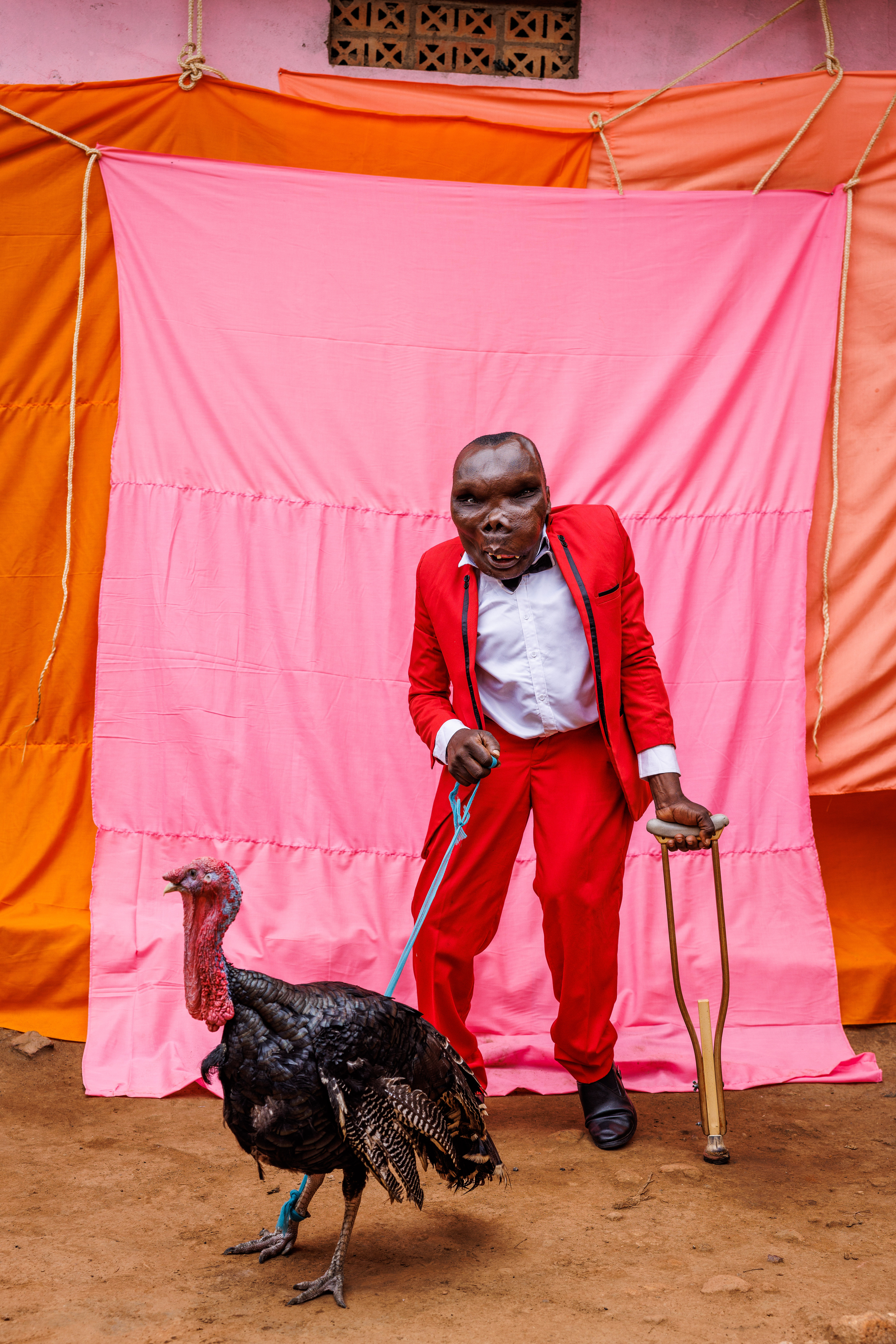
Ugandan Ssebabi, 2022 by David Cossini (Winner of the Art Handlers Award)

In my dreams I am dirty, broke, beautiful & free, 2022 by David Cossini

The finalists include a number of Canberra photographers, demonstrating once again that Australia’s capital city has many fine photo artists. Amongst them, Grace Costa, well-known for her corporate work and her imagery of horses, had Portrait of Zachary selected. She confesses that after seeing her subject at a campsite it took her around 45 mins to work up the courage to ask if she could photograph him.

Portrait of Zachary, 2023 by Grace Costa

Another Canberran, Brenda L Croft (with assistance from Prue Hazelgrove) had blood/memory: Brenda & Christopher i (Gurindji/Malngnin/Mudburra; Mara/ Nandi/Njarrindjerri/Ritharrngu, 2022 selected.

blood-memory. Brenda & Christopher  Gurindji-Malngnin-Mudburra. Mara-Nandi-Njarrindjerri-Ritharrng by Brenda L Croft, Prue Hazelgrove

Another fine, but quite different, portrait of an indigenous young woman is Yarnangu, 2022 by David Darcy.

Yarnangu, 2022 by David Darcy

Amongst some wonderful images of people from a variety of the many cultures we have in this great multicultural country, I particularly enjoyed Mela 2022 by Bahram Mia, which portrays four young women from Afghanistan celebrating birthdays together in this country where they have the freedom to enjoy such moments as once were the norm in their home country.

Mela, 2022 by Bahram Mia

I also loved Portrait of My Mother as an ethno-Futurist icon, 2023 by Sammaneh Pourshafighi. The artwork is of the artist’s mother, an Iranian migrant. The work is colourful and engaging, revealing much of the subject’s personality and identity.

Portrait of My Mother As An Ethno-Futurist Icon, 2023 by Sammaneh Pourshafighi

‘Sunju Calabrese’ #2, 2022 by Renato Colangelo portrays a man who is “unique, flamboyant with an expressive character.” This is a great contemporary artwork.

'Sunju Calabrese' #2, 2022 by Renato Colangelo

Amongst the images of famous people is Aunty Helen, 2021 by Charlie Ford. The subject is the highly successful Australian author, Helen Garner. The artist has successfully captured her in an “unspectacular act” – shutting  a gate – to reflect his aunt’s celebration of beauty in ordinary moments when she authors her works.

Aunty Helen, 2021 by Charlie Ford

I cannot close without mentioning Adam Ferguson’s emotionally moving portrait of Ukrzaliznytsia (Ukrainian Railways) employee, Sumy Oblast, Ukraine, May 2022. It is a poignant reminder of the terrible ongoing conflict there.

Ukrzaliznytsia (Ukrainian Railways) employee, Sumy Oblast, Ukraine, May 2022

by Adam Ferguson

The judges have said the winning work is a “celebration of photography”, and  the Highly Commended has “exceptional cinematic quality”. The art handlers who chose their Award described their selection as “confident and joyful.”

As always, the NPPP is an exhibition not to be missed if you are able to get to it - to see on a gallery wall both the images I’ve mentioned and those I haven’t, either now at the National Portrait Gallery or later when it tours to other Australian locations. If that is not possible for you, all the finalists can be seen here.

 This review is also available on the author's blog here. And now also in the July 2023 issue of The Printer, the online magazine of the Australian Photographic Society's Print Group here.


Saturday, July 16, 2022

National Photographic Portrait Prize 2022

Photography Review | Brian Rope

NPPP 2022 | Various artists

National Portrait Gallery | 25 June – 9 October 2022

As I noted when reviewing the 2021 NPPP here, group exhibitions can be awkward to review because of the diversity of imagery subject matter and quality. In a major show such as this though, there is unlikely to be poor quality work. Furthermore, with a focus on portraiture the diversity is diminished. That’s not to suggest there is a sameness as there are many approaches to portraiture on display here. As in previous years, the diversity of the quality artwork delivers a powerful visual exhibition.

The winning work Silent Strength 2021, by well-known Indigenous photo artist Wayne Quilliam, is a fine portrait, beautifully portraying Culture through the rich colours in the ochres and feathers of his indigenous subject, and also his sense of pride. Quilliam is a lovely modest man and very proud of his prizewinning artist daughter who was with him at the media preview I attended. And he’s giving the $20,000 worth of gear he won to Indigenous communities and organising for them to learn to use it.


Silent Strength - Wayne Quilliam

As always, in such shows, I look for works by locals and other people whom I know personally, as well as images by artists whom I follow. Canberrans in the show include Cat Leedon, with a powerful, perhaps confronting, self-portrait titled Breast Cancer, aged 37. It clearly shows the anguish she was feeling after her second breast surgery.


Breast cancer, age 37 - Cat Leedon

Fiona Bowring has a delightful Family Portrait, incorporating another shot of the same family hanging behind them. This again is a story which, no doubt, includes pain – it relates to palliative care and to love of family.


Family portrait - Fiona Bowring

Greg Stoodley’s contribution is another self-portrait Greg & Orbit that I had seen previously on his website. The image was taken during lockdown and features a cat looking at his apparently bored face and supine body.


Greg & Orbit - Greg Stoodley

And then there is Lauren Sutton’s work Lauren and Poppy. Yes, another self-portrait during lockdown. All work cancelled, the artist took this and other selfies to document the time spent with her four-month-old daughter.


Lauren and Poppy - Lauren Sutton

There are various other images made during restrictions, including Andrew Rovenko’s The Shuttle, a delightful shot of four-year-old astronaut Mia wearing her homemade space suit and helmet.


The Shuttle - Andrew Rovenko

There are also other good portraits of Indigenous people, such as Cordy in the Clouds by Adam Haddrick.


Cordy in the Clouds - Adam Haddrick

There are people from other cultures, an Olympian, well-known people such as Barry Jones, a survivor of a lifetime of abuse and mistreatment, a 6’ 9” tall man, neighbours, lifelong friends, a dancer, music journalist Bob Gordon, and a young woman in transitional housing after a period of homelessness.

One of the represented photographers whose work I always appreciate is Michael Bowers. His work Stella is of a grandmother whose grandson was last seen where she is seated on the banks of the Gwydir River.


Stella - Michael Bowers

As in previous years, there are numerous works in this diverse exhibition that we all need to study and explore, such as Matthew Newton’s Indigo, featuring an activist, dressed as an endangered wedge-tailed eagle, heading into the Tarkine forests in Tasmania, where they spent a bitter winter to halt development of roading to access a planned tailings dam – yet to be built.


Indigo - Matthew Newton
 

This is far more than pretty pictures, far more than high quality portraits. There are so many stories, so many varied aspects of our Australia and its peoples, so many identified issues for us to think about – all revealed through the talented story-telling photographers using their insights and artistic skills to depict their subjects.

We who view the works are privileged to gain access into the personal lives and emotions of the people portrayed.

This review was first published on page 23 of The Canberra Times of 11 July 2022 and online here. It is also available on the author's blog here.