Showing posts with label Visual arts. Show all posts

Thursday, July 25, 2024

Emotional Landscapes I

Exhibition Review: Photography | Brian Rope

Emotional Landscapes I | Jenny Adams, Julie Delves, Eva van Gorsel & Delene White

ANCA Gallery, Dickson | 17 July - 4 August 2024 

This art exhibition at the ANCA Gallery with the Tinshed Art Group examines the emotional connections that humans have with the natural world. It makes observations about the nuanced and intricate interaction between the natural world and humankind. It looks at how humans affect the climate and the earth, but it also maintains optimism that appreciating nature's marvels makes us feel a part of it and inspires us to take constructive action. Through this investigation, the show hopes to spark reflection, foster empathy, and motivate viewers to dedicate themselves to the pursuit of a peaceful and long-lasting cohabitation with the natural world.

The participating artists work with various mediums. Jenny Adams and Julie Delves paint with acrylic on canvas. Delene White uses oils on canvas, found objects, and fibreglass & silicone. I enjoyed all their works very much, particularly White’s installation The bigger picture, with its lightweight wall marching ants. 

However, I will concentrate here on the photography of Eva van Gorsel - since it is the art form in which I work myself and, so, am best qualified to discuss. This artist’s seventeen pieces are archival pigment prints. The seventeen works form a series created by van Gorsel for this exhibition. They are all of a high standard and I was most pleased to see several of them had already been purchased when I visited.

Watching Out explores the fact that human development and the pursuit of food security have been intertwined throughout history. The artist notes that deforestation for cultivation disrupts ecosystems, leading to biodiversity loss and climate change. She reminds us that humanity needs to watch over the landscapes and ecosystems we depend on for survival, making concerted efforts toward environmentally friendly and socially responsible land use practices.

In that piece, two or more images have been combined into a beautifully blended composite showing something of the interactions between humans and a rural landscape. So there is a human looking out over the landscape, plus a section of fencing and parts of a building constructed by humans.

Watching Out © Eva van Gorsel

The same approach has been taken with most of the artist’s other works, but the messages are diverse. For example, Morning Flight includes birds and van Gorsel’s artist statement speaks about how engaging with natural environments has been linked to improved mental health, increased creativity, and heightened feelings of belonging fostering a deeper connection with the natural world.

Morning Flight © Eva van Gorsel

I particularly appreciated Encroachment. It incorporates a drawing of Canberra’s central national capital area and two examples of the native animals seen in the city’s urban areas. This is all about the need for urban planning that achieves sustainable developments.

Encroachment © Eva van Gorsel

There are also works about foxes, weeds and habitats. One artwork is titled Endemophilia. That word may not be familiar to you. If that is the case, let me tell you that it is about the particular love manifest in the people of a place that is special to them. It is what gives people a particular sense of belonging as opposed to a global sense of place. This image shows us an example of the type of water and forest environment where the artist feels a deep sense of belonging.

Endemophilia © Eva van Gorsel

Other works tell us to stop messing with the environment, speak about the unpredictability of nature, discuss the history of climate extremes, reference the fact that water is essential for life and note that global carbon emissions have surged to record levels.

This exhibition most successfully does what it set out to do. I commend it to you and applaud all the artists.


This review is also available on the author's blog here.

Monday, June 17, 2024

Canberra Contemporary Photographic Prize 2024

Exhibition Review: Photography | Brian Rope

Canberra Contemporary Photographic Prize 2024 | Various Artists

Photo Access, Canberra | 13 - 29 June 2024 

The 2024 Canberra Contemporary Photographic Prize is a competition and exhibition open to all photo-artists worldwide, aiming to highlight fresh viewpoints in Contemporary photography. 

The inaugural 2023 Prize exhibited all 72 submitted works, some of which I believed were not Contemporary works. This year, 198 entries were received from local and distant places, including the USA. There are fifty finalists, roughly half being women and half being men. The overall quality of the Contemporary works selected is excellent. The three judges - Sandy Barnard - The Master, Sandy Prints, Oscar Capezio - Curator, ANU Drill Hall and Janice Falsone - Director, CCAS - must have had a most difficult task choosing them. The prize-winners they selected would not, of course, be everyone’s choices, but both are certainly Contemporary and deserving of recognition.

Melbourne-based Lisa Jayne Cramer took second prize with an inkjet print She carries his grief (self-portrait), 2024.  The artist statement accompanying the work says it all - From my series, ‘YOUR child, MY child, EVERYONE'S Child’, to express how grief makes demands on us, that she carries his grief. A very silent, personal journey into grief for a child that never happened, proposing dense ideas about a reformulated family structure.

She carries his grief (self-portrait), 2024 © Lisa Jayne Cramer

More of Cramer’s work can be seen at https://www.lisajaynecramer.com/ and @lisajaynecramer.

Now Sydney-based, Caleb Arcifa whose work has been seen previously in View 2024, Photo Access’s annual showcase of emerging photo-media artists from the ACT and surrounding regions, took out the first prize with a giclee enlargement from a silver gelatin original. It has the intriguing title Sonant Autograph of Joini (If I Ain’t Got You), 2023. Some of you will be familiar with the Alicia Keys track If I Ain’t Got You with its deep meaning lyrics and draw parallels.

The artist statement accompanying the work reveals that sound has been used to augment the photographic process, the print being 'signed' by the sitter’s unique sonic identity. It suggests that the portrait captures more than a visual likeness, questioning the notion of self in this Artificial Intelligence age. It describes the portrait as ephemeral, which means lasting a very short time. Let’s hope it doesn’t disappear before the exhibition closes!

I couldn’t find much about Arcifa on the web, but he is on Instagram as @thecontainerlab where I learned he is designing and fabricating a collaborative photo/design studio, darkroom/print lab and workshop in multiple freight containers.

Sonant Autograph of Joini (If I Ain’t Got You), 2023 © Caleb Arcifa

I only have space to mention two other finalists. Sydney resident Orlando Luminere has a passion for helping others develop their photography, including by setting up a photography department in a training college. His entry is a fine example of photography using a camera obscura he constructed from urban waste materials. I’ve known this artist and his artwork for a very long time and own a copy of his book about iPhone photography. I’ve participated in an online workshop watching him construct a camera obscura. One day I must have a crack at making one myself.

Souvenirs, 2024 © Orlando Luminere

The current arts practice project of Canberra’s Hilary Wardhaugh includes works created in response to feeling absolutely helpless and powerless to change the inhumane narrative of the International Criminal Court’s ‘plausible genocide’ in Gaza. She hopes her artworks resonate with others, creating a sense of shared understanding. A Meditation of Death, 2024, is part of that project - a solemn tribute to 24,000 lives lost in Gaza by 3 January 2024. Each of twelve lumen prints has approximately 2000 dots capturing the essence of those who died, inviting viewers to reflect on the profound impact of violence and loss. The major process involved in creating all those dots is detailed on Wardhaugh’s website here. If you purchase a copy from the artist, she will donate a significant amount to UNHCR in your name.

A Meditation of Death, 2024 © Hilary Wardhaugh

Congratulations to Photo Access and all the finalists.


This review is also available on the author's blog here.

Tuesday, May 28, 2024

All my memories are mistranslations

Exhibition Review: Mixed Media | Brian Rope

All my memories are mistranslations | Omar Musa

Humble House Gallery, Canberra | 4 May – 2 June 2024

Does this artist need introduction? He is a Bornean-Australian author, visual artist, poet and woodcutter from Queanbeyan, Australia - well-known to many as a rapper. In recent times he has been creating music and visual art in the two very different places he lives between - Malaysian Borneo and Brooklyn, New York City.

Omar Musa has recently been in Australia talking about his latest album which touches on environment, culture, religious identity, and mortality. And to bring us this solo exhibition All my memories are mistranslations - comprising Cyanotypes, Linocuts and Woodcuts on a variety of materials, plus a Cast Glass sculpture. The largest cyanotypes are 70cm x 95cm.

The diverse works tell us much provided we explore them closely and think about the messages Musa is seeking to share. As with the album mentioned above, the artworks look at cultural and environmental matters. And much more. The show’s title reveals a starting point for our explorations – it’s about the artist’s misinterpreted memories. His artist statement says he has found out, years later, that he misheard stories his grandparents told him, that “crucial things were lost in translation.”

The artist goes on to tell us that in this exhibition he wanted “to lean into dissonance, these spaces lacking coherence; find comfort in contradiction.” So, he sought to make a playful, unsettling world inhabited by ghosts.

Musa’s poetry piece with the same title as this show makes other references to ghosts, including one posing the question Am I so different from a hoax ghost photographer of a past age? One artwork, titled Tumbled Dry Brooklyn Ghost Boy, includes Bornean boys sailing across a coin-operated washing machine in Brooklyn.

Tumbled Dry Brooklyn Ghost Boy – Cyanotype, 58cm H x 46cm W © Omar Musa

A huge Woodcut has an equally huge title – The river is a keris / a sacred dagger / cast from meteoric iron & scrapyard bike frame nickel / patterned skin a trillion times folded with rain & song / whetted on white hot sun. Additional words on the artwork read Battle Cry or Requiem? We Buried Our Eyes In a Storm. So much to see, to read, to consider.

The river is a keris / a sacred dagger / cast from meteoric iron & scrapyard bike frame nickel / patterned skin a trillion times folded with rain & song / whetted on white hot sun - Woodcut, ink on blackout cloth, 148.59cm H x 396cm W © Omar Musa

Another smaller Woodcut has a very simple title but again has much to examine, clearly telling us that our memories are not always correct; indeed far more likely to distort over time. Perhaps, like eels, our memories can swim backwards by reversing the direction of the wave?

Bubu – Woodcut, ink on paper, 61cm H x 122cm, 2022 (reprint) © Omar Musa

A simple drawing conveys a familiar message about the way some folk converse with friends in their dreams. The resultant Linocut’s title adds further information.

He Said, “You Need to Relax, Bro” – Linocut, ink on paper 36.5cm H x 34.5cm W © Omar Musa

It is unsurprising that in many artworks, this poet/rapper again uses words. In his Smoke Over Sulu cyanotype there are words which, I believe, relate to Islamic prayer, a Malayic oral poetry form and how speakers of different native languages use a common language to converse. The background scene shows smoke rising. Is it environmental smoke? Was it caused by a terrorist attack? Something else?

Smoke Over Sulu 2 – Cyanotype 58cm H x 46cm W © Omar Musa

Another Cyanotype, Too Hard to Say, has no words on it but, nevertheless, speaks most eloquently.

Too Hard To Say – Cyanotype, 58cm H x 46cm W © Omar Musa

In an introductory statement about the exhibition, Abdul-Rahman Abdullah says “Omar is a cipher. Everything is a signpost for something more, different eyes find different truths.” If you visit this exhibition, your eyes - and your minds I expect - will very likely find different truths to me and to others who have explored it.

This review is also available on the author's blog here. And a shorter version is on the Canberra City News website here.


Thursday, June 22, 2023

Photography - 2023 National Photographic Portrait Prize (various artists)

Photography Exhibition Review | Brian Rope

National Photographic Portrait Prize 2023 | Various artists

National Portrait Gallery (Canberra) | 17 June 2022 to 2 October 2023

In this year’s NPPP, there is pathos and  humour, striking colour and sombre black and white. There are images of famous people and those known only to their families and friends, of indigenous people and of refugees, of people living in Australia and some who live elsewhere, and of people from different cultures. There are also many and varied approaches to the genre of portraiture, ranging from traditional to contemporary.

As in previous years, the diversity of the quality artwork delivers a powerful visual exhibition. Indeed, I consider the 47 works on exhibition this year to be an excellent selection well worth viewing. The three judges would, as is always the case with such successful competitions, have had a tough challenge in making their selections from almost 2400 entries. I acknowledged that when speaking briefly with judge Daniel Boetker-Smith at the very well attended media preview (whilst jokingly noting that they didn’t select any of mine).

It is of interest that the subject of the winning image Ruby was also a finalist, with a self-portrait so there are two photos of her in the exhibition.

Ruby (left view), 2022 by Shea Kirk
(The winning image)


Sisters or Friends, 2022 by Emma Armstrong-Porter

(The self-portrait by the subject of the winning image)

The winner of the Art Handlers Award, David Cossini, has both it and another work amongst the finalists on display.

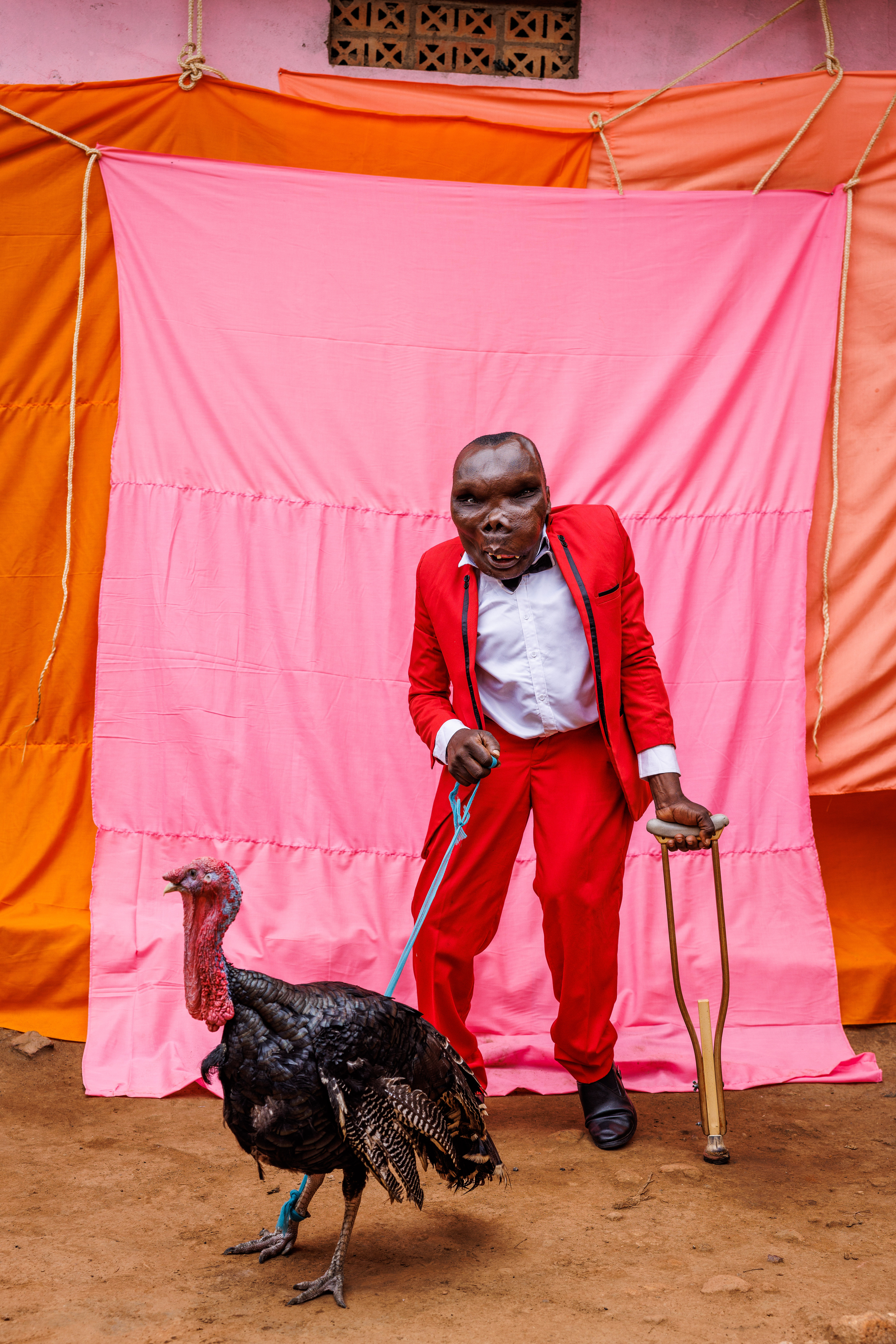
Ugandan Ssebabi, 2022 by David Cossini (Winner of the Art Handlers Award)

In my dreams I am dirty, broke, beautiful & free, 2022 by David Cossini

The finalists include a number of Canberra photographers, demonstrating once again that Australia’s capital city has many fine photo artists. Amongst them, Grace Costa, well-known for her corporate work and her imagery of horses, had Portrait of Zachary selected. She confesses that after seeing her subject at a campsite it took her around 45 mins to work up the courage to ask if she could photograph him.

Portrait of Zachary, 2023 by Grace Costa

Another Canberran, Brenda L Croft (with assistance from Prue Hazelgrove) had blood/memory: Brenda & Christopher i (Gurindji/Malngnin/Mudburra; Mara/ Nandi/Njarrindjerri/Ritharrngu, 2022 selected.

blood-memory. Brenda & Christopher  Gurindji-Malngnin-Mudburra. Mara-Nandi-Njarrindjerri-Ritharrng by Brenda L Croft, Prue Hazelgrove

Another fine, but quite different, portrait of an indigenous young woman is Yarnangu, 2022 by David Darcy.

Yarnangu, 2022 by David Darcy

Amongst some wonderful images of people from a variety of the many cultures we have in this great multicultural country, I particularly enjoyed Mela 2022 by Bahram Mia, which portrays four young women from Afghanistan celebrating birthdays together in this country where they have the freedom to enjoy such moments as once were the norm in their home country.

Mela, 2022 by Bahram Mia

I also loved Portrait of My Mother as an ethno-Futurist icon, 2023 by Sammaneh Pourshafighi. The artwork is of the artist’s mother, an Iranian migrant. The work is colourful and engaging, revealing much of the subject’s personality and identity.

Portrait of My Mother As An Ethno-Futurist Icon, 2023 by Sammaneh Pourshafighi

‘Sunju Calabrese’ #2, 2022 by Renato Colangelo portrays a man who is “unique, flamboyant with an expressive character.” This is a great contemporary artwork.

'Sunju Calabrese' #2, 2022 by Renato Colangelo

Amongst the images of famous people is Aunty Helen, 2021 by Charlie Ford. The subject is the highly successful Australian author, Helen Garner. The artist has successfully captured her in an “unspectacular act” – shutting  a gate – to reflect his aunt’s celebration of beauty in ordinary moments when she authors her works.

Aunty Helen, 2021 by Charlie Ford

I cannot close without mentioning Adam Ferguson’s emotionally moving portrait of Ukrzaliznytsia (Ukrainian Railways) employee, Sumy Oblast, Ukraine, May 2022. It is a poignant reminder of the terrible ongoing conflict there.

Ukrzaliznytsia (Ukrainian Railways) employee, Sumy Oblast, Ukraine, May 2022

by Adam Ferguson

The judges have said the winning work is a “celebration of photography”, and  the Highly Commended has “exceptional cinematic quality”. The art handlers who chose their Award described their selection as “confident and joyful.”

As always, the NPPP is an exhibition not to be missed if you are able to get to it - to see on a gallery wall both the images I’ve mentioned and those I haven’t, either now at the National Portrait Gallery or later when it tours to other Australian locations. If that is not possible for you, all the finalists can be seen here.

 This review is also available on the author's blog here. And now also in the July 2023 issue of The Printer, the online magazine of the Australian Photographic Society's Print Group here.


Wednesday, August 31, 2022

Into the Forest

Photography | Brian Rope

Into the Forest | Eva van Gorsel and Manuel Pfeiffer

M16 Artspace, Gallery 1b | UNTIL 4 SEPTEMBER 2022

Partners Eva van Gorsel and Manuel Pfeiffer are regular exhibitors at M16 Artspace. Their 2020 joint show Facets exhibited interpretations of the Australian landscape they had seen during a lengthy journey. Their works complemented each other as they revealed the same facets. Then, in 2021, they brought us Congruent-Incongruent using numerous diverse techniques and media to create varied, interesting and pleasing artworks.

Their 2022 exhibition Into the Forest aims to raise awareness of the role our forests have on our planet, our climate and our lives by showcasing the beauty of mostly regional treescapes and woodlands using imagery, sculpture and a sound installation. Along with growing numbers of people around the world, they recognise that the importance of forests cannot be underestimated.

Pfeiffer has a background in earth system sciences, graphic design and arts and shares a deep appreciation of the environment with Van Gorsel who was a principal research scientist in atmospheric sciences before turning to photography. The two artists asked themselves why it is important to show and appreciate the beauty of our natural environment and have offered an answer.

“In science we have pointed out the dangers of climate change before anyone cared to listen. With climate extremes now so extreme that they are getting hard to ignore many more people are aware that urgent action is needed. Many artists were early uptakers of that message. There is a long tradition of showing natures beauty. But many artists now also show the impact our disrespect of nature has on ecosystems. This is important work that is critically needed. But it is key that we do not get lost in despair. That is why we think it is important to show and appreciate the beauty of our natural environment. I think we are at a turning point where it becomes important to again remind us of what we can keep - if only we set our minds and actions to it.”

Van Gorsel’s works here are, perhaps, more traditional than she has shown in their previous two joint exhibitions. They are fine examples of this genre of photography, showing us numerous wonders of nature in our forests – birds, mist, and understory vegetation are just some examples. In every case, the available natural light is used beautifully - as all photographers should strive to do. Monochrome is used sparingly, but to great effect. Shallow focus is used wonderfully in others.


Eva van Gorsel_Into The Forest II_Namadgi


Eva van Gorsel_Mist_Gundagerra NR


Eva van Gorsel_Last Light_Namadgi NP


Eva van Gorsel_Aglitter 03


Pfeiffer’s contributions are equally pleasing, showing us the sights of the forests through his chosen media. A set of artworks of trees, bark and fungi using colour pencils on paper are simply lovely, with their wonderfully balanced light and peaceful hues. Others painted with acrylics on canvas, such as Dreaming Xanthorrhoeas, are equally successful.


His three pieces using wood are special features in the exhibition. A mixed media piece, The Wise, 2021, is the standout for me. Glass, a suspended small rock gently moving, wood and more combine beautifully into a piece to explore, a piece that also says much about nature.


Manuel Pfeiffer_BarkA


Manuel Pfeiffer_Dreaming Xanthorrhoeas


Manuel Pfeiffer_At The Coast


All the artworks take us into the artists’ views of nature. They make us feel good – enabling us to see the colours, hear the sounds, smell the scents. All give us some comfort. And they make us want to be amongst the calming effects of forests and connecting directly with nature through our senses, seeking to reduce the gap that we have opened between us and the natural world. This exhibition very much invites us to reflect on how we humans have impacted the natural environment, and to ask ourselves what we as individuals must now do.

This review was published online by The Canberra Times on 30.08.22 here. It is also on the author's blog here.

Saturday, January 23, 2021

Australian Dreams: Picturing our Built World


Visual Arts | Brian Rope

Various Artists | Australian Dreams: Picturing our Built World

Exhibition Gallery, National Library of Australia | Until 31 January 2021

Australian Dreams: Picturing our Built World shows how visual artists have documented and interpreted Australia’s buildings for over 200 years. The works are exclusively from the National Library’s extensive collections and include many of our best artists; those whose names and images are known by all art lovers, some less familiar.

Entering the gallery, I was immediately immersed in a stunning photo wall of 48 images, selected from the vast 25,292 collected for the Regional cities and major towns project, which documents the architecture of hundreds of Australian towns. There is a dark moody image of the closed railway station on the Kulwin line in Wycheproof. And there’s an image of Toowoomba’s closed Camera Obscura – how many remember sitting inside as the cylinder wall rotated noisily and you saw significant buildings below in the ancient crater where the city is situated?

Inside the gallery, there are many more wonderful photos, prints, drawings and paintings. Captions are not needed for famous buildings, such as Canberra’s Shine Dome and Parliament House but, for most of us, are necessary for a Surry Hills street, a deserted farmhouse on the outskirts of Maitland during the major flood of 1955, a home by Lynchford railway tracks, a scarred tree in the front yard of a suburban Canberra house, and a miner's hut in Lithgow Valley.


A miner's hut, Lithgow Valley, New South Wales, ca. 1885 © Charles Kerry

There are other delights in display cabinets - contemporary photo books documenting Oxford Street, Masters stores, and ordinary homes. How I longed to pick them up and turn their pages! There is a slide show from Wes Stacey’s archive - homesteads, timber buildings, and the architecture of historic towns and settlements.

Visitors to the exhibition explore the colonial era, when European artists produced paintings, prints and photographs of streetscapes and major public buildings in the new cities and towns, and on frontier properties. Conrad Martens’ striking watercolour of Craigend in Sydney is a feature.

Then we see the first decades of the twentieth century, when artists such as photographer Harold Cazneaux and wood engraver Lionel Lindsay created romantic images of old Sydney, the bush and grand colonial buildings. These images were influenced by the revival of etching in printmaking and a more impressionistic approach to photography.


Going home, Doohat Lane, North Sydney, New South Wales, 1910 © Harold Cazneaux

Later, modernism began to dominate - whether the subjects were post-war architecture or familiar old streets. We see compositions utilising strong contrasts, sharp forms and lines. Olive Cotton’s Fire Escape clearly displays her techniques as expressed in a 1938 magazine interview: “The lighting, the relation of the various objects to the shape of the picture, and many other factors can be changed by the individual, and this is where discernment and personality come into the picture.”


Fire Escape c.1935 © Olive Cotton (1911–2003)

The final images in the exhibition demonstrate how many of these artists found something compelling in buildings where ordinary lives played out, in various states of use, disuse, demolition and destruction. They also created images communicating why buildings are worth seeing and saving.

William Yang, a third generation Australian Chinese, has developed an international reputation as a photographer and performer. His art is about the telling of stories, often writing words on the surfaces of his prints, as in his image of Canberra’s School of Art after a hailstorm in 2007.


Hail #5, School of Art, 2007. From the series - Breathing the Rarefied Air of Canberra
© William Yang

Other great images that appealed to me were Maggie Diaz’s Higgins Boys, Charles Bayliss’s Sydney Technical College Building Exterior, Wolfgang Sievers’ Olympic Swimming Pool, and John Bertram Eaton’s Steps in a Courtyard. Go see for yourself and think about what other buildings are worth going to see again or should be saved for future generations.


Sydney Technical College Building Exterior, 1889, 2 in Photographs of Premises Occupied by the Board of Technical Education of New South Wales, 1889 © Charles Bayliss (1850-1897)


This review was first published by the Canberra Times of 23/1/21 here. It is also on the author's own blog here.