Showing posts with label Videography. Show all posts

Saturday, May 13, 2023

Between Presumption and Melancholy, Huon, The Grand Scheme

Brian Rope | Photography, Videography

Between Presumption and Melancholy | Toni Hassan

Huon | Noah Thompson

The Grand Scheme | Chris Round

Photo Access | 27 Apr – 10 Jun

These three exhibitions set out to explore environment and climate threats - two by looking at physical changes made by humans and the third at impacts on particular people.

Toni Hassan is a social practice visual artist, Walkley Award-winning journalist, and Adjunct Research Fellow of the Australian Centre for Christianity and Culture. Between Presumption and Melancholy shows three multimedia artworks from her video series Body and Breath: Remembering Black Summer, 2021-23.

Three women share personal experiences of Australia’s Black Summer of 2019-20. Against the background of an Australian flag in a smoke-free azure sky, Rhian Williams, a volunteer firefighter takes us right into those times of fear. The visual is projected on a translucent curtain that moves such that the flag ripples.

Toni-Hassan, Video still, 2021, Body and Breath-Remembering-Black Summer - 1

Moving water and moving plane propellors are backgrounds as Sarah Bachelard, a Canberra-based priest and theologian speaks “It was supposed to be Epiphany, … coming of the light….We actually changed the hymn we were going to sing, which was ‘Here in this place a new light is shining’ because, it was just, how could you sing that?”

Toni-Hassan, Video still, 2021, Body and Breath-Remembering-Black Summer - 2

Luminous and liquid light circles draw us in as Tess Horwitz, the late Canberra artist who created the Bushfire memorial at Mt Stromlo, speaks of "a journey from painful memory and the reality of the day of the fire” and “strength of community and shared experience and on to a very gradual sense of healing and regeneration." We share in her dream. 

Toni-Hassan, Video still, 2021, Body and Breath-Remembering-Black Summer - 3

How should we respond emotionally? Have we had a cathartic experience? Have we engaged our own grief regarding environmental changes? Hassan also has a book that includes transcripts of these three plus a further ten interviews.

Noah Thompson seeks to shed light on the continuing conflict between environmental preservation and industrial development in Huon. His large high quality framed inkjet prints are mostly untitled. He has taken inspiration from the destruction of the 2500-year-old Lea Tree – by supporters of the Gordon-below-Franklin project in 1989.

The images are intended to explore continuing tensions between conservation and development. Some are more successful than others. An image of the Lea Tree showing its vandals photographed before their “Fuck You Green Cunts” message painted on the tree’s still burning remains is powerful. Mt Lyell, 2020 presents a severe and disturbing reminder of that mine’s impact.

Noah Thompson, Mt Lyell, 2020

Chris Round has documented The Grand Scheme – the Snowy Hydro. His inkjet prints, also large and high quality, are images taken during the period 2016-2022. They do not include anything from the years before or during construction. They do provide clear evidence as to why he is an award-winning landscape photographer. Round has a book of these and other images available for purchase. 

Chris Round, Intake Tower, 2017

Round has expressed some opinions about hydroelectricity, both positive and negative, and argues for a balanced approach. He has “not tried to politicise environmental energy issues” and wonders whether his “approach might be too sedate”. He describes it as aiming to capture captivating and intriguing images and suggests that passing judgement would risk stifling conversations. I am not convinced and confess disappointment with the content of the works displayed.

Having first visited the Scheme and the area in 1958 and many times since, did I unfairly expect more? During the exhibition opening, a comment was made that it was refreshing to see straight photography on the gallery walls. Whilst, perhaps, it has become less common to see such works at this venue, I would question why that is necessarily “refreshing”. More contemporary artworks would have challenged me and stimulated greater consideration of the important issues these three shows were meant to present to us.

This review was first published by The Canberra Times on 13/5/23 - on page 10 of Panorama and online here. It is also available on the author's blog here.


Saturday, March 25, 2023

Haunting

Photography, Videography, Text | Brian Rope

Haunting | Vic McEwan

National Museum of Australia | 23 Feb - 30 Apr 2023

Vic McEwan was National Museum of Australia (NMA) 2015 artist-in-residence. He created this exhibition’s large-scale still photography and video works in collaboration with curator George Main.

McEwan is a contemporary artist with a deep interest in the ethics involved in making artistic work relating to the lives of other people. His rich, and most successful, practice has nourished broad cross-sector conversations about the role that arts can play within communities. He was the recipient of the Council for the Humanities Arts and Social Sciences 2018 Australian Prize for Distinctive work for another project -  which involved three years of creative research within hospital environments.

He has shared his project outcomes at such places and events as Tate Liverpool, the National Gallery of Lithuania and Australia’s Big Anxiety Festival (the biggest mental health and arts festival in the world). The Director of Australia’s National Institute for Experimental Arts, Jill Bennet, has declared McEwan’s outputs as ‘field defining work’ and ‘both intensely moving and inspirational’.

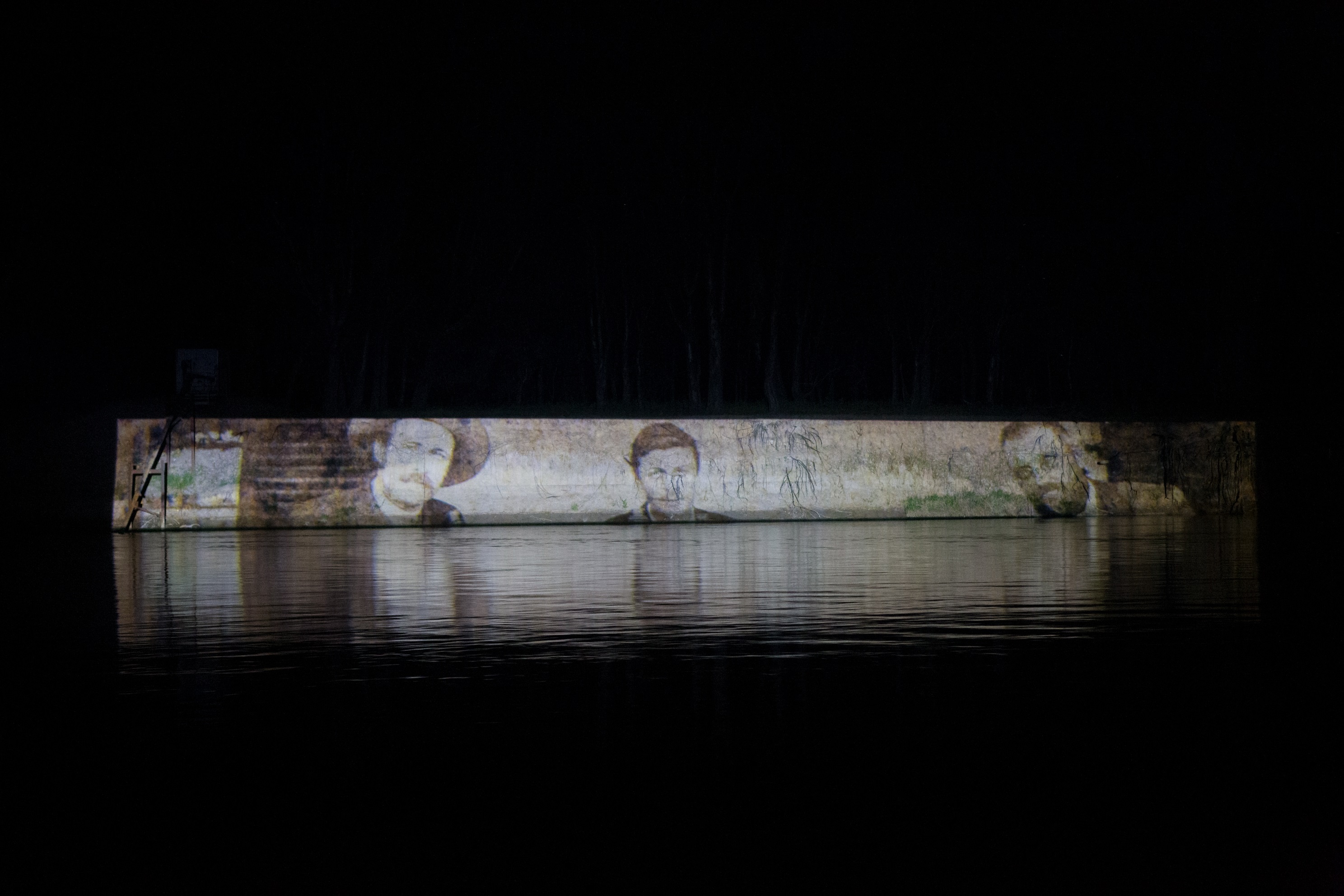
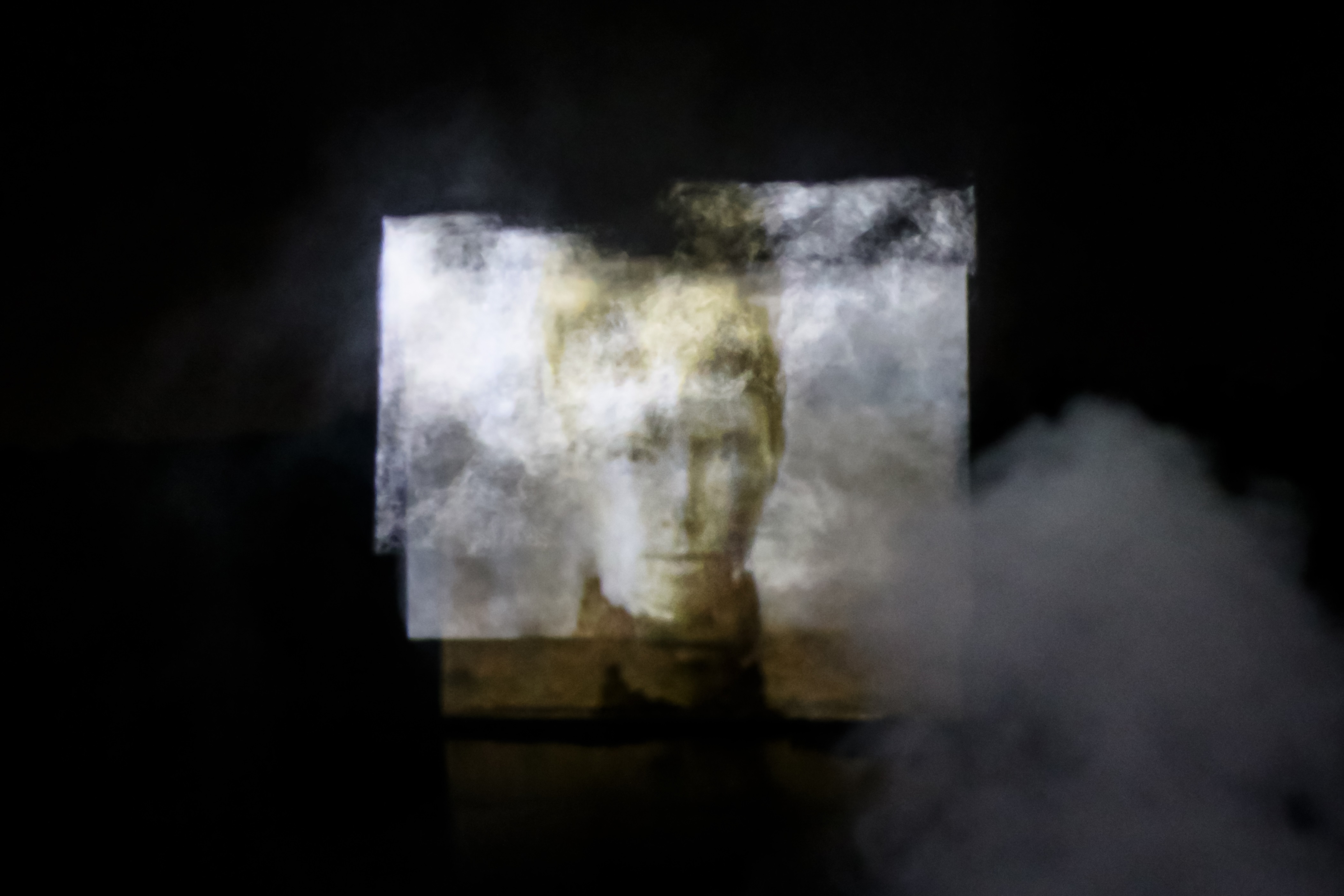
The aim of the project featured here was to “remove” objects from their cabinets and put them instead into “the active materiality of places connected to the stories of those objects”. During the cold of night, photos of museum objects, historic photographs and a time-worn map were projected across the Murrumbidgee River, onto drifting and swirling mist, fog, and campfire smoke.

Haunting comprises over 65 photographic works and 2 video works created during McEwan’s yearlong NMA residency. Touring the country since 2020, it explores the complex history of agriculture and land use in the Murray–Darling Basin. The tour has included the Blue Mountains and Burnie.

Key collection objects photographed and projected include prize-winning wheat samples collected at agricultural shows by Cootamundra district farmer James Hately and his son. There’s a stump jump plough used on a Canberra CSIRO research station projected onto Murrumbidgee River fog at Lambrigg.

NMA - Haunting: Stump-Jump Plough: Fog Murrumbidgee River at Lambrigg  - stump-jump plough, light, projector, fog, archival pigment print

A historic photo of William Farrer, Fred Wills & Nathan Cobb was also projected on fog – at both Lambrigg and Narrandera.

NMA - Haunting: Farrer: Riverbank Murrumbidgee River at Narrandera - photograph, light, projector, fog, archival pigment print

Another projected photo is of the Dunn family farmers near Wagga Wagga. The back row folk seem to have shafts of light searching the skies above. Another, of the Sutton family, is projected onto both fog and campfire smoke. There is poet/activist Mary Gilmore and her typewriter, and a stack of wheat bags awaiting rail transport at Temora.

NMA - Haunting: Mary Gilmore 4: Fog and Smoke Murrumbidgee River at Lambrigg - photograph, light, projector, fog, smoke, archival pigment print
 
NMA - Haunting: Mary Gilmore’s Typewriter 1: Riverbank Murrumbidgee River at Lambrigg - typewriter, light, projector, fog, archival pigment print


NMA - Haunting: Wheat Bag 2: Fog Murrumbidgee River at Lambrigg - photograph, light, projector, fog, archival pigment print

Part of a letter from climate scientist Katrin Meissner expressing her concerns about climate change in 2014 is also projected – onto fog and smoke and also the riverbank. A video shares her concern that her children “won’t have the same quality of life that we had” for us to reflect on.

McEwan has said the exhibition offers a chance to reconsider the complex histories of museum objects. Reanimating then layering them back into the landscape using light, projection and natural elements, created the abstract images on display - looking as though they were painted with light into the landscapes.

This is not the first exhibition by McEwan of imagery using this approach. For Shadows and Consequences (Photo Access, 2020), he photographed animal specimens, also (mostly) from the NMA’s collection, and then projected his images onto diverse surfaces to create new imagery.

But this time we have images created in a landscape along a river we all know or, at least, have heard about. Some of us have camped or lived on its banks, many have been to country towns along the ’bidgee, even photographed the riverbank scenery. These haunting images challenge us to think again about the great river, and its place in both First Nations and European settlement history.

This review was fist published by The Canberra Times on page 10 of Panorama and online on 25/03/23 here. It is also available on the author's blog here.


Saturday, January 28, 2023

WE ARE ONE - The First XI

Photography | Brian Rope

WE ARE ONE - The First XI Claire Letitia Reynolds and Sasha Parlett

PhotoAccess | 20 Jan – 10 Feb 2023

Everyone should see this exhibition. All indigenous people, because it is about a significant event in their history. Cricketers and cricket lovers, as it’s a significant cricket story. Historians, since it’s a historical event. Photographers and everyone interested in the medium. And everyone else, as it’s a fascinating and important story.

The portraits in WE ARE ONE - The First XI were produced by artist Claire Letitia Reynolds, the filmed interviews by Sasha Parlett. Reynolds discovered her love of photography at 14. She is known for capturing subjects at their most familiar moments. Parlett is the proud descendant of the first Indigenous woman to break in horses, was born on Darumbal country and educated and raised in Kabi Kabi ways. Together, the two artists are aiming to champion this epic piece of Australian history.

Parlett’s two videos are a series of vignette interviews providing a documentary style look into the verbal history of cricket in Australia. Through discussions with descendants of The First XI, past and current First Nations Cricketers, a

light is shed on the truths and triumphs such cricketers have faced since The First XI. Highlighting a forgotten history of this colonial sport turning stockmen into athletes and becoming an iconic sport within First Nations communities. The exhibition aims to uplift and contribute to reconciliation in Australia.

Still from Part 1 - WE ARE ONE –The First XI -
Uncle Adrian, Mununjalli, Goreng Goreng Nations, QLD © Sasha Parlett

Still of title page of Part 2 – WE ARE ONE – First Nations Cricket © Sasha Parlett

Reynolds’ artworks, created utilising analogue and digital processes, comprise twenty-two portraits and three landscapes referencing the unique connection between Australian Indigenous people, culture and Country. The First XI included men from tribes in Victoria, NSW and Queensland. The portraits are of current and past Indigenous Australian cricketers, direct descendants of the First XI, and Elders. 

Incredibly, this indigenous team of thirteen athletes undertook Australia’s first ever international tour. It is a story of strength, triumph and, sadly, tragedy. Several players suffered severe illness. Some were sent home early; others lost their lives. Despite the tragic incidents, the ledger was 14 apiece at the end of the England-wide tournament.

This exhibition seeks to square up the Australian identity ledger, with these pioneering men providing impetus for progress. Their story of courage, resilience, and identity is celebrated with pride. The beautifully printed artworks from hand-developed films are mostly on fine art paper using handcrafted dyes from various trees, bark, leaves, and sap. 

Rosie, Gubbi Gubbi Nation, QLD, 2022 photographic print on fine art paper
with narrow-leaved Red Gum bark hand crafted dye © Claire Letitia Reynolds

Aunty Betty, Bundjalung Nation, NSW, 2022 photographic print on fine art paper
with Brown Bloodwood bark hand crafted dye © Claire Letitia Reynolds

Uncle Mickey AM, Yawuru Nation, WA, 2022 photographic print on fine art paper
with Brown Bloodwood bark hand crafted dye © Claire Letitia Reynolds

One large portrait, of Aunty Fiona Clarke, is printed on 100% pure mulberry silk and displayed hung on a found Eucalyptus branch. 

Aunty Fiona Clarke, Gudintjimara, Kirre Whurrong Nations, VIC photographic print on 100% pure mulberry silk © Claire Letitia Reynolds (Installation view)

Three landscapes showing black swans are hung close together in a row alongside each other on an end wall of the gallery.

Black Swans of Gunaduyen, Home of The First XI, Parts 1,2,3 photographic prints on fine art paper with Grey Ironbark hand crafted dye © Claire Letitia Reynolds (Installation View)

Below each portrait are quotes from  ‘Cricket walkabout : the Australian Aboriginal cricketers on tour, 1867-8 / D.J. Mulvaney’. Part of one reads “Yanggendyinadyuk/Dick-a-Dick challenged all comers to stand 15 or 20 yards distant and pelting with cricket balls….protected his body with a [narrow wooden parrying shield]….during his displays he often called out to the throwers ‘Can’t you do better than that?’….His wooden club is now in Lord’s Cricket Museum.”

There is one other rather special exhibit - The First XI Didge-Bat, with the names of The First XI inscribed.

The project was previously exhibited briefly on the Sunshine Coast (where Reynolds is based). It opened here as a big bash cricket fixture next door attracted a huge crowd by comparison. Its run includes the contentious 26 January date. It will be going to the home of The First XI - Harrow, Victoria and elsewhere. It is hoped to show it at Lord’s. And, more importantly, I was pleased to learn there are folk seeking to have items such as the previously mentioned club returned to Country.

This review was first published by The Canberra Times here and in its print edition of 28/1/23. It is also available on the author's blog here.


Monday, October 24, 2022

Watching Me, Watching You

Photography and Videography | Brian Rope

Watching Me, Watching You | Jemima Campey

Tuggeranong Arts Centre Foyer | 8 to 29 October 2022

Jemima Campey (Ngunnawal/Ngambri lands) graduated from the Australian National University in 2021 with degrees in English and Visual Arts. She is currently completing her Honours in Visual Arts.


Campey makes photos, performances, installations and films. Through the use of appropriated and reworked materials which are borrowed from a day-to-day context, she touches various overlapping themes and strategies, including performance and contemporary culture. Her text and photographic works are often deeply personal, providing insight into her act of making art.


I’ve previously seen only a little of Campey’s artwork – videos in which she examined the phenomenon of the ‘apology video’, exploring how the spread of social media was impacting and re-shaping the nature of peoples’ emotions.


In this exhibition, Watching Me, Watching You, she has worked with both appropriated material and newly created photographs, and presents a selection of her recent works, united by their focus on the intersections of contemporary culture, online behaviours, and performance.


She has drawn from her own experiences growing up during the rise of social media and from the writings of Rayne Fisher-Quaan, a Canadian political commentator who, aged seventeen, created the organisation March for Our Education to lead student actions protesting the repeal of the sex education content of a Health and Physical Education curriculum.


Campey has used video and photography to make sense of some aspects of online life and subcultures that may not be well known to those who do not engage with particular trends or online platforms. A 500cm long inkjet print titled Doomscrolling reveals the types of interactions that might be read on some platforms, such as Pinterest. Here is just a tiny section of the text on the scroll:


SHE IS BEAUTIFUL. HER BODY IS BEAUTIFUL. With that said, she is clearly tilting a lot and flexing to make herself look thinner and more toned. she’s also using the clothing to her advantage to make her body look how she wants, which is her right, just remember that everything on the internet can be so tainted and altered from its natural state.


And one response to that:


yesss, thank you also notice that she like purposely took her shirt off for the pic


We all know that social media can infiltrate almost every part of our lives. We can present ourselves to others in whatever way we choose. Some opt to perform for their audience, whom they may or may not know, to create the image they wish to portray. Doing so raises such questions as “What are the impacts of adopting a moral superiority within your online persona and brand?”


Campey does not claim to answer these questions. Rather, she considers how authenticity and perception come into play in various online spaces, such as dating apps.


That’s All I Have to Say (a 9-channel digital video which runs for a little over three minutes) is intriguing. It is important to put on the headphones and listen to the words spoken by numerous people whilst viewing the images scattered on the screen.


That’s All I Have To Say. 2021. Still from video 03_07


Lovers’ Hands, (a ten-minute long looped video screening within a lovely and very small handmade frame) is also well worth close inspection.


Lovers Hands (2021). Installation image supplied. Digital video and handmade frame. 10_02, looped


There is a performance video piece, Routine, showing the artist herself engaging in a somewhat drawn-out and surreal process performing wellness and wellness-related activities – skincare, vitamins, hair brushing and so on.


Routine (still) 27_45. 2022


And to complete this modest but thoughtful exhibition, there is just one photograph. It is a self-portrait, Saint Belle, again focussing on the wellness industry, which is booming as consumers spend on products to improve their health, fitness, nutrition, appearance, sleep, and mindfulness.


Saint Belle. 2022. Inkjet print, 84.1x59.4 cm


This review was first published online on 17/10/22 by the Canberra Times here and then in print (page 27) on 24/10/22. It is also available on the author's blog here.