Showing posts with label Environment. Show all posts

Tuesday, February 4, 2025

Exhibition Review: Visual Art | Brian Rope

Creek I Kirsten Wehner

M16Artspace, Gallery 2 I 24 January - 16 February 2025

Kirsten Wehner is a research-centred artist, curator, producer and writer living and working in Ngunnawal Country (Canberra). In her practice the artist works across a number of disciplines. She creates accessible writing, participatory experiences, sculpture installations, and a variety of visual media works.

Wehner is a Co-Director of Catchment Studio, an ACT-based independent creative platform transforming people’s relationships with waterways. She is also Co-Chair of the Board of the Cad Factory, an artist-led organisation based in Narrandera, NSW which collaborates ethically with people and place to create a local, national and international program of experimental work. And this busy artist also contributes to the committee of Plumwood Mountain, a unique 120-hectare heritage-listed private property near Braidwood, NSW which was handed back to the Walbunja people of the Yuin Nation in 2024 - the first time such a property has been gifted to an Aboriginal community.

Wehner is the M16 Artspace/ConceptSix Environmental Artist-in-Residence for 2024/5. Significant recent projects in which she has been involved include the National Museum of Australia pop-up touring installation River Country, the documentary More than a Fish Kill which explored how artists, fishery managers, and First Nations custodians processed 2019 and 2023 fish death events along the Darling River, and Finding Weston, Considering Country, a Traditional Custodian-led series of on Country walks. She has explored how disordered and unloved waterways can be re-imagined as holders of story and sites of cultural/ecological potential.

So where and what is Weston Creek? Located in south-western Canberra where a suburb carries its name, the creek was in the past “an intermittent stream, a system of rills, soaks and wetlands vibrantly alive with plants, insects and birds. Today, the waterway is largely piped and drained, forced underground or encased in concrete, struggling with pollution from street run-off and largely invisible to people who live in the area. And yet the creek is still there. Wehner says it is “flowing as it can, supporting life as it can, creating traces that ask us to know it.”

Immediately upon entering the gallery to see the artist’s exhibition, simply titled Creek, I was drawn to the framework of gathered sticks which invites us to imagine the creek as it once was. That, of course, is very much a part of what good artists do – they imagine things and invite those of us who see their artworks to do likewise.

Kirsten Wehner_Creek (installation view)_2024_Image Brenton McGeachie, courtesy the artist

Creek explores life along the Weston Creek waterway, asking what it might mean to care better for this particular disordered place. Inspired by talks and walks with Ngunawal Elders Uncle Wally Bell and Aunty Karen Denny that considered the creek as Country, Wehner explores some of the ways in which people connect with and seek to look after places along this waterway.

Just to the left of the stick structure some words about the exhibition pose a few questions adding to what we might think about. How might we respect and nurture Ngunawal wisdom? How does the work done by local park care groups sit alongside the invasive re-engineering of the creek’s flows? How can we listen to such waterways?

In what she appropriately describes as the “bends and eddies of the stick structure”, Wehner shows us some delightful watercolour and pastel works revealing what volunteers have done. Can we see how their efforts near to invasive engineering have contributed to the restoration of native habitat, despite the legacies of concrete drains?

Kirsten Wehner_Channel_2024_Image Brenton McGeachie, courtesy the artist

Other artworks in this excellent show incorporate ideas of fracture, using multiple panels or separated surfaces so we might avoid seeing the waterway simply as a ‘view.’


Kirsten Wehner_Flow Story_2024_Image Brenton McGeachie, courtesy the artist

Kirsten Wehner_Liferafts_2024_Image Brenton McGeachie, courtesy the artist

I considered how we humans think of fractures as something that occurs when our bones are broken, interfering with our everyday tasks. Then I thought about fractures in the land, caused naturally or by human interventions. Whether fractures occur naturally or otherwise, proper diagnosis and treatment are crucial for effective healing and recovery. Wehner is effectively encouraging us to understand that.


This review is also available on the author's blog here.


Monday, March 18, 2024

MONACHOPSIS

Exhibition Review: Photography | Brian Rope

MONACHOPSIS | Hilary Wardhaugh

CCAS Manuka | 14 – 24 March 2024

Speaking at the opening of her exhibition, local long-established career professional photographer, Hilary Wardhaugh, announced it was the first step in her new career as an artist. There was much laughter and positive response to that. Having long believed artists can emerge later in their life journeys – without undertaking formal tertiary art studies – I was delighted.

Wardhaugh has been capturing images for around 27 years, specialising in portrait, event, editorial and branding photography. But now, she proclaimed, a separate artist career was also underway.

In fact, this photographer’s website states that, more than a photographer, she considers herself an artist, activist/provocateur, volunteer and creator of community. It says her creative endeavours bring people together in the pursuit of a better world, her interest involves the human condition: irony and contradiction - and she also pursues topical and creative projects to highlight a theme or an issue, most recently climate change.

Wardhaugh has curated many projects involving women and photography; for example, Loud and Luminous (with Mel Anderson as co-Creator) and most recently a climate change project, The #everydayclimatecrisis Visual Petition, which achieved global recognition. Those projects have clearly demonstrated this photographer is an artist, activist, etc.

So this artist is very passionate about using photography as activism and demonstrating that through artistic, provocative and innovative means. And that is just what she is doing with this solo exhibition.

I had not previously heard the word monachopsis so turned to online sources seeking its meaning. I learned it is a new word, coined by writer John Koenig in his Dictionary of Obscure Sorrows. It describes the feeling of being maladapted to your surroundings, like a seal on a beach. Monachopsis is temporary for most people and diminishes when the unfamiliar becomes familiar and new routines and unknown faces become norms.

I now know I have personally experienced monachopsis as a result of being in a new and not familiar situation. I’m sure everyone else has had the same type of experience. But have we had quite the type of experience Wardhaugh has put before us here?

The journey that has culminated in this exhibition actually began in June 2016 when Wardhaugh saw the Queanbeyan River’s bank was littered with what she has described as “the detritus of the capitalist Anthropocene era”, and as a “grim testament to our collective negligence.” The sight stirred within her “a potent blend of horror and introspection.”

However, these exhibited artworks were created later. Wardhaugh visited Indonesia’s Bintan Island, and Greece’s Santorini. Again, the artist saw vast quantities of waste on beaches. I only saw pristine beaches on those two islands when I visited them many years ago; clearly our personal experiences depend on where we go and when.

So, this exhibition of artworks by this emerging artist is very much a response to experiences, revealing her hope that nature might reclaim those beaches.

Portrait of a discarded plastic sunscreen bottles cultivated by molluscs on Bintan © Hilary Wardhaugh

Feral car reclaimed by prickly pear on Santorini © Hilary Wardhaugh

Derelict building spoiling the natural landscape on Santorini © Hilary Wardhaugh

The artist has also created a site-specific artwork, placing digital copies of waste objects she found onto a long decal laid on the gallery floor. Her aim was to make exhibition visitors reflect on their responsibility to our planet. During the opening numerous visitors unintentionally walked on that artwork.

There is a very large print filling the entire end wall of the gallery space. And there is to be a closing ticketed event with composer @ruthleemartin who has created three new pieces of music in response to the exhibition.

Everything in this splendid exhibition encourages reflection about human impact on the environment. It transports us into that unsettling place to which monachopsis refers. Wardhaugh’s belief that art can provoke valuable conversations and lead to meaningful action underpins her purpose. And she has most successfully achieved what she set out to do.

This review (in an abbreviated form) was first published by Canberra City News on 17 March 2024 here. It is also available on the author's blog here.


Wednesday, February 28, 2024

With Nature

Exhibition Review: Visual Art | Brian Rope

With Nature | Bridget Baskerville, Megan Cope, Wendy Dawes, Marley Dawson, Sammy Hawker, Annika Romeyn (curated by Alexander Boynes)

CCAS Lakeside | 10 February - 6 April 2024

With Nature is about environmental changes happening because of us. Six contemporary Australian artists address the issues, aligning the materials they employ in their studios to convey their messages.

The landscape has influenced their work outcomes, revealing our impacts on Earth’s transformation. Humans have the ability to collaborate, but we need to explore our frequent failure to do so with respect to nature. These artists, working in photography, drawing, sculpture and textiles, ask “how can we collaborate with our natural environment to better understand how to live a sustainable future on this planet?”

Kamberri/Canberra-based Sammy Hawker is showing a number of her marvellous salt works here. These photographs (created across the Yuin Nation on Walbunja & Djiringanj Country) explore repeated motifs presented by salt in the ocean. Her experimental technique challenges traditional approaches to film development and cultivates a deeper connection between art and nature. She allows the environment to shape the outcome saying, “the crosses and fractals feel like signs of sentience, marks of the deeper frequency” and “Earth’s oceans were created from forms of water that came from outer space - a combination of icy comets and grains of solar dust. It feels the oceans hold material memory of this interstellar resonance.”

Murramarang NP #1, 2020 – Pigment inkjet print 110 x 110 cm © Sammy Hawker

Emerging artist Bridget Baskerville has previously explored the effect of extractive industries on waterways around her Kandos hometown. Dead River (2023) shown here originated from a 2023 residency in Queenstown, Lutruwita/Tasmania when she explored how the Queen River, one of Australia's most polluted waterways, interacted with immersed copper plates. A 2-channel video shows her work in progress, and a superb set of corroded copper plates created by an etching process in the water, reveal bright orange rust patterns. The plates indicate the impact of extractive industries on water systems.

Dead River, (detail) 2023, corroded copper plates,
2 channel video, dimensions variable © Bridget Baskerville

 Annika Romeyn, another Kamberri/Canberra-based artist contributes more corrosion/rust in a very different artwork. This artist combines watercolour, drawing and printmaking processes to create intricate and immersive works on paper looking to convey a restorative experience of being in nature, focussing on the threshold of rock and water. Wana Karnu (2024) is a spectacular multi-panel rust and ink drawing which captures her experience of walking gravelly ridges in Mutawintji National Park at sunset. The work reveals rich colours of iron oxide and 'rock rust' formed when iron, oxygen and water interact.

Wana Karnu (detail) - rust and ink, 2024 on Rives BFK 300gsm paper
240X360cm 
© Annika Romeyn

Quandamooka artist Megan Cope, from Minjerribah/North Stradbroke Island, is known for her site-specific sculptural installations, public art, and paintings. She blended art and conservation with Indigenous history and practice in her impressive large-scale midden installation Whispers at the entrance to the Sydney Opera House in 2023. Comprising a 14m wall and 200 timber Kinyingarra Guwinyanba poles covered in Kinyingarra (oyster) shells, it emphasised the resilience, and historic erasure, of First Nations custodianship, culture and Country at the world-renowned site. Here again we are asked to consider the role of art in bringing about cultural and ecological change. A single channel video reveals the landscape of country. It is well worth watching. It clearly reveals what we all should be looking for and seeing wherever in this land we live or visit.

'Kinyingarra Guwinyanba' 2022, Burogari (Cyprus Pine), Kinyinyarra (Sydney Rock Oyster) shell and stainless-steel trace wire Photo by Cian Sanders © Megan Cope

Wendy Dawes has created a remarkable perpetual motion machine, using an overhead projector with a deconstructed monitor to show, on a screen, permanent marker drawings on transparency film. A meter measuring power consumption during the exhibition acknowledges the artist's personal use of resources and highlights the need for more renewable energy sources.

'Perpetual Motion Machine' (work in progress), 2024 © Wendy Dawes

Using chemistry, mechanics and construction techniques, Marley Dawson creates sculptures and installations that highlight some outlandish aspects of our world and ourselves. He is dedicated to pushing the limits of what is considered to be art and encouraging dialogue about the wonders of our environment and ourselves. One of his contributions to this exhibition is a stunning and high-quality artwork constructed from brass, steel and timber and utilising electrics to produce a mesmerising hum from brass pieces vibrating against each other.

Hum (Louis + Morris), 2022, brass, steel, timber, electrics, 184 x 71 x 6cm – Marley Dawson

Concluding his curator’s essay, Alexander Boynes writes “Together, these six artists demonstrate art's ability to prompt introspection, foster conversation, and inspire action in addressing environmental challenges.”

This review is also available on the author's blog here.

Saturday, May 13, 2023

Between Presumption and Melancholy, Huon, The Grand Scheme

Brian Rope | Photography, Videography

Between Presumption and Melancholy | Toni Hassan

Huon | Noah Thompson

The Grand Scheme | Chris Round

Photo Access | 27 Apr – 10 Jun

These three exhibitions set out to explore environment and climate threats - two by looking at physical changes made by humans and the third at impacts on particular people.

Toni Hassan is a social practice visual artist, Walkley Award-winning journalist, and Adjunct Research Fellow of the Australian Centre for Christianity and Culture. Between Presumption and Melancholy shows three multimedia artworks from her video series Body and Breath: Remembering Black Summer, 2021-23.

Three women share personal experiences of Australia’s Black Summer of 2019-20. Against the background of an Australian flag in a smoke-free azure sky, Rhian Williams, a volunteer firefighter takes us right into those times of fear. The visual is projected on a translucent curtain that moves such that the flag ripples.

Toni-Hassan, Video still, 2021, Body and Breath-Remembering-Black Summer - 1

Moving water and moving plane propellors are backgrounds as Sarah Bachelard, a Canberra-based priest and theologian speaks “It was supposed to be Epiphany, … coming of the light….We actually changed the hymn we were going to sing, which was ‘Here in this place a new light is shining’ because, it was just, how could you sing that?”

Toni-Hassan, Video still, 2021, Body and Breath-Remembering-Black Summer - 2

Luminous and liquid light circles draw us in as Tess Horwitz, the late Canberra artist who created the Bushfire memorial at Mt Stromlo, speaks of "a journey from painful memory and the reality of the day of the fire” and “strength of community and shared experience and on to a very gradual sense of healing and regeneration." We share in her dream. 

Toni-Hassan, Video still, 2021, Body and Breath-Remembering-Black Summer - 3

How should we respond emotionally? Have we had a cathartic experience? Have we engaged our own grief regarding environmental changes? Hassan also has a book that includes transcripts of these three plus a further ten interviews.

Noah Thompson seeks to shed light on the continuing conflict between environmental preservation and industrial development in Huon. His large high quality framed inkjet prints are mostly untitled. He has taken inspiration from the destruction of the 2500-year-old Lea Tree – by supporters of the Gordon-below-Franklin project in 1989.

The images are intended to explore continuing tensions between conservation and development. Some are more successful than others. An image of the Lea Tree showing its vandals photographed before their “Fuck You Green Cunts” message painted on the tree’s still burning remains is powerful. Mt Lyell, 2020 presents a severe and disturbing reminder of that mine’s impact.

Noah Thompson, Mt Lyell, 2020

Chris Round has documented The Grand Scheme – the Snowy Hydro. His inkjet prints, also large and high quality, are images taken during the period 2016-2022. They do not include anything from the years before or during construction. They do provide clear evidence as to why he is an award-winning landscape photographer. Round has a book of these and other images available for purchase. 

Chris Round, Intake Tower, 2017

Round has expressed some opinions about hydroelectricity, both positive and negative, and argues for a balanced approach. He has “not tried to politicise environmental energy issues” and wonders whether his “approach might be too sedate”. He describes it as aiming to capture captivating and intriguing images and suggests that passing judgement would risk stifling conversations. I am not convinced and confess disappointment with the content of the works displayed.

Having first visited the Scheme and the area in 1958 and many times since, did I unfairly expect more? During the exhibition opening, a comment was made that it was refreshing to see straight photography on the gallery walls. Whilst, perhaps, it has become less common to see such works at this venue, I would question why that is necessarily “refreshing”. More contemporary artworks would have challenged me and stimulated greater consideration of the important issues these three shows were meant to present to us.

This review was first published by The Canberra Times on 13/5/23 - on page 10 of Panorama and online here. It is also available on the author's blog here.


Saturday, February 4, 2023

REFLECTIONS ON NATURE

Photography | Brian Rope

REFLECTIONS ON NATURE | VARIOUS ARTISTS

OLD BARN GALLERY | 2 – 12 FEBRUARY 2023

The Reflections on Nature artist-in-residence project was launched on social media at the end of April 2020. At that time it was described as “designed to encourage artists to connect with nature over the coming months…… observing and creating in response to observations of colour, regrowth, seasonal change and interesting revelations….. for everyone from beginner artists ….. a guided journey of topics and inspirational thoughts….. a safe space …. to share …. sketches, photos, ideas, prose and observations.…… We may even grow this into an exhibition of observations or a publication eventually!”

Well it certainly grew. And now there is an exhibition of works selected from the huge number of observations by the substantial membership of the project - more than 600 people made thousands of contributions. The creative reflections gathered represent a unique and contemplative perspective on the environment during a time when our world changed. 

Before this project was born, the environment had been dreadfully damaged by fire and drought. Then COVID-19 began. As a result, project participants felt a great need to explore the outdoors. They slowed down and looked for ways to create a sense of possibility, and for the promise of healing. 

Photographers, writers, artists, journalers, ecologists and naturalists joined forces exploring the natural environment. Places they often knew well became sources of fresh wonder and delight, as they rediscovered and saw them afresh. Indeed this was a personal experience as I walked around the open areas of my own suburb.

Over a period of twelve months of guided, focussed observations in the Canberra region and beyond, the artists shared purpose around a common interest in nature resulted in a rich record of their experiences.

The exhibition was officially opened on World Wetlands Day (wetlands are being lost three times faster than forests) by Senator David Pocock who described the artworks as incredible and the exhibition as making a massive contribution.

The Senator noted that First Nations people had looked after our environment for thousands of years and that we all need to do so now. He suggested the participants’ engagement with the environment had gathered information that politicians could not ignore, and urged all present to fight for what they love – the bush capital and its landscape – by having hard cultural conversations with other Canberra residents and seeking to engage the next generation.

The many fine artworks on display are diverse – photography, video, drawings, painting, sketched and written journal entries, and more. It is difficult to single out some artworks for individual mention.

However, amongst those to which I was drawn was Bohie Palecek’s delightful and colourful portrait of herself with a bird on her shoulder.


Transformations Theme - Self-portrait by 
Bohie Palecek

Rainer Rehwinkle’s spectacular Grasslands was one of many standout photographic images.


Sense of Place theme - Rainer Rehwinkel - Grassland image-2

I also very much enjoyed David Flannery’s various quality bird images.


Transformations Theme - Choughs - Photography by David Flannery

Amongst the many collages is an excellent one of eucalypt bark abstracts.


Panel of eucalypt patterns - colours and textures by Terry Rushton (Installation shot)

Chris Lockley is showing a colourful image amongst another of the collages.


Waning Theme - Fungi photography by Chris Lockley

Sue Bond shares a delightful photo of a crane fly at a sundew .


Textures and Revelations Theme - A sundew with a crane fly Photography by Sue Bond

There also are many marvellous journal pages to flick through or explore carefully, depending how much time you are able to spend at the exhibition.


Emergence Theme - Nature journaling of grassland forbes by Julia Landford


Julia Landford 1

Waning Theme - nature journaling response by Fiona Boxall (watercolour sketch)

An engaging Nature Video by David Rees is also well worth viewing in its entirety. Images included in the video can be seen on his Flickr site here.

I could go on sharing details of individual artworks here for ever, but it would be much better to visit the exhibition for yourself if possible. If you can’t make it, take a look at the project’s Facebook page here. 

I understand the organisers have been invited to show the work at Canberra Museum and Gallery in 2024, which is further recognition of the importance of our environment and the value of nature. It will provide another opportunity to see the artworks on display.

This review is also available on the author's blog here.


Monday, May 30, 2022

Entanglement

 Photomedia Exhibition | Brian Rope

ENTANGLEMENT | NOELENE LUCAS

Canberra Contemporary Art Space | Until 12 June 2022

Noelene Lucas is a video installation artist with a background in sculpture. Her work addresses our land from ecological and historical perspectives. It has been curated into major exhibitions in Australia, Europe and Asia, awarded three major Australia Council grants, Thailand, Paris and two Australia Council Tokyo residencies, the latter one deeply affecting both her life and art practice.

Birds are disappearing. Common wild birds connect us to nature. The chance of seeing a Kookaburra in SE Australia has halved since 1999. Those are just three of the messages presented on some of the video panels in this thought-provoking exhibition by Lucas.


Noelene Lucas, Bird text, 2022, (detail) multi-screen video

Other panels display slowly moving clouds and ocean waters overlaid with words such as Ozone (O3), Halons (CBrClF2), Halogenated Gases – Fluorine (F2), and Black Carbon (PM2.5). Those words are about a colourless unstable toxic gas with a pungent odour and powerful oxidizing properties, unreactive gaseous compounds of carbon with bromine and other halogens known to damage the ozone layer – including a poisonous pale-yellow gas that causes very severe burns on contact with skin, and a climate-forcing agent contributing to global warming.


Noelene Lucas, Entanglement, 2022, Multi-screen video installation with sound, Dimensions variable_022

I’m no scientist and had to research the meanings of some words when writing this. Nevertheless, the message about environmental changes and damage had been very clear to me whilst actually viewing the works in the gallery.

Another video panel reminds us – if we need any reminder – that “We are dependent for our wellbeing on the wellbeing of the environment.” And yet another informs us that “Filling the Hunter’s existing 23 massive mine voids will cost $25.3 billion but the government holds only $3.3 billion in bonds.”


Noelene Lucas, Entanglement, 2022, Multi-screen video installation with sound, Dimensions variable_008

This well-presented exhibition leaves visitors in no doubt that environmental issues are important and require urgent attention in order to “Save the planet” – words that passed by, overlaid against clouds, on another video panel.

Bird numbers and habitats have dwindled as we have destroyed many forests and wetlands, plus our previously clean air and water. Birds have disappeared as humans have destroyed their life support systems - as well as our own. So, it is most appropriate that there are also several videos of various birds and of water contaminated with drifting litter. The clear message is everywhere as you walk around the exhibition spending time watching the moving imagery.


Noelene Lucas, Galah, 2022, (detail) multi-screen video

Central to Lucas’s work is her investigation of the land from both environmental and historical perspectives. Land, birds and water quality in the light of climate change are key to the environmental research. At the base of all her video work is the exploration of time and fleeting moments.


Noelene Lucas, Entanglement, 2022, Multi-screen video installation with sound, Dimensions variable_011

Every day we hear or read about unprecedented flood or fires, that glaciers are melting faster and faster, that people’s homes and gardens are being inundated by rising sea levels. We are told there’s yet another crisis then, thankfully, that it’s passed.

We only have to consider the recent flood events in NSW and Queensland to appreciate the truth of those words. More crises do keep occurring and many of us now expect that, as a result of climate change inaction, they will only happen more and more frequently – that we are moving towards creating a world that our descendants do not deserve. If any reminder of the problem is needed this exhibition serves that purpose most effectively. 

Entanglement highlights so many environmental issues and points to our involvement in the climate change crisis. But it also points to where hope resides - in our contact with other life forms, in seeing and valuing and not being indifferent to the damage that has been done.

This review was published in the Canberra Times of 30.05.22 here. It is also on the author's blog here.

Monday, November 29, 2021

RECOVERY

Photography | Brian Rope

RECOVERY | Various Artists

ANBG Visitors Centre Gallery | 25 November – 12 December

Recovery is the eighth annual photographic exhibition by the Friends of the Australian National Botanic Gardens Photographic Group.

This year there are four categories of images. Firstly, there are plant portraits of a single plant, or group of primarily the same species. Then there are wildlife images (in the Gardens, but also outside due to access restrictions this year). Next there are creative compositions of banksia plants in recognition of Joseph Banks’ visit to Australia and the new banksia garden. And, to complete the show, images of rare, threatened or endangered plants. In total there are forty-eight prints by twenty artists, all framed in a light-coloured timber and, so, the overall exhibition looks cohesive.

The exhibition successfully displays in print aspects of our beautiful natural environment through the camera lens - and on screen with revolving images of plants, birds and animals in the ANBG.

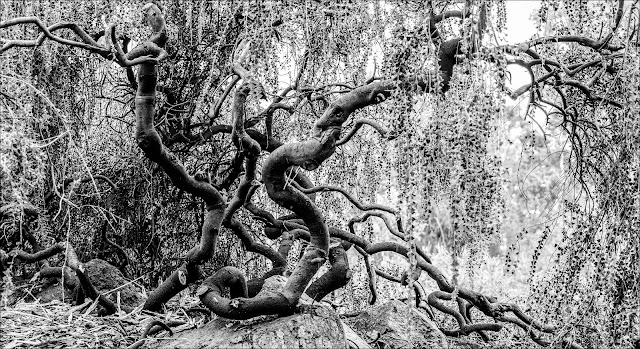
There are just three monochrome prints on display, all by the same author - Ulli Brunnschweiler. They stand out amongst the colour works, not just because they are black and white but also because they are quite lovely works each showing plants (plural). In particular, Acacia pravissima, hung at the top of the three works here is just delightful. Commonly known as the Ovens or Tumut wattle, this is an acacia with which we are all familiar. But generally, we see it in yellow and green.


Ulli Brunnschweiler - Acacia pravissima

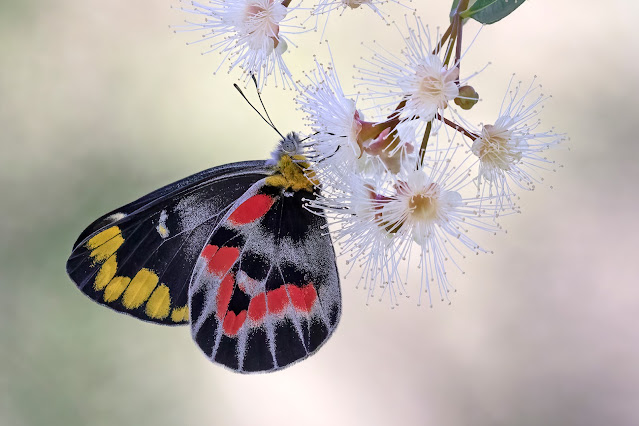
Amongst the colour works the standouts for me include David Bassett’s Feeding Gang-Gang and Imperial Jezabel. This Queanbeyan author’s nature imagery – indeed all his varied artworks - are consistently excellent and these are no exception.


David Bassett - Imperial Jezabel

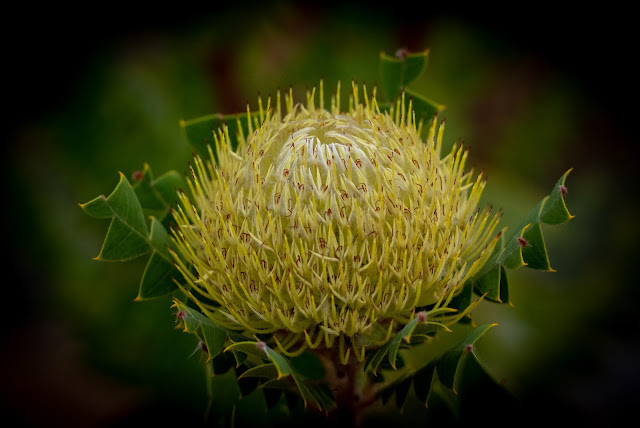
Local professional and photography teacher Irene Lorbergs has contributed several fine prints - Honeyeater and Macrocarpa, Bee and Flower, and Banksia. The latter is suggestive of a delicious tasting cupcake.


Irene Lorbergs - Banskia

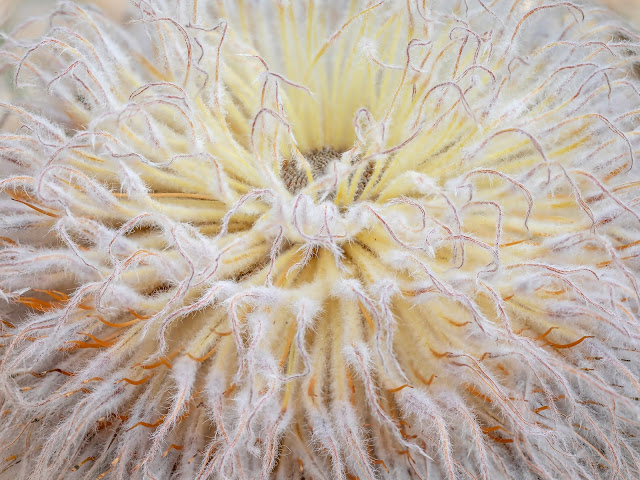
Pam Rooney’s winning Woolly Banksia image superbly displays what can only be described as delicate tracery.


Pam Rooney - Woolly Banksia

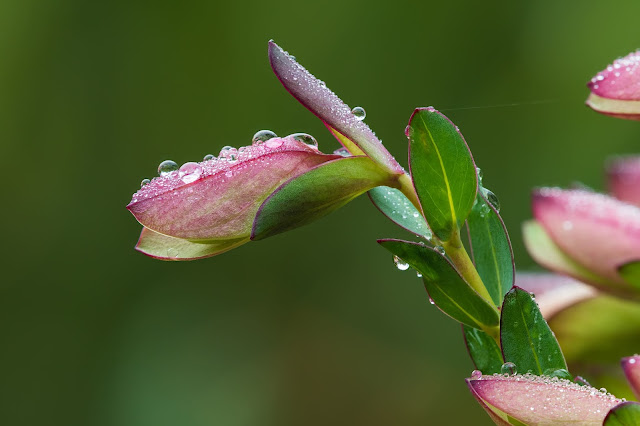
Bill Hall’s vulnerable Thick-lip Spider Orchid shows great detail and makes excellent use of complementary colours. Steve Playford’s Bejeweled Qualup Bell does the same with virtually identical colours.


Bill Hall - Thick-lip Spider Orchid


Steve Playford - Bejeweled Qualap Bell

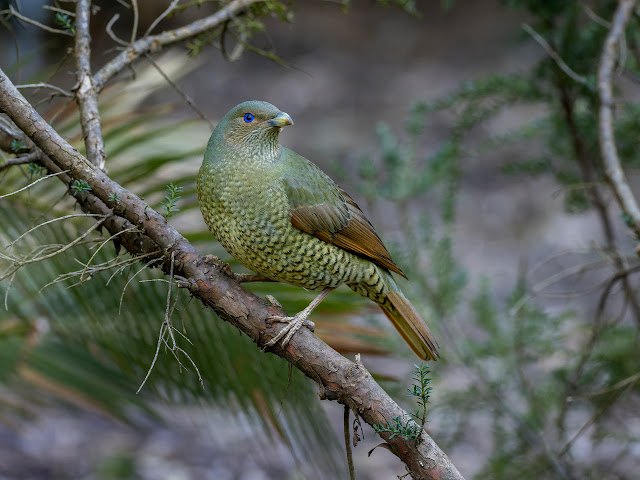
Graham Gall’s Juvenile Male Satin Bowerbird shows the bird’s soft, mostly green and brown, colours amongst similar greens and browns of the foliage. The rich blue of the bird’s eye is striking and commands attention.


Graham Gall - Juvenile Male Satin Bowerbird

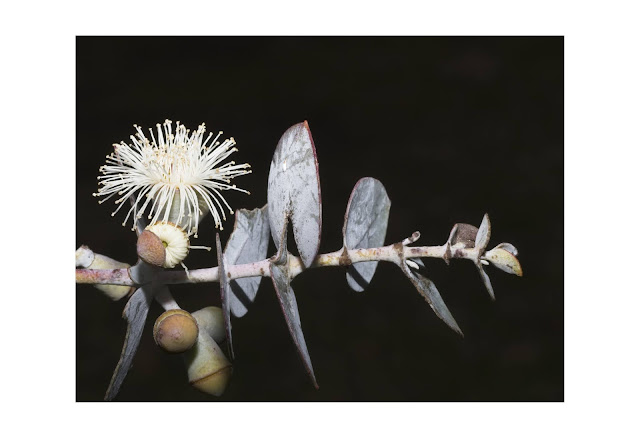
Jim Gould’s Baby Blue Flowers is a visually pleasing selection of a small piece of a silver-leaved mountain gum, clearly showing viewers how its flowers bud in groups of three; white flowers and cup-shaped to cylindrical fruit.

Jim Gould - Baby Blue Flowers

All the prints are worthy of close examination, and I encourage readers who can do so to visit and see for themselves.

Both framed works and unframed prints are for sale. Unique gifts of cards, calendars, photo bags and more are also on display and available for purchase. A percentage of sales go to the Friends for projects in the Gardens.

Visitors can also check out the 2022 Calendar that is available in the bookshop; all images produced by the Photographic Group members.

The exhibition supports and raises awareness of the aims and values of the ANBG and highlights the Gardens’ wide-ranging diversity of flora and fauna through the medium of photography. The participating members of the Photographic Group should be pleased and proud of their contributions.

Any reader who would like more information on the Photographic Group should email photo@friends.org.au. The Group encourages potential speakers and new members.

This review is also on the author's own blog here.