Sunday, June 9, 2019

LIOR AND PAUL GRABOWSKY ADELAIDE CABARET FESTIVAL 2019


Lior with Paul Grabowsky.

 The Dunstan Playhouse. Adelaide Festival Centre. June 7-8 2019.


Reviewed by Peter Wilkins


Lior and Paul Grabowsky
Lior’s lyrical voice lulled me into a state of relaxed enjoyment. With Wizard of the Ivories Paul Grabowsky on piano, Lior reprised popular songs including from his hit Autum Flow Album to the delight of   a responsive audience. There is no pretension to his performance. He stands simply before the microphone and sings from the heart, songs that ring with the sincerity of personal  experience such as My Grandfather and If I Lost Your Love. Anecdote gives the song a personal touch, captured in the gentle touch or occasional flourish by Grabowsky on piano. Unobtrusive showmanship accompanies the appealing charm of the singer, rendering the songs a fresh and imaginative appeal

Lior is a songwriter who instantly resonates with the listener. We identify with his experience and his true tenor voice carries us along with his music, here arranged imaginatively with Grabowsky. Piano and voice merge in  collaborative syncronicity. Here are two artists, comfortable and secure in their musicianship and  very much friends in collaboration.

Lior, away from the recording studio appears  to be the natural folk artist, embracing the flavor of his style and the subject of his music. His appeal is in the lyrical qualiy of his song, the people’s songwriter with an instinctive appreciation of the human condition. This is heightened by his anecdotes. He sings of his longing for the relaxed life in the rural surrounds of Daylesford, and his regretful  withdrawal  from the dream of a country life. He relates the challenges of a difficult relationship, and the anxiety of his stride to visit his new born daughter in the ICU unit after her premature birth. He entertains with the account of being  put on hold with Virgin and hearing one of his more serious songs played on the phone.

As the programme draws to a close, Lior reaches for his guitar, which has played second fiddle to Grabowsky’s accompaniment. In a closing song from his highly acclaimed Autumn Flow album, Lior immerses himself in his love of songwriting, singing and guitar playing, and the audience greets the partnership of these two outstanding talents with enthusiastic and appreciative applause.

I have not been particularly familiar with Lior’s music, but his talent and his popularity is undeniable, and I decide to buy a CD. That’s high praise indeed!

THE LARAMIE PROJECT & THE LARAMIE PROJECT: TEN YEARS LATER


By Moises Kaufman and members of Tectonic Theatre
Directed by Chris Baldock
Mockingbird Theatre production
Theatre 3 to 22 June

Reviewed by Len Power June 7 & 8, 2019

Two plays performed in repertory, ‘The Laramie Project’ and ‘The Laramie Project: Ten Years Later’, focus on the 1998 murder of a gay student, Matthew Shepard, in the town of Laramie Wyoming.  A particularly vicious murder by two young men who hated gays, the crime brought attention to the lack of hate crime laws in various US states including Wyoming.

Tectonic Theatre Company members conducted hundreds of interviews in Laramie subsequent to the murder and returned ten years later to repeat the process.  The plays, fashioned from the information obtained, give a fascinating and disturbing insight into the minds of the members of a tight-knit community.  It causes us to question attitudes and values universally.  An example of verbatim theatre, eight actors portray more than sixty characters who speak in their own words as recorded in the interviews.

The first play covers the murder, the trial and the interview process by the Tectonic Theatre Company members. It was very strong in its message but its length and too much overstatement caused emotional involvement to flag eventually.  The second play presents a disturbing picture of townspeople ten years after the murders trying to rewrite history.  ‘Ten years of change, no progress’ is how one character bleakly sums it up.  This play is shorter and doesn’t try as obviously to engage your emotions and is much more effective as a result.


The plays are finely directed by Chris Baldock who is also one of the acting ensemble.  With a multitude of characters talking directly to the audience, the plays demand a simple, cohesive style of presentation.  Baldock achieves this to great effect with a bare stage and changing patterns of chairs.

Left to Right: Andrea Close, Hayden Splitt, Liz St Clair Long, Joel Horwood, Michael Cooper, Karen Vickery, Meaghan Stewart and Chris Baldock

The performances of the eight cast members are flawless.  They are Chris Baldock, Andrea Close, Michael Cooper, Joel Horwood, Hayden Splitt, Liz St Clair Long, Meaghan Stewart and Karen Vickery.  All present fine, believable characterisations, many of them brief, with believable American accents.  The opportunity to see these powerful performers working together in this memorable production is not to be missed.

Photos by Janelle McMenamin

Len Power’s reviews are also broadcast on the Artsound FM 92.7 ‘In the Foyer’ program on Mondays and Wednesdays at 3.30pm.

Saturday, June 8, 2019

THE HOUSE IS LIVE OPENING GALA. ADELAIDE CABARET FESTIVAL 2019


The House is Live. Opening Gala of the 2019 Adelaide Cabaret Festival

Host Artistic Director Julia Zemiro. Directed by Craig Ilott. Musical Director  Daniel Edmonds. Produced by Maggie Oster. Thebarton Theatre. June 7 2019

Reviewed by Peter Wilkins

Mitchell Butel and Julia Zemiro What A Swell Party This Is
Photo by Claudio Rascella


The red carpet rolls out and the crowd rolls in. The crowd throngs in the foyer of the Thebarton Theatre, the Cabaret Festival’s 1928 art deco venue. The air is abuzz with excitement. Camera’s flash and members of The Swell Mob, direct from Edinburgh, weave in and out through the crowd with their in your face brand of interactive participation. It is the opening of this year’s Adelaide Cabaret Festival and Artistic Director Julia Zemiro has lined up a stellar company of cabaret artists to serve up a banquet of delectable cabaret morsels.
Queenie van de Zandt
“The house is live” the stage manager announces to the waiting artists as the audience files in and a night of sheer entertainment, social  commentary and political subversion breathes life into the world of cabaret.  A didgeridoo sounds in the darkness and three indigenous performers emerge to welcome to country in dance and music.  The dance represents the strength of women and the spirit of humanity that permeates the thousands of years of aboriginal culture. It is sombre, yet proud and uplifting and a reminder from the man that “Life is a cabaret. And so the opening gala gets under way.

Reuben Kaye
Zemiro’s opening under the direction of Craig Ilott and musical director and pianist Daniel Edmonds is more than a taste of things ro come. It is a celebration of joy and the wonder and thrill of Life. Artistic Director of State Theatre South Australia Mitchell Butel and Zemiro set the tone with their lively and fun-filled rendition of “What a Swell Party This Is.” The mood is set and who better to  take it up a few notches than that Colossus of Camp, the flamboyant, outrageous  and sequined Reuben Kaye with his devil may care political jibes and full throttled voice. Following that whirlwind of energy would daunt the most seasoned performer, and Alma Zygier’s love of the songs of Ella Fitzgrald and Judy garland took a shaky ride on the trolley of the great American Songbook with flat notes and a hint of apology. I suspect that she will be more at ease with her own show in the festival.

Meow Meow and Paul Capsis
I am conscious that it is the occasion that is the star of this event, and not the acts, although it is impossible not to be blown away by the powerful voice and personality of Queenie van de Zandt, the searing soulfulness of Paul Capsis’s channeling of Billie Holiday and Meow’ Meow’s magical hold on an audience caught under her bewitching spell with original songs and cheekily confronting audience involvement.  Internationally acclaimed from Adelaide to Berlin and the West End, Meow is a legend of the cabaret and this year’s worthy recipient of the Icon Award, previously awarded to Reg Livermore, Rhonda Birchmore, Robyn Archer and the late Godfather of the Adelaide Cabaret Festival, the inimitable, inspiring Frank Ford.

Maude Davey
Burlesque artist, Maude Davey, complete with feathers, tassles and fishnet stockings and little else flaunts and frolics her way through her act to the delight of audience in the stalls. What is most refreshing in Zemiro’s festival are the new faces who open our eyes to new perceptions of the continuing question, “What is Cabaret?” Queanbeyan raised and Canberra educated poet rapper Omar Musa, winner of the Sydney Cabaret Festival Award brings a new and dynamic voice to the cabaret stage with his rocket fueled defiance of social injustice and political interference. The rapid fire delivery of this master of the poetic dialectic is thoroughly absorbing, challenging audiences to take the ride and make the commitment.   Another newcomer to the scene is Nikechi Anele, an Australian Nigerian singer song-writer and broadcaster with the rich voice and sophisticated stage presence to charm and enchant. She and Musa were the one night stands of the Opening and I eagerly await their inclusion in a future cabaret Festival.

Omar Musa
The tickertape glittered down from the ceiling as the event came to a close, but not before a touching and moving ode from  Meow Meow to honour Frank Ford and introduce the eternal light that will shine in his memory throughout the festival. From jazz to pop to rock to soul and everything in between this festival has something for everyone whether one loves romance, comedy, music that moves you, reminiscence, something shiny or that curve ball that comes from left field and surprises.

It is a banquet waiting to be tasted after an opening that promised more nights to remember.
Photos by Claudio Raschella

Friday, June 7, 2019

END OF THE RAINBOW ADELAIDE CABARET FESTIVAL 2019


End of the Rainbow by Peter Quilter.

 Directed by Elena Carapetis. Musical Director Carol Young. Musical Arrangements Andrew McNaughton. Designer Ailsa Paterson. Lighting Designer Mark Pennington. Sound designer. Andrew Howard. Assistant director. Adriana Bonaccurso. Fight choreography. Ruth Fallon. State Theatre South Australia in association wih the Adelaide Cabaret Festival. Royalty Theatre. May 31 – June 22 2019

Reviewed by Peter Wilkins

Helen Dallimore as Judy Garland
Photo by Chris Herzfeld


Fifty years after her death, Judy Garland’s immortality lives on in the magnificent performance of Helen Dallimore as the iconic legend of stage, screen and song  in Peter Quilter’s  End of the Rainbow. Dallimore eerily inhabits Garland in every gesture, every vocal sound, every moment of fragility, petulance ,loving tenderness and human complexity.
Director Elena Carapetis

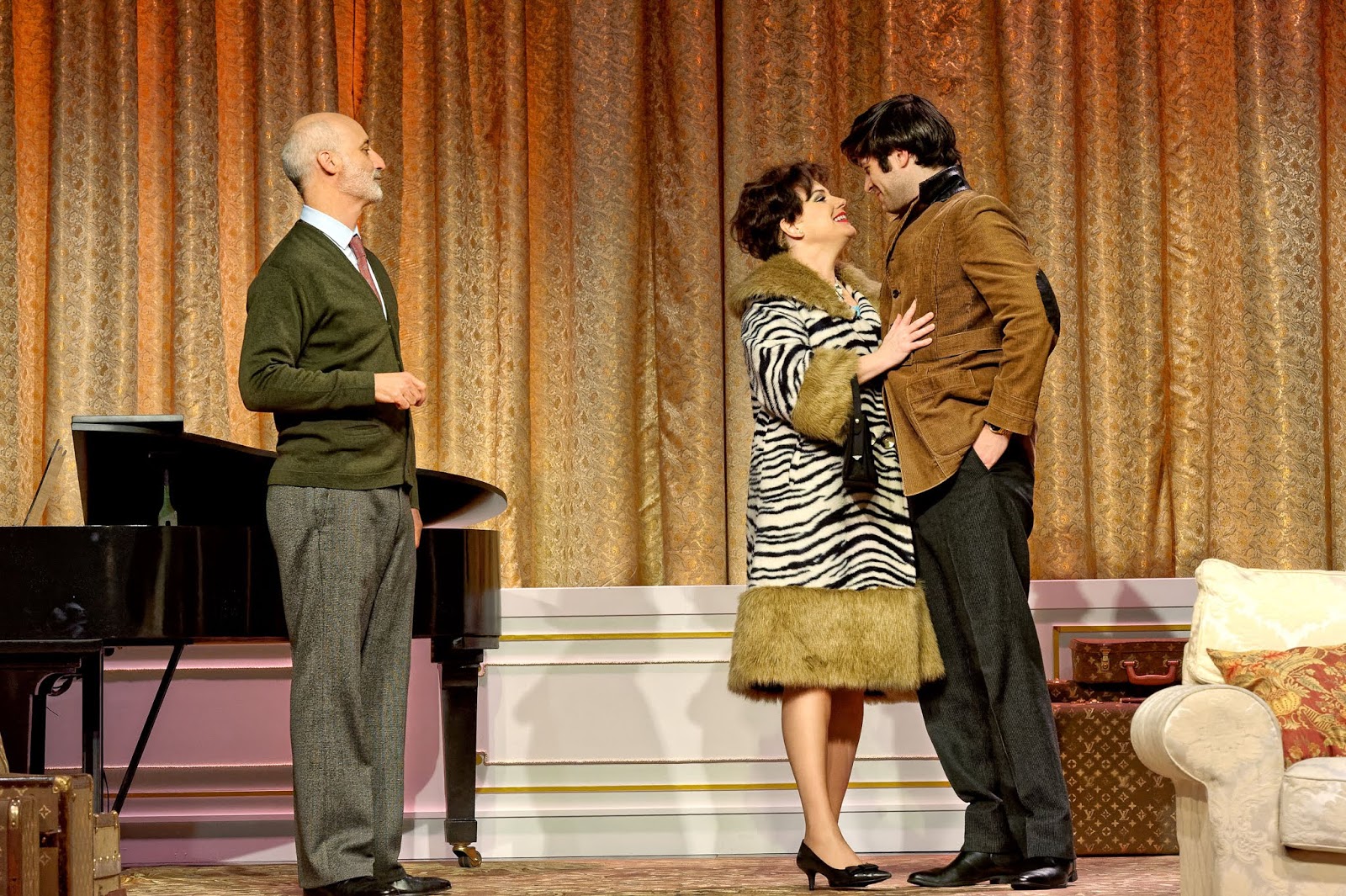
End of the Rainbow recounts the final month of Garland’s life. Recalling a disastrous concert tour of Melbourne a few years earlier, Garland embarks with some trepidation on a season at London’s Talk of the Town in 1969 The play is set in her suite at the Ritz, where she is accompanied by her fiancé/manager Micky Deans (Nic English) and long time accompanist Anthony Chapman (Stephen Sheehan). The curtain rises on a playful scene between the  middle-aged Garland and  the much younger, handsome Deans. Gradually, as the pressure of the prospect of performing mounts, Garland’s life begins to unravel as drug and alcohol dependency again takes hold. Tension mounts between Chapman and Deans, both vying for Garland’s affection and favour.

 Director Elena Carapetis skillfully guides the play’s unfolding moments with an unerring instinct for the shifting moods. The actors segue perfectly from one emotion to another as Deans and Chapman navigate Garland’s unpredictability. Loving tenderness gives way to dissatisfaction with the suite and argument with the hotel manager. Pleading provokes outrage and sullen defiance. The stage becomes a battleground between the voice of reason and stubborn willfulness. Sheehan beautifully plays the homosexual’s adoration of the gay icon in scenes of gentle devotion and the familiarity of a long time relationship. English’s fiery and frustrated lover flails before Garland’s cantankerous will, and yet in English’s assured performance we see a man driven not by self interest, but by a manager’s sense of responsibility and a lover’s love. End of the Rainbow is tragic in the inevitability of Garland’s fall. Alone in a spot at the end of the show, Dallimore reminds us of the tragic consequences of Garland’s fate with a soulful, moving and prophetic rendition of Dorothy’s innocent question “If happy little bluebirds fly beyond the rainbow then why oh why can’t I?” And Ailsa Paterson’s design on the Royalty stage lights up with the colours of the rainbow.


Stephen Sheehan, Helen Dallimore and Nic English
Photo by Chris Herzfeld
It is to the credit of the director and the cast that the dramatic scenes between Dallimore, Sheehan and English are not overshadowed by the classic numbers of Garland’s vast repertoire and Dallimore’s remarkable rendition of the songs. Under the baton of musical director, Carol Young, and her musicians, Eddie Morrison on Upright Bass, aswell as playing the minor roles of Bellboy and BBC Interviewer, Warren Heading on Trumpet, Tom Pulford on Alto and tenor Saxophone and Clarinet, Thomas Voss on tenor Trombone and Steve Todd on Drums.  It is the small combo with the big band sound  and cast us back to the era with songs such as The Bells Are Ringing and Come Rain or Come Shine.


Nic English as Micky Deans and Helen Dallimore as Judy Garland
Photo by Chris Herzfeld

The bells were still ringing in my head with a musical medley of nostalgia as I left the theatre. State Theatre South Australia’s production of End of the Rainbow has delivered a triumphant tribute to a dazzling yet tragic star who continues to light up the colours of our lives. and inspire us to fly beyond the rainbow of our dreams.

Monday, June 3, 2019

HELLO, DOLLY!


Book by Michael Stewart
Music & Lyrics by Jerry Herman
Directed by Michael Moore
Queanbeyan Players
Q Theatre, Queanbeyan to 9 June

Reviewed by Len Power 31 May 2019

‘Hello, Dolly!’ is one of the most successful musicals ever produced.  Opening on Broadway in 1964, this musical version of the play, ‘The Matchmaker’, by Thornton Wilder had an initial run of over 2,800 performances.  The delightful musical score by Jerry Herman contains one well-known song after another.

The story involves a wily matchmaker at the end of the 19th century in New York City who decides to make a match for herself with stingy and irritable hay and feed merchant, Horace Vandergelder, of Yonkers, New York.

The huge role of Dolly Levi, the matchmaker, is played by Janelle McMenamin.  She sings the role strongly and appealingly but opts for a low key and more realistic performance in the role.  It’s an interesting choice but the role was written for a charismatic star performer and it really needs stronger and more eccentric playing to be fully satisfying.

Tony Falla is terrific as Horace Vandergelder, singing and playing the irascibility of the character with a fine sense of comedy.  Will Collett gave a great performance as the innocent Cornelius Hackl.  He has a good singing voice and stage presence.  Demi Smith played the widow Irene Molloy with great sensitivity as well as fun.  Her singing of ‘Ribbons Down My Back’ was especially fine.

Left to Right: Madeline Calder (Ermengarde), Aaron Sims (Ambrose), Janelle McMenamin (Dolly), Tony Falla (Horace), Demi Smith (Irene) and Will Collett (Cornelius)

Max McMillan as Barnaby Tucker excelled with his physical comedy abilities and sang very well too.  Madeline Calder, in her Canberra theatre debut, was a standout in the comic role of the snivelling Ermengarde.  She also showed that she is a fine dancer.

Emily Pogson was very appealing and effective in her role of Minnie Fay as was Aaron Sims as Ambrose Kemper.  Judith Colquhoun gave a skilful and very funny performance in the small role of Ernestina Money.

Costumes by Janetta McRae were nicely in period and very colourful.  Set pieces by Thomson Quan Wing were simple but effective, especially the transition from the outside to the inside of the hat shop.  It was disappointing to see some scenes played on a bare stage with only black curtains.

Musical director, Jenna Hinton, obtained very attractive singing performances by all cast members.  The fine harmony singing by the chorus was especially notable.  The orchestra on opening night had a few wobbly moments but was otherwise fine.  Sound balance between orchestra and performers was just right as was the choreography by Belinda Hassall.

Queanbeyan Players and director, Michael Moore, have given us a very entertaining, well-sung and colourful production of this much-loved and famous musical.
 
Photo: Canberra Times
 
This review was first published in the Canberra City News digital edition of 1 June 2019

Len Power’s reviews are also broadcast on the Artsound FM 92.7 ‘In the Foyer’ program on Mondays and Wednesdays at 3.30pm.

Sunday, June 2, 2019

TANGOS & MOZART - CANBERRA SINFONIA


Conducted by Leonard Weiss
Barbara Jane Gilby, violin
Lucy Carrigy-Ryan, viola
Wesley Uniting Church, Forrest 1 June

Reviewed by Len Power

Canberra Sinfonia under the baton of Leonard Weiss presented a program of contrasts with their latest concert at the Wesley Uniting Church.

Subtitled ‘A Splendour Of Tangos’, the first half of the program focussed on this wonderfully sensual South American music.

‘Tanguera’ was originally composed around 1955 but the Sinfonia played the world premiere of an arrangement by Mariana Rivaya.  The combination of strings and French horns was particularly enjoyable in this well-played, passionate work.

Next, two older tangos – ‘El Choclo’ and La Cumparsita’ were presented.  Both very romantic and colourful, they were played with great accuracy and a sense of fun.  When people think of tango music, the melody of ‘La Cumparsita’ usually comes to mind as it has become a cliché over the years.  It was especially interesting to hear the whole work played as originally composed.

Two well-known works by Astor Piazzolla, who influenced the Tango Nuevo movement, completed the tango set.  ‘Milongo del Ángel’ in an arrangement by Canberra’s Dan Walker, is a dream-like work filled with romance and the performance was sublime.  ‘Libertango’ was edgy, passionate and played with great feeling.

Canberra Sinfonia

After interval, Mozart’s Sinfonia Concertante for Violin, Viola and Orchestra in E-flat major was presented with soloists, Barbara Jane Gilby on violin and Lucy Carrigy-Ryan on viola.  Oboeists, Chayla Ueckert-Smith and Lucy Preece, also joined the company.

Composed in 1779, this work is in three movements.  The first movement was given an enjoyably colourful and energetic performance.  The violin and viola solo passages by the two soloists towards the end of the movement were very well-played.

The andante second movement was most enjoyable, sensitively played by the soloists and the whole orchestra.  The bright and exciting finale was also well-played and brought this enjoyable concert to a satisfying close.

Photo by Chris Retter

Len Power’s reviews are also broadcast on the Artsound FM 92.7 ‘In the Foyer’ program on Mondays and Wednesdays at 3.30pm.