Saturday, November 5, 2022

UTOPIATE - Rebus Theatre & Belco Arts Centre.


The cast of "Utopiate"

Co-Directed by Sammy Moynihan & Ben Drysdale – Assistant Director: Melissa Gryglewski

Sound Designer:  Marlene Claudine Radice – Costume Designers:  Leah Ridley & Fi Hopkins 

Belconnen Arts Centre Theatre - November 4, 5 & 12.

Reviewed by Bill Stephens.

Sam Floyd as Thorax Mansion in "Utopiate"


Rebus is a Canberra-based award-winning mixed-ability theatre company focussed on creating social change through inclusive theatre experience for people with disability and lived experience of mental ill-health. The company offers a range of programs including one entitled “Flair” which offers disability leaders of the future the opportunity to discuss, devise, write and perform their own original work.

“Utopiate” is the second production presented under this banner and offered for a season of three performances in the Belconnen Arts Centre Theatre.

Leanne Shutt as Crystal Hart in "Utopiate".


Subtitled “ Would You Choose a World of Pain ? ”, the play transports the audience into an intergalactic world where a cast of eight disabled actors, and actors with lived experience of mental ill health, portray a group of humans suffering from various forms of unbearable pain.

When a smart-talking alien called Thorax Mansion, played by Sam Floyd, offers the humans the opportunity to follow him to planet Utopiate with the promise that there they will live a life free of pain, the humans enthusiastically accept his offer. .

On Utopiate they meet a group of Aliens, and while Thorax’s promise of a life a pain is fulfilled, the humans discover there is a price.

Stephen Perkins (Silver Star) - Zoe Trevorrow (Purple Raindrop) - Megumi Kawada (Mars Bar)
in "Utopiate"


Sam Floyd, Megumi Kawada, Zoe Trevorrow and Stephen Perkins play the Aliens, while Edward “Woody” Menzies, Carol Jayne “CJ” McManus, Leanne Shutt and Josh Rose are the bewildered humans.

The direction is inventive, the costumes are colourful, the lighting effects are excellent and the witty script is peppered with enough tongue-in-cheek lines to keep the audience chuckling through-out. Together with the underlying theme of “careful what you wish for” which bring the proceedings to an optimistic and satisfying conclusion, “Utopiate” offers a revealing insight into the valuable work being undertaken by Rebus Theatre.  


                                                 Images by Andrew Sikorski

The Corner of My Eye

Photography | Brian Rope

The Corner of My Eye | Mark Van Veen & David Hempenstall

M16 Artspace Gallery 1 | 21 October - 6 November


Mark Van Veen - Edge Pool Branches, 2020.


Mark Van Veen - Grey Stone Branches

The term The Corner of My Eye might refer to things one sees quickly and briefly, rather than clearly. Using that phrase as its title, this exhibition explores the work of two photographers reflecting on easily overlooked details that, when studied, can reveal hidden meaning in the everyday. Both artists use photographic imagery as points of departure from actuality or truth, and as instances of lucidity.

Davis Hempenstall’s “familiar” family life photographs each show one view of the state of things as they actually exist, in which individuals in his family inhabit the places where he has chosen to photograph them. No doubt this illustrates fondness for his subjects. Perhaps he is even investigating the meaning of life. But it is left to us to interpret them for ourselves. Apart from a location – Narrabundah, Etty Bay, Lake Wivenhoe – or a name – Neville, Rafi, Fred – we have only what we are looking at to use in discern his meanings.

In the room sheet, Hempenstall quotes the famous American photographer Lee Friedlander “I only wanted Uncle Vern standing in front of his new car (a Hudson) on a clear day. I got him and the car. I also got a bit of Aunt Mary’s laundry and Beau Jack, the dog, peeing on the fence, a row of potted tuberous begonias on the porch and seventy-eight trees and a million pebbles in the driveway anymore. It’s a generous medium photography”.

Hempenstall’s black and white images include a lot of shadows – in one case partially obscuring a child such that a touch of mystery is added, often adding an additional shape to a geometric image.


David Hempenstall - Untitled, 2015

There are two photographs displayed alongside each other which are essentially identical in most respects. However, the face of the young child portrayed in them is a little more visible in one than the other. This is a delightful touch, illustrating how quick photographers need to be to capture particular postures or expressions adopted by people – especially youngsters. Whilst each separate image reveals a different moment, the two together provide a hint of how the child was responding to Hempenstall. 

Mark Van Veen’s series “Cease to Exist” reveals a fascination with the reflections in cemetery headstones and graves, how they hold images of the surrounding branches, leaves, skies, that sets one’s eyes focusing beyond the polished stone surface. In that moment it's as if we can see into a world beyond the engraved memorial as the hard materiality seemingly dissolves and a portal opens.

His quote in the room sheet is from another famous American, Minor White, “No matter what role we are in - photographer, beholder, critic - inducing silence for the seeing in ourselves, we are given to see from a sacred place. From that place the sacredness of everything can be seen.”

Van Veen’s works are all colour photographs, although it is difficult to see much colour in a small number of them. The titles of his works are generally sufficient to reveal the stories he saw and is sharing with us – Barriers are Imagined, Veiled Landscape, Deep Space.


Mark Van Veen - Memorial Stone Garden

Mark Van Veen, Puddle Forest

There are a number of excellent images relating to horizons – not what we traditionally consider to be a horizon, perhaps a set of strata with particular characteristics, or even simply his perception that what he saw when he looked was a horizon.


Mark Van Veen - Lichen Stone Sky

Appropriately, since photography is painting with light, the word light appears in four separate titles where Van Veen has seen it dividing time, being hard breaking, or even sacred.

This is a substantial exhibition – both in terms of quantity and quality.

This review was first published online by The Canberra Times here on 31/10/22. It is also available on the author's blog here.


UTOPIATE


Utopiate.

 Co-directed by Ben Drysdale and Sammy Moynihan. Assistant director Melissa Gryglewski. Sound design Marléné Claudine Radice. A Rebus Theatre and Belco Arts Production,  The Theatre. Belconnen Arts Centre. November 4,5 and 12. 2022

Reviewed by Peter Wilkins


“They make me so proud.’ co-director Ben Drysdale said to me as I was leaving Belconnen Theatre after the opening night of Rebus Theatre’s Utopiate. And so he should be. If the aim of theatre is to make a difference and bring about change, then      Rebus Theatre is its standard bearer. Drysdale and co-director Sammy Moyniham have worked for months with a cast of mixed ability to create a show that is both funny and insightful with considerable appeal by a cast and crew who possess the ability to see the world through a different lens.  Utopiate is a work that compels an audience to see the world differently. It invites an audience to discover new possibilities and make choices that open the way to positive change.

In 1516 Sir Thomas More, Lord Chancellor to Henry Vlll, wrote Utopia, his vision of an imaginary perfect world. Was it satire or a serious social experiment? Rebus Theatre has cleverly spun a satirical  slant on the Utopian concept. Utopiate is a pain free planetary opiate where Grand Master Thorax Mansion (Sam Floyd) has invited the suffering Earthlings to leave their mundane world of repetitive routine and painful ailments for the stress free world of Utopiate. In a sales pitch reminiscent of television marketing four Earthlings are invited to leave Earth and discover true happiness and pain free heaven on Thorax’s Paradise. Here with the aid of his minions Mars Bar (Megumi Kawada), Purple Raindrop (Zoe Trevorrow), and Silver Star (Stephen Perkins) Thorax can cure the aches and pains that plague Tom (Josh Rose), the stress that bedevils  Environmentalist Elsa Whitney (Carol-Jayne ‘CJ” McManus), the invading thoughts of Gestalt Therapist Crystal Hart (Leanne Shutt) and Depressive Mitchell King (Edward ‘Woody’ Menzies).

Sam Floyd as Thorax Mansion in Utopiate
However Rebus Theatre is not in the business of false panaceas. The company’s cast and crew  live in the real world, a world of challenges and difference. Theirs is the art of connectivity, reaching out to an audience and opening their eyes and hearts to alternative possibilities. Thorax’s Paradise offers a flawed solution to pain relief and Rebus Theatre’s Utopiate extrapolates a universal truth within the quest for perfection . And so, like every good story there is a moral that rings true – to overcome pain and suffering it is necessary to embrace change. This is Rebus Theatre’s raison d’etre to effect change through the empowerment  of theatre. Utopiate  is not theatre of sophistication. It is simple, but not simplistic, honest but not condescending and instructive though not didactic. The performances, assisted by the projection of the text and the presence of an Auslan interpreter are aurally enhanced by Marléné Claudine Radice’s evocative sound design, Stephen Rose’s lighting and Fi Hopkins’ and Leah Ridley’s costume designs.

If you have never seen a Rebus Theatre production and of course if you have then Utopiate is must see theatre, not because this hour long satire will satisfy conventional  expectation but because it alters one’s perception of our world and how we  confront life’s challenges and experience. Utopiate is comical and serious, heart-warming and entertaining. And a show of which Rebus Theatre can be truly proud.

Photos by Andrew Sikorski

Friday, November 4, 2022

SUNSHINE SUPER GIRL


Ella Ferris as Evonne Goolagong.


Written and directed by Andrea James – Set and Costumes designed by Romanie Harper

Lighting Design by Karen Norris – Choreographed by Vicki Van Hout

Sound Design by Gail Priest. - Presented by Performing Lines  

The Q, Queanbeyan Performing Arts Centre – 2nd - 5th November, 2022.

Reviewed by Bill Stephens.

Born in Griffith NSW, Evonne Goolagong was a household name by 1971 when she won the women’s tennis singles tournament at Wimbledon leading to her being named Australian of the Year.  She went on to have a glittering tennis career, winning no fewer than 14 Grand Slam tournament titles and being inducted into the Australia Hall of Fame in 1985, and the International Tennis Hall of Fame in 1988.

Written and directed by Andrea James, “Sunshine Super Girl”, celebrates Goolagong’s achievements and career in a charming doco-style presentation performed by an ensemble cast in which Ella Ferris  portrays Evonne Goolagong, supported by Katina Olsen, Jacqueline Compton, Sermsah Bin Saad and  Lincoln Elliott portraying a myriad of other significant others involved in Goolagong’s story.

The Company of "Sunshine Super Girl"


Played out on Romanie Harper’s simple, attractive setting representing an actual tennis court, complete with a tennis-net able to be moved around by the cast, and four metal benches which neatly double as the family car, Goolagong’s  childhood bed in Barellan which she shared with her brother, and whatever other purposes required of them.

Imaginative lighting design by Karen Norris transforms the court into clay or grass when required to differentiate the various international tournaments in which Goolagong competed, and also divides the stage into smaller areas for the more intimate scenes.

Vicki Van Hout’s simple, effective choreography provides an elegant solution for portraying Goolagong’s endless tennis practice sessions, firstly on the walls of the family home in Barellan, and later on various tennis courts around the world, under the watchful eye of coach Vic Edwards, as well as the significant tennis tournaments in which she participated. 

Ella Ferris as Evonne Goolagong in "Sunshine Super Girl"


Despite bearing little physical resemblance to Goolagong, Ella Ferris nevertheless charms with her depiction of her as a calm, unflappable soul who sails through life largely, unaffected by the challenges thrown at her by her chosen career.

While the script dutifully works through the significant events in Goolagong’s life and career, it misses opportunities to explore the motivations, drama and sacrifices behind those events. It often feels like an extended monologue, interrupted only as the other members of the cast join Ferris to act out significant incidents in Goolagong’s life but in such a broad cartoonish style that there is little opportunity to make much individual impact.  

So although the audience is entertained by this charming portrait of Goolagong as a folksy, unflappable Australian sportsperson, it is ultimately left with little insight into the person behind the public persona other than the impression that she would have much rather have been fishing rather than pursuing the career that brought her world fame. 


                                                           Images by Paz Tassone   


This review also published in AUSTRALIAN ARTS REVIEW. www.artsreview.com.au


SUNSHINE SUPER GIRL


Sunshine Super Girl. 

Written and directed by Yorta/Ganaikurnai Theatre Maker Andrea James (Yanagai! Yanagai!).  A Performing Lines touring production. The Q. Queanbeyan Performing Arts Centre. November 2-5. Bookings  theq.net.au , 026285

Reviewed by Peter Wilkins


Performing Lines have served up an ace of a show with Sunshine Super Girl on tour at The Q Theatre in Queanbeyan.  Creator and director Andrea James has written a delightful and heart-warming account of the life and phenomenal tennis career o fAboriginal Australian sporting icon and trailblazer Evonne Goolagong. The play is essentially a monologue delivered with enormous appeal by Ella Ferris in the role of Goolagong. She is supported by other members of the company in various roles as members of the family and the local community, her coach Mr. Edwards, husband Roger Cawley and her competitors, including Chris Evert, Margaret Court nee Smith and Martina Navratilova. As well as Ferris in the title role, the cast includes Katina Olsen, Jacqueline Compton , Kirk Page, Lincoln Elliott and Sermsah Bin Saad. I have no programme to denote the roles they played but James has created a beautifully composed ensemble for a story that lifts the spirit and inspires admiration, pride and respect.  It is the story of “the babe from the bush”, the “sunshine super girl” who rose from humble beginnings and a loving aboriginal family to win 92 singles titles including the Wimbledon crown twice and the French and Australian Open.

James has created the drama as a narrative dance in which Ferris’s telling of Goolagong’s story is accompanied by carefully choreographed movement by Katina Olsen after Vicki van Hout’s original concept. Like the circular motif of an aboriginal work of art it weaves and spirals and occasionally pulses with the cut and thrust of the match.  At times other performers enter the narrative with short scenes between Goolagong and her family or awkward moments in the presence of coach Edwards or the developing love story, that leads to the romantic proposal by Cawley and the birth of their daughter, Kelly. Every short scene is a pivotal moment in this story of life’s amazing journey.

The episodes of Goolagong’s life from joining the Barellan Memorial Tennis Club at the age of seven to her Wimbledon victory in 1971 are played out on Romanie Harper’s design of a tennis court, complete with a revolving net and umpire’s seat and off court benches under Karen Norris’s  lighting design, assisted on tour by Ben Anshaw. At one stage the court evokes the patterns and moods of country . Every aspect of this production, including Gail Priest’s composition and sound design evoke a harmony  of action and emotion.

 You will laugh at the playful antics of Goolagong’s family and siblings. The strong sense of community and love permeates the deep affection of family. You will cry at the moments of pain and sacrifice and loss and you will feel the immense sense of pride as Goolagong, a blak aboriginal girl from the bush makes her family, her mob and the nation proud. James has created a simple yet evocative tribute to a legendary aboriginal tennis player who forged a future path for her people and all women who aspired to strive with passion for their dream.

Ella Ferris as Evonne Gooligong

Sunshine Super Girl is a powerful tribute to all aboriginal people who have struggled and fought to give their people a voice. She strode the international tennis circuit at a time when the likes of Charlie Perkins, her idol Lionel Rose, Albert Namatjira and Jimmy Little were laying the path to recognition. She pioneered the opportunities for Cathy Freeman and Ash Barty. Sunshine Super Girl is not merely a fascinating and illuminating account of Evonne Goolagong’s life and career. It is a testament to all aboriginal people past and present who have made a difference and continue to do so across the world.

The performance that I attended was dedicated to the memory of 15 year old Cassius Turvey, murderously attacked while walking home from school. It is a chilling reminder of the heinous hate that still stains society and against which Australia’s indigenous peoples continue to struggle. Sunshine Super Girl lays no judgement. It is a beautifully staged tribute to a remarkable Australian sportswoman and champion. And yet there are lessons for us all to learn.  

“Why me?” Goolagong asks in James’s play. It is a question we may all ask when urged to act for change. Goolagong’s final words at the close of Sunshine Super Girl provide the answer- “Why not.”

Photos by Joel Horwood


Thursday, November 3, 2022

Sunshine Super Girl


Ella Ferris as Evonne Goolagong Cawley

Sunshine Super Girl by Andrea James.  Performing Lines at The Q, Queanbeyan Performing Arts Centre, November 2-5 2022.

Reviewed by Frank McKone
November 2

Writer/Director - Andrea James
Movement Director & Additional Choreography -
Katina Olsen
Original Choreographic Concept & Initial Movement Direction - Vicki Van Hout
Set & Costume Design - Romanie Harper
Lighting Design - Karen Norris
Tour Lighting Design -
Ben Anshaw
Head of Lighting -
Steve Hendy
Composition & Sound Design -
Gail Priest
Video Media Design - Mic Gruchy
AV Technician -
Corey Wiles
Dramaturg -
Louise Gough
Mentor -
Paige Rattray
Production Manager -
Jason Thelwell
Stage Manager -
Jess Keepence

Performers - Ella Ferris
as Evonne Goolagong, Katina Olsen, Jacqueline Compton, Kirk Page, Lincoln Elliott, Sermsah Bin Saad
*
On opening night, Sermsah Bin Saad went on for Kirk Page, who was unwell.
Photos by
Paz Tassone


Sunshine Super Girl is a quite fascinating story of the tennis star Evonne Goolagong’s career, from batting a ball against a wall at age three.

I will call this kind of show Picaresque Theatre.  Evonne tells her story on a tennis court via a ‘chorus’ who play, in dialogue and often in dance, the central characters in her family and tennis life.

Though it seems a little like children’s theatre in style,  regularly receiving highly enthusiastic responses especially from younger members of the audience (while the use of microphones instead of live voices was a bit too distancing for me), the story makes a valuable contribution to our understanding of how the real Evonne Goolagong Cawley dealt with the pressures of professional tennis life, including sexual harassment from her strict demanding coach, falling in love, and racism.

As in those picaresque novels of the 18th Century (think of Henry Fielding’s Tom Jones, for example) episode follows episode, as in real life, without much sense of dramatic direction.  However, when in the end she has succeeded in winning a huge collection of ceremonial cups; and the love of Roger Cawley; and won on Wimbledon Centre Court – despite being forced to miss her loving father’s funeral; it is the strength of her character that wins the hearts of her audience.

What seems like light entertainment – essentially fun to watch – tells us what being a good sport is really all about.  It’s a matter of sunshine as a person, as a girl, and as an Indigenous iconic figure that makes Evonne Goolagong Cawley super.


Wednesday, November 2, 2022

ATTILA - Opera Australia


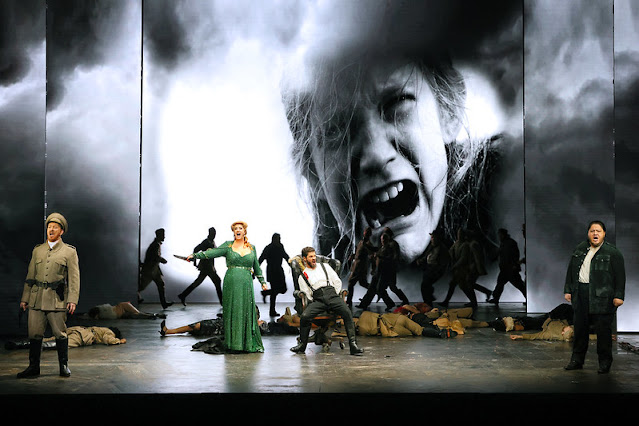
Michael Honeyman - Natalie Aroyan - Taras Berezhansky- Diego Torre in "Attila". 

Composed by Giuseppe Verdi – Libretto by Francesco Maria Piave

Directed by Davide Livermore – Revival Director: Kagte Gaul

Conducted by Andrea Battistoni –Set designed by Gio Forma

Costumes designed by Gianlucca Faschi – Lighting designed by Antonio Castro.

Joan Sutherland Theatre – Sydney Opera House Oct. 29th to November 5th.

Reviewed by Bill Stephens OAM
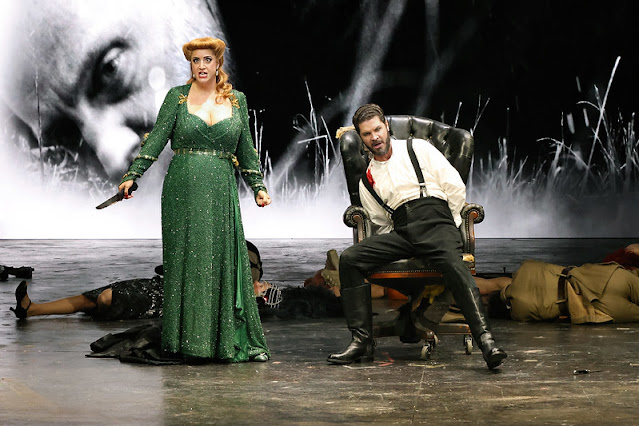

Natalie Aroyan - Taras Berezhansky - in "Attila"


This was always going to be a memorable night. With the sudden decision by long-serving Artistic Director, Lyndon Terracini to step down from his position a year earlier than originally advised, Opera Australia announced that the opening night of “Attila” would be his official farewell.

This was particularly appropriate, because this would be just the third performance of this massive production since it was forced to close down because of the Covid pandemic after only two performances in 2020. “Attila” was re-scheduled in the 2021 season, but that whole season was also lost to the pandemic. Therefore the re-scheduling of this production, which Opera Australia shares with La Scala, in 2022, was highly anticipated, particularly as the company had been able to present it with most of the original 2020 cast still intact.

Making it even more appropriate, this cast features soprano Natalie Aroyan repeating her much lauded break-out performance as the heroine, Odabella. Aroyan has been steadily cementing her reputation as an outstanding singer, but those two performances as Odabella in 2020 have catapulted her into being recognised as a major star in the operatic firmament, and few who were lucky enough to experience either of those performances would disagree.  Aroyan credits Terracini as the guiding force behind her career.

Performing beside Aroyan in this production, the great Mexican tenor, Diego Torre, lured to Opera Australia by Terracini, and now an Australian citizen and audience favourite. Also repeating his magnificent performance in the title role as Attila, the celebrated Ukrainian bass-baritone Taras Berezhansky, who would be returning to his family in war-torn Kyiv immediately after the “Attila” season finishes.

This production is also a wonderful showcase for Opera Australia’s chorus, which Terracini takes pride in describing as one of the best opera choruses in the world. Marshalling the huge musical resources necessary to mount this production would be one of Terracini’s favourite conductors in Andrea Battistoni.

So expectation was already high when Tahu Matheson, took the stage just before the opera commenced to acknowledge Lyndon Terracini in the audience in the favoured seat in the Joan Sutherland Theatre that he had occupied for the countless performances he has attended during the 13 years of his tenure. Matheson’s graceful announcement was greeted with enthusiastic applause and cheers from the audience, many of whom were Terracini’s admirers who wanted to share this momentous performance with him.

When the applause died down however, Matheson made another unexpected announcement. The Italian baritone, Mario Cassi, who was to perform the role of Italian General, Ezio, had taken ill, and that role would now be performed by Opera Australia Principal Baritone, Michael Honeyman.

However it was the opera itself, and the events that had occurred between its first two Sydney Opera House performances and this performance that made this performance even more memorable.

Although Verdi originally set the action for his opera in 5th century Italy, he had written it as a thinly veiled argument for Italy’s independence from Austria. But when Director, Davide Livermore decided to update his production to fascist Italy during the 1930’s, he could hardly have imagined how closely his production would reflect present day events in Ukraine.

The first scene in the opera is played out on a massive setting depicting a war-damaged city.  Prisoners are herded on to the stage and summarily shot by Attila’s army.  The murders are interrupted by Attila’s entrance on his horse, and while he is surveying this scene another group of female prisoners are herded in. Among them is Odabella, who defies the gunmen to challenge Attila. 

This scene is so realistically staged, that it was shocking in 2020, but now in 2022, it was impossible not to be reminded of the unintentional similarities to the horrible events occurring daily in Ukraine.

Later in the opera there is another disturbing scene depicting Odabella’s childhood recollections of witnessing her father being murdered by a soldier on horseback, and the final Fellini-like decadent party scene in which Odabella reeks her terrible vengeance on Attila, all carefully restaged for this revival by Kate Gaul.

By sheer happenstance, I found myself sitting next to Ukrainian conductor, Vladimir Fanshil, who, with his opera singer wife, Eleanor Lyons, found themselves stranded in Australia by Covid. Ashen-faced at interval, Fanshil confided that Lyons was currently singing in Poland, and while waiting to re-join her, he was busying himself raising money to support his compatriots in the Ukraine. He was attending tonight’s performance in support of his friend, Taras Berezhansky.

“Attila” is an opera which requires massive resources both vocally and physically to stage successfully. It would be hard to think of a more appropriate opera to illustrate and celebrate Lyndon Terracini’s achievements during his tenure as Artistic Director of Opera Australia.

Aroyan of course was even more spectacular during this performance having grown in confidence between the seasons. Together, with Berezhansky, Torre and the ever-reliable Michael Honeyman, who rose to the occasion to match them every step of the way, as well as  Virgilio Marino and  Richard Anderson in lesser roles, this was inspired casting that would be the envy of  any opera company in the world.
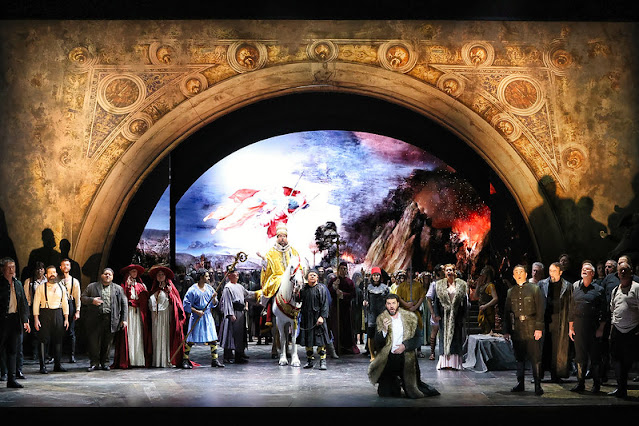
Richard Anderson - Taras Berezhansky - Natalie Aroyan in "Attila"

Together with the magnificent Opera Australia Chorus and the Opera Australia Orchestra under Andrea Battistoni, it treated its appreciative audience to an unforgettable evening of grand opera at its grandest.

It was a performance destined to live long in the memories of those who experienced it, but particularly for Lyndon Terracini, to whom the evening was dedicated, and perhaps also for Taras Berezhansky, who when taking his bows, draped himself in a Ukrainian flag; a gesture which earned tumultuous applause from the appreciative audience. 


                                                     Images by Prudence Upton.


     An edited version of this review first published in CITY NEWS on 1st November 2022.